Hoi An Food Tour for Vegetarians: What You Can Eat (No Fish Sauce, Promise)
Hoi An is one of the best cities in Vietnam for vegetarian travellers, especially if you’re planning a hoi an food tour vegetarian itinerary, and I will die on this hill. Most of Vietnam makes vegetarians work for it: pointing, miming, praying, getting a plate of plain rice and boiled morning glory. Hoi An gives you Cao Lau, white rose dumplings, banh xeo, and an actual dedicated vegetarian menu at restaurants you’d want to eat at anyway. You still need to know the phrases, and you still need to flag fish sauce, but you can eat the famous dishes here, not just the sides, useful context for anyone piecing together a wider vegetarian food in Vietnam trip.
This guide covers the exact dishes worth targeting, the phrases that get them out cleanly, the two MẸT branches (the only proper vegetarian restaurants in walking distance of the Old Town that deliver on both taste and setting), the night market stalls that are safe without a guide, and what a customised private veg food tour costs in 2026. Planning the wider region? Our Southeast Asia backpacking hub covers the full multi-country route.
Quick Answers
| What | Answer | Price (INR) |
|---|---|---|
| Average cost of a private vegetarian food tour in Hoi An (3 hours) | ₹4,416-₹6,624 (~1,200,000-1,800,000 VND or ~$45.84-$68.76), plus tip | ₹3,960 (~$41.04) to ₹5,940 (~$61.57) |
| Typical set-menu price at a dedicated vegetarian restaurant | ₹294-₹662 (~80,000-180,000 VND or ~$3.06-$6.88) | ₹260 (~$2.69) to ₹590 (~$6.12) |
| Cao Lau at a local spot (made vegetarian) | ₹147-₹221 (~40,000-60,000 VND or ~$1.53-$2.29) | ₹130 (~$1.35) to ₹200 (~$2.07) |
| White rose dumplings (4 to 6 pieces) at the market | ₹74-₹110 (~20,000-30,000 VND or ~$0.76-$1.15) | ₹65 (~$0.67) to ₹100 (~$1.04) |
| Lantern-lit night market banh xeo (vegetarian, made on request) | ₹92-₹184 (~25,000-50,000 VND or ~$0.96-$1.91) | ₹80 (~$0.83) to ₹165 |
All VND prices use the July 2026 rate of 1 INR ≈ 270 VND (1 VND ≈ ₹0.00370). Double-check the rate the day you go; the VND has been steady, but your forex card rate will be slightly worse than the mid-market. For a deeper look at how the conversion shakes out, see the INR to Vietnam currency exchange guide.
The Local Culinary Landscape: Hoi An is Easier Than Hanoi, but Fish Sauce is Still the Default
Hoi An’s food scene is built on five or six hero dishes: Cao Lau (the famous local noodle), white rose dumplings (banh bao vac), mi quang (turmeric noodles), banh xeo (sizzling crepes), and com ga Hoi An (chicken rice). The good news: most of these are vegetable-forward by default. The bad news: every single one of them carries a hidden layer of pork, shrimp, fish sauce, or chicken broth that you will not see on the plate.
The local attitude toward “vegetarian” is the same as the rest of Vietnam: it usually means “I’ll skip the visible meat,” and the cook will still reach for the fish sauce bottle out of habit. Travellers report that even restaurants advertising “vegetarian options” on the English menu will sometimes default to a fish-sauce base if you do not specify otherwise. The MẸT branches are the exception: they are properly set up for veg, with separate cooking stations and no fish sauce on the line. Everywhere else, the phrases in the next section are not optional, a pattern that mirrors what’s covered in the broader Vietnam food guide.
Subodh’s Pro Tip: The most common mistake is ordering “an chay” (vegetarian) and assuming the dish is clean. “An chay” in Hoi An often just means no visible meat. Add “khong nuoc mam” (no fish sauce) every single time, and “khong tom” (no shrimp) for anything that comes with dried shrimp on top, which Cao Lau and mi quang often do.
Key Phrases in Local Script
Print this table or screenshot it. Showing it on your phone beats a verbal back-and-forth in a noisy night market.
| English Phrase | What it Means | Local Script | Pronunciation |
|---|---|---|---|
| I am vegetarian | Skip meat and seafood entirely | Tôi ăn chay | Toy an chay |
| No fish sauce | The big one | Không nước mắm | Khom nuoc mum |
| No shrimp / no dried shrimp | Critical for Cao Lau and mi quang | Không tôm | Khom tom |
| No egg | For vegan and Jain strict | Không trứng | Khom trung |
| No onion, no garlic | For Jain strict | Không hành, không tỏi | Khom hanh, khom toy |
| Is there pork or chicken in this? | Pre-flight check | Có thịt heo hay thịt gà không? | Ko tit heo hay tit ga khom? |
| Vegetable only, please | When miming | Chỉ rau thôi | Chee row toy |
| Is the broth from meat? | Soup question | Nước dùng có thịt không? | Nuoc dung ko tit khom? |
The first three phrases cover 90% of situations. The “broth from meat” line is what saves you from a vegetable soup that is, in fact, pork-bone broth.
Safe Local Street Food Dishes (and How to Make Them Vegetarian)
Hoi An’s night market along Nguyen Hoang street and the daytime stalls around the Central Market are denser and more vegetarian-friendly than Hanoi’s. Here are the dishes worth targeting, in priority order.
Cao Lau (Cao Lầu)
This is the dish that defines Hoi An. Thick yellow noodles, sliced pork, croutons, fresh herbs, and a small amount of pork broth. The noodles themselves are made with well water from a specific Hoi An well (Ba Le Well), and they have a slightly chewy, alkaline texture you cannot get anywhere else.
How to make it vegetarian: ask for “Cao Lầu chay, không tôm, không nước mắm” (vegetarian Cao Lau, no shrimp, no fish sauce). Most places will swap the pork for tofu and either skip the broth or switch to a mushroom version. Travellers report the result is about 80% as good as the real thing, which is still excellent.
Price: ₹147-₹221 (~40,000-60,000 VND or ~$1.53-$2.29) at a local spot, ₹294-₹442 (~80,000-120,000 VND or ~$3.06-$4.58) at a tourist-oriented restaurant.
White Rose Dumplings (Bánh Bao Vạc)
Translucent rice-paper dumplings shaped like roses, usually filled with minced shrimp or pork. The wrapper is the star: thin, almost see-through, and slightly chewy. These are a Hoi An original.
How to make them vegetarian: the vegetarian version is widely available because the original filling is so subtle. Most stalls sell a separate vegetarian batch, often coloured slightly differently. Point to them and say “chay” to confirm. Travellers report that asking for “bánh bao vạc chay” gets a confident yes from most vendors, and the filling is typically a mix of glass noodles, mushroom, and jicama.
Price: ₹74-₹110 (~20,000-30,000 VND or ~$0.76-$1.15) for a plate of 4 to 6. The dedicated white-rose restaurants on Phan Chu Trinh street are the best places to try these.
Bánh Xèo (Sizzling Crepes)
A crispy yellow crepe made from rice flour and turmeric, traditionally filled with shrimp, pork, and bean sprouts. Eaten by wrapping pieces in rice paper with herbs.
How to make it vegetarian: ask for “bánh xèo chay, không tôm” (no shrimp). The cook will use mung beans or just bean sprouts. The crepe itself is already vegan; the question is only the filling. The result is lighter than the original, but the crispy texture is the same.
Price: ₹92-₹184 (~25,000-50,000 VND or ~$0.96-$1.91) for a small crepe, more at restaurants with a river view.
Mì Quảng (Turmeric Noodles)
A small bowl of flat turmeric noodles, usually with a tiny amount of meat, a few prawns, and a small quantity of broth. It looks like a soup but is more of a noodle dish with just enough liquid to keep things moist.
How to make it vegetarian: say “mì quảng chay, không tôm, không nước mắm.” The vegetarian version at most places uses tofu puffs and shiitake, and it works because the dish is already mostly about the noodles and herbs.
Price: ₹110-₹184 (~30,000-50,000 VND or ~$1.15-$1.91).
Bánh Mì Chay (Vegetarian Baguette)
Vietnam’s famous sandwich is trivially easy to make vegetarian: just hold the pâté and the meat. Hoi An’s bánh mì is slightly different from Hanoi’s: the baguette is usually a touch softer, the pickled carrot ratio is higher, and you’ll often find a local green called rau thom added.
How to make it vegetarian: “bánh mì chay, không pâté” gets you a sandwich with tofu, egg (ask to skip if vegan), pickled veg, cucumber, cilantro, and chili. Most bánh mì stalls in the Old Town have a chay version on the menu.
Price: ₹55-₹92 (~15,000-25,000 VND or ~$0.57-$0.96). Bánh mì is one of the few dishes in Vietnam where the street version is genuinely as good as the restaurant version.
Subodh’s Pro Tip: Bánh mì Phượng on Phan Chu Trinh is the most famous bánh mì in Hoi An. Their chay version is solid, but the line is brutal. The unnamed stall directly opposite is almost as good, half the price, and nobody queues.
The Night Market: What is Safe Without a Guide
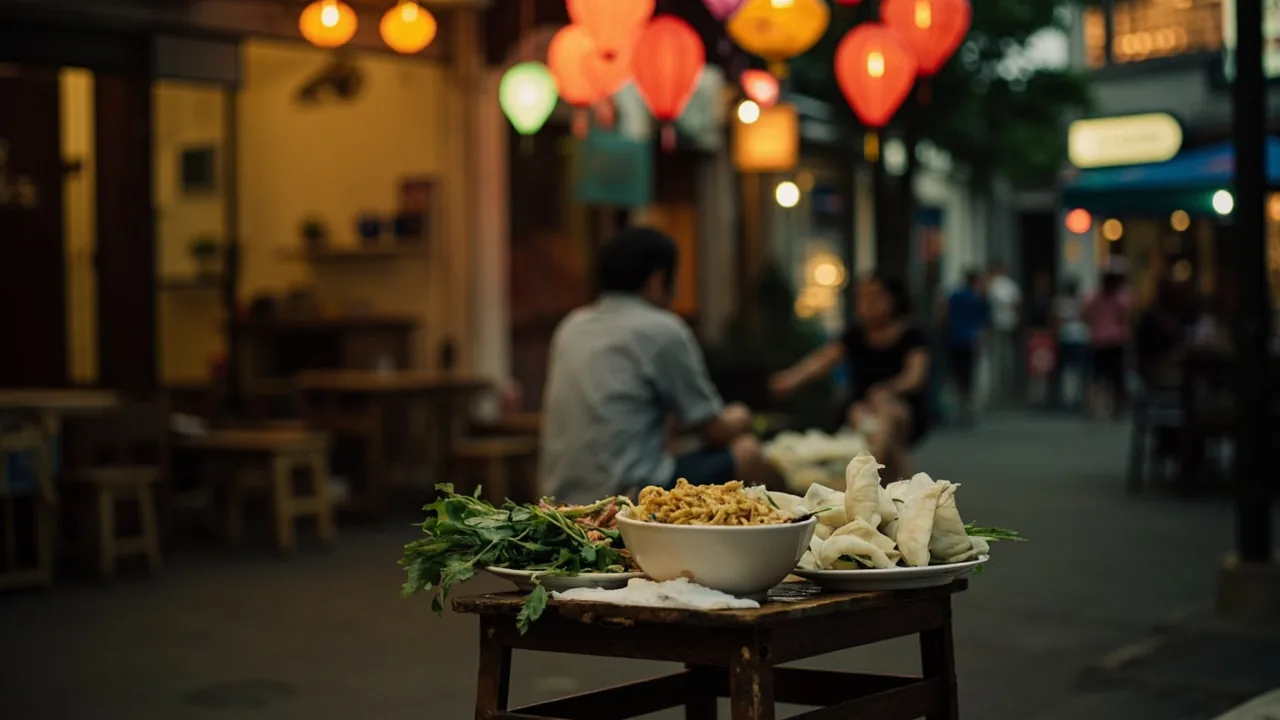
The Hoi An night market on Nguyen Hoang street lights up from about 5pm to 10pm, with stalls on both sides selling dumplings, sweets, lantern souvenirs, and small plates. Travellers report that about 30% of the food stalls have vegetarian items, but they are not always marked. Here is what to do:
- Walk the full length first before buying anything. Look for stalls with a clear “chay” sign or a separate vegetarian tray.
- The dumplings section is your friend: white rose (bánh bao vạc) and the smaller wontons are usually the most reliably vegetarian.
- Avoid the central grilled-meat section; cross-contamination is common and the vendors rarely speak enough English to confirm a clean dish.
- Sweet options are almost all safe: chè (sweet soup), bánh ít (sticky rice dumplings), and the coconut ice cream served in a half coconut.
- If you want to be 100% sure, eat at a MẸT branch before or after the market instead of gambling at random stalls.
Recommended Vegetarian Restaurants
MẸT Hội An (Two Branches, Both Excellent)
These are the only dedicated vegetarian restaurants in central Hoi An that deliver on flavour, not just absence of meat. Both have full menus, not just stir-fried vegetables, and both have English-speaking staff who understand “no fish sauce” without follow-up questions. The two branches are close enough that you can visit both in one trip.
MẸT Hội An. Vietnamese restaurant & Vegetarian Food (MET 9 branch), is the larger of the two, in a restored colonial building with a quiet courtyard. Their Cao Lau chay is the best vegetarian Cao Lau I have eaten, and travellers agree. The white rose dumplings here are made in-house and the vegetarian version is identical in look to the original.
The MET 7 branch of MẸT Hội An. Vietnamese cuisine & Vegetarian options, is a smaller, more intimate branch. The menu overlaps but the kitchen is more flexible about substitutions, and the lighting in the evening is better for couples or for food photography.
Must-try at either branch: vegetarian Cao Lau, white rose dumplings, banana flower salad, and the deep-fried spring rolls (chay) which are the best fried spring rolls I have eaten anywhere in Vietnam.
Set menu price: ₹294-₹662 (~80,000-180,000 VND or ~$3.06-$6.88) per person, including a main, two sides, and a drink. À la carte mains are ₹147-₹294 (~40,000-80,000 VND or ~$1.53-$3.06).
Other Spots Worth Knowing About
Nhan’s Kitchen is not a vegetarian restaurant, but travellers report that the kitchen is unusually accommodating for vegetarians. The owner speaks good English, will walk you through the menu, and is happy to make a clean version of Cao Lau or white rose on request. Worth visiting once for the friendliness, even though you have to work a little harder to keep your food separate from the meat dishes on the same menu.
Mê Hội An Rooftop Coffee & Kitchen is technically a café, but the kitchen turns out a few solid vegetarian Vietnamese dishes, the rooftop views over the old town are excellent at sunset, and the staff are used to “no fish sauce” requests. Better as a coffee-and-light-bite stop than as a proper meal.
A Little Kitchen Restaurant (Bếp Nhỏ) is a small family-run spot near the river with a short menu that includes a couple of genuinely good vegetarian Vietnamese dishes without you needing to modify anything. Travellers report the staff are patient and the prices are noticeably lower than the tourist-zone restaurants.
Hoi An Old Town Table - Cơm Nhà Hội An focuses on traditional Vietnamese home-style cooking. Their vegetarian set is a multi-dish meal at one sitting, which is unusual in Hoi An and a nice change from the usual one-bowl-per-restaurant rhythm.
Joining a Customised Private Vegetarian Food Tour
Hoi An has more food tours per square metre than almost any other city in Vietnam, and most operators are willing to customise a tour for vegetarians if you ask in advance. Here is what to expect in 2026, and how it compares to the Vietnam cooking class and food tour in Hanoi and Hoi An setup.
Standard Group Food Tour
A typical group food tour lasts 3 hours, covers 8 to 10 stops, walks through the Old Town, and costs around ₹2,944-₹4,416 (~800,000-1,200,000 VND or ~$30.56-$45.84) per person. The vegetarian version is almost always possible but rarely advertised. The catch: you will be at the same 8 to 10 stops as the meat-eating group, with the guide translating your “no fish sauce” requests at each one. It works, but it is a step behind a private tour.
Customised Private Vegetarian Food Tour
A private veg food tour is where Hoi An shines. You get:
- A guide who pre-confirms vegetarian options at each stop
- A route designed around meat-free dishes (white rose specialist, MẸT branch, a bánh mì stall, the central market veg section, a dessert stop)
- Flexibility to spend more time at the places you like
- A guide who explains what is in each dish in English, not just Vietnamese
Cost: ₹4,416-₹6,624 (~1,200,000-1,800,000 VND or ~$45.84-$68.76) for 2 to 3 people for 3 hours, which is roughly ₹147-₹221 (~40,000-60,000 VND or ~$1.53-$2.29) per person extra compared to a group tour. Travellers report that the upgrade is for the time savings and the food quality.
Subodh’s Pro Tip: When you email to book, write back the four phrases from the phrases table above in English and ask: “Please confirm the guide knows these phrases and can brief each vendor in advance.” A guide who says “yes of course” without asking you to repeat the request is usually a good sign. A guide who asks you to clarify what fish sauce is, less so.
If you’d rather not email operators directly, a GetYourGuide search for “Hoi An food tour” lets you filter by vegetarian-friendly and message the operator before you book, though the same options are usually available through your hostel or a local operator, often at a lower price.
Food Safety & Hygiene
Hoi An’s tap water is not drinkable, same as the rest of Vietnam. A few specific things to know:
- Drink only bottled or filtered water. Bottled water is ₹18 (~5,000 VND or ~$0.19) at any convenience store. Refill your bottle at your hotel; most hostels have a refill station.
- Eat at busy stalls. The Central Market and the night market have high turnover. Avoid stalls where the food has been sitting out for hours with no movement.
- Skip the raw herbs at unknown places. Coriander, mint, and basil are usually washed in clean water, but at a stall you do not trust, skip the herb garnish and the dish is still good.
- Ice is fine in cities and tourist areas. The tube ice sold at cafes and restaurants in central Hoi An is factory-made and safe. The hand-cut ice at remote stalls is less reliable.
- For the first 48 hours, eat light. Travellers report that sticking to plain rice, vegetable dishes from known restaurants, and bottled drinks for the first two days dramatically reduces the chance of stomach trouble later. This applies to everyone, not just vegetarians.
Safety Alert: For current health advisories before you fly, check the MEA travel advisory page at mea.gov.in and the Vietnamese government’s official tourism site. Both are updated more often than third-party blogs.
Getting Connected
For an offline translation app, Google Maps for the night market layout, and Grab to get back to your hostel after dinner with a full stomach, a local SIM or eSIM is essential. A 30-day Viettel or Mobifone tourist SIM is around ₹368 (~100,000 VND or ~$3.82) at the airport or any Vinaphone store. If you want to skip the airport queue and activate before you land, Get Nomad eSIM works in Vietnam from the moment you clear immigration and has a 5 GB plan that covers a typical 3-day Hoi An stay.
Common Food Mistakes Indians Make
Mistake 1: Assuming “An Chay” Means What It Says
What people do wrong: order “an chay” and assume the dish is clean. What happens: the cook skips the visible meat but the fish sauce is still in the broth or the dressing. How to avoid it: always add “không nước mắm” (no fish sauce) on top of “chay.”
Mistake 2: Trusting the English Menu
What people do wrong: see “vegetarian spring rolls” on the English menu and order. What happens: the rolls were last fried in the same oil as the pork spring rolls, and the dipping sauce has fish sauce. How to avoid it: ask whether the oil is shared, and request a different sauce. The MẸT branches are the only places in central Hoi An where you do not need to ask this.
Mistake 3: Forgetting That Cao Lau Has Shrimp
What people do wrong: order vegetarian Cao Lau and assume the only thing to remove is the pork. What happens: the dried shrimp on top is still there, and sometimes even the noodles have shrimp powder mixed into the dough. How to avoid it: say “không tôm” (no shrimp) and ask if the noodles are egg-based.
Mistake 4: Drinking the Broth
What people do wrong: sip the soup out of habit. What happens: the broth in mi quang and pho is almost always meat-based even when the toppings look vegetarian. How to avoid it: ask “nước dùng có thịt không?” (is the broth from meat?) before you touch the liquid. Vegetarian pho at the MẸT branches is the safe option.
Mistake 5: Skipping the Night Market Because It Looks “Meaty”
What people do wrong: walk through the night market, see the grills, assume there is nothing vegetarian, and head back to the hotel. What happens: you miss the white rose dumplings, the bánh ít, the chè, and the best part of Hoi An after dark. How to avoid it: walk the full length, look for the chay signs, eat at the dumplings section, and finish at a MẸT branch if you want a sit-down meal.
FAQ
Is Hoi An safe for strict vegetarians and Jains?
Yes, with the right prep. The MẸT branches are properly vegetarian and can do no-onion-no-garlic with advance notice. The MẸT menu explicitly excludes fish sauce, oyster sauce, and shrimp paste. For Jain strict, call the branch the morning of your visit so the kitchen can prep without onion and garlic. Most other restaurants can do it, but it takes more hand-holding.
Can I get real Indian vegetarian food in Hoi An?
There is no dedicated Indian restaurant in central Hoi An. The closest options are in Da Nang, about 45 minutes away. Travellers report that one or two of the larger hotels near the beach will do a basic Indian veg thali if you ask a day in advance, but it is not a regular offering. Plan to eat Vietnamese.
Is Cao Lau vegetarian-friendly?
Yes, better than most Vietnamese signature dishes. The noodles are local and the dish is built around herbs and pork, so swapping in tofu and skipping the dried shrimp and fish sauce gives a version that is genuinely good. The MẸT branches’ Cao Lau chay is one of the best things you can eat in Hoi An.
How much should I budget per day for vegetarian food in Hoi An?
At street stalls and markets, ₹552-₹920 (~150,000-250,000 VND or ~$5.73-$9.55) covers three solid meals. If you add one MẸT branch meal per day, push that to ₹920-₹1,472 (~250,000-400,000 VND or ~$9.55-$15.28). A private veg food tour adds about ₹2,208 (~600,000 VND or ~$22.92) to your day if you do it once.
Should I book a food tour in advance or turn up?
Turn up works for group tours, especially in shoulder season (February to April, September to October). For a private vegetarian tour, book 24 to 48 hours in advance through GetYourGuide, your hostel, or a local operator. Walk-ins get whatever the group tour is doing, which may or may not be vegetarian.
Are the night market sweets safe for vegetarians?
Most of them. Chè (sweet soup), bánh ít (sticky rice dumplings), and the coconut ice cream are all vegetarian. Avoid the caramel popcorn stalls unless you confirm no butter, and skip the dried-fruit stands that use unknown glazes. When in doubt, point and ask “chay?” with a questioning tone; vendors understand.
What about the cooking class options? Are they vegetarian-friendly?
Several Hoi An cooking classes (most famously the ones that include a market tour) are willing to run a vegetarian version. The market tour is a useful prep on its own: you’ll see exactly which stalls have the cleanest setup, and the class will give you recipes you can recreate at home. Travellers report that several Vietnam cooking class and food tour options, including the Hanoi-and-Hoi-An combined itineraries, work well for vegetarian requests with advance notice.
Subodh’s Take
Hoi An is the easiest city in Vietnam to eat well as a vegetarian, and the gap is not close. Print the phrases table, eat at least one meal at each MẸT branch, book a private veg food tour if your budget allows it, and skip the central grills at the night market. Do those four things and you will eat better than most of the meat-eaters in your hostel.
