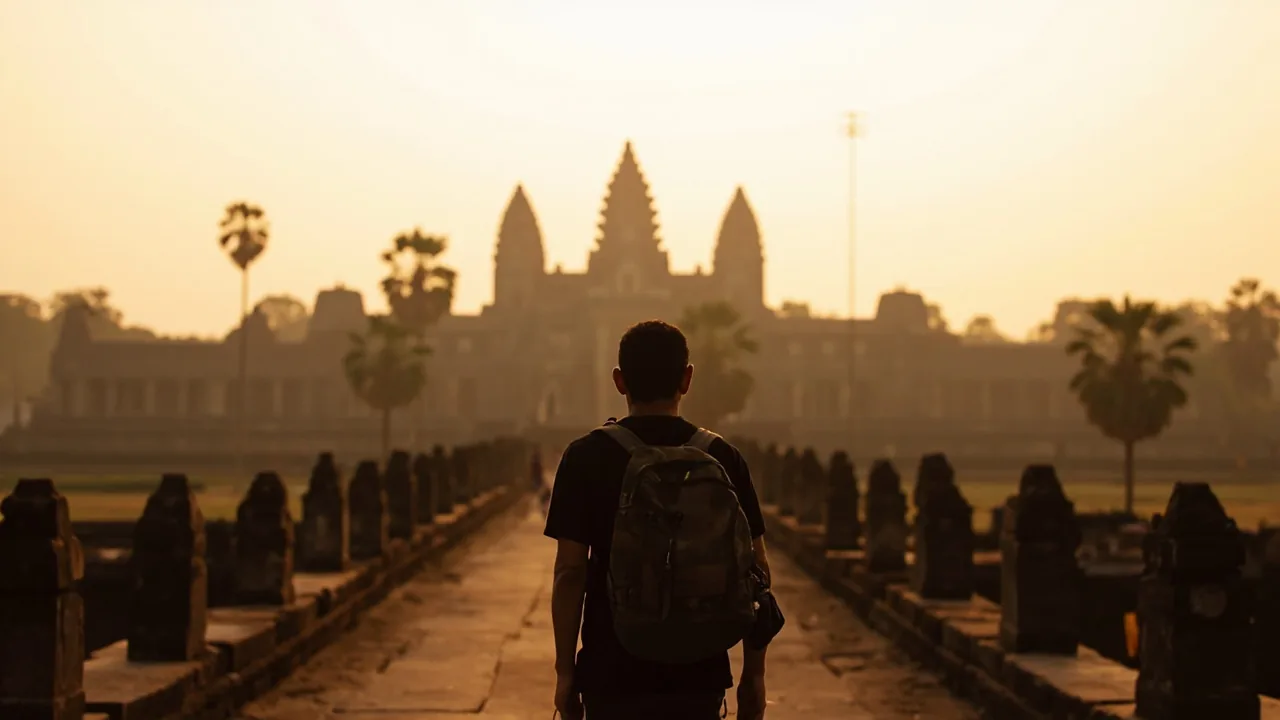
Visiting Cambodia in March: Weather, Crowds, Prices & Events
When you’re planning cambodia visit months, March sits at the tail end of the dry season and is the hottest and driest month of the year. Temperatures regularly cross 35°C in Phnom Penh and Siem Reap, and rain is rare enough that you can plan temple days without a backup. The trade-off is the heat itself, which is real, and a thin but noticeable price climb as Western Easter crowds start arriving in the second half of the month. Planning the wider region? Our Southeast Asia backpacking hub covers the full multi-country route.
For most Indian backpackers, the honest answer is this: March is a perfectly good month if you can handle the heat, a worse month if you can’t. The temples, the food, the visa process, and the routes all work the same as in February. You just sweat more, and you pay a little more for a dorm bed in Siem Reap than you would have in November.
Quick Answers
Wondering how March fits into the broader cambodia visit months picture? Here’s the snapshot:
| What | Answer | Price (INR) |
|---|---|---|
| Is March a good time to visit Cambodia? | Yes, if you can handle 35°C+ heat. Driest month, low rain risk. | ~₹5,900 (~$61.15) |
| How hot is Cambodia in March? | 32 to 38°C daytime, 24 to 26°C night. Siem Reap slightly hotter than Phnom Penh. | ~₹5,900 (~$61.15) |
| Are crowds bad in March? | Low until late March, then Easter and school holidays push Siem Reap up. | ~₹5,900 (~$61.15) |
| Are prices higher in March? | 10 to 20 percent above January for Siem Reap hostels. Flats in Phnom Penh unaffected. | ~₹5,900 (~$61.15) |
| Any major events in March? | Khmer New Year falls in April, not March, but local pagoda festivals and pre-Khmer New Year events start late March. | ~₹5,900 (~$61.15) |
Month-by-Month Breakdown
Here’s how March sits against the rest of the year. If you’re flexible on dates, this table is the fastest way to see whether March makes sense or whether you should push to November or February instead.
| Month | Weather | Crowds | Cost Level | Verdict |
|---|---|---|---|---|
| January | Dry, 30 to 32°C | Medium (peak) | Medium | Best balance of weather and crowd |
| February | Dry, 31 to 34°C | Medium | Medium | Still excellent, heat building |
| March | Hot, 32 to 38°C, almost no rain | Low to medium | Medium to high | Good if heat-tolerant, otherwise skip |
| April | Hottest month, 35 to 40°C | Low until Khmer New Year | Low (except NY week) | Brutal heat, NY spike mid-April |
| May | Hot, monsoon starts late month | Low | Low | Cheap, rain risk begins |
| June | Wet, 28 to 33°C, daily showers | Low | Low | Green landscapes, hostel deals |
| July | Heavy rain, 28 to 32°C | Low | Low | Same as June, rivers swell |
| August | Heavy rain, similar to July | Low | Low | Cheapest month overall |
| September | Wet, easing late month | Low | Low | Still wet, end-of-monsoon deals |
| October | Rain easing, 28 to 31°C | Rising | Low to medium | Shoulder season begins |
| November | Dry, 27 to 30°C | High (peak) | High | Best weather, busiest |
| December | Dry, 26 to 30°C | High (peak) | High | Coolest month, peak crowds |
March in Cambodia: Pros and Cons
Pros:
- Almost zero rain. You can book a 5 a.m. Sunrise at Angkor Wat and trust the sky.
- Pre-monsoon landscapes are still brown-gold and photogenic at temples like Banteay Srei.
- Flights from India via Bangkok or Kuala Lumpur stay in the ₹18,000 (~$186.56) to ₹22,000 (~$228.02) round-trip range, same as February.
- Fewer European families, since most travel in July-August or December.
- Indian restaurants in Phnom Penh and Siem Reap run normal hours, no monsoon closures.
Cons:
- Daytime heat is the single biggest factor. 36°C in Siem Reap at 1 p.m. Is normal, and temple-hopping between 11 a.m. And 3 p.m. Is genuinely uncomfortable.
- Late March brings Easter holidays and Western school breaks, which pushes Siem Reap dorm prices up by 10 to 20 percent.
- Water and electrolyte drinks become a real line item, not a “nice to have.”
- Khmer New Year (Chaul Chnam Thmey) officially starts 13 April, so if you arrive the last week of March you’ll see the pre-NY flower markets and decoration prep but not the festival itself.
- Air quality in Phnom Penh can dip in late March as the dry season peaks and field burning starts in surrounding provinces.
The single biggest ground-level reality of March in Cambodia is the timing of your day. Travellers who structure their temple visits around sunrise (5:30 a.m. To 9 a.m.) and then again at late afternoon (4 p.m. To 6 p.m.) get two usable windows. The middle of the day is for a Siem Reap cafe, a ₹386 (~4 USD) hour-long foot massage on Pub Street, or a pool at your hostel. The people who try to “do Angkor in one day” from 9 a.m. To 5 p.m. In March come back fried.
March Events Worth Timing Your Trip Around
March isn’t Cambodia’s biggest festival month, but a few things are worth knowing:
Pre-Khmer New Year build-up (last 10 days of March). Phnom Penh’s Central Market (Psar Thmei) and Siem Reap’s Old Market get visibly busier as Cambodians stock up for Chaul Chnam Thmey. You’ll see piles of new clothes, traditional Khmer sweets, and the first decorations going up. If you want the festival atmosphere without the 4-day shutdown of businesses, late March is a clever window.
International Francophonie Day (20 March). Mostly a diplomatic event in Phnom Penh, but some cultural centres offer free film screenings and music. Skip if it’s not on your radar.
Local pagoda festivals. These happen year-round, but March is a heavier month for Buddhist holy days. If you stay near a wat, you’ll see orange-sashed monks gathering for early-morning alms rounds. Respectful photography is fine; flash and posed shots are not.
If you want a proper festival, push your trip to mid-April for Khmer New Year itself, or to November for Bon Om Touk (water festival). For pure March, the country is calm, hot, and dry.
What to Pack Specifically for March
March packing is mostly an anti-heat list. Here’s what helps on the ground:
- Lightweight long sleeves and trousers. Not for sun protection alone, but because Siem Reap and Phnom Penh temples require covered shoulders and knees. A linen shirt over a tee saves you from carrying a scarf.
- Reusable water bottle with filter. Tap water is not drinkable. Bottled water is cheap (₹36 (~1,500 KHR or ~$0.37) per 1.5L bottle) but accumulates as plastic waste. A LifeStraw or similar bottle cuts both cost and waste.
- Electrolyte sachets. ORS packets from any Indian pharmacy (₹10 (~$0.10) each) dissolve into a 600ml bottle. They beat imported sports drinks on price and availability.
- High-SPF sunscreen and a brimmed hat. UV index in March is extreme (10 to 11). Bring sunscreen from India, as imported brands are pricier locally.
- Quick-dry towel. Useful for both showers and as a sweat rag during temple visits.
- Power bank. Heat drains phone batteries faster. A 10,000 mAh bank is enough for a full day of Google Maps, photos, and translation.
- Light scarf or buff. Doubles as sun protection and temple cover-up. A layer is useful on cold overnight buses and for cool indoor spaces.
Subodh’s Pro Tip: Don’t pack cotton. It stays wet when you sweat. Quick-dry synthetics or merino are 10x better for March temple runs. The same goes for shoes: closed-toe breathable sneakers beat sandals at Angkor because the stone heats up past 50°C in midday sun.
Season Costs Comparison
Here’s how March (late dry season) compares to the November peak and the August low season for the main costs:
| Item | Peak Season (Nov-Dec) | Shoulder Season (March) | Low (Monsoon) Season (Jul-Aug) |
|---|---|---|---|
| Flight (from India, round trip) | ₹28,000 (~$290.21) | ₹20,000 (~$207.29) | ₹15,000 (~$155.47) |
| Dorm Bed, Siem Reap (per night) | ₹429 (~18,000 KHR or ~$4.45) | ₹381 (~16,000 KHR or ~$3.96) | ₹238 (~10,000 KHR or ~$2.47) |
| Dorm Bed, Phnom Penh (per night) | ₹334 (~14,000 KHR or ~$3.46) | ₹286 (~12,000 KHR or ~$2.97) | ₹191 (~8,000 KHR or ~$1.98) |
| Private Room, Siem Reap (per night) | ₹1,907 (~80,000 KHR or ~$19.78) | ₹1,550 (~65,000 KHR or ~$16.07) | ₹954 (~40,000 KHR or ~$9.89) |
| Angkor 1-day pass | ₹3,600 (~37 USD) | ₹3,600 (~37 USD) | ₹3,600 (~37 USD) |
| Street meal (rice + curry) | ₹191 (~8,000 KHR or ~$1.98) | ₹191 (~8,000 KHR or ~$1.98) | ₹167 (~7,000 KHR or ~$1.73) |
| Tuk-tuk, Siem Reap (half day) | ₹596 (~25,000 KHR or ~$6.18) | ₹477 (~20,000 KHR or ~$4.95) | ₹358 (~15,000 KHR or ~$3.71) |
Prices reflect typical shoulder-season rates for March and were cross-checked with traveller reports; expect minor day-to-day variation.
What It Feels Like in March
The most useful thing I can tell you is what March days and nights physically feel like, because “hot and dry” doesn’t capture the rhythm.
A typical March day in Siem Reap looks like this: 25°C at 5 a.m. When you leave for Angkor Wat sunrise, climbing to 30°C by 9 a.m., hitting 36°C between 1 and 3 p.m., then easing to 32°C by 6 p.m. And back to 26°C by 10 p.m. The air is dusty at the start of the month and worsens by late March as agricultural burning picks up. Humidity is lower than June but you still sweat through a t-shirt in 20 minutes of walking.
Phnom Penh runs 1 to 2°C hotter than Siem Reap in March because of urban heat and lower elevation. The river doesn’t help much; it’s brown and slow this time of year.
Coastal Sihanoukville and the islands (Koh Rong and Koh Rong Samloem) are slightly cooler at 30 to 33°C, with sea breezes. If heat is your main concern, March is a better time to be on the coast than inland, though boat services run normally and water clarity is excellent because of the dry season.
Getting Around Cambodia in March
Internal transport is unaffected by weather in March. Roads are dry, ferries run on schedule, and the night bus network between Phnom Penh, Siem Reap, Sihanoukville, and Ho Chi Minh City is fully operational.
For cross-border moves, the dry season is the easiest time. The Bangkok to Siem Reap overland route is straightforward in March, and the Phnom Penh to Ho Chi Minh City bus is reliable.
Safety Alert: March heat is a real medical risk, especially for older travellers and anyone on blood pressure or heart medication. Drink 3 to 4 litres of water a day, avoid outdoor activity between 11 a.m. And 3 p.m., and carry ORS packets. If you feel dizzy or stop sweating despite the heat, stop and cool down immediately.
Where to Eat (March Friendly)
March is the easiest month for eating in Cambodia because food hygiene issues that flare up in the wet season are at their lowest. Street food is generally safer in March than in July, and restaurants don’t have the same risk of running low on fresh produce.
For local Cambodian food, three places stand out:
- Smokin’ Pot Authentic Cambodian Restaurant and Cooking School, a Siem Reap favourite for fish amok and beef lok lak.
- Cambodia Kitchen in Phnom Penh, known for red curry with sweet potato and a more refined take on everyday Khmer dishes.
- HoubHoub Cambodian Restaurant (BKK1) in Phnom Penh’s BKK1 district, where the local crowd eats, which usually means the kitchen knows what it’s doing.
For Phnom Penh’s evening entertainment, Phare, The Cambodian Circus is an open-air venue and runs its full show schedule in March. The dry weather means no rain cancellations, which is rare in monsoon months.
When you need a dal-chawal reset, Indian Restaurant in Phnom Penh, Galaxy Indian Restaurant in Poipet (useful if you’re crossing the Thailand border), and Saffron Indian Restaurant Poipet are the reliable fallback.
Cambodia Visa Basics for Indian Travellers
Indian passport holders need a visa for Cambodia. The two main options are:
- e-Visa (online): ₹3,473 (~36 USD), valid for 30 days, single entry. Apply at the official portal (evisa.gov.kh). Processing usually takes 3 business days.
- Visa on Arrival (VoA): ₹2,894 (~30 USD), valid for 30 days, single entry. Available at Phnom Penh, Siem Reap, and land border checkpoints. Carry a passport photo and USD cash.
Both options can be extended once for an additional 30 days through a local travel agency. Overstaying is fined ₹965 (~10 USD) per day.
Getting Connected
March is the easiest month to stay online in Cambodia because the dry season means fewer tower outages. For a physical SIM, Cellcard and Smart are the two main operators; a 30-day 30GB data pack runs around ₹482 (~5 USD), available at the airport kiosks in Phnom Penh and Siem Reap. Bring your passport.
If you don’t want to queue at the airport, an eSIM is faster. Get Nomad eSIM gets you connected before you land, useful for booking a Grab or arranging a tuk-tuk the moment you walk out of arrivals.
March vs. Neighbouring Months (May and June)
You asked specifically how March compares to May and June, so here’s the direct comparison:
March vs. May. May is when the southwest monsoon starts arriving, usually the second or third week. Rain in May is short (30 to 90 minutes, usually late afternoon) but heavy. Temperatures drop to 30 to 33°C, and hostel prices in Siem Reap fall 20 to 30 percent below March. If you can handle a 4 p.m. Downpour, May is the better deal for the same Angkor experience. For a month-by-month breakdown of May specifically, see our visiting Cambodia in May guide.
March vs. June. June is solidly wet. Daily rain, rivers full, some rural roads muddy. Prices are at their lowest, Siem Reap dorm beds drop another 20 to 30 percent from May, and temple crowds thin out. The trade-off is photography (grey skies) and rural travel (occasional delays).
March is the bridge. You pay a shoulder-season price but get peak-season weather. May and June are cheaper but wetter.
FAQ
Is March hotter than April in Cambodia? No, April is hotter. April is Cambodia’s hottest month, with daytime temperatures regularly hitting 38 to 40°C in inland cities. March is the second-hottest month, slightly more bearable, and without the Khmer New Year shutdown that hits April from 13 to 16 April.
Can I do Angkor Wat in March without sunstroke? Yes, but only if you start at sunrise. The 5:30 a.m. To 9:30 a.m. Window is the only safe time for the main temple circuit. After 10 a.m., the stone at Angkor Wat can reach 50°C and the heat becomes genuinely dangerous. Most travellers do sunrise, return to the hotel for a pool break, then revisit temples after 4 p.m.
Should I book Cambodia hostels in advance for March? Book 2 to 3 weeks ahead for Siem Reap, especially if your dates cross into Easter (last week of March). Phnom Penh is more flexible; walk-ins are usually fine even in March.
Is March the rainy season in Cambodia? No, March is the dry season. The rainy season runs May to October, peaking in July to September. March is one of the driest months, with average rainfall under 30mm in Siem Penh and 25mm in Siem Reap.
How does March compare to February for a Cambodia trip? February is the better month for most Indian travellers: 2 to 4°C cooler, similar low rain risk, and slightly lower prices before Easter pricing starts. If you can choose between the two, February wins on heat comfort. If your dates are fixed to March, it’s still a strong month, just hotter.
Subodh’s Take
March is the month I’d pick if February didn’t exist. The heat is real but predictable, the temples are uncrowded until Easter, and prices stay in the shoulder band. The honest case against March is heat sensitivity, not weather, not crowds, not cost. If you’ve done Rajasthan in May or Kerala in pre-monsoon, you can handle Cambodia in March. If you haven’t, pick February or November instead.
Before you finalize dates, check the Indian Ministry of External Affairs travel advisory at mea.gov.in for any current updates on Cambodia, and the Royal Government of Cambodia’s official tourism site for festival and road-closure notices during Khmer New Year build-up.
We run one backpacking trip through Thailand, Vietnam, Laos, and Cambodia, planned, fixed-cost, no spreadsheet required.
