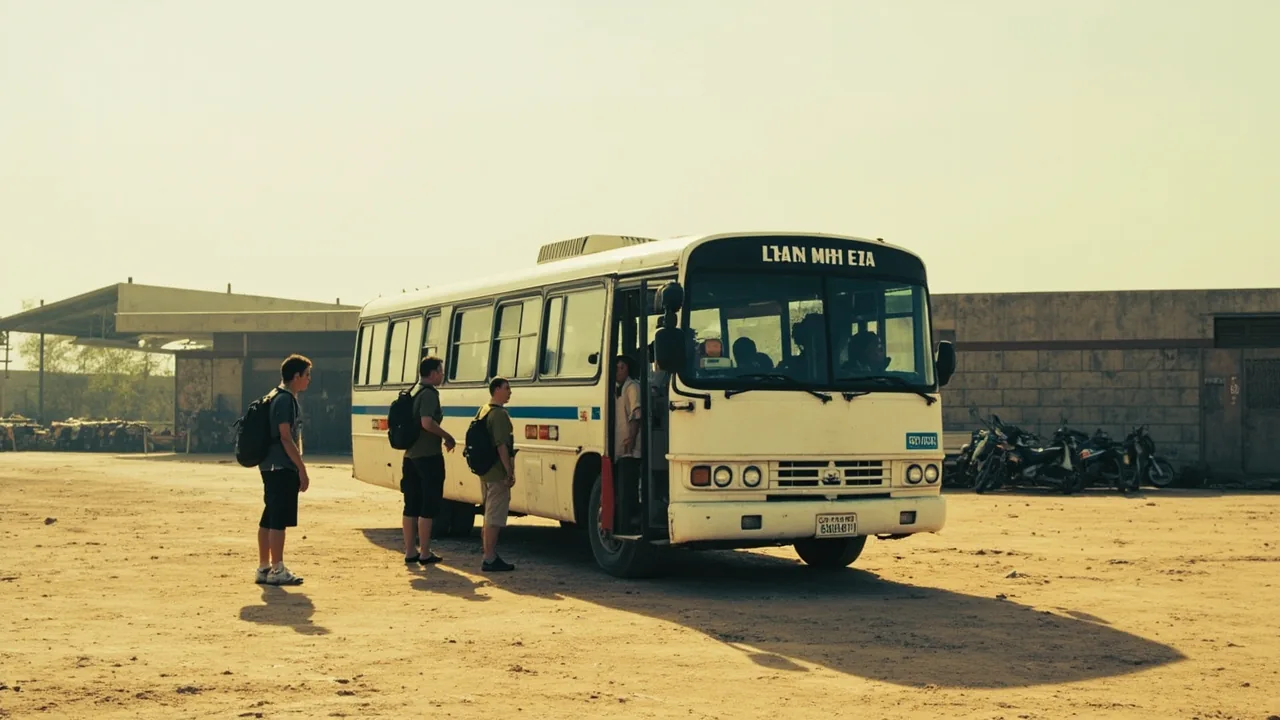
Cambodia Border Crossings Explained: Bangkok to Siem Reap & Phnom Penh to Ho Chi Minh City by Bus (2026)
Last reviewed: 2026-07-22
This cambodia border crossing bus guide covers the two overland routes that handle roughly 80% of backpacker traffic between Thailand, Cambodia, and Vietnam: Bangkok to Siem Reap via Poipet, and Phnom Penh to Ho Chi Minh City via Bavet/Moc Bai. Based on current operator schedules, border crossing reports, and visa rules verified in July 2026.
A live catch most guidebooks haven’t caught up to yet: Thailand officially suspended cross-border bus services to Cambodia in mid-2025 amid a border dispute. That’s the single biggest reason Indian backpackers land in Bangkok expecting a same-day bus and end up scrambling.
This article reflects 2026 reality: what still runs, what doesn’t, how to do it without losing a day, and how much buffer to budget. For related planning, see our guide on Kampot.
Quick Answers
| What | Answer | Price (INR) |
|---|---|---|
| Bangkok → Siem Reap direct bus | Suspended since mid-2025 | — |
| Bangkok → Aranyaprathet → Poipet → Siem Reap | 2-leg combo, both legs running | total |
| Phnom Penh → Ho Chi Minh City bus | Running, multiple daily departures | ~₹1,158 (~12 USD) |
| Cambodia VoA fee (Indian passport) | ₹2,896 (~30 USD) cash at airport/border | ~₹2,896 (~$30) |
| Cambodia e-Visa fee | ₹3,475 (~36 USD) online, processed 3 days | ~₹3,475 |
All conversions in this article use 1 USD = ₹96.53 (verified 2026-07-22). Cambodia’s riel (KHR) trades at roughly 1 KHR = ₹0.024, but USD is accepted almost everywhere for tourist services, so prices throughout are quoted in USD unless otherwise noted. You may also find Top Cities to Visit in Cambodia useful for this trip.
How to Get There: The Three Routes That Work in 2026
Route 1: Bangkok → Siem Reap (the suspended one)
The old way, the way you’ll still see on travel forums from 2024: a single minivan or coach from Khao San Road or Mo Chit, 8-9 hours including the border, drop-off at your Siem Reap guesthouse. That service was suspended when Thailand and Cambodia’s bilateral relations went sideways in June 2025 over the Preah Vihear border dispute. As of July 2026, direct cross-border buses are not operating, and Thai operators have shifted to “drop at border, walk across, meet our partner on the other side” schemes that cost roughly the same, take roughly the same time, and break your luggage onto two different vehicles.
The work-around that’s working right now is two separate tickets:
-
Bangkok → Aranyaprathet by minivan. Departs from Mo Chit (BTS Mo Chit, exit 4) or Khao San area, 4-5 hours, drops you at the Aranyaprathet bus station a few kilometres from the Rong Kluea border market. Price:.
-
Poipet (Cambodia side) → Siem Reap by minivan. The Cambodians never stopped running this, and several Cambodian operators meet arriving passengers in Poipet town itself. Vehicles are usually already full of Thais and other travellers who came through the same way, and they leave when full, often within 30 minutes of you clearing immigration. Price: ₹965-₹1,448 (~10-15 USD) on arrival, or pre-booked for slightly less.
Total door-to-door: 8-10 hours including a usually-long border crossing. A working combination costs roughly total for the two tickets, more if you negotiate badly on the Cambodia side.
Subodh’s Pro Tip: Don’t book the two-leg combo as a single “package” through a Bangkok travel agency. They’re reselling the same Thai minivan + a Cambodian partner van, marked up 30-50%. Book the first leg yourself at Mo Chit, walk across the border, and book the second leg on arrival.
If you’re already in Bangkok and want to see the full Bangkok-to-Siem-Reap leg broken down including the Mo Chit departure details, the scam-prone tuk-tuk drivers at Rong Kluea, and which side to eat lunch on, see our Bangkok to Siem Reap corridor piece. For general Southeast Asia routing, the backpacking hub lays out the full Thailand-Cambodia-Vietnam loop with every alternative.
Route 2: Bangkok → Siem Reap by air (when time matters)
If you’ve only got a week and you can’t lose a day to a bus-plus-border-plus-minivan-plus-van saga, Bangkok Airways, AirAsia, and Thai Smile all fly Bangkok (BKK or DMK) to Siem Reap (REP) direct. Flight time is one hour, plus 90 minutes each way for airport transfer and check-in. Budget fares run ₹6,500-₹9,000 (~$67.34-$93.24) return if booked 3+ weeks ahead. On arrival in Siem Reap, a tuk-tuk to the city centre is ₹483 (~5 USD).
This is the route to take if you fly out of Bangkok in the morning, or if your Cambodia e-Visa is already approved and you want to skip the land border queue entirely.
Route 3: Phnom Penh → Ho Chi Minh City (still running)
This is the easy one. Direct buses have continued running throughout the 2025-2026 political mess because the Vietnamese side never reciprocated any suspension. The route is Phnom Penh → Bavet (Cambodian border town) → Moc Bai (Vietnamese border town) → Ho Chi Minh City. Total time: 6-7 hours including the border crossing. Price: ₹965-₹1,255 (~10-13 USD) for the standard tourist bus, ₹1,448-₹1,738 (~15-18 USD) for VIP with bigger seats.
Main operators:
- Giant Ibis: The most reliable. AC, WiFi usually works, 6 daily departures from their Phnom Penh office on Monivong Boulevard. ₹1,255 (~13 USD). Book ahead on their site or via 12go.
- Mekong Express: Older buses, similar price, slightly less reliable on time but fine for budget travellers.
- Kapitours: Local, cheapest at ₹965 (~10 USD), slowest, the bus that breaks down most often.
The border process at Bavet/Moc Bai is straightforward: Cambodian exit stamp (5 minutes), walk 200 metres through no-man’s land, Vietnamese entry stamp (15-30 minutes depending on queue), then reboard the same bus on the Vietnamese side. Drivers handle luggage. Your one job is to have your Cambodia e-Visa printed out, and a printed copy of your Vietnam e-Visa if you applied online in advance.
Subodh’s Pro Tip: Pre-print your Vietnam e-Visa. The Moc Bai officers won’t always accept a phone screenshot, and the queue behind you will get restless while you fumble with brightness settings.
For the full Phnom Penh side of this journey including where to stay the night before and how to avoid the Monivong Boulevard tuk-tuk mafia, see the Phnom Penh guide.
Where to Stay at the Border Towns (If You Get Stuck)
Most travellers don’t plan to overnight in Poipet or Bavet, but sometimes you miss the last connection, your bus breaks down, or you arrive after dark and don’t want to negotiate a minivan to Siem Reap at 9pm. The few budget guesthouses within walking distance of the crossing are basic and only suitable as a last resort.
Poipet side (Cambodia, after crossing from Thailand):
- Basic guesthouses near the casino district, ₹772-₹1,448 (~8-15 USD), quality varies wildly
Bavet side (Cambodia, before crossing to Vietnam):
- Basic guesthouses, ₹965-₹1,448 (~10-15 USD), the only option near the crossing
If you get stuck at the Aranyaprathet/Rong Kluea side in Thailand, basic guesthouses on the road into town are the closest option.
What to Eat at the Border (and What to Avoid)
Border-town food is a specific genre of mediocre: stir-fried rice for $2 USD, banana pancakes for $1 USD, warm beer for $1.50 USD, and a lot of dishes that have been sitting out since morning. If you’re stuck for a meal, here’s what works:
On the Thai side (Aranyaprathet, before crossing):
- Any of the noodle shops across from Rong Kluea Market. Pork noodles with morning glory are safe enough for one meal. Vegetarian options are available at most stalls — ask for “jay” (vegetarian) or point at the vegetable dishes.
On the Cambodian side (Poipet):
- Stick to the cluster of family-run restaurants immediately after the casino on the road toward Siem Reap. Fish amok ₹386 (~4 USD), chicken lok lak ₹338 (~3.50 USD), both safe bets.
- Bottled water only. Don’t drink the iced drinks at unmarked stalls. Stick to Anchor beer (₹60 (~$0.62) per bottle) if you’re drinking.
Avoid:
- Anything labelled “buffet” in Poipet. The warm meat sits out all day.
- The Indian restaurants next to the casino. Most are fronts for something else; the few real ones serve terrible food at tourist prices.
The Visa Situation for Indian Passport Holders (2026)
You have two real options for Cambodia, and one bad option.
1. Visa on Arrival (VoA), ₹2,896 (~30 USD) cash
Available at Phnom Penh airport, Siem Reap airport, Sihanoukville airport, and all major land borders including Poipet and Bavet. You need:
- One 4x6 cm passport photo (white background)
- ₹2,896 (~30 USD) cash (they will not accept Thai baht, Cambodian riel, or any other currency for the fee; bring crisp USD bills, no folds, no marks)
- A completed arrival form (usually handed out on the plane, or available at the counter)
The line at Poipet during peak season (Nov-Feb) can run 60-90 minutes. Bring water. The line at the airports is usually 20 minutes. VoA gives 30 days single entry.
2. E-Visa, ₹3,475 (~36 USD) online
Apply at evisa.gov.kh (the only official site; ignore every .com clone that comes up first on Google). Processing takes a few business days as listed on the official portal, the visa is emailed to you, you print it, you walk through the “e-Visa” lane at the border. Slightly more expensive than VoA (₹579 (~6 USD) more, around ₹580 (~$6.01)) but you skip the form-filling and the queue.
The bad option: Visa-on-arrival “service” desks before immigration at Poipet. These are unofficial agents who charge ₹3,379-₹4,826 (~35-50 USD) to “process” your VoA for you, take your passport, walk it to the counter, and pocket the difference. You’ll wait just as long. Just walk to the official counter yourself.
For Vietnam, you need an e-Visa in advance; no VoA for Indian passports. Apply at the official Vietnamese immigration portal, ₹2,413 (~25 USD), 3 days processing, valid 30 days single entry. Print it. The Moc Bai land border checks carefully.
Subodh’s Pro Tip: If you’re entering Cambodia by land from Thailand in 2026, the e-Visa is worth the extra ₹579 (~6 USD). The Poipet border queue has gotten worse since the bus suspension concentrated more individual travellers into the same crossing window.
Common Mistakes (That Indian Backpackers Specifically Make)
Mistake 1: Booking a Bangkok-to-Siem-Reap direct bus online before checking if it’s running.
The major third-party booking sites still list direct buses because operators haven’t fully de-listed them. You book, you show up at Mo Chit at 6am, the counter tells you the bus is cancelled, you scramble. Always confirm by WhatsApp or phone with the operator 24-48 hours before, or just book the two-leg combo.
Mistake 2: Changing money at the border at a bad rate.
The Poipet money changers and the Rong Kluea market on the Thai side will give you a worse rate per ₹9,653 (~100 USD) than Bangkok or Siem Reap proper. If you’re carrying USD, change at the Bangkok airport before departure or in Siem Reap city on arrival. If you’re carrying Thai baht, spend them on the Thai side before you cross. The border rate is the worst rate you’ll see in Southeast Asia.
Mistake 3: Not carrying small USD bills for the visa fee.
The VoA counter wants ₹2,896 (~30 USD) in cash, in near-perfect condition. The torn ₹1,931 (~20 USD) from your wallet and the folded ₹965 (~10 USD) from the bottom of your daypack won’t work. Carry 4-5 crisp $20s in a separate envelope. Cambodia is unusually strict about bill condition; Thailand and Vietnam will usually accept worn notes.
Mistake 4: Assuming the Phnom Penh → HCMC bus is the only option.
There’s also a Phnom Penh → HCMC boat down the Mekong if you have 2-3 extra days, and there’s an overland route via the Central Highlands (more scenic, longer, fewer tourists). For most backpackers, the bus is still the right answer, but know the alternatives exist.
Getting Connected: SIM and WiFi
Both Cambodia and Vietnam have functioning tourist SIM ecosystems, and getting one before you cross the border is the move.
Cambodia side (Smart or Cellcard):
The tourist 7-day SIM is ₹290 (~3 USD) for about 10GB. Buy it at the airport on arrival if you’re flying in, or at any Smart/Cellcard shop in Phnom Penh or Siem Reap. Don’t buy at the border; the markup is brutal. If you’re arriving by land at Poipet, wait until Siem Reap.
Updated 2026-07-22: SIM prices in Siem Reap and Phnom Penh range from roughly ₹290 (~$3) to ₹580 (~$6.01) depending on data allowance and operator; check current rates on arrival.
Vietnam side (Viettel or Mobifone):
Similar setup. Tourist SIM is ₹483-₹676 (~5-7 USD) for 30 days with 3-5GB/day. Buy at the airport or any phone shop in Ho Chi Minh City. The border at Moc Bai has shops selling SIMs but the prices are inflated 50%.
eSIM alternative:
If you’d rather not swap physical SIMs at every border, an eSIM with regional Cambodia-Vietnam coverage works well. It covers both countries in a single plan, activates by QR code, and you keep your Indian number on WhatsApp active. For most Indian backpackers on a 2-3 week overland loop, this is now the default.
WiFi at hostels and cafes in both Siem Reap and Ho Chi Minh City is reliable. The border towns themselves have spotty WiFi; don’t count on FaceTiming your family from Poipet.
Daily Budget Breakdown
A realistic one-day budget for an Indian backpacker crossing from Thailand into Cambodia and continuing onward:
| Category | Cost |
|---|---|
| Bangkok → Aranyaprathet minivan | |
| Lunch at border | |
| Aranyaprathet → Poipet border crossing | 0 (walk) |
| Cambodia VoA fee | ₹2,896 (~30 USD) |
| Poipet → Siem Reap minivan | ₹965 (~10 USD) |
| Siem Reap dorm (one night) | ₹579 (~6 USD) |
| Dinner + beer | ₹483 (~5 USD) |
| Tuk-tuk to Angkor next morning | ₹483 (~5 USD) |
| Total for crossing day | ~₹5,406 (~56 USD) |
If you’re going from Phnom Penh to Ho Chi Minh City:
| Category | Cost |
|---|---|
| Phnom Penh hostel (night before) | ₹772 (~8 USD) |
| Giant Ibis bus ticket | ₹1,255 (~13 USD) |
| Lunch at border | ₹290 (~3 USD) |
| Bottled water | ₹48 (~0.50 USD) |
| Arrival dinner in HCMC | ₹483 (~5 USD) |
| HCMC hostel (first night) | ₹772 (~8 USD) |
| Total for crossing day | ~₹3,620 (~37.50 USD) |
This is what travellers spent on the route in May 2026, not what tourism-board brochures say. Verified 2026-07-22.
Safety and Geopolitical Context (Read This Before You Book)
Beyond the 2025 Thai-Cambodian bus suspension, a few other things are worth knowing:
- Border tensions can flare. The Preah Vihear temple area has been the flashpoint, and the situation around it has settled but not resolved. Check your Indian government’s current travel advisory at mea.gov.in before departure, and the Cambodia Ministry of Foreign Affairs site for the destination’s own advisory. Don’t rely on a forum post from three months ago.
- Border scams are persistent. The Rong Kluea market tuk-tuk drivers on the Thai side, the unofficial “visa service” desks at Poipet, and the aggressive minivan touts on the Cambodia side of Bavet are all running the same playbook they have for years. Walk past all of them, find the official counter, walk across, find the official bus.
- Solo female travellers: both crossings are safe in daylight with reasonable precautions. Don’t cross after dark alone; the Bavet/Moc Bai night crossing has had reports of harassment that the day crossing doesn’t.
FAQ
Is the Bangkok to Siem Reap bus still running in 2026?
Direct cross-border buses were suspended in mid-2025 and have not restarted as of July 2026. You can still do the route, just in two separate legs: Bangkok to Aranyaprathet by Thai minivan, then Poipet to Siem Reap by Cambodian minivan after walking the border.
How long does the Cambodia border crossing take in 2026?
For the Poipet crossing, allow 2-3 hours total including immigration on both sides during peak season (Nov-Feb). The Bavet/Moc Bai crossing is faster, typically 1-1.5 hours.
Do I need a Cambodia visa in advance?
No, but the e-Visa (₹3,475 (~36 USD)) saves time at the border. VoA at the border is ₹2,896 (~30 USD) cash plus a passport photo. Both work for Indian passports.
How much should I budget per day in Cambodia?
Budget travellers do it on $20-30 USD/day (~₹1,930-2,895), including dorm, food, and one activity. Siem Reap is more expensive because of Angkor; Phnom Penh is cheaper.
Is the Phnom Penh to Ho Chi Minh bus safe?
Yes. Giant Ibis is the most reliable operator. The route is well-traveled and police-checked. Avoid the cheapest ₹965 (~10 USD) local minivans if you’re carrying valuables; they have higher theft rates.
Can I use Indian rupees at the border?
No. Bring USD cash for the Cambodia visa fee, and either USD or Thai baht for the Cambodian side (baht accepted everywhere but at bad rates). Indian rupees are not exchangeable at any border.
What if I get stranded at the border after dark?
Both Poipet and Bavet have basic guesthouses within a 10-minute walk of immigration. Don’t accept a “free ride” from strangers offering to take you to a hotel; you’ll end up at a commission-driven guesthouse at inflated prices. Walk to the town centre and find a guesthouse yourself. If possible, push through to Siem Reap or HCMC rather than overnighting at the border.
Subodh’s Take
The Bangkok-to-Siem-Reap bus is the route that broke first when the politics shifted, and it’ll probably be the last route to fully recover. If you’re set on the overland journey, do it, but do it knowing it’s now a 2-leg combo rather than a single coach ride, and budget an extra hour for the disconnection at the border. The Phnom Penh to Ho Chi Minh route is unchanged and easy. Vietnam has its own e-Visa system that’s stricter than Cambodia’s, so get that sorted before you leave Phnom Penh, not at the border. And if the Thai-Cambodian situation is still tense when you read this, don’t take the political situation personally, just check mea.gov.in the morning of your travel day and move on. The buses will run again; the temples aren’t going anywhere.
