Chiang Dao Caves & Hot Springs: The Northern Thailand Mountain Escape
Chiang Dao sits 70 km north of Chiang Mai, tucked into the foothills of Thailand’s third-highest peak. Travellers come here for two reasons and two reasons only: the cave system (one of the longest in the country) and the hot springs just up the valley. After you’ve spent a week sweating through Bangkok and the night markets of Chiang Mai, this is the place where everyone slows down.
I cross-checked current bus timings, the cave’s 2026 entry rules, and the hot springs’ actual 2026 price against traveller reports and the official Chiang Dao Subdistrict source,. The guide below reflects what a backpacker pays, what they get, and what to skip. You may also find Bangkok to Chiang Mai useful for this trip. For the wider regional route, use the SEA backpacking hub.
📍 Distance from Chiang Mai: 70 km ⏱️ Fastest option: 1.5 hours (minivan) 💰 Cheapest option: ₹430 (~150 THB or ~$4.46) ✅ Best option: Morning minivan from Chiang Mai Arcade Bus Terminal, then motorbike to the caves
Quick Answers
| What | Answer | Price (INR) |
|---|---|---|
| How far is Chiang Dao from Chiang Mai? | 70 km north, Highway 107 | ₹430 (~150 THB or ~$4.46) by minivan |
| How much does the Chiang Dao Cave cost? | ₹115 (~40 THB or ~$1.19) Thai, ₹574 (~200 THB or ~$5.94) foreigner | ₹574 (~200 THB or ~$5.94) |
| What are the hot springs price? | Wade-in river access is free; paid pools ₹287 (~100 THB or ~$2.97) | ₹287 (~100 THB or ~$2.97) |
| Can I do Chiang Dao as a day trip? | Yes, but a night lets you catch sunrise over the peak | — |
| What’s the weather like in Chiang Dao? | Cooler than Chiang Mai, drops to 10°C in December nights | — |
How to Get from Chiang Mai to Chiang Dao
Chiang Dao is not a city you fly into. You arrive overland from Chiang Mai, and you have three real options.
Option 1. Cheapest: Local Songthaew from the Junction
The cheapest path is the blue songthaew that leaves from Chiang Mai’s Chang Phueak Gate (the “Junction”) when it fills up, usually every 30 to 60 minutes between 7 AM and 5 PM. It is slow (2 to 2.5 hours), it stops whenever someone flags it down, and on the way back you might wait 90 minutes for the bus to be full enough to leave. Book on 12go if you prefer a confirmed seat and a set time.
Cost: 80-100 THB. At current rates (1 THB = ₹2.87), 100 THB is about ₹287. Exact change, no card.
Option 2. Best: Minivan from Arcade Bus Terminal
This is the option I’d recommend to a friend. Sombat Tour runs air-conditioned minivans from the Chiang Mai Arcade Bus Terminal (just behind the old Arcade night bazaar) directly to Chiang Dao town. Buses leave roughly hourly from 7 AM to 5 PM, take about 1.5 hours, drop you in the centre of Chiang Dao, and cost ₹430 (~150 THB or ~$4.46). The catch: vans fill up with Thai travellers heading to the Chiang Dao monastery school, so book a day ahead in high season (November to February). Compare prices on 12go and you’ll usually see the same Sombat Tour vans listed with confirmed seats.
Why it wins: Set schedule, no filling-up delays, AC works, drop-off is in the actual town centre.
Subodh’s Pro Tip: The Arcade Bus Terminal has two sections. Chiang Dao minivans leave from the “old” terminal behind the night bazaar arcade, not from the new Chiang Mai Arcade 2 (the one by the moat). Take a tuk-tuk from the moat to the old terminal if the GPS tries to put you at the wrong one.
Option 3. Motorbike (Freedom, Not Speed)
Travellers who want to stop at the Sticky Waterfalls (Bua Tong) on the way or wander at will rent a scooter in Chiang Mai for ₹717-₹1,148 (~250-400 THB or ~$7.43-$11.89) per day. Read the Thailand motorbike safety guide before riding. The road is paved and scenic the whole way. It is not the fastest option (allow 2 hours including photo stops), but it is the most rewarding, and you can pull over at the 50 km marker for a coffee at the strawberry farms.
Cost: ₹717-₹1,148 (~250-400 THB or ~$7.43-$11.89) for the bike plus ₹287 (~100 THB or ~$2.97) in fuel.
Chiang Dao Cave System
The Chiang Dao Cave (Tham Chiang Dao) is one of Thailand’s most underrated cave systems. It runs more than 10 km into the limestone mountain, but only the first kilometre or so is lit and open to visitors. The Thai tourist board promotes it as a top-tier northern attraction; backpackers often skip it because they’ve heard it’s small.
That advice is wrong. The lit section alone takes 45 minutes to walk through, the stalactite formations are bigger than anything near Chiang Mai, and a Buddhist shrine sits deep in the main chamber where monks periodically meditate.
Entry fee: ₹115 (~40 THB or ~$1.19) Thai nationals, ₹574 (~200 THB or ~$5.94) foreigners. This price difference is set by the national park and exists across all Thai parks (Indian passport holders pay the foreigner rate). For the foreigner entry, get your ticket from the small wooden booth 200 metres before the cave mouth.
You will need a guide for the lit section. Guides are compulsory and cost ₹287 (~100 THB or ~$2.97) per group. They speak enough English to point out the named formations and the monk’s shrine. Tip them ₹143-₹287 (~50-100 THB or ~$1.49-$2.97) if they walk you through the whole lit chamber.
Hours: 8 AM to 5 PM. Last guide goes in around 4 PM. The cave is cooler inside than out (around 20°C year-round), so bring a light layer.
Safety Alert: Bring a torch even if you only plan to walk the lit section. Two of the three side chambers off the main walkway are not lit, and guides sometimes take visitors into them. Phone flashlights work but a separate headlamp is safer.
Chiang Dao Hot Springs
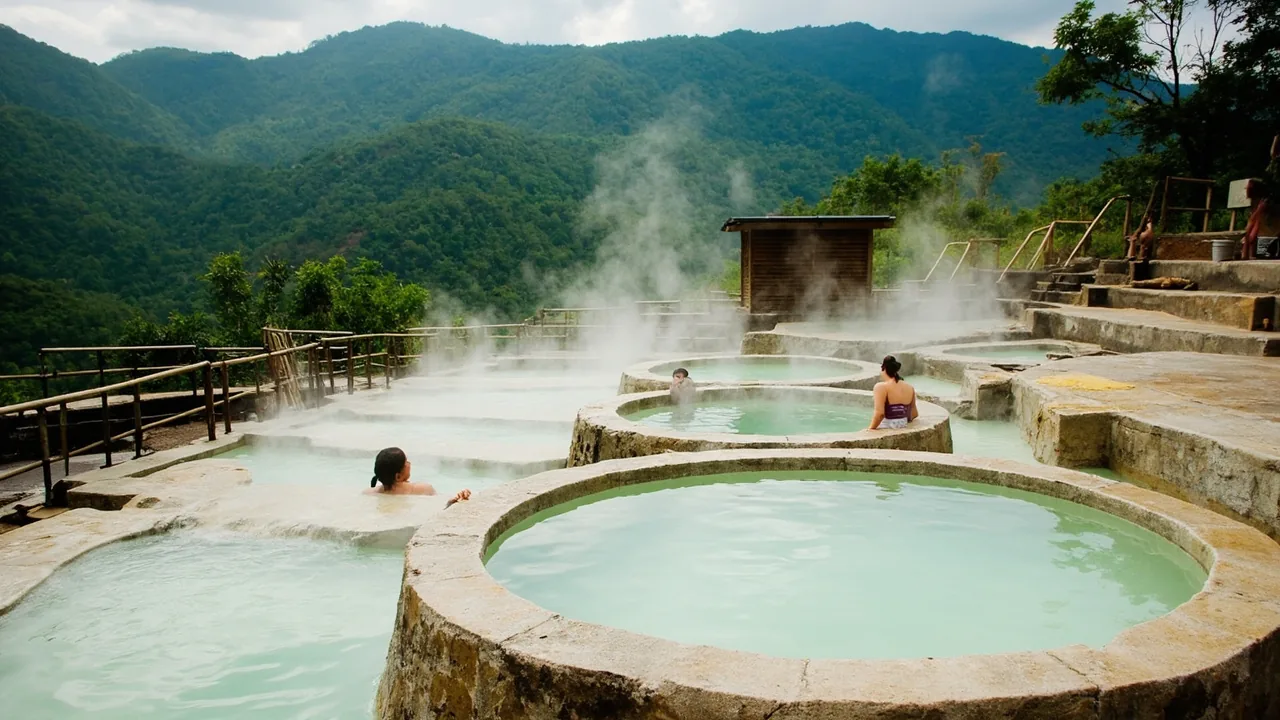
The hot springs sit about 8 km west of town, up a side valley. There are two distinct experiences here, and they have completely different price tags.
Option A. Free, the river. Just past the paid pools, walk 200 metres upstream to where the hot water flows into the river. Locals have built low stone walls and bamboo platforms here. The water is genuinely hot (around 60°C at the source, cooled by the river mixing to a comfortable soak temperature). Entry is free, no facilities, bring your own towel. This is what most backpackers use.
Option B. Paid pools (the resort). The first thing you reach when you arrive is the commercial hot springs resort with three tiered pools and a basic restaurant. Entry is ₹287 (~100 THB or ~$2.97) per person, and you can soak all day. Clean bathrooms, a small cafe, lockers. Worth it if you’re tired or want a guaranteed-clean pool. But the water is the same volcanic source, just chlorinated.
Getting there from town: 8 km, easily done by motorbike (rentals in town are ₹574-₹861 (~200-300 THB or ~$5.94-$8.92) per day). A motorbike taxi will take you and bring you back for about ₹717 (~250 THB or ~$7.43) round-trip. Songthaews also pass the turn-off for a few baht if you don’t want to ride.
Subodh’s Pro Tip: Go in the evening, around 5 to 7 PM. The afternoon heat has passed, the steam rising from the river pools is beautiful in low light, and you’re soaking while the sun sets behind the limestone cliffs. Mornings are quieter but the contrast between hot spring and cool air is the whole point.
Where to Stay in Chiang Dao
Chiang Dao has a small, slow-pace accommodation scene. There are no big hostels, no resort chains, and that is exactly the point. Most places are family-run guesthouses or bungalow-style retreats set back from the road.
For Indian backpackers on a budget, the honest reality is that dorm-style hostels barely exist here. Chiang Dao is a couples-and-quiet-travellers destination. The closest equivalent to a dorm is a fan room in a family-run guesthouse for ₹861-₹1,434 (~300-500 THB or ~$8.92-$14.86) per night. If you need a true hostel-style setup with mixed dorms, the closest one is back in Chiang Mai, so budget an extra night there.
For mid-range comfort, bungalows with a mountain view and AC run ₹2,295-₹4,304 (~800-1,500 THB or ~$23.78-$44.58) per night. December to February fills up; book ahead through the standard booking sites or directly with the property on WhatsApp.
A real Chiang Dao-style stay is one of the wood-and-bamboo bungalow resorts set into the valley sides, where you wake up to fog over the rice paddies and the limestone peak above. Travellers consistently rate these as some of the most peaceful places to stay in northern Thailand.
What to Eat in Chiang Dao
Chiang Dao is small, so the food scene is concentrated along the single main road through town. Travellers looking for Indian food will not find a dedicated Indian restaurant here, and the area’s vegetable supply is heavily dependent on what the Hmong and Lisu hill-tribe farms are growing that week. For vegetarian Indian travellers, the practical move is to stock up on ready-to-eat snacks in Chiang Mai before arriving and treat Chiang Dao as a place to try local northern Thai food at non-veg-friendly spots (most Thai restaurants here will do a veggie version of a stir-fry or a fried-egg dish if you ask).
The standout food stop is TATA Chiang Dao Cafe and Farm, a farm-to-table cafe with a vegetable garden out back and a short menu that changes with what’s in season. Travellers rate the experience as much as the food: good coffee, friendly service, a quiet garden setting, and a working farm you can walk through. Set lunch here runs ₹430-₹717 (~150-250 THB or ~$4.46-$7.43) and is one of the best meals in the valley.
Chiang Dao Weather and Best Time to Visit
Chiang Dao sits at 500 metres elevation, which gives it measurably cooler nights than Chiang Mai, especially in the cool season.
November to February (cool season): Days are warm and dry (25 to 30°C), nights drop to 8 to 12°C. Bring a light jacket. This is peak season and the best time for both the caves (no rain seeping in) and the hot springs (cold air makes the soak feel twice as good).
March to May (hot season): Days climb to 35°C, but the air is dry and the limestone peak acts as a wind tunnel. Hiking is uncomfortable. Hot springs are less appealing when the air is already 33°C.
June to October (monsoon): Heavy rain, mostly in the evenings. The Thailand monsoon guide explains the wider seasonal pattern. The cave partially floods during the worst storms (the national park closes access for safety). Hot springs still work but the river is muddy. Skip this period if caves are a priority.
The shoulder months (October and March) are the best balance: lower prices, fewer tourists, and weather that is workable for both the caves and the springs.
Other Things to Do Near Chiang Dao
Doi Luang National Park hiking. The Chiang Dao peak is one of Thailand’s most protected mountains. There are multiple-day hiking routes up to the summit, but they require a Thai-language guide and cost ₹4,304 (~1,500 THB or ~$44.58) plus per day. For most backpackers a half-day nature walk around the lower elevations is enough.
Hill-tribe villages. The Lisu, Hmong, and Karen villages on the slopes around Chiang Dao run day-visit programs where you can stay overnight, learn weaving, and eat family-cooked meals. Book through Chiang Mai tour operators, not through Chiang Dao guesthouses (they will mark up the same tour).
Wat Tham Pha Plong. A forest temple built into the limestone cliffs above town. Free entry, a real meditation centre (mostly Thai), and a steep staircase that rewards you with a valley view.
Getting Connected (SIM & Data)
AIS and TrueMove both have shops on the main road through Chiang Dao town. A 7-day tourist SIM with 50 GB costs around ₹717 (~250 THB or ~$7.43). Coverage on Highway 107 north of town is fine; if you plan to hike the limestone peak, expect dead zones above 1,000 metres. If you’d rather arrive with data already working, Get Nomad eSIM and you’ll have 4G the moment you land in Chiang Mai.
When NOT to Visit
Skip Chiang Dao in August and September specifically. Two reasons: the cave floods partially or fully closed during heavy storms, and the monsoon makes the hot springs river look like a brown soup rather than a clear pool. Travellers who arrive in those months usually leave disappointed.
Also, late December to early January is packed with Thai domestic tourists (Thai New Year / Songkran spillover for some, holiday travel for others). Book transport and accommodation at least a week ahead.
Safety & Border-Crossing Notes
Chiang Dao does not sit on an international border, so there is no passport control to worry about. For Indian travellers, the standard Thai visa-free 60-day entry applies. Make sure you have completed the TDAC digital arrival card (https://tdac.immigration.go.th) before flying into Bangkok or Chiang Mai. No fee, takes under five minutes.
For general Thailand safety, check the official MEA travel advisory at mea.gov.in before departure, and review Thailand’s own government travel page for any current advisories affecting the northern provinces. The Chiang Dao valley itself is consistently rated as one of the safer parts of northern Thailand for foreign visitors.
FAQ
Can I do Chiang Dao as a day trip from Chiang Mai? Yes, and most backpackers do. The morning minivan at 7 AM gets you there by 8:30, you have a full day for the cave and hot springs, and the 4 PM return bus gets you back to Chiang Mai by 6 PM. One night lets you catch the sunset hot-spring moment and the morning fog over the limestone peak, both worth the extra day if your schedule has flexibility.
Do I need a guide for the Chiang Dao Cave? Yes, the Thai national park requires one for the lit section. Guides are at the entrance, cost ₹287 (~100 THB or ~$2.97) per group, and speak basic English. You cannot walk the cave alone.
Are the Chiang Dao hot springs hot? Yes. The source water is around 60°C, which the paid pools cool and the river mixing brings to soakable temperature. In the cool season (December to February) the contrast between the cold mountain air and the hot pools is the whole point of coming.
Is Chiang Dao safe for solo female Indian travellers? Travellers report consistently good experiences. The valley is small, the tourism is low-key, and the few hostels and guesthouses here are used to solo travellers of all backgrounds. Use the same night-safety common sense you would in any Thai town: don’t walk alone after 10 PM outside your guesthouse, use a registered taxi or Grab if available.
How much cash should I bring? Bring enough Thai baht for 2 to 3 days. Most guesthouses, the cave, the hot springs, and the cafes in town are cash-only. There is one ATM in the centre of Chiang Dao town (Krungsri/Ayudhya bank) that accepts Indian debit cards through the Cirrus/Maestro network, but it charges a ₹631 (~220 THB or ~$6.54) foreign transaction fee per withdrawal, so take out the maximum you can per swipe.
Can I go to Chiang Dao from Pai instead of Chiang Mai? Yes, and the road from Pai through the mountains is one of the most scenic in northern Thailand. There is no direct public transport; the practical option is to hire a songthaew or motorbike taxi from Pai to Chiang Dao (around ₹3,443 (~1,200 THB or ~$35.67) for the car) or ride the motorbike yourself over the Tham Lod mountain pass. Allow 2.5 to 3 hours.
Subodh’s Take
Chiang Dao is the kind of place backpackers either love or feel underwhelmed by, and the difference usually comes down to expectations. If you’re comparing it to Pai’s nightlife or Chiang Mai’s cafes, it will feel quiet to the point of boring. If you’re comparing it to nothing, the limestone peak at sunrise and the river hot springs at sunset are some of the best things in northern Thailand. Plan at least one night, go to the caves early, soak in the river pools at dusk, and let the mountain do the rest.
