Chiang Rai to Luang Prabang: How to Get There (2026)
📍 Distance: ~470 km overland via Chiang Khong → Huay Xai ⏱️ Fastest option: ~4 hours (Chiang Rai → Chiang Mai flight, then fly to Luang Prabang) 💰 Cheapest option: ~₹5,451 (~1,900 THB or ~$56.47) by local bus + slow boat ✅ Best option: Chiang Rai → Chiang Khong bus, overnight in Huay Xai, two-day Mekong slow boat to Luang Prabang.
This is the corridor that turns a backpacking trip into a story. You cross the Mekong into Laos by longtail boat, sleep in a town where Indian restaurants outnumber ATMs, then wake up and trade wheels for a wooden slow boat that drifts two days downriver past villages, kids on the bank, and the same green water you watched from the Thai side the night before. It is not fast. It is not luxurious.
The slow boat + border route is the only option on this list that gives you a Mekong sunrise, but it is not the only way from Chiang Rai to Luang Prabang. Direct flights, a Chiang Mai connection, even an overland sleeper bus exist if your schedule is tighter than your budget. Below: every realistic option, the border paperwork for Indian passport holders, and the one month this route breaks in. For travellers planning further downstream after Luang Prabang, our Luang Prabang to Vang Vieng guide covers the next leg. If you are mapping the wider Southeast Asia overland grid, our Cambodia border crossing from Chau Doc guide covers a neighbouring Mekong crossing.
Quick Answers
| What | Answer | Price (INR) |
|---|---|---|
| Cheapest door-to-door option | Local bus Chiang Rai → Chiang Khong, tuk-tuk to border, slow boat Huay Xai → Luang Prabang (2 days) | ~₹5,451 (~1,900 THB or ~$56.47) + ₹2,031 (~470,000 LAK or ~$21.04) |
| Best overall experience | Same slow boat route, in a guided group with hotel pickup | ~₹15,780 (~5,500 THB or ~$163.47) all-in |
| Fastest option | Fly Chiang Rai → Bangkok → Luang Prabang (1 stop) | ~₹18,648 (~6,500 THB or ~$193.19) |
| Border visa-on-arrival fee (Indian passport) | ₹3,861 (~40 USD) flat fee for Indian passports | ₹3,861 (~40 USD) |
| Border post operating hours | Thai side Chiang Khong: 06:00–22:00. Lao side Huay Xai: 07:00–19:00 (last entry ~17:30) | , |
Option 1. Cheapest: Local Bus + Slow Boat (Do It Yourself)
This is the route most backpackers take, and it costs about a quarter of what a tour charges. Chiang Rai to Chiang Khong is roughly 155 km north, served by Greenbus and Sombat Tour from the Old Arcade bus station in central Chiang Rai. For context on the broader Thai overland network, see our Bangkok to Chiang Mai guide. Buses leave every hour or so through the morning, the air-con works, and the fare is ₹430 (~150 THB or ~$4.46) for a regular seat or ₹717 (~250 THB or ~$7.43) for the first-row VIP upgrade that gives you actual legroom. Buy the ticket at the counter, not from anyone who approaches you at the station door with a “the bus is leaving now” line, that is the Chiang Rai version of a commission scam and it is older than the backpacker trail itself.
Chiang Khong is the small Thai town on the Mekong bank directly across from Huay Xai in Laos. From the bus station, a tuk-tuk to the Thai immigration post is ₹143 (~50 THB or ~$1.49), or ₹86 (~30 THB or ~$0.89) if you walk the 1.5 km with your bag. The Thai side exit stamp takes about ten minutes on a normal day. A longtail boat across the Mekong to Huay Xai is a flat ₹143 (~50 THB or ~$1.49) per person plus a ₹57 (~20 THB or ~$0.59) “service fee” that is technically optional but rarely waived; agree on the price before you step in.
On the Lao side, you land at the Huay Xai immigration pier. Indian passport holders get a visa-on-arrival here. Bring a passport photo, ₹3,861 (~40 USD) cash, and a pen, the form is fillable at the kiosk. The whole process from dock to stamped-in takes 30–60 minutes when the boat queue is short, longer in November–February peak season.
You then stay overnight in Huay Xai (basic guesthouses from ₹346 (~80,000 LAK or ~$3.58), nicer rooms from ₹648 (~150,000 LAK or ~$6.71)), and board the slow boat the next morning. Tickets are sold at the Huay Xai pier the day before or morning of, with the standard 2-day option costing ₹2,031 (~470,000 LAK or ~$21.04) per person including a basic lunch on day one and a packed lunch on day two (for the full river-day breakdown, see our Huay Xai to Luang Prabang slow boat guide). The boat departs around 09:00–10:00, pulls in to Pakbeng overnight (you arrange a guesthouse there separately, from ₹346 (~80,000 LAK or ~$3.58)), and reaches Luang Prabang around 16:00 the next day.
Total door-to-door, do-it-yourself cost: roughly ₹5,451 (~1,900 THB or ~$56.47) for the Thai transport and Mekong crossing combined, plus ₹2,031 (~470,000 LAK or ~$21.04) for the slow boat ticket, plus roughly ₹693 (~160,000 LAK or ~$7.17) for one guesthouse night in Huay Xai and another ₹693 (~160,000 LAK or ~$7.17) for one in Pakbeng, for a total of about ₹8,868 (~$91.87) for the whole corridor.
Subodh’s Pro Tip: Exchange Thai baht for Lao kip on the Lao side, not before you cross. The Chiang Khong exchange booths give roughly 1 THB = 240 LAK; the same rate in Bangkok is 1 THB = 220 LAK. The 20 LAK difference on every 1,000 THB you change is a free ₹574 (~200 THB or ~$5.94) dinner.
Option 2. Best Experience: Guided Group Slow Boat
The slow boat itself is identical whether you do it DIY or with a tour. The difference is everything around it. A guided package picks you up from your Chiang Rai hostel, handles the Chiang Khong bus, queues at the border for you, books the Huay Xai guesthouse in advance, and gives you a guaranteed seat on the upper deck of the slow boat. On a DIY day, you might land in Huay Xai at 15:00 and find every guesthouse full because three overland trucks from Chiang Mai also arrived. On a guided day, your room is ready and a cold Beerlao is waiting.
Operators running this exact Chiang Rai → Luang Prabang package include several well-reviewed Chiang Mai-based agencies that send vans down to Chiang Rai for pickups, plus Chiang Rai’s own local agencies. Prices in 2026 sit between ₹15,780 (~5,500 THB or ~$163.47) and ₹21,518 (~7,500 THB or ~$222.91) per person depending on whether the Pakbeng overnight is a guesthouse, a “lodge” (better), or a “luxury boat” cabin upgrade. The middle tier, around ₹17,788 (~6,200 THB or ~$184.27), is the honest sweet spot: same boat as everyone else, a private room in Pakbeng with hot water, and a small group of 8–12 people instead of 30.
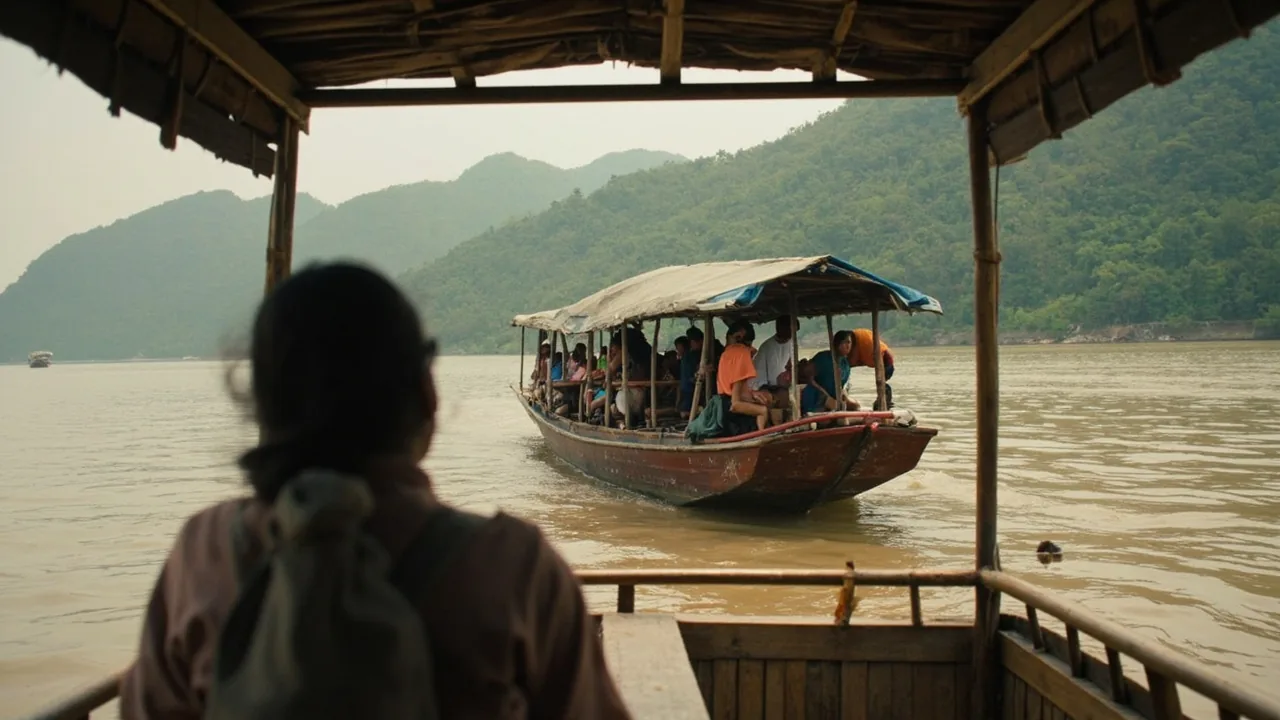
The slow boat experience itself is the same regardless. You sit on a wooden bench under a tin roof, the Mekong drifts past at walking pace, villages on either bank wave or ignore you, and at lunch the boat stops at a riverside village selling laap and sticky rice to slow boat passengers. The food is unremarkable and the beer is cold. It is the most photographed two days on the Southeast Asia backpacker trail and the reason the corridor still exists in 2026 when there are two daily flights that would cover the same distance in forty minutes.
Subodh’s Pro Tip: The slow boat is the one piece of the trip people still talk about six months later. The flight gets you there; the boat is why you went.
Option 3. Fastest: Fly Chiang Rai → Bangkok → Luang Prabang
There is no direct flight from Chiang Rai to Luang Prabang. Anyone selling one is routing you through Bangkok (BKK or DMK) or, less commonly, through Chiang Mai. The fastest practical routing in 2026 is Lao Airlines or Bangkok Airways Chiang Rai (CEI) → Bangkok (BKK) → Luang Prabang (LPQ), with a connection time of around 4 hours built in. Total flight time including the layover: about 6–7 hours door to door, versus about 50 hours for the slow boat.
Price is ₹17,214-₹27,256 (~6,000-9,500 THB or ~$178.33-$282.36) one-way depending on how far ahead you book and whether you grab a promotional fare on Bangkok Airways (which operates the CEI. BKK leg alongside Nok Air and Thai VietJet). Bangkok Airways sometimes drops the CEI. BKK leg to ₹7,173 (~2,500 THB or ~$74.30) if you book two months out; the BKK. LPQ leg with Lao Airlines is consistently ₹12,911-₹20,083 (~4,500-7,000 THB or ~$133.75-$208.05).
The honest case for flying: if you have less than a week in this region, the slow boat eats half of it and you arrive in Luang Prabang exhausted and sunscreened into regret. The slow boat makes sense as a deliberate choice, not as something you grit through because you read about it on a blog. If you do fly, comparing the two legs separately across airline sites (Bangkok Airways for CEI→BKK and Lao Airlines for BKK→LPQ) is usually cheaper than any third-party bundle.
SafetyWing Moment: Flights booked 14 days apart count as two separate international trips to most insurers. Make sure your plan covers both legs.
How to Get There. At a Glance
| Mode | Duration | Price | Operator | Book |
|---|---|---|---|---|
| Slow boat (2 days) + bus | ~50 h door to door | ~₹5,451 (~1,900 THB or ~$56.47) + ₹2,031 (~470,000 LAK or ~$21.04) DIY / ₹17,788 (~6,200 THB or ~$184.27) guided | Local Greenbus + Mekong Slow Boat | Book at Huay Xai pier |
| Sleeper bus Chiang Rai → Luang Prabang | ~19 h | ₹6,854 (~71 USD) | Book on 12go | |
| Flight (1 stop via BKK) | ~7 h | ₹17,214-₹27,256 (~6,000-9,500 THB or ~$178.33-$282.36) | Lao Airlines + Bangkok Airways | Book direct with airline |
Note: Check 12go.asia for the current operator list for this route.
The sleeper bus row is worth flagging because competitors treat it as the “just don’t do the slow boat” option. In practice it is gruelling, leaves from a small Chiang Rai depot in the middle of the night, crosses the same Chiang Khong. Huay Xai border but at 02:00 with nobody around to help, and arrives in Luang Prabang with most passengers regretting it. It exists; it is not recommended.
Border Crossing: Chiang Khong → Huay Xai
This is the only overland border crossing on the Chiang Rai. Luang Prabang corridor that matters. The Thai side is the Chiang Khong immigration office ( ด่านตรวจคนเข้าเมืองเชียงของ), about 2 km from the bus drop-off. The Lao side is the Huay Xai international port, where the slow boat pier and immigration are co-located.
The process, step by step:
- Walk into Chiang Khong Thai immigration with passport and a printed onward ticket (your slow boat confirmation or a screenshot works).
- Get exit-stamped (5–10 minutes).
- Walk 300 m to the Mekong pier, take a longtail boat across (~50 THB + 20 THB “service”).
- On the Lao side, walk past the touts into the immigration hall.
- Pay visa-on-arrival fee: ₹3,861 (~40 USD) for Indian passports in cash, plus a ₹86 (~20,000 LAK or ~$0.90) “processing fee” that is sometimes waived if you carry exact change.
- Submit passport + photo + filled form, get Lao visa pasted in (10–20 minutes).
- Get entry-stamped and walk out to Huay Xai town.
Money exchange on the Lao side: there are three counters at the Huay Xai immigration pier, all offering similar rates. The ATMs are BoP and BCEL, both charging a ₹86 (~20,000 LAK or ~$0.90) foreign-card fee per withdrawal on Visa/Mastercard. Wise card holders can withdraw up to ₹2,872 (~1,000 THB or ~$29.79) equivalent per swipe with no fee. Bring USD cash for the visa either way.
Scams to watch for:
- “Visa is closed today”, untrue. The Lao visa-on-arrival window at Huay Xai closes around 17:30, not at lunchtime.
- A “faster” immigration line run by a man with a clipboard. There is no faster line. Pay at the official counter.
- Longtail boat drivers quoting ₹287 (~100 THB or ~$2.97) per person. The official price is ₹143 (~50 THB or ~$1.49).
Total time, dock to stamped-in: 30 minutes on a quiet day, up to 90 minutes in November–February peak season.
Safety Alert: Do not photograph the Lao immigration hall or the officials inside. The Chiang Khong Thai side is fine. The Huay Xai side is not, and Indian passport holders in particular attract more scrutiny than the average backpacker here. Phones away while inside.
Indian Passport Specifics
Indian passport holders get visa-on-arrival at Huay Xai. The fee tier in 2026 is ₹3,861 (~40 USD), which is the Southeast Asian standard. The visa is valid for 30 days and can be extended once in Vientiane for an additional 30 days at a fee of ₹193 (~2 USD) per day.
Documents required beyond your passport:
- One passport-sized photo (4x6 cm or 3.5x4.5 cm both work; the kiosk has a printer if you forget, but it’s ₹86 (~20,000 LAK or ~$0.90) extra)
- A printed or screenshot proof of onward travel, your slow boat booking confirmation is enough
- ₹3,861 (~40 USD) cash in good condition (no torn bills, no pre-2006 series)
- A pen
The Lao Embassy in New Delhi issues tourist visas in 3–5 working days if you want to skip the on-arrival queue, but for this corridor the on-arrival queue is short enough that pre-arranging rarely pays off.
Indian currency (INR) is not exchangeable at the border. Bring USD or Thai baht. Indian debit cards frequently fail at BoP/BCEL ATMs in Pakbeng, so withdraw what you need before the slow boat leaves.
Subodh’s Pro Tip: The Huay Xai immigration hall has no air-con. In April it is genuinely uncomfortable. If you are travelling in the hot season, time your border crossing for the morning when the line moves faster and the building is cooler.
Where to Stay in Luang Prabang (One Night to Break Up the Journey)
If the slow boat is your plan, your first night in Luang Prabang is on the town, not the river. The two hostels below are the ones Indian backpackers end up at most, both within walking distance of the night market and the slow boat arrival pier.
| Hostel | Rating | Why | Book |
|---|---|---|---|
| Mad Monkey Luang Prabang | 9.36 | Pool, bar, the cleanest hostel in town. Slightly louder than the rest. | Check prices |
| Luangprabang Sunset Hostel | 9.26 | Quieter, family-style, walking distance to the Mekong sunset viewpoint at Phousi. | Check prices |
| Both are bookable through the same Stay22 engine that routes to Hostelworld and Booking. Book ahead in November–February; Luang Prabang fills up and walk-ins pay 30% more. |
What to See in Luang Prabang (When You Arrive)
Most travellers get off the slow boat, dump their bag at the hostel, and walk to the night market. That is the right instinct. Beyond the obvious, three spots earn the half-day each.
Luang Prabang is a UNESCO World Heritage city, which means the temples are real, the architecture is intact, and the town feels like a smaller version of the Chiang Mai you just left, except with French colonial balconies and the Mekong running through it. Most travellers give it two full days. Three is the right answer if you have them.
Wat Phra Kaew is the famous temple that housed the Emerald Buddha from 1354 to 1779 before the Siamese army took it to Bangkok, where it still is. The temple is now a museum and one of the most underrated stops in town. Most of the backpacking crowd walks past to get to the bigger temples. They are wrong; this one is worth 30 minutes.
Wat Sibounheuang is the lesser-known temple with unusual Lao architecture, sitting down a quiet lane most tour groups skip. Almost no tourists, donations welcome, the kind of spot where you end up sitting on the temple floor longer than you planned. The opposite of the Royal Palace in terms of crowds.
Where to Eat (Before You Leave Chiang Rai)
Two nights in Chiang Rai on the way out is enough time to eat well before crossing the border. These are the spots worth a deliberate stop.
IROHA Ramen & Izakaya Chiang Rai is a Japanese ramen and small-places place with a 4.9 rating, the kind of spot where you walk in for a ₹1,004 (~350 THB or ~$10.40) tonkotsu and end up staying two hours over yakitori and a highball. It is one of the few Chiang Rai restaurants where the food matches the rating.
Kunda Vegetarian Vegan Burger Cafe Chiang Rai is the city’s best plant-based stop, the answer to the “I have eaten rice for nine meals in a row” problem. Burgers from ₹516 (~180 THB or ~$5.35), smoothies from ₹344 (~120 THB or ~$3.57), and a genuinely chill vibe that makes it the easiest veg-friendly meal in the province.
Subodh’s Pro Tip: Eat lunch in Chiang Rai before you bus north. There is nothing open between 14:00 and 17:00 along the Chiang Rai → Chiang Khong highway, and the Chiang Khong night market is more drinking than eating.
When NOT to Take This Route
June through September. The Mekong rises, the slow boat gets cancelled on short notice when water levels drop too low for the boat to clear the Mekong shoals near Pakbeng, and the Chiang Rai → Chiang Khong highway is prone to landslides during heavy rain. Travellers who come in late August often end up flying anyway after a two-day bus delay, having spent more money and more time than the flight would have cost.
Late March through early May. Smoke season. The northern Thai burning season fills the air with a haze that makes the slow boat a half-day of coughing into a wet bandana. The slow boat still runs but the Mekong views disappear behind 500 m of particulate.
The right month to take this route: November, when the water is high, the air is clear, and the slow boat runs on schedule every single day. February is fine. March is borderline. April and August are the months to fly.
Safety Alert: Before departure, check both the Indian MEA travel advisory for Laos (mea.gov.in) and the Lao government’s own tourism advisory for any updates on the Huay Xai crossing. Travellers report occasional short-notice closures of the Lao immigration pier during Lao New Year (Pi Mai, mid-April) for two to three days.
Getting Connected
Coverage on the slow boat itself is patchy. AIS roaming works in Thailand, then drops to nothing the moment you cross the Mekong; the Lao side runs on Lao Telecom and Unitel, neither of which your Indian SIM touches without a roaming pack. Most travellers either buy a 1-week Lao SIM in Huay Xai town (₹432 (~100,000 LAK or ~$4.48) for 8 GB on Unitel) or skip the physical SIM and use an eSIM that activates the moment you cross. Get Nomad eSIM works on the Thai side, switches to a Lao carrier automatically at the border, and saves you the morning trip to a Huay Xai SIM stall.
FAQ
Can Indian passport holders take the slow boat from Huay Xai to Luang Prabang? Yes. The slow boat has no nationality restriction; you only need a valid Lao visa, which Indian passport holders get on arrival at Huay Xai for ₹3,861 (~40 USD).
Is the night bus from Chiang Rai to Luang Prabang safe? It exists and is technically operational, but travellers report border delays at 02:00 with nobody around to help, no working AC, and arrival in Luang Prabang exhausted. Most backpackers who try it once do not try it again.
How much cash should I carry for the border? ₹4,826-₹5,792 (~50-60 USD) is enough. ₹3,861 (~40 USD) for the Lao visa, ₹965-₹1,931 (~10-20 USD) for the first night in Huay Xai if your card doesn’t work, and the rest as float for the slow boat and Pakbeng.
Can I skip the Chiang Khong bus and take a songthaew? Yes, the Chiang Rai → Chiang Khong songthaews from the Khon Muang 1 Road departure point cost ₹574 (~200 THB or ~$5.94) per person and leave when full (usually within an hour). They are slightly slower than the bus but you skip the bus station walk.
Do I need a yellow fever certificate for Laos? No. Laos does not require a yellow fever vaccine certificate for Indian passport holders entering from Thailand.
What happens if my slow boat is cancelled for water levels? The operators refund the ticket or move you to the next day’s departure. There is no formal alternative by boat; the fallback is a minivan Huay Xai → Luang Prabang, which runs daily and costs around ₹1,210 (~280,000 LAK or ~$12.53), taking 9 hours over a rough road.
Subodh’s Take
The slow boat is not the cheapest option anymore (it has not been for a while) and it is not the fastest by any definition. It is the option that makes sense of the whole corridor. Chiang Rai, Chiang Khong, the Mekong crossing, the night in Huay Xai, the two days on the river, the Pakbeng stop, and Luang Prabang appearing at sunset on day two, each piece only matters because of the piece before it. The flight is a route. The slow boat is a trip. If you have the time, this corridor is worth spending one of your annual trips on.
