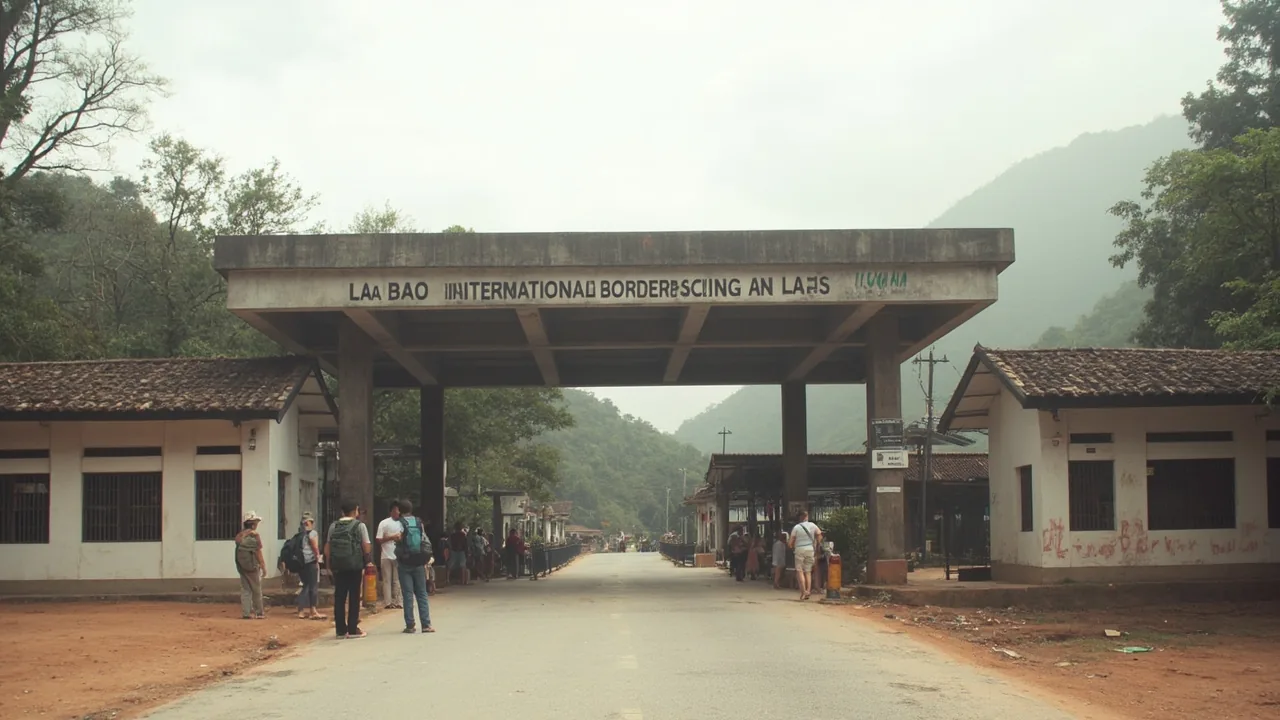
10 Common Scams at Laos Vietnam Border Crossing for Indian Backpackers (2026)
Most of the time the answer is yes. The Laos-Vietnam land border is one of the highest-density scam zones on the Southeast Asia backpacking trail, and Indian passport holders get hit harder than most because of one specific weak point: the Lao kip denominations are absurdly large, and almost no Indian traveller arrives familiar with them.
This guide is a logistics briefing, not a travel essay, and is grounded in the actual on-the-ground experience of crossing from Savannakhet, Vientiane, and the southern Lao Bao corridor into Vietnam. If you are planning a multi-country loop, our SEA backpacking hub covers routes, visas, and budget benchmarks for every country on this corridor. Every scam below has been reported by multiple travellers in the last twelve months.
Overview
📍 Most-used crossings: Lao Bao (Quang Tri) and Cau Treo (Ha Tinh) for central Vietnam; Nam Phao (Bor Tai) for Hanoi-bound buses ⏱️ Realistic border process time: 60-90 minutes if you know what you are doing, 3-4 hours if you don’t 💰 Total scam exposure (worst case): in overcharges + a fake “health check” of ₹482-₹963 (~5-10 USD)✅ Best defence: pre-booked e-visa, exact USD cash ready, zero kip in your wallet, no conversation with anyone outside the official building
Quick Answers
| What | Answer | Price (INR) |
|---|---|---|
| Do Indians need a visa for Vietnam? | Yes, e-visa mandatory. Apply online 3 days before travel. | ₹2,408 (~$24.95) |
| Can I pay the visa fee in kip? | No, USD cash only. | ₹2,408 (~25 USD) |
| What is the maximum Lao kip note? | notes are in circulation. | ~₹2,150 (~$22.27) per note |
| Is there a real “health check” at the border? | No. Anyone charging for one is scamming you. | $0 (legit) |
| Should I exchange money on the Laos side or Vietnam side? | Vietnam side, inside the bank, after immigration. | Better rate by 5-8% |
If a “helper” quotes you anything different from the fees in the table above, walk past them.
The 10 Scams, in Order of How Often Indians Get Hit
1. The “You Need a Health Check” Fee (Most Common)
A man in a white coat (sometimes just a clipboard) stands between the Lao exit stamp and the Vietnam entry building. He waves you down and says, in broken English, “Health check. Five dollar. Ten dollar. Mandatory.”
There is no health check. There has not been a mandatory health check at the Lao Bao, Cau Treo, or Nam Phao borders since before the pandemic. The clipboard is theatre. If anyone in a white coat asks you for money between immigration halls, keep walking and say nothing. Do not stop, do not explain, do not argue. They will not follow you past the official building entrance because they cannot operate inside.
It is the single highest-frequency scam on this corridor.
2. The Fake “Visa On Arrival” Agent
You arrive at the border, you have an e-visa already, and a smiling man says, “Vietnam visa? You need to pay me ₹3,853 (~40 USD), I fix for you.” You do not need to pay him. You already have your e-visa printed (you did print it, right?). Walk past.
The harder version: you did NOT pre-apply, and the agent tells you the official fee is ₹3,853 (~40 USD) or ₹4,816 (~50 USD). The actual official fee for the Vietnam e-visa is ₹2,408 (~25 USD), payable only on the official portal. There is no visa-on-arrival for Indian passport holders in 2026. If someone is offering to “process” your visa at the border, they are either running a scam or sending you to a sketchy website that will charge you ₹7,706 (~80 USD) for the same ₹2,408 (~25 USD) application. Apply at least 3 days before you travel, print the result, and the scam has no use.
See the full Vietnam e-visa process for Indian passport holders for the step-by-step.
3. Currency-Switching at the Money Changers
This is the one that hits Indians hardest because the Lao kip denominations look like Monopoly money to someone who has never seen them. You hand over a note. The changer palms it, hands you back a note and says, “This is what you gave me.”
The defence is mechanical: never hand over a note at a border changer. Put the bills on the counter, point to them, and wait for the changer to count them in front of you. Count the kip back yourself. Do this even if the changer is a sweet old lady with a Bible on the counter. Especially then.
A second version of the same scam: the changer quotes you a worse-than-market rate when the real rate is posted on the official portal. That spread is their profit on top of any legitimate commission. Change only what you need to get to the next ATM on the Vietnam side, and change it inside the official bank building, not from a roadside booth. Check the live rate before you cross with our INR to Vietnam currency exchange guide.
4. The “No Change” Over-Pricer
You hand over a note for a tuk-tuk or a bowl of noodles, and the vendor says “no change” and pockets the overpayment. This is not a misunderstanding of currency. It is theft with plausible deniability.
The fix is brutal and effective: carry small denominations. Specifically, ask your hotel or guesthouse in Vientiane or Savannakhet to break your large notes into 10,000 and 20,000 kip notes before you leave for the border. Most will do this for free if you are a guest. These denominations are the sweet spot for border-area purchases. Anything larger is a magnet for the “no change” trick.
5. Inflated Motorbike Fees on the Laos Side
You walk across the bridge, you see a row of motorbikes, and the first guy quotes you an inflated fare to ride to the next town. The same scam happens in reverse on the Vietnam side with dong.
Tuk-tuk and motorbike pricing on both sides of this border is non-standardised. Walk past the first three vehicles, talk to the fourth or fifth, and the price will usually halve. Travellers report that saying “too expensive, I walk” and starting to walk brings the quoted price down by 40-60% within thirty seconds. They would rather take a low fare than no fare.
6. The “Stamping Fee” / “Express Lane” Tax
This scam has two versions, both targeting the Lao exit stamp and the Vietnam entry stamp respectively:
Version A (Lao side): The immigration officer (someone standing next to him) hints that there is a “stamping fee” of or ₹482 (~5 USD) to get processed faster. There is no such fee. Lao exit stamps for Indians are free and take 2-3 minutes.
Version B (Vietnam side): A “helper” near the immigration hall offers to take your passport, skip the line, and get you processed in 5 minutes for $10-20. They will process you, but they will also pocket your passport and add a fake “fee” stamp inside, which can cause problems at your next border crossing. Never hand your passport to anyone other than the uniformed officer behind the counter.
The only fee at the Vietnamese immigration counter is your e-visa, which you already paid online. If anyone asks for more, it is a scam.
7. The “Bus Will Leave Without You” Pressure
You arrive at the border on a through-bus from Vientiane or Savannakhet (see the full Savannakhet to Hue route guide for timings and realistic costs). The bus drops you, the driver says “process fast, I leave in 30 minutes.” You panic. You rush through immigration, you skip counting your change at the money changer, you tip the fake health check guy, you accept the inflated motorbike because you just want to get back to the bus.
This is the master scam, the one that gets you all the others. The bus will not leave without you. Bus drivers cannot legally cross the border without their passengers. They will wait. Take 90 minutes at the border, not 30. Read every document you are handed. Count your change. Ignore anyone who tells you to hurry.
8. The “Lost Passport” Diversion
A genuine-looking person (often a woman with a clipboard) approaches you on the Laos side and says, “Did you lose a passport? Someone found one.” You say no, you have yours, and they ask to “check” it. The moment you hand it over, your passport is now in someone else’s hands inside a busy border zone, and the negotiation for its return begins.
Keep your passport in a zipped inner pocket or a money belt. Never show it to anyone who is not behind an official counter. If someone claims to have found a passport, the correct response is “no thank you” and to keep walking. Genuine lost-passport cases are handled at the immigration office, not by clipboard volunteers.
9. The “Hotel I Recommend” Commission Trap
You cross into Vietnam, you have not booked accommodation, and a friendly man at a motorbike says “I take you to good hotel, ₹482 (~5 USD).” He takes you to a hotel where the room is 50% above the going rate, and the ₹482 (~5 USD) you paid the driver is rebated by the hotel. You paid ₹482 (~5 USD) to be overcharged ₹963-₹1,445 (~10-15 USD).
The fix is the same as it is everywhere on the backpacking trail: book the first night in advance, even if it is just a hostel bed or a Hue guesthouse. The 10 minutes it takes to book on Booking.com saves you ₹1,927 (~20 USD) of commission fraud at every border on this corridor.
If you must walk in cold, walk in alone. Do not accept “hotel recommendations” from anyone who approached you first.
10. The Asymmetry Trick (Indian vs Local Pricing)
This is the one Reddit and TripAdvisor threads keep returning to, and it is worth naming explicitly because it is structural, not a single scam.
Border-area vendors across both Laos and Vietnam have one price for local faces and another, higher price for Indian, Western, and East Asian faces. A bowl of pho at the same stall is ₹92 (~25,000 VND or ~$0.96) for a Vietnamese customer and ₹184 (~50,000 VND or ~$1.91) for a backpacker. A motorbike from the border to town is priced at the local rate for a Lao rider and at double for you.
You cannot fix this with a script. You can only fix it by price-shopping at 2-3 vendors before committing, by asking your bus driver or guesthouse host what the local price is (they will usually tell you, out of self-respect), and by accepting that the first price you hear is rarely the real price. Travellers who have done this corridor before report that the price gap closes by roughly half once the vendor realises you have crossed this border more than once. The trick is to look like you have, even if you have not.
What to Carry (Border Day Checklist)
- Passport with printed e-visa result (paper, not just the email)
- ₹2,890-₹4,816 (~30-50 USD) cash in small denominations (₹482 (~5 USD)). The ₹2,408 (~25 USD) is technically enough for the visa you already paid, but bring $10 extra as a “no thank you” fund to buy your way out of any one scam without negotiation
- One small VND / LAK stash for the tuk-tuk on the other side. About or ₹736 (~200,000 VND or ~$7.64). Buy this at the official bank inside the immigration building, not from a roadside booth
- Phone with offline Grab app installed for the Vietnam side
- A local SIM or eSIM so you can call a real hotel if anything goes wrong
- Your bus company’s emergency number written on paper (not just in your phone)
Indian Passport Specifics
Vietnam in 2026 requires Indian passport holders to hold a valid e-visa before arrival. There is no visa-on-arrival counter for Indians at any land border, including the Lao Bao, Cau Treo, and Nam Phao crossings. The e-visa costs ₹2,408 (~25 USD), is valid for 90 days, allows multiple entries, and is processed on the official portal within 3 working days.
Laos, on the other hand, grants visa-on-arrival to Indian passport holders at most land borders for a fee of ₹2,890-₹4,046 (~30-42 USD) depending on nationality schedule. The Lao side of the border rarely scams Indian travellers on the visa itself, because the fee is regulated and the receipt is stapled into your passport. Where scams happen is on the “express processing” add-on, which is fake.
If something goes wrong on either side (a fake stamp, a missing passport page, a hostile officer), the Indian embassy in Vientiane handles Laos cases, and the Indian embassy in Hanoi handles Vietnam cases. Save the contacts before you leave Vientiane.
When NOT to Cross This Border
Monsoon season, roughly July to September: The road from Savannakhet to Lao Bao and the Cau Treo pass flood regularly. Landslides have closed the road for days at a time in past years. If you are flexible, cross in November to February when the road is dry and the smoke from the burning season has cleared.
Vietnamese Tet (late January / early February): The border effectively closes for 3-4 days. Travellers report being stuck on the Laos side with no food and no information. Plan to cross either well before or well after Tet.
Lao New Year (Pi Mai, mid-April): Offices are closed and the bus schedules collapse. Cross a week before or a week after.
For current conditions, check the Indian MEA travel advisory page (mea.gov.in) and the Vietnamese immigration portal (xuatnhapcanh.gov.vn) before you leave.
Getting Connected
Border corridors are patchy. You will have signal on the Laos side until about 20 km before the actual checkpoint, then nothing for 30-60 minutes around the border, then Vietnamese signal kicks in once you cross. A local Lao SIM is not worth buying for a 1-day crossing. A Vietnamese SIM on the other side is worth it if you are continuing into Hanoi or Hue.
FAQ
Can I pay the Vietnam visa fee in Lao kip? No. USD cash only. Bring ₹2,408-₹2,890 (~25-30 USD) in small USD notes for the e-visa fee you already paid online plus a small buffer.
Is the Lao Bao border open 24 hours? No. Most Laos-Vietnam land borders operate from 7:00 AM to 7:00 PM local time. Do not arrive at 6:00 PM expecting to process.
How much cash should I carry for the border day? About ₹2,890-₹4,816 (~30-50 USD) equivalent plus for the immediate tuk-tuk on the other side. Anything more is a target.
Can I avoid the fake health check by going to a different crossing? The scam is reported at all three main crossings (Lao Bao, Cau Treo, Nam Phao). Same pattern: ignore anyone in a white coat between the two immigration buildings.
What if someone has already taken my passport? Walk to the official immigration counter, ask for the duty officer, and refuse to negotiate with the person holding your passport. Do not pay a ransom. Report to the embassy on the same day.
Is the slow boat from Huay Xai to Luang Prabang a safer route into Laos? Different scam profile. The slow boat has its own issues (overpriced boat tickets, fake “deluxe” upgrades at the pier), but it is a different corridor. See the Mekong crossing guide if you are considering it. If you are heading south into Cambodia instead, the Ha Tien to Kep border crossing guide covers that route.
Subodh’s Take
The Laos-Vietnam border is not dangerous. It is just a place where a handful of organised scammers have figured out that tired, hurried, cash-carrying backpackers are an easy mark. Indian travellers are an especially easy mark because the kip denominations are disorienting and the cultural reflex is to be polite, which scammers read as “soft target.” Once you cross into Vietnam, the scam profile changes but does not stop — read our 12 things Indian tourists should avoid in Vietnam for the next set of traps. Walk through with a printed e-visa, ₹2,890 (~30 USD) in small USD notes, zero large kip notes, and the willingness to say “no” without smiling. You will be fine. Most of these scams collapse the moment you stop negotiating.
