Savannakhet to Hue via Lao Bao: Border Crossing (2026)
This is one of the few overland border crossings between Laos and Vietnam that does not involve a flight, a long detour through Vientiane, or a Mekong boat. You board a sleeper bus in Savannakhet, wake up at the Lao Bao / Dansavanh checkpoint on Route 9, walk across the bridge on foot, and catch a Vietnamese minivan on the other side that drops you in Hue. The whole thing is doable in a single long day if you leave early. For related planning, see our guides on Sea Backpacking Hub and Chiang Rai to Luang Prabang.
What trips people up is the visa situation on the Vietnamese side, the Lao immigration exit stamp, and a short stretch of road that floods in the wet season. This guide covers all of it, including what the Lao Bao visa-on-arrival process looks like for an Indian passport holder in 2026. You may also find Nong Khai to Vientiane useful for this trip.
Verified 2026-07-22. All rates, schedules, and visa fees in this article are current as of writing. Border procedures change more often than you think; check the official Lao immigration portal and the Vietnamese embassy in Vientiane before you leave. See also: Luang Prabang to Vang Vieng.
📍 Distance: 360 km door-to-door, Savannakhet bus station to Hue city centre ⏱️ Fastest option: 12 to 14 hours, sleeper bus plus border plus transfer 💰 Single-ticket option: ₹1,642 (~380,000 LAK or ~$17.01) ✅ Best option: Direct Savannakhet to Hue sleeper bus with Lao Easy Go Travel For related planning, see our guide on Nong Khiaw Laos Viewpoint Guide.
Quick Answers
| What | Answer | Price (INR) |
|---|---|---|
| Cheapest way from Savannakhet to Hue | Local bus to Lao Bao, walk across, shared minivan to Hue | ₹4,000 (~$41.44) |
| Most convenient single booking | Direct sleeper bus, Savannakhet to Hue, no transfer | ₹6,200 (~$64.23) |
| Vietnamese visa on arrival at Lao Bao | No, walk-in VoA is not issued for Indian passport holders; obtain an e-visa in advance (or, in theory, a sponsor-letter VoA at major airports only) | ₹2,300 (~$23.83) |
| Lao exit stamp fee | None, included in original visa | ₹0 |
| Total border-to-border time at Lao Bao | 45 to 90 minutes depending on queue | ₹0 |
The “Cheapest way” line is local bus + walk-across + minivan booked separately in cash at each side. The “direct sleeper” is the single-ticket option most travellers take. Both are realistic, both work, and the gap is about ₹1,700 (~$17.61).
Option 1: Cheapest (Local Bus, Walk Across, Minivan)
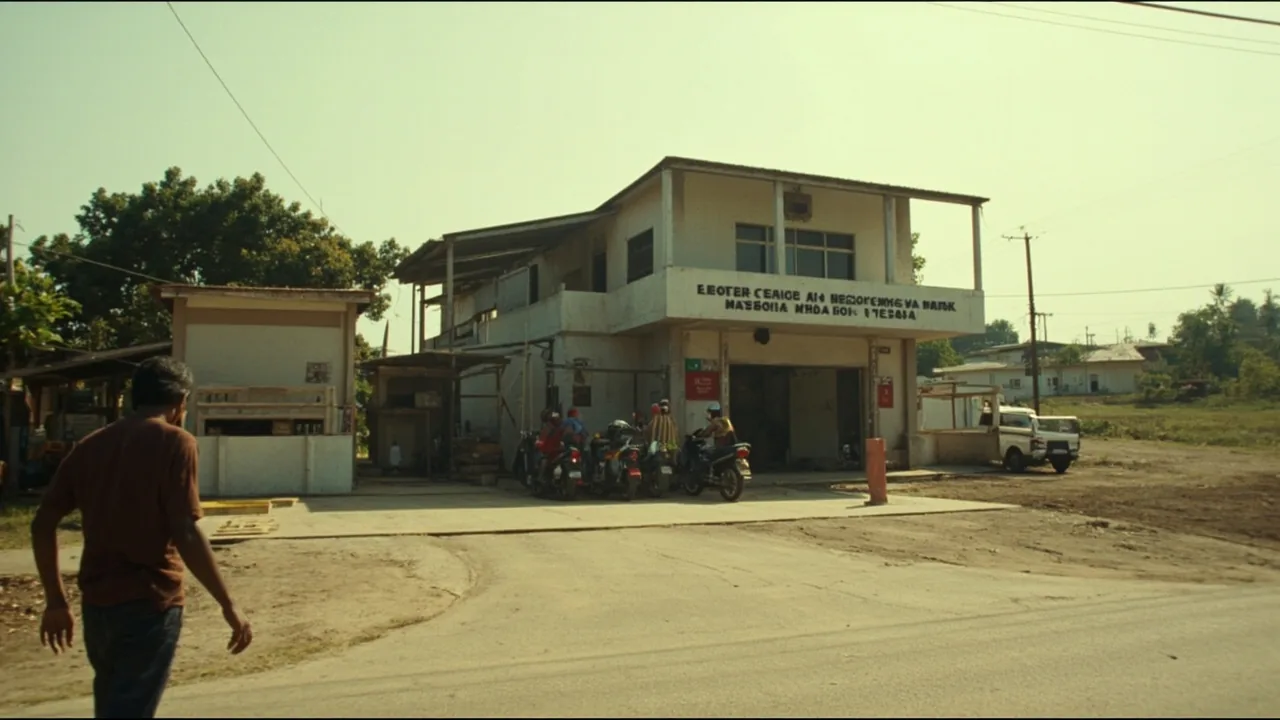
This is the version backpackers ran for years before the through-ticket became reliable. You take a Savannakhet local bus down Route 9 to the Lao Bao town bus stop, walk 2 km to the Lao Bao / Dansavanh border bridge, cross on foot, then negotiate a shared Vietnamese minivan from Dansavanh town to Hue.
The local bus from Savannakhet to Lao Bao town runs roughly every hour during daylight and costs around ₹259 (~60,000 LAK or ~$2.69). It is a regular seated coach, not a sleeper, and takes 3 to 4 hours depending on how many stops the driver makes. The road is sealed the entire way; the buses themselves vary from reasonable to alarming. Grab a window seat on the left for the Vietnamese side views as the road climbs toward the Annamite Range.
At the Lao Bao immigration window on the Lao side, you get your exit stamp and hand back any Lao exit forms. Standard Lao visa holders have no fee, the stamp is built into the visa. If you entered Laos visa-free for 14 days under the Lao exemption for Indian passport holders (introduced in 2024 and still running in 2026, with a fee of US $20 (~₹1,931) to US $40 (~₹3,861) depending on source), the exit is also free.
The walk across the old bridge is short, shaded, and you can see the Vietnamese flag from the Lao side. On the Vietnamese side, you do immigration again, this time as an entry. If you do not yet have a Vietnamese visa, the e-visa portal is the only practical way to get one before arrival. Walk-in visa-on-arrival at Lao Bao for Indian passport holders has been unreliable since 2023 and is officially discouraged by Vietnam in favour of the e-visa. Apply at least 72 hours ahead on the official Vietnamese immigration site. The current e-visa fee is US $25 (~₹2,413 at 1 USD = ₹96.5289), single entry, valid 90 days, multiple entry variant is US $50 (~₹4,826), also 90 days.
From the Vietnamese immigration hall, a shared minivan to Hue is usually waiting in the official queue. The fare is around ₹1,288 (~350,000 VND or ~$13.35) per person for a seat in a 12-seat van. Private transfer costs ₹5,522-₹7,362 (~1,500,000-2,000,000 VND or ~$57.20-$76.27) depending on how hard you bargain. Total border-to-Hue drive time is 3 to 4 hours.
Travellers report that arriving at the Lao Bao checkpoint before 11:00 local time dramatically reduces queue time. After lunch, a stream of Vietnamese trucks shows up and the immigration hall turns into a 45-minute affair.
Total cost for the cheapest path: ₹259 (~60,000 LAK or ~$2.69) + ₹1,288 (~350,000 VND or ~$13.35) + US $25 (~₹2,413) e-visa + small tuk-tuk money = roughly ₹4,000 (~$41.44) out of pocket.
Pros: Cheapest, flexible, you can stop in Lao Bao town for lunch and try the Vietnamese-influenced Lao food.
Cons: Three separate bookings, two currencies, two immigration processes on your own. If a connection breaks (no minivan waiting, slow immigration), you are stuck.
Option 2: Best Experience (Direct Sleeper with Lao Easy Go Travel)
For most Indian backpackers reading this, the right answer is the direct Savannakhet to Hue sleeper bus run by Lao Easy Go Travel. On 12go, the operator shows recent bookings and seat availability; traveller feedback on the route is generally mixed but acceptable for the price. Sleeper buses in this part of Southeast Asia are not luxury coaches. They are full-flat beds, usually clean, with a working toilet at the back and a driver who knows the road.
The bus departs Savannakhet bus station on Route 9 once daily, departure window between 17:00 and 19:00 depending on season. You board with your bags under the bus, the driver hands you a plastic bag (for shoes, not vomit, hopefully), and you find your assigned berth. The bus is split into lower and upper bunks. Lower is easier to get in and out of but louder from road noise. Upper is calmer but the climb is awkward with a 40L pack. Take lower if you have knee issues, take upper if you want to sleep.
Arrival at Lao Bao / Dansavanh border is around 04:00 to 05:00. The driver pulls up to the Lao immigration hall, you get off with your passport, walk through exit, walk across the bridge, walk through Vietnamese entry. The whole organised-crossing dance takes 30 to 60 minutes when it runs smoothly, longer if there is a queue. Most of the bus stays together, your luggage stays under the bus. After re-boarding on the Vietnamese side, the bus continues 3 to 4 more hours to Hue, dropping at the main bus station on the south side of the city, usually around 11:00 to 13:00.
Total cost: ₹1,642 (~380,000 LAK or ~$17.01) for the through ticket, plus US $25 Vietnamese e-visa. At 1 LAK ≈ ₹0.0043, that is roughly ₹6,200 including the visa.
Booking is straightforward. Compare prices on 12go and confirm the through bus code, not just a Savannakhet to Pakse sleeper you see listed in transit. The direct Savannakhet-Hue sleeper is a separate inventory on 12go.
Pros: One ticket, one payment, your bag stays on the bus, you wake up at the border and can doze back to Hue.
Cons: Hard sleeper, middle-of-the-night border stop, no flexibility if you want to spend a night in Lao Bao town (which is a decent stop, with cheap guesthouses and the Vietnamese-influenced market).
Subodh’s Pro Tip: Bring two things on this bus: a thin scarf or buff for the Lao air-con at full blast (the front half of the bus is freezing), and a 500 ml water bottle you refill in Savannakhet. The bus does not stop for water before the border.
Option 3: Fastest (Fly Lao Airlines from Savannakhet)
Strictly speaking there is one flight option: Lao Airlines from Savannakhet (ZVK) to a Lao hub, then onward to a Vietnamese city. The 12go inventory only lists a Savannakhet to Vientiane segment; from Vientiane you connect to Hanoi or Da Nang.
Cost: 1,200,000-2,500,000 LAK one-way depending on fare class. At 1 LAK ≈ ₹0.0043, that is ₹5,200 to ₹10,800 just to Vientiane. Add Vientiane to Hanoi or Da Nang (Lao Airlines has direct flights to both, around 1.5 to 2 hours), and total airfare climbs to between ₹12,000 (~$124.32) and ₹18,000 (~$186.47) one-way. Compare that to ₹6,200 (~$64.23) overland including visa, the flight makes sense only if your time is worth ₹10,000 (~$103.60).
There is no direct Savannakhet to Hue flight anywhere, not by Lao Airlines, not by Vietnam Airlines. So “fastest” here means a connection with total door-to-door time of 6 to 8 hours including airport transfers and Vietnamese visa-on-arrival at a major airport, where the e-visa queue is also faster than at Lao Bao on a busy day.
Compare prices on 12go shows the starting segment.
For most Indian backpackers on the Banana Pancake loop, the flight makes no sense. The sleeper bus saves you ₹6,000 (~$62.16) to ₹12,000 (~$124.32) and the only time you lose is 8 hours of actual travel versus 12 to 14 hours overland.
Border Crossing: Lao Bao / Dansavanh Step by Step
The official names: Lao Bao on the Lao side, Dansavanh (sometimes spelled Dansavane or Lao Bảo on Vietnamese maps) on the Vietnamese side. They are twin towns separated by a single bridge over the Sepon River (Sông Sê Pôn). The checkpoint is the only open international land crossing between Savannakhet and Đông Hà on Route 9.
Operating hours: 07:00 to 19:00 Lao time (which is ICT, same as Vietnam). Some travellers report the Vietnamese side staying open later for bus groups, do not assume a 22:00 crossing will work.
Step by step for Indian passport holders:
- Exit Lao Bao on foot from the Lao immigration hall. Standard passport, no exit fee.
- Walk across the bridge. About 5 minutes, shaded.
- Enter the Vietnamese immigration hall on the other side.
- Present passport with valid Vietnamese e-visa printout (or visa sticker if obtained via embassy in Vientiane).
- Officer stamps entry, takes photo if the system asks. Done.
Documents you must have: Passport with at least 6 months validity, Vietnamese e-visa printout (US $25 (~₹2,413), single entry, 90-day validity, apply at least 72 hours before travel via the official Vietnamese immigration site), proof of onward travel (a hostel booking in Hue, a bus ticket confirmation, anything), and proof of sufficient funds (rarely checked at land crossings, more common at airports).
Visa on arrival walk-in at Lao Bao: Officially, Vietnam does not issue walk-in visa-on-arrival at Lao Bao for Indian passport holders. The official VOA scheme is restricted to specific airports and requires pre-approval letters and pre-arranged sponsor. Travellers consistently report Vietnamese immigration at Lao Bao turning away Indian passport holders without an e-visa. Do not assume you can fall back to VOA here. Apply online in advance or skip the border.
Passport photos at Lao Bao: Per immigration.gov.la, even Lao visa extensions at the Lao side require 2 photos on the spot. Vietnamese immigration at Lao Bao has historically not asked for photos when an e-visa is presented, but carry 2 spare passport photos anyway. Vietnamese e-visa applications do not require a photo upload; you upload the digital passport photo embedded in the passport.
Money exchange: Both sides have money changers, but the Lao side has better rates for USD and Thai Baht. Some Vietnamese money changers at the border will exchange Lao kip for dong at a rough rate of around 1 LAK to 2.5–3 VND, rates are poor, so arrive with USD or Thai baht if you can. Do not expect good rates for Indian Rupees at the border. Bring US dollars or Thai Baht from Vientiane or Savannakhet.
Scams to watch: The two main ones are (a) “helpers” at the Lao immigration hall offering to fill out your exit form for ₹216 (~50,000 LAK or ~$2.24), polite decline; (b) Vietnamese drivers quoting inflated fares to Hue, agree on price before getting in the van. The ₹1,288 (~350,000 VND or ~$13.35) shared-van rate is the standard for 2026.
Typical time: 45 to 90 minutes total at the border on a normal morning. Up to 2 hours during Vietnamese National Day week (early September) when there are long weekend flows.
Indian Passport Specifics
- Vietnamese visa: Apply online via the official Vietnamese immigration portal at least 3 working days before you reach the border. Single-entry e-visa is US $25 (~₹2,413). Multiple-entry is US $50 (~₹4,826), also 90 days. Printout is required.
- Lao visa: Most Indian passport holders enter Laos on the visa exemption scheme introduced in 2024, valid for 14 days at any Lao checkpoint. If you want longer than 14 days, get a visa on arrival at Vientiane airport (US $40 (~₹3,861) for 30 days, US $55 (~₹5,309) for 90 days) or apply at the Lao embassy in New Delhi.
- Proof of onward travel: Carry your booked Hue hostel confirmation on your phone. Immigration at either side may ask. We have not seen anyone refused for lacking this, but the 30-second check that “yes, you have somewhere to go” is part of the routine.
- Indian embassy in Laos: New Delhi maintains the embassy in Vientiane at Ban Phonxay, Route 13 South, Saylom Road. Emergency line: +856 21 413 524. If you lose your passport at the Lao Bao border, this is who you call. There is no Indian consulate in Savannakhet.
When NOT to Take This Route
The single biggest variable is weather. Route 9 between Savannakhet and Lao Bao has been known to flood during the Lao wet season. In heavy rain years, August and September bring enough water to close sections of road for hours at a time. Vietnamese side, Route 1 north of Dong Ha into Hue can also see localised flooding in October typhoon flows.
If you are travelling in August or September, monitor the Lao Department of Meteorology and the Vietnam National Centre for Hydro-Meteorological Forecasting in the days before you cross. If there is heavy rain forecast for Savannakhet or Quang Tri province, delay a day.
The route passes through a section of Khammouane and Savannakhet provinces that has historically seen occasional security incidents, mostly related to drug trafficking on the Lao side. Travellers report no issues on Route 9 itself in 2026, but the corridor is not a place to hitchhike at night. Stay with the bus.
Border-side tensions in 2024 between Vietnamese and Lao authorities regarding a planned road realignment at the bridge have since been resolved, and the checkpoint operates normally. For any current safety updates before you cross, check the official Indian Ministry of External Affairs travel advisory at mea.gov.in and the Vietnamese government’s own advisory page.
Getting Connected
Mobile coverage on Route 9 between Savannakhet and Lao Bao is patchy. Unitel (Lao) coverage drops after Salavan, picks up again close to the border. The Vietnamese side has better Viettel coverage along the same road. Expect 30 to 60 minutes of dead zone on the Lao side after Salavan, then continuous Viettel once you cross.
If you want data the whole way, Get Nomad eSIM is the cleanest option. Coverage is regional across Southeast Asia and the eSIM activates before you board the bus. The physical SIM alternative is to pick up a Lao SIM in Savannakhet, use it for the first half of the route, then buy a Vietnamese SIM at the bus station in Hue when you arrive (Viettel counter is open into the afternoon).
Where to Stay in Hue
The sleeper bus drops at Hue’s main south-side bus station on Bùi Thị Xuân street, a short drive from most backpacker hostels. Hue is small enough that anything in the Pham Ngu Lao area is a 10 to 20 minute grab-ride away.
Backpacker hostels cluster in the Pham Ngu Lao area; browse current options on Hostelworld or Booking.com. Once you have dropped your bag, most of Hue is best explored by motorbike. The Hue to Hoi An corridor is one of the most scenic motorbike rides in Vietnam, and you can rent a 110 cc semi-auto for around ₹552 (~150,000 VND or ~$5.72) per day from rental shops near the citadel.
FAQ
Can I cross the Lao Bao border without an e-visa as an Indian citizen? No, walk-in visa-on-arrival is no longer issued to Indian passport holders at Lao Bao. Apply for the Vietnamese e-visa at least 3 working days before travel via the official Vietnamese immigration portal. US $25 (~₹2,413) single-entry, valid 90 days.
How much cash should I carry for the Lao Bao border crossing? Roughly US $50 (~₹4,826) equivalent in either Lao kip, Thai baht, or US dollars. Lao side kip is preferred, Vietnamese side dong is preferred. Foreign currency exchanges rates are fair at the Lao side money changers, poorer at the Vietnamese side. ATMs in Savannakhet and Hue are reliable for both LAK and VND.
Is the Savannakhet to Hue sleeper bus safe? Yes, the Lao Easy Go Travel direct sleeper has been running this route for years without major incidents. Buses are full-flat sleeper coaches. The middle-of-the-night border stop is the only unusual part, with your passport and luggage staying with you through the crossing.
What happens if I get sick or injured at the border? The closest hospitals are in Dong Ha on the Vietnamese side (45 minutes north) and Thakhek on the Lao side (4 hours east). For real emergencies, Hue Central Hospital is your destination. Carry a full travel insurance policy. Get SafetyWing travel insurance, covers Indian travelers from ~$62/month (~₹5,900). Includes COVID, trip interruption, and medical evacuation across Southeast Asia.
Do I need to print anything for the border? Yes. At minimum: passport with both visas (or visa + exemption confirmation), e-visa printout for Vietnam, proof of onward travel (hostel or bus booking), travel insurance confirmation. Border agents at land crossings occasionally check proof of onward travel even when the policy says it is optional.
What is the best month to do this route? February, March, and April are the driest months on Route 9. May and June are pre-monsoon, October and November are post-monsoon and a good second choice. Avoid August and September for the wet-season flood risk.
Subodh’s Take
This corridor looks harder than it is. The hardest part is not the bus, the border, or the visa, it is the gap between reading a dozen contradictory traveller reports about visa-on-arrival at Lao Bao and figuring out what happens at the immigration window. The reality in 2026: Vietnamese e-visa in advance, ₹2,413 (~25 USD) on the official portal, printout, walk across, get stamped. The bus is the easy part. Skip the flight unless you have an actual time crunch, the sleeper is half the price and twice the experience. If you have not done an overland border at night before, this is a reasonable first one: short, well-trodden, and you wake up on the Vietnamese side already rolling toward Hue.
