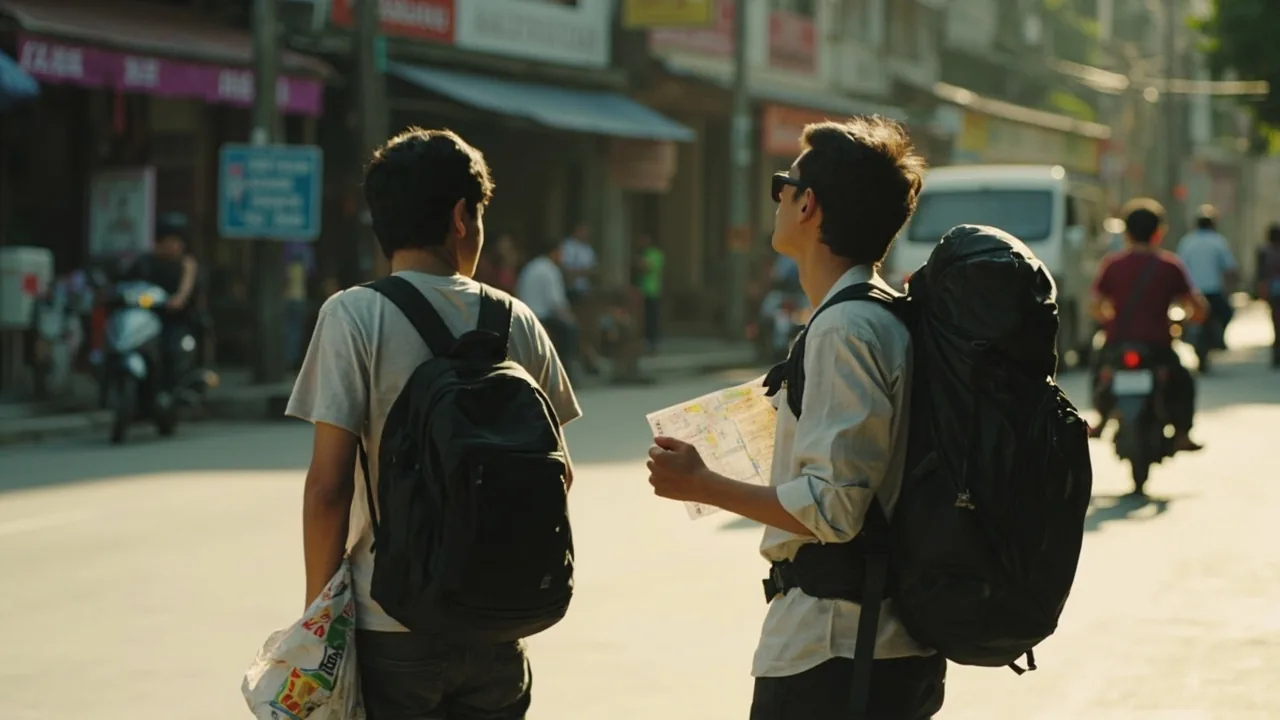
Backpacking vs Package Tour: Which Is Better for Indians?
Thai VoA fee cross-checked against the official Thai Immigration Bureau PDF (July 2026); hostel dorm prices from Mad Monkey and Lub d Bangkok booking pages (July 2026).
Backpacking vs tour package: backpacking costs about 30 percent less on any trip longer than 7 days, but a package tour removes every planning decision. The backpacking vs tour package choice for Indian travellers to Southeast Asia comes down to three things: your budget, your trip length, and how much planning you want to do before you fly. Both options work across Thailand, Vietnam, Laos, and Cambodia.
Neither option is objectively better. Indian travellers do both every month, and many who try a package tour on their first trip switch to independent travel for subsequent trips once the structure feels limiting. This article covers the per-category cost split, the four types of tour packages sold to Indian travellers, the 20 percent rule, and the one case where a package genuinely wins on value.
Quick Answers
| What | Answer | Price (Local / INR) |
|---|---|---|
| Average 7-day backpacking budget (Thailand. Vietnam. Cambodia) | What most Indian backpackers spend on a low-friction loop | ₹103,789 (~36,140 THB or ~$1,077) |
| Average 7-day package tour (mid-range, same route) | Same route, everything pre-booked | ₹134,498 (~46,830 THB or ~$1,395) |
| Cheapest package tour you can book from India | 4N/5D Thailand group departure from Mumbai or Delhi | ₹71,788 (~25,000 THB or ~$744.66) |
| Backpacker SIM (30 days, 4 countries) | Local SIM per country or regional eSIM | ₹2,410 (~25 USD) |
| Visa-on-arrival fee, Thailand | Single entry, 30 days (walk-up counter) | ₹7,173 (~2,500 THB or ~$74.34) |
| Visa-on-arrival fee, Vietnam | Single entry, 30 days (approval letter required) | ₹2,410 (~25 USD) |
| Visa-on-arrival fee, Cambodia | Single entry, 30 days | ₹2,892 (~30 USD) |
Quick Comparison Table
| Factor | Backpacking | Package Tour |
|---|---|---|
| 7-day cost (Thailand focus) | ₹103,789 (~36,140 THB or ~$1,077) | ₹134,498 (~46,830 THB or ~$1,395) |
| Flexibility | Set your own pace, leave whenever | Fixed itinerary, fixed dates |
| Visa handling | You queue, you fill forms | Operator handles paperwork |
| Veg food options | Easy in Thailand and Vietnam, harder in Laos | Pre-set menu, mostly non-veg buffets |
| Solo safety | High in cities, exercise care at borders | High, guide handles scams and transport |
| English spoken | Widely in Thailand, decent in Vietnam | Widely, your guide speaks it |
| Best for | Second-trip-plus, ages 22 to 35, curious | First trip, parents, fixed leave window |
| Effort needed | High (planning + execution) | Low (just show up) |
Backpacking vs Tour Package: What Each Means
Backpacking means you book your own flights into one city, then move between countries using sleeper buses, regional flights on 12go, and shared minivans. You stay in hostels, eat at street stalls, and figure out visas yourself. For a broader look at the backpacking route network across the region, see Southeast Asia Backpacking Hub.
A package tour means an Indian or local operator (MakeMyTrip, SOTC, Kesari, Thrillophilia, local agencies in Phuket or Bangkok) pre-sells you a fixed itinerary: flights from Mumbai, hotels, breakfast, a guide, internal transfers, and 4 to 6 sightseeing stops per day. You sign up, pay a lump sum, and the operator handles everything else.
Choose Backpacking If…
- You have 14 days or more. Anything under 10 days, and the planning overhead eats the savings.
- You’re between 20 and 35, reasonably comfortable with Google Maps, UPI apps, and booking sites in English.
- You want to stay 4 nights in Chiang Mai and skip Phuket entirely. Packages don’t usually allow this.
- You eat vegetarian or Jain and want to choose where you eat. Most group tour meals are buffet-heavy and non-veg-default.
- You’ve already done one international trip and know you like travelling, not just “going somewhere.” For more on travelling alone vs with a group, see Solo vs Group Backpacking.
Choose a Package Tour If…
- This is your first international trip and the unknowns feel overwhelming. A 6-day Thailand package removes 80 percent of the decisions.
- You have a hard 5 to 7 day window from office and don’t want to spend 2 of those days on buses.
- You’re travelling with parents above 55 or with kids under 10. Hostel dorms and night buses don’t work here.
- You want zero SIM card, visa, or airport-arrival decisions. The operator handles it.
- You prefer Indian food (dal-rice-roti) every night. Some operators include an Indian restaurant every night, which a backpacker has to find on their own.
Four Types of Tour Packages You’ll See
Most “Southeast Asia packages” sold to Indians fall into one of these four buckets:
- Group departure from India. Fix departure date from Mumbai, Delhi, or Bangalore. Flights, hotels, breakfast, guide, sightseeing. Fixed itinerary. Cheapest variant goes for around ₹71,788 (~25,000 THB or ~$744.66) all-in for Thailand. You share a coach with 25 other Indians.
- Customised FIT (Free Independent Traveller). You pick dates, operator quotes. Flights plus hotels plus transfers, no guide, no sightseeing. Mid-range.
- All-inclusive resort week. Phuket or Krabi, one hotel, breakfast and dinner, optional tours. Good for parents and honeymoons. Costs more, does less.
- Cruise package. Singapore. Phuket. Penang 4N/5D cruises marketed to Indians. High cost, low flexibility, but no effort.
The cheapest group departures from India run ₹71,788-₹100,502 (~25,000-35,000 THB or ~$744.66-$1,042.52) for 5 nights Thailand. Mid-range customised FIT for Thailand plus Cambodia runs ₹229,720-₹344,580 (~80,000-120,000 THB or ~$2,382.90-$3,574.34). Anything below ₹71,788 (~25,000 THB or ~$744.66) is either a loss-leader or has hidden costs you’ll find at the hotel.
The 20% Rule
Here’s the rule that experienced backpackers use to sanity-check their trip cost:
Your international airfare from India should be roughly 20 percent of your total trip budget.
If your Bangkok round trip costs ₹18,000 (~$186.71) and your total budget is ₹90,000 (~$933.57), you’re at exactly 20 percent, which is healthy. If your Bangkok flight costs ₹22,000 (~$228.21) and your trip budget is ₹55,000 (~$570.52), you’re at 40 percent, meaning your airfare is eating half your money and you have nothing left for accommodation, food, and activities. The 20 percent rule applies to both backpackers and package buyers. Packages have the same problem: a ₹22,000 (~$228.21) flight bundled into a ₹45,000 (~$466.79) package means your airfare is now 49 percent of the package cost, leaving only ₹23,000 (~$238.58) for 5 nights of hotel, food, guide, and transfers, which is genuinely less than what a backpacker would spend.
Cost Comparison: Backpacking vs Package Tour, Category by Category
This is the section most comparisons skip. Here’s the per-category breakdown for a 7-day Thailand trip from India:
| Expense | Backpacking | Package Tour |
|---|---|---|
| Flights (Mumbai. Bangkok, round trip) | ₹22,000 (~7,665 THB or ~$228.21) | ₹22,000 (~7,665 THB or ~$228.21) |
| Accommodation (7 nights, dorm vs 3-star) | ₹20,100 (~7,000 THB or ~$208.50) | ₹46,000 (~16,020 THB or ~$477) |
| Food (street vs buffet breakfast) | ₹20,100 (~7,000 THB or ~$208.50) | ₹24,121 (~8,400 THB or ~$250.20) |
| Local transport (BTS, tuk-tuk, Grab) | ₹10,050 (~3,500 THB or ~$104.25) | Included |
| Activities (Grand Palace, day trips) | ₹12,060 (~4,200 THB or ~$125.10) | ₹16,080 (~5,600 THB or ~$166.80) |
| Guide fees | 0 | ₹12,060 (~4,200 THB or ~$125.10) |
| Visa fee | ₹7,173 (~2,500 THB or ~$74.34) | Included |
| SIM card (30 days, local) | ₹861 (~300 THB or ~$8.94) | Included |
| Insurance (7 days) | ₹2,010 (~700 THB or ~$20.85) | Often optional |
| Buffer (10%) | ₹9,435 (~3,285 THB or ~$97.87) | ₹12,227 (~4,257 THB or ~$126.84) |
| Total | ₹103,789 (~36,140 THB or ~$1,077) | ₹134,498 (~46,830 THB or ~$1,395) |
That’s about a 30 percent premium for the package, and most of the difference is in accommodation and guide fees, not convenience. The package also has hidden soft costs: optional shopping stops (gem shops, tailor shops) where the guide earns commission, and a tightly packed itinerary that leaves you 90 minutes at the Grand Palace instead of the half-day a backpacker takes.
For a 14-day Thailand-Vietnam-Cambodia loop, the gap widens:
| Expense | Backpacking (14 days) | Package Tour (14 days) |
|---|---|---|
| Flights | ₹22,000 (~7,665 THB or ~$228.21) | ₹22,000 (~7,665 THB or ~$228.21) |
| Accommodation | ₹40,201 (~14,000 THB or ~$417.01) | ₹105,000 (~36,560 THB or ~$1,089) |
| Food | ₹40,201 (~14,000 THB or ~$417.01) | ₹48,241 (~16,800 THB or ~$500.41) |
| Local transport + intercity | ₹34,458 (~12,000 THB or ~$357.43) | Included |
| Activities | ₹24,121 (~8,400 THB or ~$250.20) | ₹32,161 (~11,200 THB or ~$333.61) |
| Guide fees | 0 | ₹24,121 (~8,400 THB or ~$250.20) |
| Visas (3 countries) | ₹12,475 (~4,349 THB or ~$129.27) | Included |
| eSIM (regional, 4 countries) | ₹2,410 (~840 THB or ~$25) | Included |
| Insurance (14 days) | ₹4,020 (~1,400 THB or ~$41.70) | Often optional |
| Buffer | ₹17,989 (~6,265 THB or ~$186.61) | ₹23,152 (~8,062 THB or ~$240.17) |
| Total | ₹197,875 (~68,895 THB or ~$2,053) | ₹254,675 (~88,665 THB or ~$2,642) |
The package premium is about 30 percent over 14 days because visa fees are bundled and the guide cost amortises. But the absolute gap is roughly 25,675 THB, which covers a domestic flight within Southeast Asia or a week of extra accommodation.
Backpacking: Pros and Cons
Pros:
- Total control over where, when, and how long. Stay 4 nights in Pai if you like, skip it if you don’t.
- About 30 percent cheaper than an equivalent package on any trip longer than 7 days.
- You meet other travellers in hostels, not on a coach with 25 Indians. The social scene is genuinely international.
- You learn how to travel, which compounds. The third trip is cheaper than the first.
Cons:
- Planning overhead is real. Expect 8 to 12 hours of research, booking, and visa work before you fly.
- Solo female travellers should research specific routes. Most major corridors are fine; some border zones have higher reported incidents. Check the MEA travel advisory before booking.
- If you have a hard return date, a missed bus or flight can cascade. Build a buffer day.
- Hostel dorms mean shared bathrooms and unpredictable sleep. Not for everyone.
Package Tour: Pros and Cons
Pros:
- Zero planning. You book, you pay, you fly. Everything else is handled.
- Indian food at most meals (if you choose the right operator, confirm before paying).
- Group safety for first-trip anxiety. A guide who speaks Hindi, English, and Thai removes the language barrier.
- Fixed cost. You know the exact rupee amount before you leave, no surprises.
Cons:
- About 30 percent more expensive for the same route and duration.
- Tighter itinerary. Most 6-day Thailand packages spend only 1 night in Chiang Mai, which is barely enough to see the old city.
- Commission stops. Expect 1 to 2 shopping detours per trip where the guide earns a cut.
- Limited veg or Jain food unless pre-requested, and even then it’s usually one option per meal.
The Bananarchy Take
Here’s the honest split. If you have 7 days, fixed leave, and you’ve never been abroad, book a Thailand group departure from Mumbai or Delhi, eat the 30 percent premium, learn whether you like this kind of travel. The first trip is a learning experience about yourself, and the structure is worth the money.
If you have 14 days or more, you’ve done at least one international trip, and you want to see Thailand plus Vietnam plus Cambodia without burning leave, go backpacking. The 20 percent rule works, the per-category cost table above holds, and the experience compounds. You’ll come back knowing how to read a bus schedule, negotiate a tuk-tuk, and order vegetarian food in four languages.
For Indian travellers specifically, one extra wrinkle: if your group has anyone above 55 or below 12, the package wins on safety and logistics. Backpacking hostels and night buses don’t work for grandparents. Bananarchy’s 30-day trip covers both Thailand and Vietnam with the logistics handled for first-time and second-time backpackers who want the cost of independent travel without the planning overhead.
Getting Connected
For a backpacking trip, buy a regional eSIM before you fly. Nomad, Airalo, and Holafly all sell 30-day Southeast Asia plans starting around ₹2,410 (~25 USD), which covers Thailand, Vietnam, Cambodia, and Laos on one data bundle. Get Nomad eSIM is the option most Indian backpackers use because it accepts UPI and works the moment you land.
If you prefer a physical SIM, Thailand has the best tourist SIM in the region: AIS, dtac, or TrueMove, ₹861 (~300 THB or ~$8.94) for 30 days with 15 GB. Buy at the airport counter, they speak English and accept cash. Vietnam and Cambodia tourist SIMs are similar in price but require passport registration at the vendor.
For package tours, SIM is usually included or the guide handles it.
Can You Do Both?
Yes, and this is the move many Indian travellers settle on after their second trip. A common 14-day split is 7 days Thailand on a budget group package (covers Bangkok and Pattaya, gets you comfortable with the region), then 7 days independent backpacking in Vietnam (Hanoi, Ha Long Bay day trip, sleeper bus to Sapa). The package handles your first-week anxiety, the backpacking leg handles the “I want to do this myself” feeling. For a detailed cost comparison between the two countries, see Thailand vs Vietnam for First-Timers.
You can also do the reverse: 7 days independent in Bangkok and Chiang Mai, then a 7-day Vietnam package from HCMC up the coast. Both work.
For route planning between Thailand, Vietnam, Laos, and Cambodia, see Overland vs Flying Southeast Asia and Sleeper Bus vs Train for the actual transport decisions you’ll make.
Subodh’s Pro Tip: The single best value upgrade for any backpacker is one guided day tour in each major city. Book a 4-hour walking tour on GetYourGuide on day one. You get the orientation, the history, and the scam-avoidance briefing, then the rest of your trip is independent. Costs ₹1,723-₹3,446 (~600-1,200 THB or ~$17.87-$35.74) per city, saves you 10 hours of confused wandering.
FAQ
Is backpacking cheaper than a package tour for Indians?
Yes, by about 30 percent on any trip longer than 7 days. The gap comes from accommodation (dorms vs 3-star hotels) and guide fees. On short 4 to 5 day trips the gap is smaller because visa handling and internal transfers dominate the package premium.
What is the 20 percent rule in backpacking?
Your international airfare from India should be about 20 percent of your total trip budget. If your Bangkok round trip is ₹18,000 (~$186.71), plan a total trip budget of ₹90,000 (~$933.57) or less. Anything more expensive and the flight is eating your spending money.
Is solo backpacking safe for Indian women in Southeast Asia?
Major tourist corridors in Thailand, Vietnam, and Cambodia are well-trodden and reported as safe by most solo female travellers. The usual caveats apply: don’t walk alone at 2 a.m. In unfamiliar areas, check the MEA advisory before departure, and avoid border regions with current travel advisories. Hostel staff are good about flagging local conditions.
Can I do backpacking and a package tour on the same trip?
Yes. A common split is a 7-day Thailand package for the first leg (handles your arrival anxiety), then 7 days independent backpacking in Vietnam or Cambodia. Total cost is lower than a 14-day full package.
Which is better for parents travelling with me?
Package, almost always. Indian operators run Thailand packages with Indian food every meal, AC coaches, and English/Hindi-speaking guides. Backpacking with parents means hostel dorms, night buses, and figuring out vegetarian options on your own. Not worth the savings unless your parents are experienced travellers.
How do I avoid package tour shopping traps?
Say “no thank you” to the guide at the first stop, not the third. Once you go into one shop, the guide earns commission and the rest of the day slows down. Most Indian operators are honest about the stops, but the pressure is real. If a stop wasn’t in your pre-booked itinerary, refuse politely.
