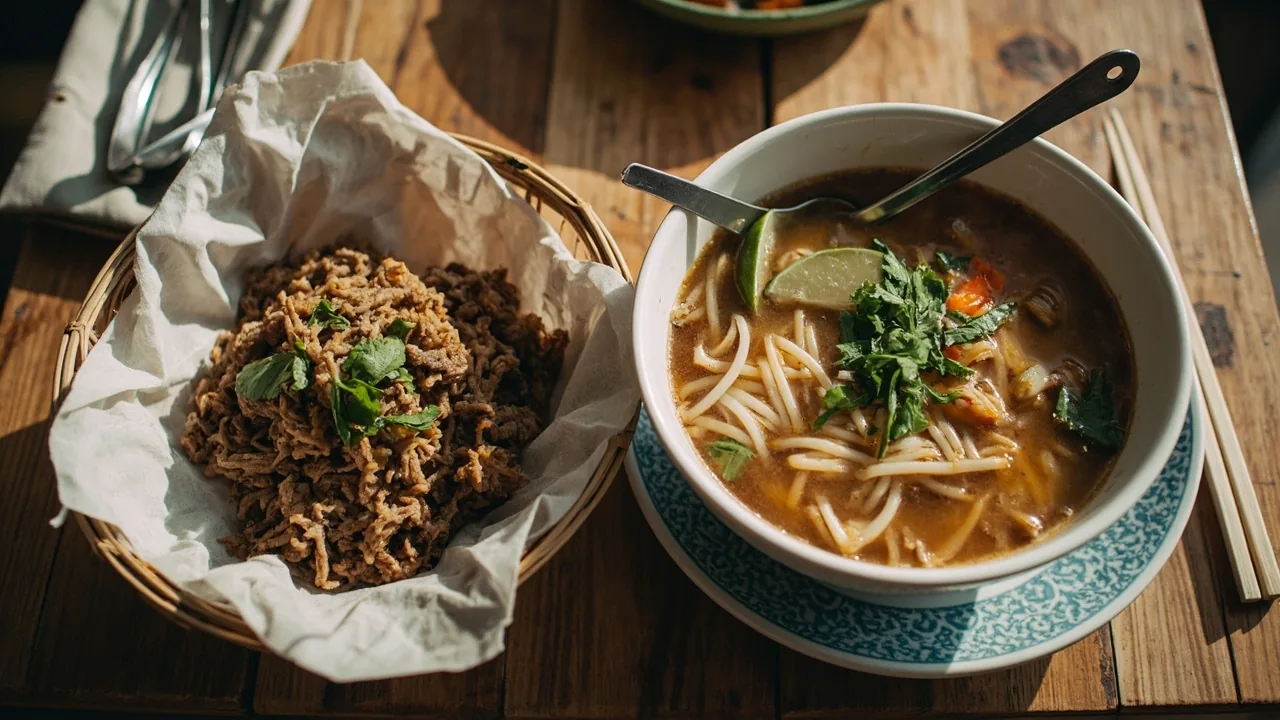
Laotian vs Vietnamese Food: A Backpacker’s Guide to Tastes, Dishes & Prices
If you want the most diverse and relentlessly snackable street food scene in Southeast Asia, eat your way through Vietnam. If you want fewer tourists, slower meals, and a cuisine built almost entirely around sticky rice, freshwater fish, and herbs you have never heard of, eat your way through Laos. Vietnam wins on variety and the raw number of cheap meals you can shove into a day; Laos wins on the calm of eating it. Both are excellent, and both reward the backpacker who treats food as half the trip.
This guide walks through the real differences: flavor profiles, the dishes that define each country, what vegetarians eat on the ground, and the realistic backpacker cost of eating well across both. Prices are quoted in the local currency (VND in Vietnam, LAK in Laos) at current rates (1 VND ≈ ₹0.0037, so 100,000 VND ≈ ₹370; 1 LAK ≈ ₹0.0043, so 100,000 LAK ≈ ₹430). You’ll find the full triple-currency form once you cross over to the live article.
Quick Answers
| What | Answer | Price (INR) |
|---|---|---|
| Cheapest meal (Vietnam) | Banh mi from a roadside cart | ₹55-₹92 (~15,000-25,000 VND or ~$0.57-$0.95) |
| Cheapest meal (Laos) | Khao jee baguette sandwich | ₹43-₹86 (~10,000-20,000 LAK or ~$0.45-$0.89) |
| Signature noodle dish (Vietnam) | Pho bo (beef pho) | ₹129-₹220 (~35,000-60,000 VND or ~$1.33-$2.29) |
| Signature noodle dish (Laos) | Khao soi (different from Thai khao soi) | ₹107-₹172 (~25,000-40,000 LAK or ~$1.11-$1.78) |
| Daily food budget (Vietnam) | Backpacker eating street food | ₹551-₹918 (~150,000-250,000 VND or ~$5.72-$9.53) |
| Daily food budget (Laos) | Backpacker eating street food | ₹344-₹644 (~80,000-150,000 LAK or ~$3.57-$6.69) |
A bowl of pho in Hanoi will cost you the same as a khao soi in Luang Prabang in rupee terms, but Vietnam’s street food depth is unmatched. The variety in Hanoi alone runs into the hundreds of distinct dishes; Laos runs into dozens.
Quick Comparison Table
| Factor | Vietnam | Laos |
|---|---|---|
| Daily food budget | ₹551-₹918 (~150,000-250,000 VND or ~$5.72-$9.53) | ₹344-₹644 (~80,000-150,000 LAK or ~$3.57-$6.69) |
| Variety of street food | Hundreds of distinct dishes per city | Dozens, more regional |
| Signature flavor | Fish sauce (nuoc mam), fresh herbs, lime | Padaek (fermented fish sauce), sticky rice, freshwater riverweed |
| Veg food availability | Excellent in cities, lots of Buddhist veg spots | Limited outside Luang Prabang and Vientiane |
| Spice level | Mild to medium, adjustable | Mild, but more chili-heavy in the south |
| Eating culture | Communal, small plastic stools, eat-anywhere | Communal, floor mats, slower pace |
| Cost vs India | Cheaper than most Indian cities | Slightly cheaper than Vietnam in absolute VND, slightly more expensive per meal due to fewer vendors |
| Best for | Food-first travelers, vegetarians, repeat visitors | Slow travelers, off-the-beaten-path eaters, people who like one cuisine done well |
Vietnamese food costs less per meal than Laotian food in absolute terms (VND prices are lower than LAK prices for similar dishes), but the variety means you can eat 5-6 different things a day in Hanoi without trying hard. In Laos, you might eat the same sticky rice and laap three meals running. Both have merit.
Flavor Profiles: What Tastes Different
The single biggest flavor difference between these two cuisines comes down to one condiment: nuoc mam (Vietnamese fish sauce) versus padaek (Laotian fermented fish sauce). If you have eaten in Thailand, you already know Thai fish sauce (nam pla) is sharper and saltier. Vietnamese nuoc mam is sweeter, lighter, and used as a dipping sauce straight from the bowl. Padaek, on the other hand, is dark, thick, funky, and smells like cheese to anyone raised on Indian food. Travellers report that padaek is the dividing line: you either love it immediately or you never get used to it.
Beyond the fish sauce wars, the second big difference is the herb palette. Vietnamese food leans on cilantro, Thai basil, mint, perilla, and sawtooth coriander, all served raw on the side of almost every dish so you can build your own bowl. Laotian food uses the same herb family but adds more obscure jungle herbs (bua loi, phak khao), more dill, and a stronger reliance on roasted chili pastes (jaew). The result: Vietnamese food tastes fresher and brighter; Laotian food tastes earthier and more fermented.
A practical test: eat the same dish, a grilled fish or a green papaya salad, in both countries on consecutive days. The Vietnamese version will be cleaner and sweeter; the Laotian version will be deeper, funkier, and stick to your ribs longer. That contrast, fresh and bright versus slow and fermented, is the backbone of laotian vs vietnamese food.
Signature Dishes Side by Side
Vietnam’s defining dishes
- Pho (pho bo / pho ga): Beef or chicken noodle soup, the national dish. Light beef-bone broth, flat rice noodles, sliced onion, scallion, a plate of raw herbs on the side. Hanoi-style is the original, with a clearer, less sweet broth than the Saigon version. The cheapest bowls run ₹129 (~35,000 VND or ~$1.33) in Hanoi; tourist-area versions can hit ₹294 (~80,000 VND or ~$3.05).
- Banh mi: The Vietnamese baguette sandwich, a legacy of French colonialism. Pork, pâté, pickled carrot and daikon, cilantro, chili, mayonnaise. The most complete cheap meal in Southeast Asia. ₹55-₹92 (~15,000-25,000 VND or ~$0.57-$0.95) from a roadside cart.
- Bun cha: Grilled pork patties and sliced pork belly served over cold rice noodles with a bowl of nuoc cham (sweet fish sauce dip). A Hanoi specialty. ₹147-₹220 (~40,000-60,000 VND or ~$1.52-$2.29).
- Com tam: Broken rice with grilled pork, a fried egg, pickled vegetables, and fish sauce. The Saigon working-class meal. ₹129-₹184 (~35,000-50,000 VND or ~$1.33-$1.91).
- Cao lau: A Hoi An-only noodle dish made with pork, greens, rice noodles that only work because of the local well water, and crispy croutons. ₹184-₹257 (~50,000-70,000 VND or ~$1.91-$2.67).
- Banh xeo: Crispy turmeric rice flour crepe stuffed with shrimp, pork, and bean sprouts, eaten wrapped in lettuce leaves. ₹147-₹257 (~40,000-70,000 VND or ~$1.52-$2.67).
Laos’s defining dishes
- Laap (larb): The national dish. Minced meat (beef, pork, duck, or fish) tossed with toasted rice powder, herbs, chili, lime, and padaek. Eaten with sticky rice. Found everywhere, ₹107-₹172 (~25,000-40,000 LAK or ~$1.11-$1.78).
- Khao niaw (sticky rice): Not a dish, a staple. Served in a bamboo basket (tip khao), eaten by hand, rolled into balls and dipped into laap or any accompanying dish. No Laotian meal exists without it.
- Khao soi (Laotian version): Not the Thai coconut curry noodle soup. The Laotian version is a clear broth with wide rice noodles, tomatoes, fermented mustard greens, and pork or beef. Distinctly sour, distinctly Laotian. ₹107-₹172 (~25,000-40,000 LAK or ~$1.11-$1.78).
- Mok pa: Fish steamed in banana leaf with herbs, chili, and padaek. Mekong River specialty. ₹129-₹215 (~30,000-50,000 LAK or ~$1.34-$2.23).
- Sai oua: Laotian sausage, packed with lemongrass, galangal, kaffir lime, and chili. Grilled over charcoal. ₹64-₹129 (~15,000-30,000 LAK or ~$0.67-$1.34) per stick.
- Khao jee: French baguette legacy meets Laotian filling: pork, pâté, pickled vegetables, chili, herbs. The Laotian answer to banh mi. ₹43-₹86 (~10,000-20,000 LAK or ~$0.45-$0.89).
- Or lam: A Luang Prabang stew made with eggplant, pumpkin, and a local wild vegetable called sakhan, thickened with a mucilaginous plant that gives the broth a slightly slimy texture. A polarizing dish; travellers report you either love the texture or leave half the bowl. ₹107-₹172 (~25,000-40,000 LAK or ~$1.11-$1.78).
Vegetarian Food: What Indians Eat
This is where Vietnam pulls ahead decisively for Indian travelers. Vietnamese Buddhist vegetarian cuisine (com chay) is its own well-developed tradition. Most cities have at least one vegetarian restaurant on every block near a pagoda, and these places serve mock-meat versions of pho, bun cha, banh mi, and everything else on the regular menu, made with tofu, mushrooms, and seitan. In Hanoi and Ho Chi Minh City, you’ll find vegetarian spots where the menu runs into 50+ items and a full meal costs ₹110-₹184 (~30,000-50,000 VND or ~$1.14-$1.91). The food is genuinely good, not an afterthought. For Indian vegetarians, this is the easiest country in Southeast Asia to eat well without cooking.
Luang Prabang has a handful of dedicated vegetarian restaurants, and Vientiane has a growing scene. Outside those two cities, vegetarian options thin out fast. Expect to eat the same stir-fried morning glory (pak boong), fried rice, and fried eggs at most restaurants. The word “jay” (เจ) signals Buddhist vegetarian food in Thailand, but Laos doesn’t have a widely-used equivalent. Learn to ask: “phet dai phak?” (Is there vegetable food?) or just point at what you want.
Subodh’s Pro Tip: In Vietnam, look for the word “chay” on signs. It means vegetarian. Any place with “com chay” or “pho chay” in the name is a full vegetarian restaurant. In Luang Prabang, the night market has a whole row of vegetarian-only stalls with English menus. Take advantage.
For a deeper look at food across Southeast Asia, see the Thai vs Vietnamese food comparison and the street food showdown across Bangkok, Hanoi, and Penang.
Street Food Culture: Eating Habits Compared
Vietnam eats standing up, sitting on tiny plastic stools, or hunched over a motorbike. Hawkers with shoulder poles move through alleys selling bahn mi, grilled corn, and che (sweet dessert soup). Every block in Hanoi and Ho Chi Minh City has at least one street food cluster. The pace is fast: order, eat, move. Vietnamese street food is built around small portions eaten many times a day, not three big meals. A typical eating day might be a banh mi for breakfast (₹73 (~20,000 VND or ~$0.76)), a bowl of bun cha for lunch (₹184 (~50,000 VND or ~$1.91)), and three or four small snacks in the evening: grilled skewers (₹18-₹37 (~5,000-10,000 VND or ~$0.19-$0.38) each), a bowl of che (₹55 (~15,000 VND or ~$0.57)), fresh fruit, and a banh xeo from a cart. Total: ₹551-₹918 (~150,000-250,000 VND or ~$5.72-$9.53).
Laos eats slower. Sticky rice comes in a basket meant for sharing, and meals are designed to be sat with. The Luang Prabang night market is one of the great street food experiences in Southeast Asia, with a long row of vendors selling laap, grilled fish, khao jee, and fresh fruit shakes all at fixed prices (mostly ₹43-₹129 (~10,000-30,000 LAK or ~$0.45-$1.34) per dish). Outside Luang Prabang, the night market scene is much thinner. Vientiane’s evening food streets are good but smaller. Smaller towns like Vang Vieng have a handful of tourist-oriented restaurants but almost no street food stalls.
The single biggest practical difference: in Vietnam, you can eat street food at almost any hour. In Laos, the main meal is often over by 8 PM, and finding food late at night outside Vientiane and Luang Prabang can be a struggle.
Cost Comparison in Local Currency
| Expense | Vietnam (VND) | Laos (LAK) |
|---|---|---|
| Banh mi / Khao jee | 15,000-25,000 | 10,000-20,000 |
| Pho / Khao soi | 35,000-60,000 | 25,000-40,000 |
| Laap / Bun cha | 40,000-60,000 | 25,000-40,000 |
| Vegetarian restaurant meal | 30,000-50,000 | 20,000-35,000 |
| Restaurant meal (mid-range) | 100,000-200,000 | 60,000-120,000 |
| Beer (local, large) | 15,000-25,000 | 15,000-25,000 |
| Coffee (Vietnamese drip / Laotian coffee) | 15,000-30,000 | 15,000-25,000 |
| Fresh fruit shake | 15,000-25,000 | 10,000-20,000 |
| Daily food total (backpacker) | 150,000-250,000 | 80,000-150,000 |
Note: ₹367 (~100,000 VND or ~$3.81) ≈ ₹370 and 100,000 LAK ≈ ₹430 at current rates (1 VND ≈ ₹0.0037, 1 LAK ≈ ₹0.0043). Vietnamese street food is cheaper per dish in absolute local-currency terms, but the variety means you tend to eat more meals per day. Total daily food spend lands roughly similar in INR once you convert.
Where Each Cuisine Wins
Choose Vietnam if:
- You’re vegetarian and don’t want to think about it. Vietnam has the best and easiest vegetarian street food scene in Southeast Asia.
- You want variety. Five different things for breakfast, ten for lunch, twenty for dinner. You will not run out.
- You want to eat 4-6 times a day. Vietnamese food culture is built for grazers.
- You want cooking classes. Hanoi and Hoi An have dozens of excellent half-day cooking schools, often ₹1,469-₹2,570 (~400,000-700,000 VND or ~$15.25-$26.68) including a market tour.
- You want coffee as a destination. Vietnamese coffee (especially egg coffee in Hanoi) is world-class and cheap.
Choose Laos if:
- You want fewer tourists. Laos has a fraction of Vietnam’s tourism volume, and street food vendors in smaller towns are often genuinely curious to meet you.
- You want a slower trip. The eating pace in Laos is different. You sit, you share, you take your time.
- You want to try padaek. The funky Laotian fermented fish sauce is the most distinctive flavor in mainland Southeast Asia. If you find it once, you’ll find it nowhere else.
- You want to learn a cuisine most of your friends have never heard of. Laap, mok pa, or lam, and sai oua, the food here is its own thing, not a Thai lite.
- You want one dish done well. Laotian cuisine has fewer dishes, but the depth on each is real.
For a side-by-side look at Bangkok and Hanoi food scenes specifically, see the Bangkok vs Hanoi food guide.
The Bananarchy Take
I’ve eaten my way through both countries on multiple trips, and the honest answer is: they taste different enough that doing both is worth it if your route allows. Vietnam wins on volume, vegetarian access, and cooking-class availability. Laos wins on character, the slow pace of meals, and a flavor profile (padaek, sticky rice, fermented greens) you literally cannot find anywhere else. If you have to pick one, pick Vietnam for the food itself. If you have time for both, eat three weeks in Vietnam and one week in Laos. The transition from Hanoi overland through northern Laos (Sapa, Luang Prabang, Vang Vieng, Vientiane) is one of the great food trips in mainland Southeast Asia, and the contrast between the two cuisines hits harder when you experience them back to back rather than reading about them on the internet. To see how this route fits into a longer mainland loop, check 2 weeks vs 3 weeks in Vietnam and overland vs flying in Southeast Asia.
Getting Connected
Both Vietnam and Laos have reliable tourist SIMs. Vietnam has the better 4G/5G coverage and faster speeds; Laos is fine for navigation and messaging but slower outside Vientiane and Luang Prabang. If you want to skip the airport counter, Get Nomad eSIM covers both countries on a single regional plan.
Can You Do Both?
Yes, and you should. The standard backpacker route runs Hanoi → Ha Giang loop or Cat Ba/Halong → Ninh Binh → Hoi An → Ho Chi Minh City (3 weeks minimum), then overland or a short flight into Laos (Vientiane → Vang Prabang → Vang Vieng, 1-2 weeks). Total food spend across both countries for 30 days: roughly ₹16,524-₹27,540 (~4,500,000-7,500,000 VND or ~$171.52-$285.87)-equivalent, which at current rates lands in the ₹16,500-₹27,500 (~$171.27-$285.45) range. Add accommodation, transport, and visa fees, and a month-long food-focused trip across both lands comfortably under ₹100,000 (~$1,038) for a budget backpacker.
Logistically, the easiest connection is a Hanoi → Vientiane flight (1 hour 20 minutes, several budget carriers, frequent deals under ₹4,817 (~50 USD)) or an overland bus via the Nam Phao-Cau Treo border if you’re coming from central Vietnam. Vietnamese and Laotian visas are separate, and both can be obtained as e-visas before departure.
FAQ
Is Vietnamese food cheaper than Laotian food for backpackers? Per meal, Vietnamese street food is cheaper in local currency terms (₹55-₹92 (~15,000-25,000 VND or ~$0.57-$0.95) for a banh mi vs ₹43-₹86 (~10,000-20,000 LAK or ~$0.45-$0.89) for a khao jee, both roughly ₹35-₹90 (~$0.36-$0.93)). However, Laos has fewer vendors, so backpackers often eat at restaurants more frequently, pushing daily totals closer to Vietnam’s than the per-dish prices suggest.
Which country is easier for Indian vegetarians? Vietnam, by a wide margin. The com chay (Buddhist vegetarian) tradition means entire restaurants dedicated to vegetarian pho, vegetarian bun cha, and mock-meat versions of every Vietnamese dish. Laos has good vegetarian spots in Luang Prabang and Vientiane but thin options elsewhere.
Can I do both countries on one trip? Yes, and it’s one of the best food itineraries in Southeast Asia. The most common route is Hanoi → northern Vietnam highlights → fly or bus to Vientiane → Luang Prabang. Allow at least 30 days for both without rushing.
Which country’s food is spicier? Laos is slightly spicier in absolute terms, with more raw chili and chili pastes (jaew) on the table. Vietnamese food is mild to medium and almost always adjustable. Both cuisines use chili as an accent, not the dominant flavor.
Is it safe to eat street food in both countries? Travellers report that street food in Vietnam and Laos is safe for foreigners, with the same standard caveats as anywhere: pick stalls with high turnover, watch your food being cooked if possible, and avoid raw vegetables if you have a sensitive stomach. The vast majority of backpackers eat street food daily in both countries without issue.
Do I need to know any food-related Vietnamese or Laotian words? A few basics help. In Vietnam: “chay” (vegetarian), “khong cay” (not spicy), “cam on” (thank you). In Laos: “phet dai phak” (is there vegetable food?), “bor dai phet” (not spicy), “khop jai” (thank you). Pointing works everywhere.
Subodh’s Line
If food is half the reason you travel, do both. Vietnam feeds you; Laos teaches you to slow down and taste it.
