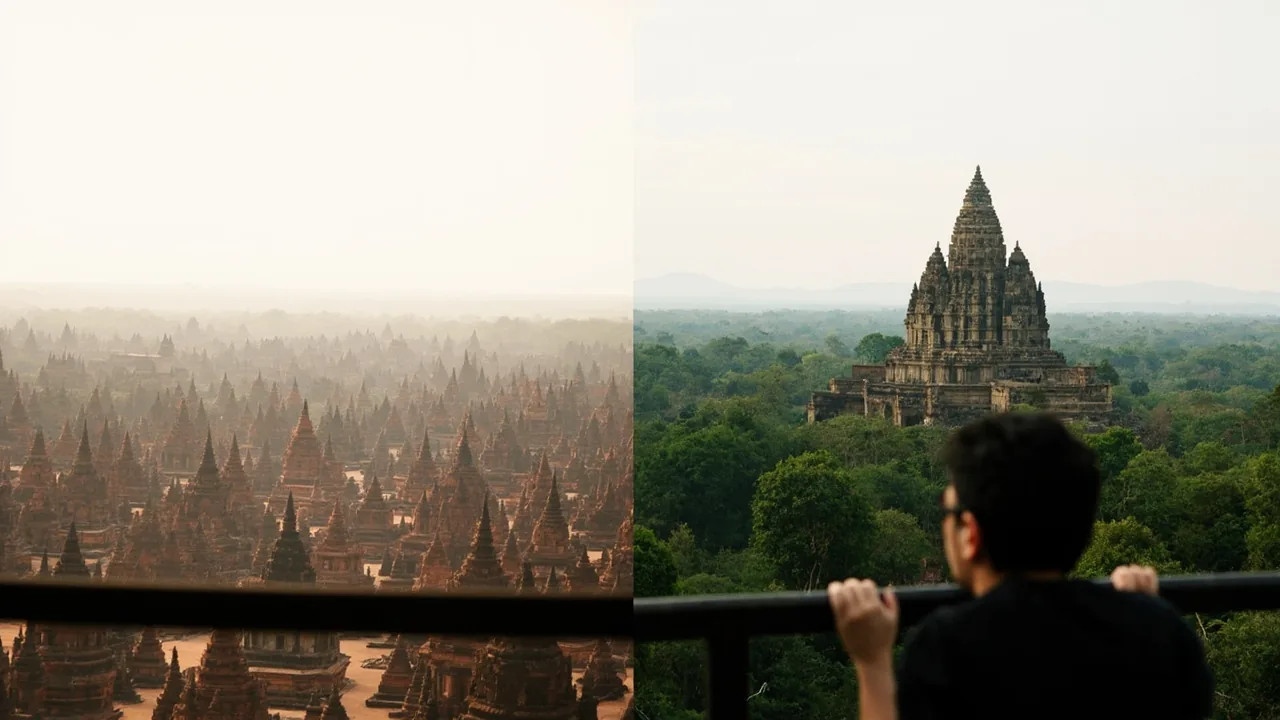
Myanmar vs Cambodia for History Buffs: Which Temples Offer More Bang for Your Buck?
Cambodia is 25-35% cheaper per day than Myanmar for a temple-focused trip, and Angkor Wat’s 3-day pass at ₹5,973 (~62 USD) is the best-value entry in world heritage tourism. Bagan is quieter and more photogenic, but costs more and requires a pricier visa. For the full Southeast Asia backpacking context, see our Southeast Asia backpacking hub.
If you want the single most photogenic Hindu-Buddhist temple experience in Southeast Asia, fly straight to Bagan in Myanmar. If you want the world’s largest religious monument and the most varied temple architecture on earth, plus easier logistics, head to Siem Reap and the Angkor complex in Cambodia. Prices cross-checked against the official Angkor ticket office rates and Myanmar e-visa portal as of July 2026.
Quick Answers
| What | Answer | Price (INR) |
|---|---|---|
| Cheapest country for a 7-day temple trip | Cambodia | ~₹14,451-₹21,195 (~150-220 USD) total |
| Most expensive country for a 7-day temple trip | Myanmar | ~₹24,085-₹36,609 (~250-380 USD) total |
| Single Angkor Wat 1-day pass | Angkor, Cambodia | ₹3,565 (~37 USD) |
| Bagan Archaeological Zone entry fee (foreign visitor) | Bagan, Myanmar | 25,000 MMK |
| Best months for temple photography | Both (Nov-Feb) | Dry season |
The Myanmar kyat is the local currency in Bagan. 1 USD = 4,200 MMK roughly, and the kyat inflates so on-the-ground temple fees change quarter to quarter. Always carry clean USD bills for visa fees in both countries.
Quick Comparison Table
| Factor | Myanmar (Bagan) | Cambodia (Siem Reap / Angkor) |
|---|---|---|
| Daily budget (USD) | ~₹3,372-₹4,817 (~35-50 USD) | ~₹2,408-₹3,372 (~25-35 USD) |
| Visa for Indians | E-visa, ₹4,817 (~50 USD) | E-visa, ₹2,890-₹3,468 (~30-36 USD) |
| Best months | Nov-Feb (dry, cool) | Nov-Feb (dry, cool) |
| Veg food availability | Limited but workable | Easy in Siem Reap |
| Safety (solo) | Stable in tourist zones | Stable, well-trodden |
| English spoken | Moderate in tourist hubs | Good to good |
| Vibe | Quiet plains, ancient brick, off-grid sunrise crowds | Stone giants, jungle temples, full backpacker scene |
| Best for | Slow travellers, photographers, repeat SEA visitors | First-timers, tight schedules, photographers who want variety |
This table answers the core question for most readers. If you want fewer people around your sunrise shot, Bagan. If you want variety and easier logistics, Angkor.
Choose Myanmar (Bagan) If…
- You’ve already done Angkor and want a different flavour of Southeast Asian temple culture. Bagan’s brick stupas predate Angkor’s sandstone kings by about 200 years and feel distinctly Burmese.
- You can handle slow travel. Bagan rewards staying 3-4 nights. The magic is the second sunrise when you know which temple to climb and which to skip.
- You want photographs with almost no other people in them. Even in peak season, you can find a deserted stupa at 5:45 AM.
- You have a flexible schedule and don’t mind checking the Myanmar e-visa portal before booking, as processing times vary.
Choose Cambodia (Siem Reap / Angkor) If…
- It’s your first major Southeast Asia temple experience and you want the headline monument. Angkor Wat is the largest religious building on earth, full stop.
- You want maximum variety in 3-4 days. Angkor Thom, Ta Prohm, and other outer temples. Different styles, different centuries, different states of ruin.
- You have a tight budget. Cambodia’s daily costs are lower across the board, from dorms to street food to tuk-tuks.
- You want a working backpacker infrastructure. Siem Reap has 50+ hostels, Pub Street, and night markets for any night you need a break from temple fatigue.
Myanmar (Bagan). Pros and Cons
Pros:
- The “sea of temples” view from atop Dhammayangyi Temple at sunrise is genuinely unique in the world. No other site has 2,000+ spires in one frame.
- Bagan sees significantly fewer foreign visitors per year than Angkor, which means quieter sunrise spots.
- Burmese food is underrated, and Bagan has solid vegetarian options at The Moon Vegetarian Restaurant and Khaing Shwe Wha Vegetarian Restaurant.
- Excellent e-bike rental infrastructure for hopping between temples on your own schedule.
- Genuinely different architecture: red brick, terracotta plaques, hollow stupas you can enter. A different aesthetic from Angkor’s sandstone bas-reliefs.
Cons:
- The Myanmar e-visa process for Indians has been intermittent and slow at times. Check the current status before booking flights.
- Internet and banking infrastructure are patchy outside Yangon. Bring USD cash and a backup SIM.
- Hot season (Mar-May) hits 40°C+ on the Bagan plains. Not pleasant.
- Fewer hostels than Siem Reap, so quality options like Ostello Bello Bagan Pool book out faster than you’d expect.
Cambodia (Siem Reap / Angkor). Pros and Cons
Pros:
- Angkor Wat, Bayon with its 200+ face towers, Ta Prohm with the strangler figs. Three of the most photographed temples on earth, all within one tuk-tuk ride.
- The Angkor Pass works at 40+ sites over 1, 3, or 7 days.
- Siem Reap’s food scene is strong, with Indian restaurants, veg cafés, and a well-marked Pub Street for non-temple nights.
- Tourist infrastructure is mature. ATMs, eSIMs, Grab, remittance apps, and 24-hour tuk-tuks all work.
- The 1-day pass at ₹3,565 (~37 USD) is one of the best value entries in world heritage tourism.
Cons:
- Crowd pressure at sunrise at Angkor Wat is real. You will have 200-400 people around the reflection pond, plus monks with selfie sticks.
- Siem Reap has become a tourism machine. Pub Street can feel like Khao San Road lite.
- Heat and humidity are punishing from Mar-Sep. Plan your temple days for early morning only in those months.
- “Temple fatigue” is real after day 3. Most temples blur together if you don’t slow down.
Cost Comparison in USD
These figures reflect a 7-day trip dedicated to temple sightseeing, staying in mid-range dorms and eating at local spots. Exchange rate for reference: 1 USD = ₹96.5, and 1 USD = 4,200 MMK in Myanmar.
| Expense | Myanmar (Bagan area) | Cambodia (Siem Reap) |
|---|---|---|
| Dorm bed (avg/night) | ₹771-₹1,445 (~8-15 USD) | ₹482-₹963 (~5-10 USD) |
| Street food meal | 2,000-4,000 MMK | ₹48-₹95 (~2,000-4,000 KHR or ~$0.49-$0.99) |
| Restaurant meal | 8,000-15,000 MMK | ₹289-₹771 (~3-8 USD) |
| E-bike rental (per day) | 5,000-8,000 MMK | ₹482-₹771 (~5-8 USD) |
| Local transport (per day) | 5,000-10,000 MMK | ₹482-₹963 (~5-10 USD) |
| SIM card (tourist) | 10,000-15,000 MMK | ₹289-₹482 (~3-5 USD) |
| Visa fee | ₹4,817 (~50 USD) | ₹2,890-₹3,468 (~30-36 USD) |
| Top activity (Angkor pass or Bagan zone) | 25,000 MMK | ₹3,565 (~37 USD) |
| Beer | 2,000-4,000 MMK | ₹96-₹241 (~1-2.50 USD) |
| 7-day total (budget) | ~₹24,085-₹30,828 (~250-320 USD) | ~₹17,341-₹25,048 (~180-260 USD) |
| 7-day total (comfortable) | ~₹36,609-₹48,170 (~380-500 USD) | ~₹26,975-₹38,536 (~280-400 USD) |
Travellers report that the gap between the two is roughly 25-35% in favour of Cambodia for strict-budget temple trips, mostly because of accommodation and the multi-day Angkor Pass math. The 3-day Angkor pass at ₹5,973 (~62 USD) is the sweet spot for most backpackers.
The Temples Themselves. What’s Different
This is where the choice gets interesting, not just on cost but on what you’re looking at.
Bagan’s defining temples. Old Bagan is the central archaeological zone, with 2,200+ surviving structures spread across 40 sq km of dry plain. Dhammayangyi Temple is the largest, a brooding brick monolith with the densest, most solid massing of any Pagan-era temple. Climb it for the panoramic view at sunrise. See Dhammayangyi Temple tours on GetYourGuide. That Bin Nyu is the tallest, a slender whitewashed spire that catches the late-afternoon light beautifully. Apalyadana Temple is the quiet one, often empty, with well-preserved frescoes and a meditative stillness that’s hard to find at the bigger sites. Check Apalyadana Temple availability. The whole experience is about scale and emptiness: brick after brick after brick, with you in the middle of it.
Angkor’s defining temples. Angkor Wat itself is the largest religious monument on earth, a 400-acre Hindu-turned-Buddhist complex built in the early 12th century. The bas-reliefs of the Churning of the Sea of Milk run 600+ metres along its outer gallery. Bayon, at the centre of Angkor Thom, has 200+ face towers carved with the Bodhisattva Avalokiteshvara. Ta Prohm is the jungle temple, half-consumed by silk-cotton and strangler fig roots. Banteay Srei is the “citadel of women,” 30 km from the main complex, with pink sandstone carvings so fine they look like embroidery. Each one is a different century, a different king, a different style. Browse Angkor temple tours on GetYourGuide.
The honest split: Bagan is one style, repeated across 2,000 buildings. Angkor is a dozen styles, repeated across 400 buildings. Bagan rewards breadth and quiet. Angkor rewards variety and depth.
Where to Stay
For Bagan, Ostello Bello Bagan Pool is the standout backpacker choice in Nyaung-U, with a pool (rare in Bagan’s heat), a social common area, and a solid location near the e-bike rental shops. Check prices.
For Siem Reap, the hostel scene is mature and competitive. You’ll find plenty of ₹482-₹963 (~5-10 USD) dorms on Hostelworld.
Subodh’s Pro Tip: Book the Angkor 3-day pass instead of the 1-day if you have 3+ days. The maths work out to ~$20/day for access to 40+ sites, and you can space the temples out so you’re not seeing five in one exhausting morning.
Getting Connected
Both countries have decent 4G in tourist zones, with Cambodia slightly ahead on speed and coverage. In Siem Reap, Smart and Cellcard both sell 7-day tourist SIMs for ₹289-₹482 (~3-5 USD) at the airport. In Bagan, Ooredoo and Telenor Myanmar cover the plains but speeds drop outside the main temples. For eSIM, Get Nomad eSIM covers both countries and lands on your phone before you board the flight.
Can You Do Both?
Yes, and the route that makes sense is Cambodia first, Myanmar second. Logistically, Siem Reap has direct flights to Bangkok and onward connections to Yangon, then a domestic flight or overnight bus to Bagan. The total combined trip is 14-18 days for a comfortable pace, and the visa situation is straightforward: one Cambodian e-visa and one Myanmar e-visa, applied separately, both processed within 3 business days.
Budget for the combined trip is roughly ₹38,536-₹57,803 (~400-600 USD) for 14 days on a tight budget, including both visa fees, all temple passes, dorms, and local transport. The Khmer temples prepare you for the Burmese ones in a way that feels like a natural progression: Khmer sandstone kings first, then Pagan brick stupas.
For a deeper Siem Reap vs Bagan decision, our Siem Reap vs Bagan comparison breaks it down further. For the broader Cambodia question, Cambodia vs Myanmar covers the logistics in more detail.
FAQ
Is Bagan cheaper than Angkor for a temple-focused trip? On a strict daily basis, no. Myanmar’s visa is more expensive (₹4,817 (~50 USD) vs ₹2,890-₹3,468 (~30-36 USD)) and Bagan’s accommodation costs run slightly higher. Cambodia wins on the per-day budget by roughly 25-35%, mostly because of the multi-day Angkor Pass and cheaper dorms.
Can I get a visa for both on the same trip? Yes. Apply for the Cambodia e-visa first (faster processing), then the Myanmar e-visa 1-2 weeks before departure. Both allow Indian passport holders.
Which is safer for solo travellers? Both are stable in the main tourist zones. Siem Reap has a more developed tourist infrastructure and a larger backpacker network, which makes it feel safer for first-time solo travellers. Bagan is quiet and low-crime but isolated if something goes wrong. For specific Myanmar safety guidance, see solo female travel in Myanmar.
When should I go for the best temple photography? Both countries share the same dry season: November through February. Cooler temperatures, clear skies, and golden-hour light that lasts longer. Avoid March-May, when temperatures regularly hit 38-42°C on the Bagan plains and humidity in Siem Reap becomes oppressive.
How many days do I need for each? Bagan needs a minimum of 3 full days to feel unhurried. Angkor can be done in 2-3 days with the 1-day or 3-day pass, though serious temple-lovers stay 4-5 days to cover the outer sites.
Are there Indian food options in both? Yes, but Siem Reap is the easier destination. Multiple Indian restaurants on Pub Street and the surrounding lanes serve dal, rice, and veg thalis. Bagan has fewer options; The Moon Vegetarian Restaurant and Khaing Shwe Wha Vegetarian Restaurant are the reliable picks, both serving Burmese-style vegetarian food. For a broader look, our vegetarian Indian food SEA comparison covers the region.
Subodh’s Take
If this is your first major Southeast Asia temple pilgrimage, go to Cambodia. The Angkor complex is more accessible, the infrastructure is friendlier, the visa is simpler, and you get more architectural variety in less time. You won’t regret it. But if you’ve already done Angkor, or you’ve done Thailand and Vietnam and want to feel the older, quieter, stranger version of Hindu-Buddhist Southeast Asia, Bagan is the move. Fewer tourists, red brick instead of grey sandstone, and a sunrise over the plains that no other site on earth can match. The 25,000 MMK zone fee is also a remarkable bargain.
