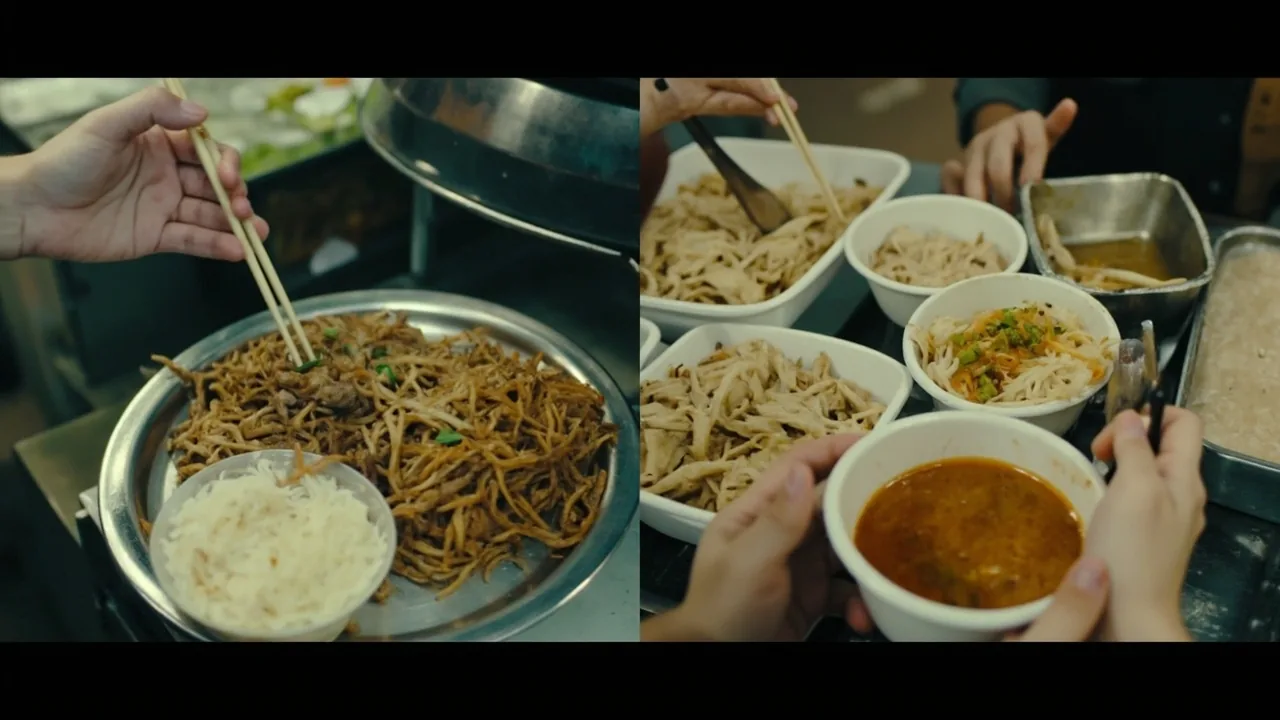
Penang vs Singapore Food: Hawker Centers, Cost & Variety Compared
Penang is cheaper for hawker meals (₹142-₹237 (~6-10 MYR or ~$1.47-$2.46) vs Singapore’s ₹299-₹598 (~4-8 SGD or ~$3.10-$6.20) per plate), and Singapore is cleaner with more Michelin stamps. The rest of this article compares both side by side so you can pick which one matches your trip style, mess tolerance, and budget.
Quick Answers
| What | Answer | Price (INR) |
|---|---|---|
| Cheapest hawker meal | Penang (hawker centre char koay teow) | ₹142 (~6 MYR or ~$1.47) |
| Most Michelin-decorated hawker | Singapore (10+ hawker stalls on the Bib Gourmand list) | ₹224-₹374 (~3-5 SGD or ~$2.33-$3.88) |
| Variety of cuisines in one hawker centre | Singapore (Chinatown Complex has 200+ stalls) | — |
| Most “Instagram-able” food | Penang (street art, clan jetties, hawker grit) | ₹142-₹237 (~6-10 MYR or ~$1.47-$2.46) |
| Easier logistics for first-timer | Singapore (MRT, Grab, English everywhere) | — |
Subodh’s Pro Tip: Both cities have Indian-Muslim (Mamak) and Tamil-Muslim food that feels close to home. If you’re vegetarian and worried about Asia, Penang’s Little India and Singapore’s Little India Arcade are both safe bets. Singapore’s labelling laws are stricter on packaged food, but hawker stalls in both cities use fish sauce, shrimp paste, or lard by default.
Quick Comparison Table
| Factor | Penang | Singapore |
|---|---|---|
| Daily budget (₹) | ₹1,800 (~$18.67) | ₹4,200 (~$43.57) |
| Visa for Indians | eVisa, 30 days, ~₹1,500 (~$15.56) | eVisa, 30 days, ~₹2,000 (~$20.75) |
| Best months | December to March (drier) | February to April (less humid) |
| Veg food availability | Good (Little India + Chinese veg stalls) | Excellent (labelled, dedicated veg menus) |
| Safety (solo) | High (low violent crime) | High (low, clean) |
| English spoken | Widely in Georgetown | Universal |
| Vibe | Chaotic, loud, sticky tables, “real” street food | Air-conditioned, sanitised, international food court feel |
| Best for | Budget backpackers, food pilgrims, “I want to feel Asia” travellers | First-timers, clean freaks, business + leisure combos, family trips |
Choose Penang If…
- You want a meal under ₹237 (~10 MYR or ~$2.46) that you’d happily fly back for (char koay teow, asam laksa, hokkien mee).
- You don’t mind plastic stools, sweat on your brow, and a hawker shouting your order number.
- You’re already doing a Malaysia loop and want the food capital, not the capital city.
- You want to walk off dinner through Penang Street Art lanes and end up at a clan jetty at sunset.
- Budget is tight. Penang is roughly half the daily cost of Singapore.
Choose Singapore If…
- You want Michelin-starred chicken rice for under ₹374 (~5 SGD or ~$3.88).
- You’re nervous about your first SEA trip and want everything labelled, clean, and MRT-accessible. Our solo Singapore guide covers everything a first-timer needs.
- You’re vegetarian and need every dish cross-labelled for egg, dairy, and meat stock.
- You only have 3 to 4 days and want a dense, walkable food city with zero logistics friction.
- You’re combining business or a transit stop with food tourism.
Penang. Pros and Cons
Pros:
- Cheapest hawker meals in the region outside Indochina. A plate of char koay teow or a bowl of asam laksa runs ₹142-₹237 (~6-10 MYR or ~$1.47-$2.46).
- Concentration of food in Georgetown. You can eat at a different hawker centre every meal for a week without repeating.
- The food has Chinese-Malay-Indian-Thai-Nyonya cross-pollination you won’t find in Singapore, which standardised its hawker culture in the 1970s and 80s.
- Walkable: most famous spots (Lebuh Chulia, Lebuh Cintra, Penang Road) are within a 20-minute walk.
Cons:
- Hot. Georgetown is on a granite island with poor airflow. Hawker centres are open-sided and rarely air-conditioned.
- Finding the “best” stall takes legwork. No Michelin guide for Penang, so you rely on queues, Google ratings, and word of mouth.
- Limited English at some hawker stalls. Mandarin, Hokkien, Malay, and Tamil all blur together.
- The cheapest places close by 9 pm. Late-night food exists but is less centralised.
Singapore. Pros and Cost
Pros:
- Michelin Bib Gourmand list actively rates hawker food. Tian Tian Hainanese Chicken Rice, Liao Fan Hong Kong Soya Sauce Chicken Rice, and Tai Wah Pork Noodle are on it for a reason.
- Hygiene standards are uniform. Clean trays, gloves, no mystery oil. If you have a weak stomach, Singapore is the lowest-risk SEA food city.
- Hawker centres are integrated into HDB housing estates and MRT stations. Lunch for office workers means lunch for you, with the same stalls.
- Variety per square foot is higher: Chinatown Complex alone has 200+ stalls, Lau Pa Sat runs another 150.
Cons:
- A hawker meal in Singapore is ₹299-₹598 (~4-8 SGD or ~$3.10-$6.20). Double Penang for the same plate. Drinks are also marked up: ₹187-₹299 (~2.50-4 SGD or ~$1.94-$3.10) for a kopi or teh.
- Most stalls close by 9 pm. Late-night food exists in Geylang and certain hawker centres, but the bulk shuts down.
- The experience is more “food court” than “street.” Even the most famous hawker centres feel orderly.
Cost Comparison in ₹
Verified 2026-07-17 at 1 MYR = ₹23.64 and 1 SGD = ₹74.69.
| Expense | Penang (₹) | Singapore (₹) |
|---|---|---|
| Dorm bed (avg/night) | ₹709 (~30 MYR) | ₹2,240 (~30 SGD) |
| Hawker meal (avg) | ₹142 (~6 MYR) | ₹299 (~4 SGD) |
| Restaurant meal (mid-range) | ₹1,182 (~50 MYR) | ₹2,988 (~40 SGD) |
| Local transport (per day) | ₹236 (~10 MYR) | ₹747 (~10 SGD) |
| SIM card (tourist, Penang) | ₹709 (~30 MYR or ~$7.37) | N/A |
| SIM card (tourist, Singapore) | N/A | ₹1,495 (~20 SGD or ~$15.50) |
| Visa fee | ₹1,500 (~$15.56) | ₹2,000 (~$20.75) |
| Top activity (hawker food tour) | ₹1,418 (~60 MYR) | ₹3,734 (~50 SGD) |
| Beer (hawker) | ₹709 (~30 MYR) | ₹1,495 (~20 SGD) |
| 7-day total (budget) | ₹12,500 (~$129.66) | ₹29,400 (~$304.97) |
| 7-day total (comfortable) | ₹23,000 (~$238.58) | ₹52,000 (~$539.40) |
If you’re already in KL or Bangkok, the Malaysia side is cheaper. Singapore costs roughly 2.3x Penang for a 7-day budget trip. The gap shrinks for comfort tier because Singapore’s upper-end hostels and hawker meals are still cheap by global standards, while Penang’s comfort tier has fewer mid-range hotels, so prices climb.
Where to Stay
Penang hostels cluster in Georgetown around Lebuh Chulia and Lebuh Cintra, both 5 to 10 minutes from the best hawker centres.
| Hostel | Rating | Vibe | Book |
|---|---|---|---|
| EZ Social Hostel Georgetown, Penang | 9.52 | Social, central, rooftop (dorm) | Check prices |
| House of Journey, Penang | 9.48 | Quiet, design-led, walking distance to street art (dorm) | Check prices |
| Some Place Else, Penang | 9.28 | Indie, artsy, common kitchen (dorm) | Check prices |
| Dream Lodge @ Tyrwhitt, Singapore | 9.20 | Social, central, close to MRT (dorm) | Check prices |
Where to Eat
Penang Hawker Centres (Real, Named)
- Siam Social Penang (4.8): Thai street food in the middle of Penang. Slightly elevated pricing, around ₹426-₹663 (~18-28 MYR or ~$4.42-$6.88) a dish, but worth it for the tom yum and pad thai quality.
Subodh’s Pro Tip: For Penang, eat one breakfast at a kopitiam (coffee shop), one lunch at a hawker centre, and one dinner at a different hawker centre every day. You’ll cover the full range in 4 days.
Singapore Hawker Centres (Real, Named)
- Maxwell Food Centre (Chinatown): Tian Tian chicken rice, Zhen Zhen porridge, and 100+ other stalls. MRT to Chinatown, 5-minute walk.
- Chinatown Complex Market: largest hawker centre by stall count in Singapore. Liao Fan Hong Kong Soya Sauce Chicken Rice is here.
- Lau Pa Sat: touristy but central. Satay Street closes one lane at night for outdoor satay grills. ₹60-₹90 (~0.80-1.20 SGD or ~$0.62-$0.93) per stick.
Veg & Indian Spots (Penang)
- Bombay Kitchen And Bar Penang (4.8): Mumbai street food, casual, lively. Most plates under ₹473 (~20 MYR or ~$4.91).
For more vegetarian options in Singapore, see our Indian food in Singapore guide.
Safety Alert: Singapore has strict food labelling. Penang is fine but read the Chinese characters. Look for “素” (vegetarian) or ask “no meat, no egg, no fish sauce?”. Indian-Muslim (Mamak) stalls serve vegetarian roti canai and dhal that are safe.
Singapore vs Penang: What to See When You’re Not Eating
Food isn’t the only game. Both cities have non-eating draws worth a half-day each.
- Kek Lok Si Temple (4.4) in Penang: largest Buddhist temple in Malaysia. Cable car up the hill, 360° views of Georgetown. Free entry to the base, ₹237 (~10 MYR or ~$2.46) for the pagoda.
- Chinatown Penang: clan houses, temples, hawker stalls, street art. Walk the whole thing in 2 hours.
Singapore has Gardens by the Bay (₹2,092 (~28 SGD or ~$21.70)), Marina Bay Sands SkyPark (₹1,719 (~23 SGD or ~$17.83)), and the hawker food tour circuit on Sentosa. The most underrated “non-food” thing in Singapore is the Haw Par Villa: free entry, weird Chinese mythology statues, deeply strange. If you’ve never been.
The Bananarchy Take
Here’s the honest answer. For a backpacker doing their first SEA food trip, Singapore is the safer bet: clean, easy, English everywhere, and the Michelin stamp means you can’t go wrong. For a backpacker who’s already done the basics and wants the meal that makes them book the next flight, Penang wins. The hawker culture in Georgetown is what Singapore’s hawker culture was before the government standardised it in the 1970s and 80s, with the grease, the shouting, the aunties wiping tables between customers.
If you have 10 days, do Penang first, then fly to Singapore for 3 to 4 days as a city finish. The contrast in food, cost, and pace is the whole point. If you only have a long weekend, pick Singapore. You won’t regret it, but you’ll have a reason to come back.
Subodh’s Pro Tip: Don’t try to “do both” in less than 7 days. The flight is cheap (AirAsia runs KL-Singapore from ₹1,894 (~80 MYR or ~$19.64) one way), but the food cultures need separate pacing. Penang needs 3 days minimum. Singapore needs 3 days minimum. Don’t double up.
Getting Connected
Penang has solid 4G coverage. A Maxis or Celcom tourist SIM runs ₹710 (~30 MYR or ~$7.37) for 7 days with 30 GB. Singapore has free WiFi almost everywhere, and tourist SIMs from Singtel, StarHub, or M1 are ₹1,495-₹2,242 (~20-30 SGD or ~$15.50-$23.26) for 100 GB. Both support eSIM.
Can You Do Both?
Yes, and it’s the smart play. Penang and Singapore are 1 hour 20 minutes by air (AirAsia, Scoot, Jetstar) or 8 hours by bus overland via Kuala Lumpur. Most backpackers fly.
A 4 + 3 split (4 days Penang, 3 days Singapore) is the minimum. A 5 + 4 split is the sweet spot. A 7 + 5 split is the food pilgrimage version, where you eat three meals a day at hawker centres and clock 10 to 15 km on foot each day.
Combined 9-day budget: ₹42,000 (~$435.67) from India (visa + flight + food + dorms + local transport). Combined 9-day comfort: ₹75,000 (~$777.98). The single biggest saving is doing it as part of a larger SEA loop (KL → Penang → Singapore → fly home), since the international return is the most expensive part of any SEA trip.
For more on how Penang stacks up against other SEA food cities, check our street food showdown and our Malaysian vs Singaporean food comparison. Planning the logistics? Our Malaysia transport guide covers the cheapest flights and trains to Penang. On a budget? Our Malaysia trip cost breakdown and Singapore budget guide show exactly where to save.
FAQ
Is Penang or Singapore cheaper for food?
Penang. A hawker meal in Penang runs ₹142-₹284 (~6-12 MYR or ~$1.47-$2.95). In Singapore, the same dish runs ₹299-₹598 (~4-8 SGD or ~$3.10-$6.20). Singapore is roughly 2x more expensive across the hawker category.
Why is Singapore hawker food so cheap if Singapore is expensive?
Two reasons. First, hawker stall rents in Singapore are heavily subsidised by the government to keep street food accessible. Second, hawker meals are a political and cultural issue. If prices went to “real market” levels, low-wage workers couldn’t afford lunch, and the government has spent decades making sure that doesn’t happen.
What is Singapore most known for food-wise?
Hainanese chicken rice, laksa, chilli crab, and bak kut teh. Chicken rice is the cultural dish. Tian Tian at Maxwell Food Centre is the most famous stall (₹224-₹374 (~3-5 SGD or ~$2.33-$3.88) a plate, Bib Gourmand).
Is Penang food safe for Indian vegetarians?
Yes, with one caution. Most hawker stalls use fish sauce, shrimp paste, or pork lard unless you specifically ask. Look for “vegetarian” signs in Chinese, or eat at Little India restaurants and dedicated veg spots. Both cities have Indian-Muslim (Mamak) and Tamil-Muslim food that is veg-friendly: dhal, roti canai, banana leaf rice.
How many days do I need in each city?
Penang: 3 full days minimum, 4 to 5 days for the full hawker list. Singapore: 3 full days minimum, 4 to 5 days if you include Sentosa and Haw Par Villa. Less than 3 days in either means you’re rushing.
Can I use the same visa for both countries?
No. Malaysia and Singapore have separate eVisas for Indian passport holders. Budget ₹1,500 (~$15.56) for Malaysia, ₹2,000 (~$20.75) for Singapore. Apply online, both are usually approved within 48 hours.
Do I need a separate visa for a Penang-Singapore overland trip?
Same as above. The border between Malaysia and Singapore is at Woodlands or Tuas, and your passport is checked. Both visas must be valid on the day you cross. Travellers report eVisa applications for both usually clear in 1 to 3 working days.
Subodh’s Line
Penang is the meal you’ll dream about on the flight home, Singapore is the meal you’d feed your parents on their first Asia trip. Pick based on who you’re travelling with, not who you want to be.