Malaysian vs Singaporean Food: Which Cuisine Wins?
Short answer: No single winner. Malaysia is roughly 2-3x cheaper and offers more regional variety; Singapore costs more but is cleaner, easier to navigate, and home to Michelin-decorated hawker stalls. For most Indian backpackers, the right move is to do both on one trip, but if you can only pick one, Malaysia wins on food-per-rupee and Singapore wins on logistics.
If you want the broadest, most regional food tour per dollar, eat your way through Malaysia. If you want the cleanest, most Michelin-decorated hawker experience with the easiest logistics, eat your way through Singapore. Both are excellent, but they scratch different itches.
The Malaysian vs Singaporean food debate gets heated on Reddit and travel forums because the two cuisines share DNA, both grew out of the same Chinese, Malay, Indian, and Nyonya roots, and both punch well above their weight for the size of the country. The difference is texture, not quality. Malaysia is louder, more regional, and dirt cheap. Singapore is tidier, more uniform, and costs roughly three times more for the same plate.
The honest answer for an Indian backpacker weighing Malaysia vs Singapore for food is that you should probably plan a trip that hits both, since Penang is a 90-minute flight from Changi and the cuisines genuinely complement each other. But if you only have time for one, this guide will help you pick.
Quick Answers
| What | Answer | Price (INR) |
|---|---|---|
| Cheaper country for food | Malaysia (about 3x cheaper for most dishes) | ₹188-₹353 (~8-15 MYR or ~$1.96-$3.67) vs ₹298-₹597 (~4-8 SGD or ~$3.10-$6.19) |
| Best hawker food on a budget | Malaysia (Penang especially) | ₹118-₹283 (~5-12 MYR or ~$1.22-$2.93) a plate |
| Best fine dining of the two | Singapore (more Michelin stars per capita) | ₹1,865-₹5,967 (~25-80 SGD or ~$19.36-$61.94) a meal |
| Best for vegetarian food | Singapore (clearer labelling, more Indian restaurants) | ₹597-₹1,492 (~8-20 SGD or ~$6.19-$15.48) a meal |
| Most variety in one city | Malaysia (Kuala Lumpur has Malay, Chinese, Indian, Nyonya, Tamil) | ₹188-₹353 (~8-15 MYR or ~$1.96-$3.67) a dish |
Quick Comparison Table
| Factor | Malaysia | Singapore |
|---|---|---|
| Daily food budget (budget) | ₹1,178-₹1,885 (~50-80 MYR or ~$12.23-$19.57) | ₹1,492-₹2,984 (~20-40 SGD or ~$15.48-$30.97) |
| Visa for Indians | eVisa, around ₹2,356 (~100 MYR or ~$24.46) | No visa needed for most Indian passport holders, just SG Arrival Card |
| Best months for food | June to August (durian season), December to February (hawker centres at full strength) | Year-round, June and December for food festivals |
| Veg food availability | Good in KL and Penang, patchy elsewhere | good, Little India and many hawker stalls have clear veg options |
| Hawker safety | Generally high, ask for stall recommendations | Higher, with strict hygiene grading |
| English spoken | Excellent in cities, OK in smaller towns | Universal |
| Vibe | Chaotic, regional, every state has its own thing | Polished, easy, every hawker centre is a trip |
| Best for | Travellers who want to eat across regions, try the dishes in their original context | First-timers who want a smooth, predictable food trip without language barriers |
Choose Malaysia If…
- You want to eat the original versions of dishes that Singapore later refined. Nasi lemak, laksa, char kway teow, and roti canai all started on this side of the causeway, and the regional versions (Penang laksa vs KL laksa vs Sarawak laksa) are wildly different from each other.
- You’re vegetarian and want to plan a trip around Little India plus Indian-Muslim restaurants. Brickfields in KL and Little India in Penang serve some of the best South Indian food you can find outside of Tamil Nadu.
- You want to do a food trip on a real backpacker budget. A full day of eating at hawker centres in Penang can run ₹825-₹1,178 (~35-50 MYR or ~$8.56-$12.23) for breakfast, lunch, and dinner, with drinks.
- You want to go beyond the famous dishes. East Malaysia (Sabah, Sarawak) has food that few tourists ever try, including Hinava, Manok Pansuh, and Sarawak Laksa, which is a different noodle soup entirely from the Penang version.
Choose Singapore If…
- You want a clean, predictable food experience with zero stress about hygiene. Singapore’s hawker centres have a grading system, and you can mostly walk up to any stall without worrying.
- You want Michelin-starred street food. Hong Kong Soya Sauce Chicken Rice and Newton Food Centre’s stalls are the most famous examples, and you can eat a Michelin meal for under ₹746 (~10 SGD or ~$7.74).
- You want Indian food at every meal. From Komala Vilas at ₹298 (~4 SGD or ~$3.10) to upscale spots like Gayatri on Race Course Road, Singapore’s Indian food scene is dense and consistent.
- You’re short on time and want to fit food into a 3-day layover. Singapore’s hawker centres are clustered around MRT stations, and Changi Airport is connected to the hawker network by a single train ride.
Subodh’s Pro Tip: Don’t frame this as “which is better.” Both cuisines are world-class. The real question is which one fits your itinerary, budget, and risk tolerance. If you’ve never been to the region, start with Singapore for the ease, then take a 4-day Penang side trip from there. You’ll get the best of both without burning out.
Malaysian Food, The Honest Version
Malaysian food is plural. The country has three major culinary traditions stacked on top of each other: Malay cooking (nasi lemak, rendang, sambal), Chinese cooking (Hokkien, Cantonese, Hakka, Teochew), and Indian cooking (Murtabak, banana leaf rice, biryani). On top of that you get Peranakan or Nyonya cooking, which is the fusion of Chinese and Malay flavours that developed in the Straits Settlements.
Hawker centres are the backbone. A typical Malaysian hawker stall serves one dish and does it well, and you mix and match across stalls. A meal at a Penang hawker centre might start with a bowl of asam laksa at one stall, move to char kway teow at the next, and end with a bowl of cendol at a third.
Signature dishes to try:
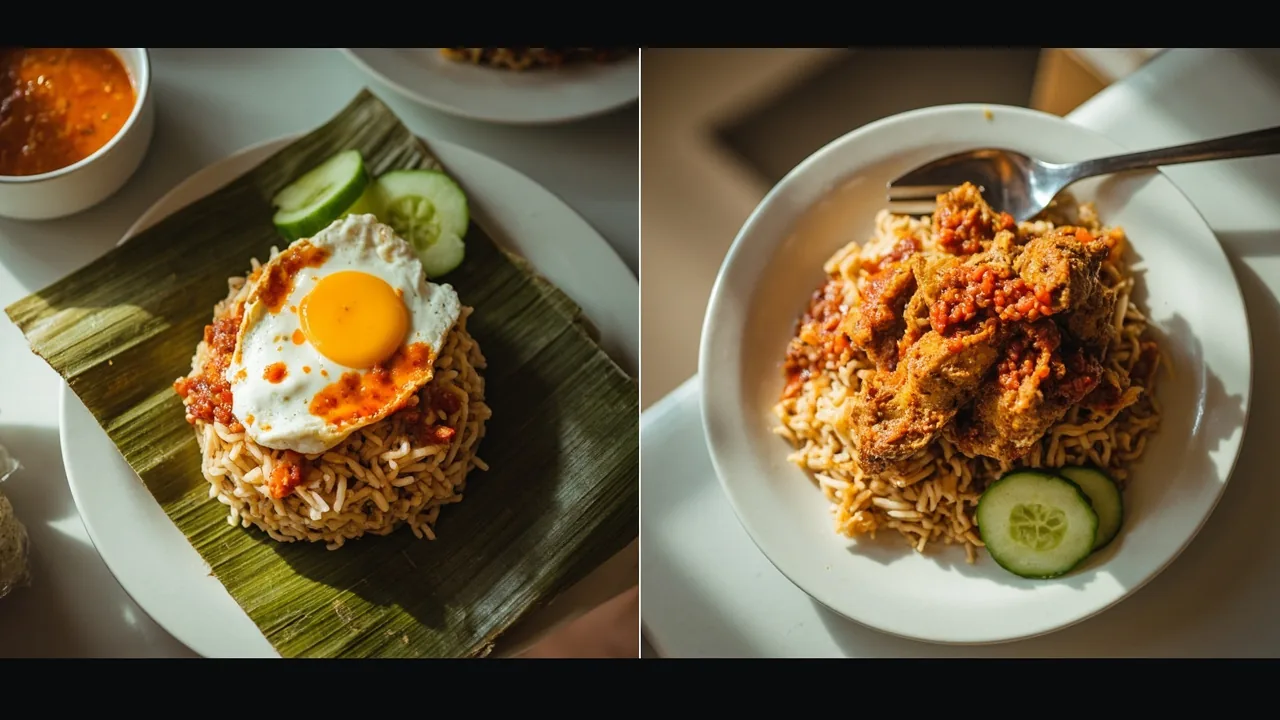
- Nasi lemak (coconut rice, sambal, anchovies, egg, cucumber), ₹94-₹188 (~4-8 MYR or ~$0.98-$1.96) at any hawker stall
- Char kway teow (flat rice noodles, prawns, egg, bean sprouts, dark soy), ₹165-₹283 (~7-12 MYR or ~$1.71-$2.93)
- Asam laksa (sour fish curry noodle soup, tamarind-based), ₹141-₹236 (~6-10 MYR or ~$1.47-$2.45)
- Roti canai (flaky flatbread with dhal or curry), ₹35-₹71 (~1.50-3 MYR or ~$0.37-$0.73) at mamak stalls
- Hainanese chicken rice, ₹118-₹236 (~5-10 MYR or ~$1.22-$2.45)
Pros:
- Cheapest regional food in Southeast Asia after Vietnam and Laos
- Massive regional variety, every state has its own cuisine
- Strong Indian food scene (KL Brickfields, Penang Little India)
- 24-hour eating culture, mamak stalls open until 5 AM in cities
Cons:
- Hygiene standards vary, especially in smaller towns
- Halal labelling can be strict, which limits some pork dishes
- Less air-conditioned comfort than Singapore hawker centres
- English is fine in cities but thinner in rural areas
Singaporean Food, The Honest Version
Singaporean food is what happens when a city-state takes a regional cuisine, standardises it, and presents it back to the world. The famous dishes (chicken rice, laksa, bak kut teh, satay) were either invented in Singapore or brought over by migrants and refined. There is a real national cuisine here, distinct from Malaysian food, even if the overlap is large.
Hawker centres are the soul of the food scene. Singapore has over 100 hawker centres, and they are a UNESCO-listed cultural institution. The hygiene is graded, the stalls are licensed, and the prices are set by the government for basic dishes.
Signature dishes to try:
- Hainanese chicken rice, ₹298-₹597 (~4-8 SGD or ~$3.10-$6.19) at hawker centres
- Laksa (curry coconut noodle soup), ₹373-₹597 (~5-8 SGD or ~$3.87-$6.19)
- Bak kut teh (pork rib peppery soup), ₹597-₹1,119 (~8-15 SGD or ~$6.19-$11.61)
- Chilli crab (Singapore’s national seafood dish), ₹2,238-₹4,475 (~30-60 SGD or ~$23.23-$46.45) per kg at seafood restaurants
- Char kway teow, ₹373-₹597 (~5-8 SGD or ~$3.87-$6.19)
- Roti prata, ₹112-₹224 (~1.50-3 SGD or ~$1.16-$2.32)
Pros:
- World-class hygiene grading at hawker centres
- Michelin-starred street food at sub-₹746 (~10 SGD or ~$7.74) prices
- Easy logistics, every hawker centre is MRT-connected
- English is universal, no menu translation headaches
Cons:
- Costs roughly 3x Malaysia for the same dish
- Less regional variety, since it’s a city-state
- Tourist areas (Chinatown, Bugis) mark up prices aggressively
- Real estate is scarce, so buffet-style hawker exploration is harder
Cost Comparison in Local Currency
| Expense | Malaysia (MYR) | Singapore (SGD) |
|---|---|---|
| Hawker meal (avg) | ₹188-₹353 (~8-15 MYR or ~$1.96-$3.67) | ₹373-₹746 (~5-10 SGD or ~$3.87-$7.74) |
| Indian restaurant meal | ₹353-₹707 (~15-30 MYR or ~$3.67-$7.34) | ₹895-₹1,865 (~12-25 SGD or ~$9.29-$19.36) |
| Coffee (kopi) | ₹35-₹71 (~1.50-3 MYR or ~$0.37-$0.73) | ₹112-₹224 (~1.50-3 SGD or ~$1.16-$2.32) |
| Local transport (per day) | ₹236-₹471 (~10-20 MYR or ~$2.45-$4.89) | ₹597-₹1,119 (~8-15 SGD or ~$6.19-$11.61) |
| SIM card (tourist, 7 days) | ₹589-₹707 (~25-30 MYR or ~$6.11-$7.34) | ₹1,492-₹2,238 (~20-30 SGD or ~$15.48-$23.23) |
| Visa fee | ₹2,356 (~100 MYR or ~$24.46) | 0 |
| Famous dish (chilli crab per kg) | ₹1,414-₹2,356 (~60-100 MYR or ~$14.67-$24.46) | ₹2,238-₹4,475 (~30-60 SGD or ~$23.23-$46.45) |
| Beer | ₹283-₹471 (~12-20 MYR or ~$2.93-$4.89) | ₹746-₹1,343 (~10-18 SGD or ~$7.74-$13.94) |
| 7-day food total (budget) | ₹8,246-₹11,780 (~350-500 MYR or ~$85.60-$122.28) | ₹14,918-₹26,106 (~200-350 SGD or ~$154.85-$270.98) |
| 7-day food total (comfortable) | 700-1000 MYR | 500-800 SGD |
Exchange rate at time of writing: 1 MYR ≈ ₹23.59, 1 SGD ≈ ₹74.76. So a 7-day food budget in Malaysia (₹9,424 (~400 MYR or ~$97.83)) is roughly ₹9,400 (~$97.57), while the same week in Singapore (₹18,647 (~250 SGD or ~$193.56)) is around ₹18,700 (~$194.11), about double.
Why Indian Backpackers Should Care
Food is the single biggest difference between Malaysia and Singapore for Indian travellers, and it’s not the cuisine itself, it’s the surrounding ecosystem.
Halal and vegetarian labelling. Malaysia has stricter halal rules, which means chicken rice in Malaysia is almost always halal, but pork-based dishes like bak kut teh are harder to find in some areas. Singapore labels both, and you can find excellent veg Indian food at any hawker centre. If you’re strict vegetarian, Singapore’s Little India and the Annalakshmi-style vegetarian restaurants are easier to navigate.
Indian food depth. Both countries have large Tamil and Punjabi communities, but Malaysia’s Indian food scene is more spread across the country (Penang, Ipoh, KL), while Singapore’s is concentrated in Little India and Geylang. For a 5-day food trip, Singapore’s compactness wins. For a 2-week regional food tour, Malaysia’s spread wins.
Mamak culture. Malaysian mamak stalls (24-hour Indian-Muslim restaurants) are a whole phenomenon. You can eat roti canai at 3 AM, drink teh tarik, and watch football. Singapore has late-night food but not the same all-night mamak culture.
Spice tolerance. Both cuisines handle spice well, but Malaysian Indian food tends to be heavier on the masala, while Singaporean Indian food is often more refined. Travellers who like their dal spicy should head to Penang; travellers who want variety and presentation should stick to Singapore.
Where to Eat in Singapore (Without Regret)
Since this site’s shortlist is Singapore-focused, here are the actual spots worth hitting, not generic “go to a hawker centre” advice.
For hawker staples: People’s Park Food Centre Blk 32 in Chinatown is one of the most reliable hawker centres in the city, with a wide range of local dishes under one roof. The chicken rice and laksa stalls here are consistently good, and it’s a 5-minute walk from Chinatown MRT.
For Indian food in Singapore: Black Pepper Multicuisine Restaurant near Little India serves North and South Indian dishes in a modern setting, with a 4.8 rating from travellers. Sahebs on Orchard Road is the spot for a fine-dining North Indian meal, Punjabi-style, with a 4.7 rating.
For Thai food in Singapore (yes, really): Khao Hom by Rung Mama in Ang Mo Kio is an authentic Thai spot with a 4.7 rating, useful if you want a break from local food and are planning a Thai vs Vietnamese food comparison trip.
For drinks and atmosphere: Bojio Pub is a live-music bar with a 4.3 rating, known for its Spicy Mango Mojito. If you want a more upscale cocktail spot, Coriander Leaf at the Singapore Polo Club sits at 4.5.
For sights between meals: Merlion Park is essential, the half-lion, half-fish statue overlooking Marina Bay is the city’s most photographed spot. See Merlion Park tours on GetYourGuide. Marina Bay Sands SkyPark gives you the skyline shot from 200 metres up. See Marina Bay Sands SkyPark Observation Deck Ticket tours on GetYourGuide. For a calmer evening, the Singapore River Cruise combined with the Garden Rhapsody light show is a 4.7-rated experience that combines three attractions in one evening.
Where to Stay in Singapore (Backpacker Picks)
Singapore is not cheap, but the hostel scene is solid. From the shortlist:
| Hostel | Rating | Book |
|---|---|---|
| Dream Lodge @ Tyrwhitt | 9.2 | Check prices |
| Atelier Hostel | 9.08 | Check prices |
| The Bohemian | 8.94 | Check prices |
| Dream Lodge @ Farrer Park | 8.62 | Check prices |
The Bananarchy Take
Here’s the honest call. If you want the most fascinating food experience per dollar spent, go to Malaysia. Penang and KL give you a week of eating that would take a month in Singapore to replicate, and the regional variation (Penang vs KL vs Ipoh vs East Malaysia) is something Singapore can’t match because it’s a city-state.
But if you want a food trip that is easy, predictable, and high-quality from start to finish, Singapore is the cleaner choice. Hawker grading, MRT access, English everywhere, and the no-visa-for-Indians reality make it the lowest-friction food destination in Southeast Asia for first-timers.
The Reddit consensus on “Malaysia vs Singapore food which is better” usually lands on Malaysia for authenticity and Singapore for cleanliness. Travellers report that the taste difference is real but small, while the price difference is large and the logistics difference is huge.
If you’re already doing a Southeast Asia backpacking trip that includes Thailand or Vietnam, the smart move is to tack on Singapore for 3 days at the end (it’s the regional flight hub) and skip Malaysia. If your trip is Malaysia-focused, fly in and out of Singapore, spend 2 days there, and use the rest of the time in Penang and KL. There’s no wrong answer, only suboptimal sequencing.
For broader regional context, this comparison sits inside a wider food debate across Southeast Asia. Street food showdown: Bangkok vs Hanoi vs Penang covers the Vietnam and Thailand angles, and the Penang vs Singapore food comparison goes deeper on the hawker centre face-off.
Getting Connected
Both countries have excellent mobile data. For broader Southeast Asia backpacking routes and connections, see the hub guide. Singapore’s tourist SIMs (Singtel, StarHub, M1) run ₹1,492-₹2,238 (~20-30 SGD or ~$15.48-$23.23) for 7 days with 100 GB, available at Changi Airport on arrival. Malaysia’s tourist SIMs (Maxis, Celcom, Digi) run ₹589-₹707 (~25-30 MYR or ~$6.11-$7.34) for similar data, available at KLIA or any 7-Eleven. If you’d rather skip the airport counter, Get Nomad eSIM works in both countries and you can activate before you fly.
Can You Do Both?
Yes, this is the only comparison where the answer is a clear “do both.” The Johor Bahru-Singapore Causeway connects the two countries directly, and there are buses every 15 minutes from Woodlands or Kranji MRT to Larkin Bus Terminal in JB. A 5-day Singapore + 7-day Malaysia trip is the classic backpacker sequence.
Suggested itinerary:
- Days 1-3: Singapore (Chinatown hawker, Little India, Marina Bay sights)
- Days 4-5: Day trip to Johor Bahru or overnight in Melaka (colonial-era town, Nyonya food capital)
- Days 6-12: Penang (hawker food, Indian food, beach time at Batu Ferringhi)
- Days 13-15: Kuala Lumpur (Brickfields Indian food, mamak hopping, Petronas Towers)
Total cost roughly ₹35,342-₹47,122 (~1,500-2,000 MYR or ~$366.85-$489.13) + ₹22,377-₹37,295 (~300-500 SGD or ~$232.27-$387.12) for two weeks of food and transport, which lands at around ₹60,000-₹80,000 (~$622.80-$830.40) for the food-and-transport slice of a longer trip.
If you’re already doing a Thai vs Vietnamese food comparison trip, ending in Singapore is the natural bookend since Singapore Airlines, Scoot, and AirAsia all have cheap flights from Bangkok, Hanoi, and KL.
FAQ
Is Malaysian food cheaper than Singaporean food?
Yes, by a factor of about 2x to 3x for the same dish. A plate of char kway teow in Penang runs ₹165-₹283 (~7-12 MYR or ~$1.71-$2.93), while the same dish in Singapore runs ₹373-₹597 (~5-8 SGD or ~$3.87-$6.19). The gap is largest at hawker centres and smallest at high-end restaurants.
Which city has better Indian food, KL or Singapore?
Different strengths. KL has more variety across the city (Brickfields, Bangsar, Petaling Jaya) and serves proper Chettinad-style banana leaf rice. Singapore has more refined North Indian dining and established 24-hour South Indian options. For a 5-day trip, Singapore is more convenient. For a 2-week trip, KL’s depth wins.
Can I do Malaysia and Singapore in one trip?
Yes, and you should. The Causeway connection makes it trivial, and the cuisines complement each other. Singapore is the polished version, Malaysia is the original. Doing both gives you context for both.
Is Singapore worth it just for the food?
If you have unlimited time, no. If you have 3 days on a longer trip, yes. Singapore’s food is world-class but not unique, you can eat similar dishes in Penang, KL, Jakarta, or even Bangkok. The advantage is logistics and hygiene, not flavour.
Which country is better for vegetarian Indian travellers?
Singapore is slightly easier because the Indian food scene is dense and the labelling is clear. Malaysia is more varied but requires more planning, especially outside KL and Penang.
Do I need a visa for Singapore or Malaysia as an Indian citizen?
Singapore: no visa for Indian passport holders, just the SG Arrival Card (free, online). Malaysia: eVisa required, around ₹2,356 (~100 MYR or ~$24.46) for single entry, processed in 1-3 working days through the official Malaysia eVisa portal.
Is it safe to eat street food in both countries?
Singapore’s hawker centres are graded by the government and safe. Malaysia’s hawker centres are safe in cities and tourist areas, but stick to busy stalls where the food is turning over fast. Avoid pre-cut fruit from street vendors in both countries if you have a sensitive stomach.
