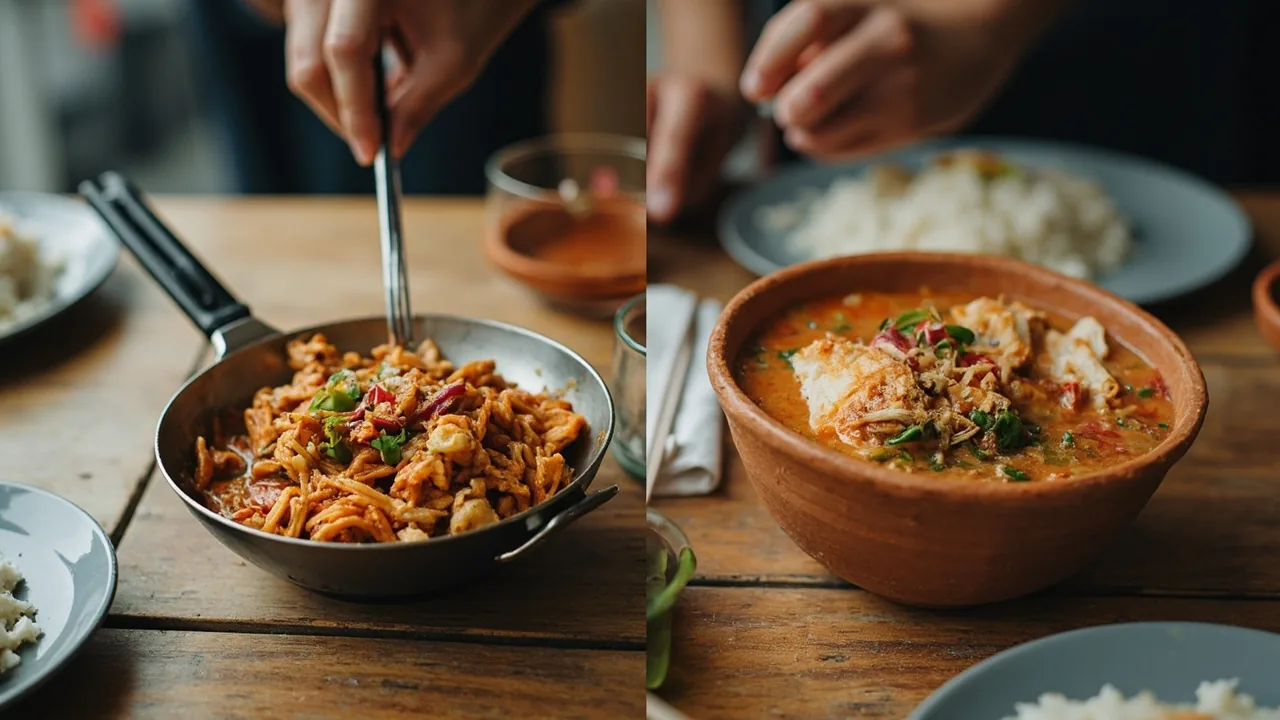
Thai vs Cambodian Food: How Similar (and Different) Are They Really?
Thai and Cambodian food are about 70% similar in ingredients (rice, coconut milk, fish sauce, lemongrass) but differ sharply on heat, sweetness, and umami depth. Thailand serves bolder, five-flavour-zone plates; Cambodia serves gentler dishes built around freshwater fish, rice, and French colonial ghosts.
Quick Answers
| What | Answer | Price (INR) |
|---|---|---|
| Daily food budget (Thai street food) | 3 to 5 meals a day in Thailand from roadside stalls | ₹572 (~200 THB or ~$5.94) |
| Daily food budget (Cambodia) | The street food in Phnom Penh is the cheaper side of the border | ₹595 (~25,000 KHR or ~$6.18) |
| National dish of Thailand | Pad Thai, but Tom Yum, Som Tum, and Massaman curry all have stronger claims | ₹172 (~60 THB or ~$1.78) |
| National dish of Cambodia | Fish Amok, a coconutty steamed curry, plus Lok Lak and Nom Banh Chok | ₹833 (~35,000 KHR or ~$8.75) |
| Spice level on average | Thai curries punch you in the face, Khmer dishes hold back and lean on aromatics | Thai hot, Khmer medium |
Subodh’s pro tip: Don’t order “mild” in Thailand and expect Indian-restaurant-level mild. Thai kitchen mild still has a kick. Order “pet nit noi” (just a little spicy) if you want it gentle, or “mai pet” (no spice) and accept that the dish will taste different from the version in the photo. You may also find Is Hanoi Or Ho Chi Minh City Better for Nightlife useful for this trip.
Quick Comparison Table
| Factor | Thai | Cambodian |
|---|---|---|
| Daily food cost | Lower per meal thanks to competition, Bangkok stalls are notoriously cheap | Slightly cheaper per calorie in Cambodia, but portions run smaller |
| Visa for Indians | Visa-free entry, 60 days on passport stamp | Visa on arrival or eVisa, roughly ₹2,890 (~30 USD) |
| Best months (food + weather) | November to February (cool, dry, mango season) | November to January (cool, dry, mango season) |
| Veg food availability | Stronger, Bangkok and Chiang Mai have dedicated veg neighbourhoods | Limited, Phnom Penh and Siem Reap have only a handful of veg-friendly spots |
| Spiciness on default | Hot by default, easy to dial down | Medium by default, most curries are aromatic rather than fiery |
| English spoken on menus | Almost every stall has a menu with English and photos | Often Khmer-only with no pictures, you point or learn three words |
| Coconut milk usage | Heavy in curries and desserts | Heavy in fish curries and desserts, often with galangal |
| Sweetness profile | Sweetness is a stated taste zone, sugar goes into everything from pad Thai to fried chicken | Less sugar in mains, more in desserts like num pang and the seasonal fruits |
| Fish sauce usage | Frequent, sometimes beside soy | heavy, prahok (fermented fish paste) is the foundation of Khmer umami |
| Vibe | Loud, busy, flavour-first, every stall is a competition | Quieter, smaller menus, French baguette sandwiches sit beside amok |
| Best for | Travellers who want variety and want to eat every meal as an event | Travellers who want subtle flavours, rice as the centre of the plate, and don’t mind pointing |
Choose Thai Food If…
- You want every meal to come with crunch, acid, sweet, salt, and heat all on one plate. Thai cuisine is built on balancing five flavour zones in a single dish, which makes eating there feel like a complete experience even at a stall with one plastic table.
- You’re vegetarian or vegan and want options everywhere. Bangkok, Chiang Mai, and Pai all have dedicated veg districts, and even omnivore stalls usually offer a tofu or vegetable version of their hero dish. Soy milk replaces fish sauce in many Thai stir-fries.
- You want a dessert culture. Mango sticky rice, coconut ice cream in a hot bun, Thai tea, and pandan-layered cakes are a meal in themselves. Most of them happen to be vegetarian.
- You want to take a cooking class and have hundreds of options. Half-day market tours in Bangkok and Chiang Mai run every morning and cost less than a night out.
Choose Cambodian Food If…
- You want a quieter meal where rice is the centre of the plate. Khmer cuisine treats rice as the main event and everything else (the amok, the lok lak, the samlor) as the supporting cast. The portions reflect that.
- You like seafood and freshwater fish. Cambodia sits on the Tonle Sap, and fermented fish (prahok) and freshwater river fish appear in dishes that Thai cuisine barely touches.
- You want French colonial ghost flavours on the same trip. Phnom Penh bakeries sell Cambodian-style baguettes filled with pork or pâté, and the Khmer cuisine quietly absorbed that influence.
- You want to feel like you’re eating something your guidebook hasn’t planned yet. Cambodia gets far fewer food tourists than Thailand, so the average eatery is a discovery rather than a checked-off list.
Thai Food: Pros and Cons
Pros:
- Every stall has a menu in English with photos, so ordering is stress-free for first-timers
- Vegetarian and vegan options exist almost everywhere thanks to Buddhist-influenced meatless dishes
- Five taste zones per dish (sweet, sour, salty, spicy, bitter if you count the greens) keep meals interesting
- Cooking classes, market tours, and food tours are inexpensive and run multiple times a day
Cons:
- Tourist-area Thai food has been dialled back to mild for Western palates, so the “real” Thai flavour is harder to find without going off the strip
- Fish sauce and shrimp paste appear in many dishes that look vegetarian on the menu, so always ask
- Sweetness is heavier than in Khmer food, sugar goes into fried rice, pad Thai, and even some curries
- The “I tried something spicy and now I’m crying” cycle happens to a lot of first-timers
Cambodian Food: Pros and Cons
Pros:
- Curries and soups are built around coconut milk and turmeric rather than chilli, so the heat is more aromatic than aggressive
- Rice is the star of every meal, and a plate of rice plus an amok or lok lak fills you up for less than a Bangkok equivalent
- The French influence means crusty baguettes and coffee are everywhere, and the coffee is grown locally in Mondulkiri
- Travellers report almost no tourist-trap versions of dishes, so a random Phnom Penh curry house is more likely to taste “authentic” than a random Chiang Mai one
Cons:
- English menus and photos are rare outside of tourist zones, so ordering takes some courage or a translator app
- Vegetarian options are limited, and Khmer curries often contain prahok (fermented fish paste) by default
- Portions are smaller than Thai equivalents, so a hungry backpacker ends up ordering more
- Street food variety is narrower, fewer stalls per block compared to Bangkok
Cost Comparison
| Expense | Thai | Cambodian |
|---|---|---|
| Street food meal | ₹172 (~60 THB or ~$1.78) | ₹95 (~4,000 KHR or ~$0.99) |
| Restaurant meal (mid-range) | ₹572 (~200 THB or ~$5.94) | ₹595 (~25,000 KHR or ~$6.18) |
| Local transport (per day) | ₹286 (~100 THB or ~$2.97) | ₹381 (~16,000 KHR or ~$3.95) |
| SIM card tourist | ₹855 (~299 THB or ~$8.87) | ₹482-₹674 (~5-7 USD) |
| Beer (local) | ₹200 (~70 THB or ~$2.08) | ₹71 (~3,000 KHR or ~$0.74) |
| Cooking class (half-day) | ₹3,431 (~1,200 THB or ~$35.61) | ₹2,408 (~25 USD) |
| Coffee | ₹172 (~60 THB or ~$1.78) | ₹95 (~4,000 KHR or ~$0.99) |
| Dessert | ₹229 (~80 THB or ~$2.37) | ₹238 (~10,000 KHR or ~$2.47) |
| Mango sticky rice | ₹286 (~100 THB or ~$2.97) | ₹286 (~12,000 KHR or ~$2.96) |
For a same-budget traveller eating three meals plus snacks plus one cooking class a day over a week, Thai food in Bangkok or Chiang Mai runs cheaper per meal but a cooking class adds up. Khmer food adds up slower through the day, so the cost evens out over a week.
Subodh’s pro tip: Right now, 1 THB runs about 2.87 INR and 1 KHR runs about 0.024 INR. A 60 THB pad Thai is the same as a ₹95 (~4,000 KHR or ~$0.99) noodle soup in raw rupee terms, so don’t expect Cambodia to be a “huge” saving on food. The real saving in Cambodia comes from accommodation and museum passes.
The Shared Roots
Both cuisines grew up in the same Mekong region with the same rice-based agriculture, the same Buddhist fasting traditions that pushed meatless eating as a virtue, and the same monsoon-season pantry of lemongrass, galangal, kaffir lime, and turmeric. The same families crossed the same rivers, and several dishes (pork rice porridge, fermented fish sauce, sticky rice sweets) appear across both menus with only minor tweaks.
What changed over the last century:
- Thailand opened to tourism in the 1960s and the cuisine became a tourist product. Dishes were standardised, pad Thai was reinvented under nationalist rule, and menus spread to London and Los Angeles. Thai food abroad is a chosen subset.
- Cambodia lost its chef class between 1975 and 1979, and Khmer cuisine never got the same global marketing push. The dishes that survived are more rural and more tied to rice, river fish, and coconut palms.
Both cuisines use:
- Fish sauce as the main salt vehicle. In Cambodia, fermented fish paste (prahok) goes even further into the dish.
- Coconut milk for curries and desserts. Thai coconut milk is slightly thinner and lighter in tom kha and massaman. Khmer coconut milk in amok is denser and seasoned with turmeric.
- Lemongrass and galangal in soups and curries. Tom Yum has them raw and sharp. Samlor Machu has them cooked long and softer.
- Rice in three forms: jasmine (long grain, Thailand), jasmine and a fragrant short grain (Cambodia), plus glutinous sticky rice in the northeast of Thailand and around Battambang.
What Sets Them Apart
The Heat
Thai cuisine puts cap-sicum and bird’s-eye chilli into the dish at the end, so the heat hits you first. Khmer cuisine cooks turmeric, galangal, and chilli into the curry base, so the heat arrives later and feels more rounded.
Curries make this clear. Thai green curry is bright green with bird’s-eye chilli paste, Thai red curry is thicker with dried chilli paste. Khmer amok is yellow from turmeric and coconut milk, with a softer finish.
The Sweetness
Sugar is one of the five flavour zones in Thai cooking. Pad Thai starts with tamarind pulp and sugar, fish sauce and chilli. Many Thai stir-fries balance sweet against sour against salty, all as equals. Khmer cooking tends to take the sweetness out of the mains and pour it into the desserts instead.
The Umami Source
Both cuisines use fish sauce, but Cambodia takes it further with prahok (fermented river fish paste) and Cambodia also keeps dried fish and salted fish in the kitchen as building blocks. Travellers who tried the Khmer version of the same dish often say it tastes “deeper” than the Thai version, in the same way Italian anchovies are deeper than Spanish olive oil.
The Fat
Both cuisines use coconut milk, but the dish most foreigners point to in Cambodia (fish amok) is a steamed coconut-milk custard with fish wrapped in banana leaves. It’s closer to a curry-meets-egg-custard than a stir-fry. The Thai version of coconut milk is the tom kha gai soup or the thin coconut-paste in panang curry.
The Influence
Thai cuisine absorbed heavy Chinese influences (chilli, soy, wok-frying, dim-sum-style snacks). Khmer cuisine absorbed heavier French and Vietnamese influences (baguettes, pâté, coffee). If you’ve eaten banh mi in Vietnam, the Cambodian num pang sandwich will look and taste familiar.
Side-by-Side Dish Comparison
| Dish Slot | Thai Version | Khmer Version |
|---|---|---|
| National noodle | Pad Thai (stir-fried rice noodle, tamarind, sugar, fish sauce, egg, tofu, peanut) | Nom Banh Chok (cold rice noodles with fish curry gravy, cucumber, herbs) |
| National curry | Green curry or Massaman (coconut, green chilli paste, peanut, potato) | Fish Amok (steamed fish in coconut turmeric custard, banana leaf) |
| National stir-fry | Pad Krapow (holy basil, chilli, pork or chicken, garlic, served on rice with fried egg) | Lok Lak (stir-fried beef, tomato, onion, served with rice and lime-pepper dipping sauce) |
| National soup | Tom Yum Goong (hot and sour shrimp soup, lemongrass, galangal, kaffir lime) | Samlor Machu Trey (sour fish soup, tamarind, okra, bean sprout, Khmer celery) |
| National salad | Som Tum (green papaya pounded with chilli, lime, fish sauce, sugar, peanut) | Pickled green mango salad (lighter, no sugar, no fish sauce in tourist versions) |
| National dessert | Mango Sticky Rice | Num Krok (coconut-rice pancakes) or seasonal fruits with salt-chilli-sugar dip |
| National breakfast | Jok (rice porridge) or Khao Tom (soup rice) | Bay Sach Char (rice with pork and veggies) or rice porridge with quail egg |
Cooking Class Comparison
Both countries run half-day market + cook + eat programs. The Thai version has more options, but the Khmer version is more relaxed.
- Thai cooking class: ₹3,276 (~34 USD) in Bangkok and Chiang Mai, includes a market walk, four dishes, recipe booklet, lunch or dinner
- Khmer cooking class: ₹2,408-₹3,372 (~25-35 USD) in Phnom Penh and Siem Reap, includes a market walk and usually three to four dishes
If you’re taking both, do the Thai one first. The Khmer cuisine will look more familiar after a Thai class, and you’ll spot the overlaps faster.
For tours, see Compare tours on GetYourGuide if you want to book before arriving.
The Bananarchy Take
Most backpackers eat their way through Thailand first and then cross into Cambodia. That’s the right order for two reasons. First, Thai food prepares your palate for Khmer food. Second, the Cambodian food feels quiet and elegant in comparison, and that contrast is what makes Khmer cuisine memorable.
For Indian travellers specifically, Thailand wins on vegetarian variety and on the strong soy-milk-and-tofu options that exist across most dishes. Cambodia wins on rice-based mains and on subtle flavours that pair well with Indian-style mixed grills if you’re doing both within one trip.
Don’t plan a “Thai food trip” or a “Cambodian food trip”. Plan a two-country trip that gives you at least four days in each. The cuisines are similar enough that one without the other feels incomplete. For a broader country-level comparison beyond food, see Thailand vs Cambodia for Indian Backpackers.
Bananarchy’s one trip covers both, with a market-to-plate cook in Bangkok and a Khmer cooking class in Siem Reap. Same trip, two cuisines, one seat.
Getting Connected
Thailand’s tourist SIM (AIS, dtac, TrueMove) runs about ₹855 (~299 THB or ~$8.87) for 8 days at the airport, or ₹57 (~20 THB or ~$0.59) less at a 7-Eleven with passport. Cambodia’s main tourist SIM (Smart, Cellcard, Metfone) runs ₹482-₹674 (~5-7 USD) for a week or a fortnight of data. For most backpackers, the Cambodia SIM is cheaper but the Thailand network covers more remote islands and hill-tribe areas.
For a no-physical-SIM option that covers both countries on one eSIM, Get Nomad eSIM and pick a regional Southeast Asia data plan.
Can You Do Both?
Yes, and this is the most common version of an overland SEA trip. The standard loop is Bangkok, then overland or a flight to Siem Reap, then Phnom Penh, then back into Thailand or onward to Vietnam. Food-wise, plan at least:
- 4 days of Bangkok and Chiang Mai or Pai to absorb the range of Thai food
- 2 days of Siem Reap to eat Khmer cuisine between temple days
- 2 days of Phnom Penh to try coffee, baguettes, and the local curry houses
Total trip: 10 days minimum, 14 days comfortable. Combined food budget per day averages out to roughly the same as a Thai-only trip because accommodation is cheaper in Cambodia, and that saving offsets the higher Cambodia visa fee.
For a deeper look at comparing Thai food against a different cuisine, see Thai vs Vietnamese food and the broader street food showdown.
FAQ
Is Thai food spicier than Cambodian food? Generally yes. Thai cuisine leans on chilli paste and fresh bird’s-eye chilli at the end of cooking. Khmer cuisine uses turmeric and galangal as the building blocks and the heat is more aromatic. Order “pet” in Thai if you want hot, and “mai pet” if you don’t. Khmer food rarely needs the warning.
Which one is cheaper for an Indian backpacker? Cambodia is cheaper per meal in raw rupee terms, with most street meals at ₹595 (~25,000 KHR or ~$6.18). Thailand is more competitive per stall because of Bangkok’s density, and a ₹172 (~60 THB or ~$1.78) pad Thai is about the same in rupees. The bigger Thai saving is variety at that price; the bigger Cambodia saving is on accommodation.
Can I find vegetarian food easily in both? Easier in Thailand. Bangkok and Chiang Mai have dedicated veg neighbourhoods, and most stir-fries have a tofu version. Cambodia has fewer pure-veg restaurants, and Khmer curries often contain prahok or fish sauce by default. Ask at every Khmer stall whether the dish is made with prahok if you’re strict about it.
Do I need a visa for either? Indian passport holders get a visa-free 60-day stamp in Thailand. Cambodia requires a visa on arrival (about ₹2,890 (~30 USD)) or an eVisa. Full Thai visa rules are listed at the Thailand backpacking hub. There’s no joint visa. The Thailand stamp and the Cambodia eVisa can be done on the same trip in any order.
Which cuisine is closer to Indian food? Both have a few overlaps with South Indian food: the use of curry leaves in Thai cuisine, the rice-based breakfast in Khmer cuisine, and the sweet-sour flavour combination in both. Travellers report Thai cuisine as the closer match because of the coconut curries and the heat profile, while Khmer cuisine feels more South-East Asian overall.
Should I take a cooking class in one or both? Both, if you have time. The Thai classes are more polished and have hundreds of options, while Khmer classes are more home-style. The Thai class will set you up for spotting Khmer ingredients by sight on day two of the Cambodia leg.
Can I use Indian rupees in Thailand or Cambodia? No. Both countries use their local currency. Thai baht and Cambodian riel are used side by side in Cambodia for small change, but Thai baht does not flow into Cambodia any more (only on rare border-marker shops). Carry some USD for Cambodia to get the best rate on a visa on arrival and on bigger purchases.
Where to Stay on a Thai + Cambodia food trip? Most backpackers base in Bangkok (Khao San / Sukhumvit) for 4 nights, then move to Siem Reap (Pub Street area, 2 nights), then Phnom Penh (Riverside or BKK1, 2 nights).
