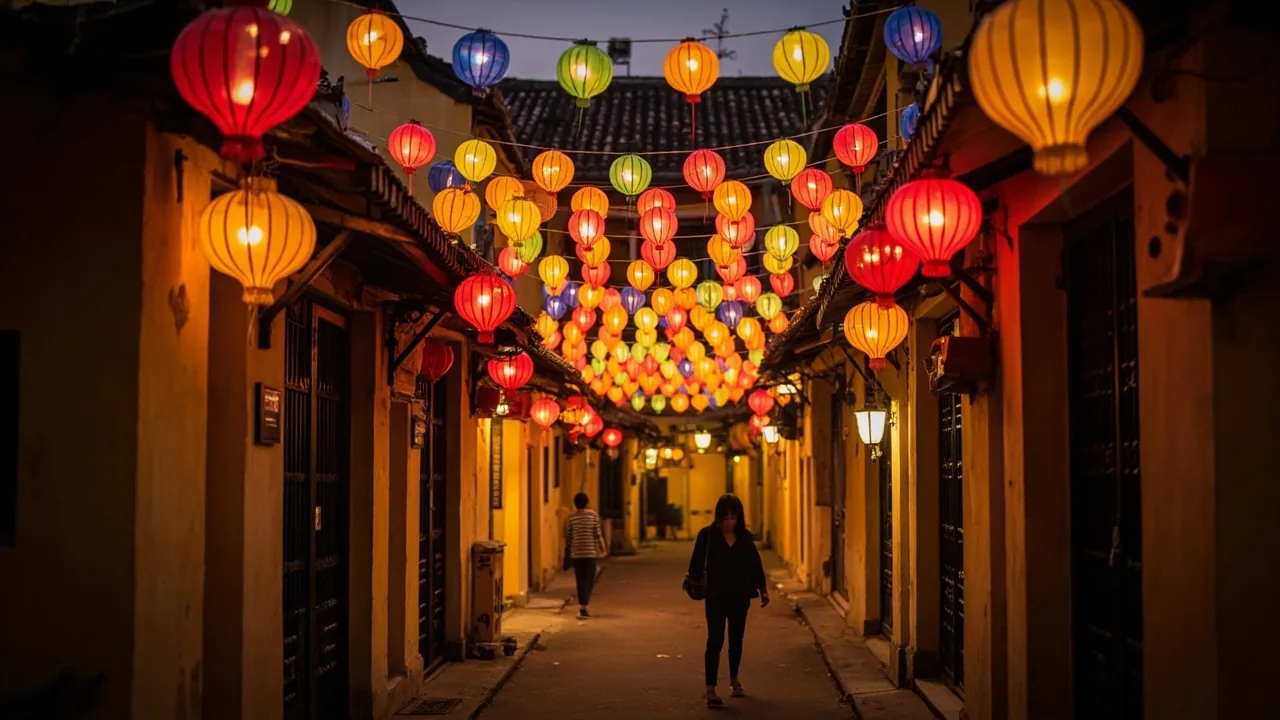
Where Are the Lanterns in Hoi An? A Photowalk Map for Indian Travelers
The lanterns in Hoi An cluster in 5 main spots: both banks of the Thu Bon riverside, the Japanese Covered Bridge, the alleys off Nguyen Thi Minh Khai and Tran Phu, and the 4 Old Town gates. A free 1.5 km riverside loop hits the densest clusters in 90 minutes. Ticket: ~₹441 (~120,000 VND or ~$4.57) on festival nights and ticket-required evenings.
This guide maps that loop with exact timing, the monthly festival schedule, and the rules about touching lanterns. For related planning, see our guide on Sea Backpacking Hub or Famous Train in Vietnam Reunification Express Cost Worth It.
Quick Answers
| What | Answer | Price (INR) |
|---|---|---|
| When do lanterns come on in Hoi An? | Daily, sunset to ~10 pm (no ticket needed outside festival nights) | Free |
| Monthly Hoi An Lantern Festival date | Full moon night of the lunar calendar, every month | Free for the riverside, ₹441 (~120,000 VND or ~$4.57) for the Old Town ticket |
| Old Town entrance ticket | Required on festival nights and certain weekends; covers 5 of the main heritage sites | ₹441 (~120,000 VND or ~$4.57) |
| Best photo hour (lanterns on, soft light, low crowd) | 8:30 to 9:30 pm | Free |
| Cheap dorm in Hoi An | 105,000-240,000 VND per night | ₹350-800 |
Note: 1 VND ≈ ₹0.0037 right now. A 240,000 VND dorm bed comes to about ₹890 (~$9.24), and a ₹184 (~50,000 VND or ~$1.91) banh mi works out to roughly ₹185 (~$1.92). These rates shift weekly; the prices in this guide use the current rate as of July 2026. You may also find Vietnam Best Beaches Under 15000 Rupees Indian Travelers useful for this trip.
Two Routes: Free Walk vs. Paid Old Town Ticket
Hoi An runs two parallel lantern experiences, and most first-timers confuse them. Pick the wrong one and you either overpay or miss the part you came for. See also: Southeast Asia on 1 500 Day Country By Country Budget Breakdown.
| Factor | Free Riverside Walk (every night) | Old Town Ticket + Lantern Festival (monthly) |
|---|---|---|
| What you see | Lanterns over the river, lanterns in riverside shops, the bridge from outside | Inside the Ancient Town alleys, festival crowds, floating candle trays on the river |
| Crowd level | Heavy on weekend evenings, manageable on weeknights | heavy. Expect to wade through bodies from 7 to 9 pm |
| Ticket cost | Free | ₹441 (~120,000 VND or ~$4.57) per person, covers 5 heritage sites |
| When it happens | Every night, sunset to ~10 pm | The full moon night of every lunar month (see schedule below) |
| Best for | Photographers who want clean shots with low foot traffic | Travellers who want the festival ritual, boat ride, and energy |
| Best photo window | 7:30 to 8:30 pm, weeknight | 9 pm onwards on the festival night, once the first wave of crowds thins |
The honest take: if your only goal is the viral lantern photos, do the free walk on a weeknight. If you want the cultural ritual, lantern-making classes, candle-floating, and the festival atmosphere, pay for the festival night once. For related planning, see our guide on Southeast Asia on 3 000 Day Country By Country Budget Breakdown.
Quick Comparison Table
| Factor | Free Walk | Old Town Ticket |
|---|---|---|
| Cost (₹) | Free | ₹444 (~$4.61) |
| Best night of month | Any weeknight (Mon-Thu) | Full moon lunar night |
| Crowd | Medium on weeknights, heavy weekends | heavy on festival night |
| Coverage | Riverbanks + bridge exterior | Inside alleys + riverside |
| Photo flexibility | Move at your own pace | Roped off routes during festival |
| Rules on touching lanterns | Shop lanterns: ok to look, ask before touching | Festival lanterns: never touch, fine applies |
Choose the Free Walk If…
- You want clean, low-crowd shots of the lanterns over the river
- You are in Hoi An for 2 or more nights and can pick a weeknight
- You don’t care about the candle-floating ritual
- You don’t want to buy the ₹441 (~120,000 VND or ~$4.57) ticket (₹444 (~$4.61))
- You want full flexibility to step off the main tourist loop
Choose the Old Town Ticket If…
- You only have one night in Hoi An and it happens to be the festival night
- You want to combine lantern photos with the Japanese Covered Bridge interior and 4 other heritage sites
- You want to attend a lantern-making class (see festival schedule below)
- You want the candle-on-water ritual: a small wax tray floated down the Thu Bon from a sampan
- You don’t mind dense crowds and a tourist-heavy atmosphere
Free Walk. Pros and Cons
Pros:
- Zero cost, no ticket booth queue
- Crowds thin out fast after 9 pm, especially on weeknights
- Full flexibility to wait for the right light, the right gap between tour groups
- The most photographed stretch (the riverside near the Japanese Bridge) is fully outside the ticketed zone
Cons:
- Misses the lantern clusters inside the narrow alleys between Tran Phu and Bach Dang
- No access to the indoor lantern museums or the lantern-making demonstrations on Tran Phu
- Festival night crowds spill out and ruin riverside shots even from the free side
Old Town Ticket. Pros and Cons
Pros:
- Access to the densest lantern alleys, the 5 heritage buildings, and the covered bridge interior
- Festival night access: candle floating, lantern parade, traditional performances on the stage near the river
- One ticket covers up to 5 site entries, including the History Museum and the old houses
- Lantern-making classes happen inside the ticketed zone; most require ticket entry
Cons:
- ₹441 (~120,000 VND or ~$4.57) per person, every entry day, no multi-day pass
- Heavy crowds make tripod photography almost impossible between 7 and 9 pm on festival nights
- No re-entry once you leave; you must commit to staying in the zone
- Ticketing windows close at 9:30 pm, so late-night shots are out
Cost Comparison in ₹
This is what each option costs on the ground, beyond the ticket itself.
| Expense | Free Walk | Old Town Ticket |
|---|---|---|
| Entrance ticket | Free | ₹441 (~120,000 VND or ~$4.57) |
| Street food (banh mi, dinner) | ₹184 (~50,000 VND or ~$1.91) | ₹184 (~50,000 VND or ~$1.91) |
| Drinks at riverside cafe | ₹110 (~30,000 VND or ~$1.14) | ₹110 (~30,000 VND or ~$1.14) |
| Sampan boat ride (festival only) | N/A | ₹551 (~150,000 VND or ~$5.72) |
| Floating candle tray (festival only) | N/A | ₹37 (~10,000 VND or ~$0.38) |
| Dorm bed in Hoi An | ₹386-₹881 (~105,000-240,000 VND or ~$4-$9.15) | ₹386-₹881 (~105,000-240,000 VND or ~$4-$9.15) |
| Grab bike from dorm to Old Town | ₹37-₹92 (~10,000-25,000 VND or ~$0.38-$0.95) | ₹37-₹92 (~10,000-25,000 VND or ~$0.38-$0.95) |
| One-night total (budget) | ₹600-₹900 (~$6.23-$9.34) | ₹1,200-₹1,500 (~$12.46-$15.57) |
| One-night total (comfortable) | ₹1,200-₹1,600 (~$12.46-$16.61) | ₹1,800-₹2,200 (~$18.68-$22.84) |
The 600 rupee gap on the budget tier is mostly the ticket itself. On a festival night, add the ₹551 (~150,000 VND or ~$5.72) sampan ride (₹556 (~$5.77)) for the floating candle experience, which is genuinely the best part of the festival if you can stomach the crowds.
The Photowalk Map
This is the loop. The full walk is 1.5 km, takes 90 to 120 minutes at a photographer’s pace, and hits every dense lantern cluster.
Stop 1: The Japanese Covered Bridge (from outside, north end)
The bridge itself has a single red lantern hanging at the entrance on the northern side. The bigger photo is the view FROM the bridge: looking down the riverside, both banks glowing with red and gold lanterns. From here, no ticket needed. The shot is cleanest at 7:30 pm, just as the lights come on but before the tour groups arrive in force.
Stop 2: Nguyen Thi Minh Khai riverside (west bank, north section)
Walk south along the west bank. The lanterns here hang over the river, casting red reflections on the water. This is the densest cluster outside the ticket zone, and the buildings across the river are lit with a sea of small silk lanterns in red, gold, and pink. Most of the “Hoi An lanterns on the river” stock photos are shot from this stretch.
Stop 3: Tran Phu alleys (inside the ticket zone, west side)
Inside the ticketed Ancient Town, Tran Phu is the main street. Side alleys feeding off it (look for the alley signs marked with “Đường”) are where lantern density goes through the roof. The shops here hang lanterns from the second-floor eaves, so the alley is roofed in silk. The light is warm, the crowd is dense, and the photos are saturated. On festival night, this is also where the candle-floating stage gets set up.
Stop 4: Bach Dang riverside (east bank, full stretch)
Cross the bridge to the east bank and walk south along Bach Dang. This side has more cafes with outdoor seating, fewer tour groups, and lantern clusters over the river in longer, calmer stretches. The reflections here are better than the west bank because the buildings across (the west bank) have more lantern density per square metre. Photographers who want the most reflective water shots come to this side.
Stop 5: The Old Town gates (free to photograph from outside)
Hoi An’s Old Town is bounded by several historic gates and bridges at its edges, including the Japanese Bridge on the west and the Cau An Hoi Bridge on the east, plus the corner gates of the walled Old Town. Each is hung with large red lanterns, bigger than anything else in town. They’re all outside the ticket zone, so you can shoot them freely.
Stop 6: The Cau An Hoi Bridge (free, east end)
Often missed by first-timers. This bridge is 200 metres east of the Japanese Bridge, and it’s lit by a continuous row of lanterns along the railings. The view from the bridge is the shot: river, lanterns, and the Ancient Town behind you. It’s quieter than the Japanese Bridge, and locals use it to cross, not tourists.
Stop 7: Return via the riverside
Walk back along whichever bank you didn’t shoot on the way out. By 9 pm, the tour groups are mostly back at their hotels. The lanterns stay on until 10 pm. This is when you get clean shots.
Timing for Photos
The lantern lighting in Hoi An is timed to sunset, not a clock. In July, lanterns come on at about 6:45 pm. In December, it’s closer to 5:30 pm. The 30 minutes after sunset is when the sky still has colour, the lanterns are just turning on, and the light is softest. The “golden hour” for Hoi An lantern photography is the 30 minutes right after the lanterns come on, before the sky goes fully dark.
| Time | What you get | Crowd level |
|---|---|---|
| 6:30 to 7:00 pm (winter) / 7:00 to 7:30 pm (summer) | Sky still has colour, lanterns just on, soft light | Low |
| 7:30 to 8:30 pm | Lanterns fully bright, sky dark, reflections on the river | Heavy on weekends, manageable on weeknights |
| 8:30 to 9:30 pm | Crowds starting to thin, light still strong | Medium |
| 9:30 to 10:00 pm | Fewest people, lanterns still on, darker sky | Low |
The 7:30 to 8:30 pm window is the default recommendation, but the 8:30 to 9:30 pm slot is better for clean shots. If you can wait, wait.
The Monthly Hoi An Lantern Festival
The festival happens on the full moon night of every lunar month. The riverside becomes pedestrian-only, candle trays are floated down the Thu Bon, the streets fill with lantern parades, and traditional music plays from the stage near the Japanese Bridge. The lanterns get switched off briefly during the candle-floating ceremony (about 10 minutes), then all back on for the rest of the night.
The 2026 festival dates in Hoi An fall on the following nights (approximate, based on the lunar calendar; tourism offices publish the confirmed date 2 weeks ahead):
| Month 2026 | Festival Night (approximate) | Notes |
|---|---|---|
| January | 24 January | Coolest month, smallest crowd |
| February | 22 February (Tet overlap) | Avoid: Tet crowds and many shops closed |
| March | 24 March | Good conditions, low rain |
| April | 22 April | Hot, dry, manageable |
| May | 22 May | Hot, dry, photogenic |
| June | 20 June | Hot, humid |
| July | 19 July | Peak summer heat, late afternoon showers |
| August | 17 August | Same as July |
| September | 16 September | Rainy season starts to ease |
| October | 16 October | Best month overall |
| November | 14 November | Best month overall |
| December | 14 December | Cool, dry, second-best month |
Travellers report: the October and November festival nights are the best combination of weather and atmosphere. Avoid Tet (late January / early February) because the Old Town is partly closed for the holiday and most lantern-making classes are not running.
Lantern-Making Classes
A handful of shops inside the Ancient Town run lantern-making workshops, most lasting 2 to 3 hours. You pick a silk frame, stretch the fabric, and assemble your own lantern to take home. These are not the festival lantern parades; they’re hands-on classes.
Most workshops require the ₹441 (~120,000 VND or ~$4.57) Old Town ticket for entry to the shop. Prices vary by shop and duration; ask at your hostel or homestay for the current rate and to book a slot, since same-day availability is often limited on festival nights.
Rules About Touching Lanterns
This is the bit that gets first-timers into trouble.
On the riverside and in shops: the lanterns hanging outside shops are for sale. You can look, photograph, and ask about prices. Do not touch them without asking first. Some shopkeepers will allow it; some won’t. A polite gesture (“cho tôi chạm thử?” or just hand-on-heart + point) gets you a yes or no quickly.
Festival lanterns floating on the river: these are dedicated to a person (often a deceased relative) or a wish. Touching them is considered disrespectful. Don’t pick them up, don’t push them around, and don’t film yourself “playing” with one.
Public lanterns over the alleys inside the ticket zone: same rule. Photograph, don’t touch. The fines for tampering with public lanterns in Hoi An are real, and the police presence on festival nights is not symbolic.
Your own lantern from a class: yours to take home, yours to handle. Most classes will pack it carefully for the flight back.
Getting Connected in Hoi An
You’ll want Google Maps loaded for the photowalk loop and Grab for getting back to your dorm after dark. The free Wi-Fi at most cafes in the Old Town is strong enough for photo uploads, but a local SIM or eSIM is faster and more reliable.
Vietnam’s three big carriers (Viettel, Mobifone, Vinaphone) sell tourist SIMs at the airport and in any Hoi An phone shop. A 30-day tourist SIM with 3 to 4 GB per day runs ₹734-₹1,102 (~200,000-300,000 VND or ~$7.62-$11.43), usually with a Viettel or Mobifone brand. The signal in Hoi An Old Town is strong.
Get Nomad eSIM is the eSIM alternative if you don’t want to swap your Indian SIM out. Same coverage, same price band, instant activation on arrival. Either option works; the eSIM has the advantage of keeping your Indian number live on the same phone for UPI and OTPs.
Where to Eat Near the Lantern Loop
You’ll be hungry after the photowalk. Two reliable stops near the riverside, both confirmed as still operating in July 2026.
Nhan’s Kitchen sits just off the main lantern stretch and runs a short, sharp menu of Vietnamese staples. Cao Lau (the local noodle dish) is the reason to come. Cao Lau is a pork-and-noodle bowl specific to Hoi An; you cannot get it anywhere else in Vietnam. Order it here, expect ₹294-₹367 (~80,000-100,000 VND or ~$3.05-$3.81).
The Soul Restaurant is for the after-photo sit-down meal. Smaller space, seasonal menu, well-lit garden. The bun cha (grilled pork with cold noodles) is the signature. Expect ₹367-₹551 (~100,000-150,000 VND or ~$3.81-$5.72) per main.
For Indian food or strict vegetarian, MẸT Hội An has two locations in town (MET 9 and the Vietnamese cuisine & Vegetarian options branch on the other side). Both run a full Vietnamese vegetarian menu in a restored colonial building, plus a few Indian-leaning dishes. Cao Lau and the local vegetable curries are the highlights. Most mains run ₹294-₹551 (~80,000-150,000 VND or ~$3.05-$5.72). Vegetarians from India will not go hungry here.
Where to Stay
Hoi An has a wider hostel range than Da Nang or Hue, mostly because the Old Town is small and backpacker-oriented. Dorm beds run ₹386-₹881 (~105,000-240,000 VND or ~$4-$9.15) per night (₹350-₹800 (~$3.63-$8.30)), with most places clustered in two zones: the backpacker strip along Nguyen Duy Hieu (10 minutes’ walk from the Old Town) and the homestay-heavy alleys east of the Japanese Bridge.
| Area | Vibe | Walk to Old Town | Dorm price (VND) |
|---|---|---|---|
| Nguyen Duy Hieu / Hai Ba Trung | Backpacker strip, hostels, cheap food | 10-15 min | 105,000-180,000 |
| Cam Pho (east of bridge) | Homestays, quieter, family-run | 5-10 min | 130,000-220,000 |
| An Bang Beach (north) | Beach hostels, relaxed | 25 min by bike | 150,000-240,000 |
The Nguyen Duy Hieu strip is the cheapest and most social, but you’ll walk or Grab to the Old Town each evening. The Cam Pho homestays cost 20-30% more but put you inside walking distance of the lanterns. Pick Cam Pho if photography is your main reason for being in Hoi An.
Getting There and Away
Hoi An has no airport. The closest is Da Nang International (DAD), 30 km north. From Da Nang, the options are:
| Route | Method | Price (VND) | Time |
|---|---|---|---|
| Da Nang to Hoi An | Grab car | 250,000-400,000 | 45 min |
| Da Nang to Hoi An | Public bus #1 | 30,000 | 60-75 min |
| Da Nang to Hoi An | Pre-booked shuttle | 150,000-200,000 | 60 min |
| Hanoi to Hoi An (sleeper bus) | Direct overnight | 250,000-400,000 | 14-16 hours |
| Hanoi to Hoi An (sleeper bus) | Via Da Nang | 250,000-400,000 | 14-16 hours |
The sleeper bus from Hanoi is the budget move and a rite of passage; the Reunification Express train to Da Nang then a short Grab to Hoi An is the more comfortable version. Both end at the same door.
FAQ
When do the lanterns turn on in Hoi An? Daily, around sunset. In summer (May to August) that’s about 6:45 pm; in winter (November to January) closer to 5:30 pm. They stay on until about 10 pm.
Do I need to buy a ticket to photograph the lanterns? No. The riverside lanterns, the bridge, and all four Old Town gates are outside the ticket zone and free to photograph. The ticket is only required for entry to the indoor heritage sites, the alley lanterns on Tran Phu, and festival-night access to the candle-floating ceremony.
What is the Hoi An Lantern Festival? A monthly cultural event held on the full moon night of every lunar month. The riverside becomes pedestrian-only, candle trays are floated down the Thu Bon, traditional performances run on the stage near the Japanese Bridge, and the lanterns are briefly dimmed during the candle ceremony.
Can I touch the lanterns in Hoi An? Shop lanterns: ask first. Floating festival lanterns: no, ever. Public lanterns inside the ticket zone: no. Your own lantern from a class: yes, freely.
What time is best for Hoi An lantern photos? The 30 minutes right after the lanterns turn on (sky still coloured) is the magic window. If you can’t make that, 8:30 to 9:30 pm is the second-best window, when the tour groups start to thin out.
Is Hoi An safe at night for the photowalk? Yes. The Old Town is well-lit, pedestrian-only after dark, and the police presence on festival nights is visible. Standard rules apply: keep your phone in your front pocket in dense crowds, and don’t leave bags unattended at the riverside cafes.
Subodh’s Take
I’ve walked this loop four times now. The first time was on a festival night, and Photographers regularly report fighting through shoulder-to-shoulder crowds on festival nights for shots that come out worse than the same route shot on a weeknight around 9 pm. The free weeknight walk is the right answer for photographers, full stop. The festival night is for the ritual, the candle-floating, and the atmosphere. If you care more about photos than ceremony, save your ₹441 (~120,000 VND or ~$4.57) and your sanity, do the free walk on a weeknight, and stay out past 9 pm.
The one exception: if you’re only in Hoi An for one night and it happens to be a festival night, do the festival. The candle-floating ritual is genuinely beautiful, the sampan boat ride is worth the ₹551 (~150,000 VND or ~$5.72), and you will not regret it. Just don’t try to fight the crowd with a tripod between 7 and 9 pm. Wait it out. The lanterns stay on until 10.
