3 Days in Siem Reap: The Real Backpacker Itinerary (Temples, Food & What to Skip)
Siem Reap is the gateway to Angkor, a temple complex so vast that trying to see it all in one trip is the most common mistake backpackers make. Three days is the right amount: one day for Angkor Wat and the Grand Circuit, one day for the temples you’ve seen on every Instagram feed, and one day to slow down, eat well, and do the non-temple stuff most itineraries skip.
If you’re weighing 2 versus 3 days, the answer below is concrete, not a hedge. For the full Southeast Asia route this stop fits into, see the Southeast Asia Backpacking Hub.
Quick Answers
| What | Answer | Price (INR) |
|---|---|---|
| Is 3 days enough for Siem Reap? | Yes, with the 3-day Angkor pass | ₹6,652 (~$69) |
| Angkor 1-day pass | Covers Angkor Wat only | ₹3,567 (~$37) |
| Angkor 3-day pass | Best value, valid across 3 days | ₹6,652 (~$69) |
| Getting from Bangkok to Siem Reap | Flight or overland bus | ~₹5,000 (~$52) |
| Daily backpacker budget | All-in (hostel + food + temples) | ~₹2,900 |
Is 3 Days in Siem Reap Enough?
Yes. Three days is the sweet spot for the Angkor Archaeological Park, and here’s the math behind it.
The Angkor pass system forces the question. A 1-day pass costs ₹3,567 (~37 USD). A 3-day pass costs ₹6,652 (~69 USD) but is valid across any 3 days within a 10-day window. So you’re paying ~₹3,085 (~32 USD) extra for two extra days of temple access, which works out to roughly ₹1,067 (~$11.07) per extra day. That’s cheaper than a dorm bed in most of Siem Reap. If you’re physically able to wake up before sunrise twice, the 3-day pass pays for itself the moment you use it on day two.
Two days is possible but compressed. The 2-day version of this itinerary (1-day Wat + Grand Circuit compressed, 1-day Ta Prohm/Bayon/Banteay Srei compressed, no slow day) works for travellers with a flight out on day three. You trade half-day rest breaks, half the food spots, and any meaningful time at the floating village for a tighter schedule. If you have more time, our 1 week in Siem Reap guide covers the slower version.
One day is not enough. It makes Angkor a checklist rather than an experience.
Subodh’s Pro Tip: Buy your 3-day pass from the official Angkor Enterprise counter near the main entrance to the temple complex. Online pre-purchase through third-party “fast-track” vendors can add ₹482-₹771 (~5-8 USD) in service fees for zero time saved. The counter opens at 4:30 AM for sunrise crowds and your photo will be taken at purchase, so dress accordingly.
How to Get There
Most Indian backpackers arrive in Siem Reap from Bangkok, Phnom Penh, or Ho Chi Minh City. The overland journey from Bangkok through Aranyaprathet/Poipet is doable but grueling, and once you factor in the border crossing time, a flight often costs less per hour saved. For the full breakdown of border options, see our Cambodia border crossings guide.
| Route | Mode | Duration | Book |
|---|---|---|---|
| Bangkok → Siem Reap | Flight | 1h 10m | Book on 12go |
| Bangkok → Siem Reap | Bus via Poipet border | 9 to 11 hours | Book on 12go |
| Phnom Penh → Siem Reap | Bus | 6 to 7 hours | Book on 12go |
| Ho Chi Minh City → Siem Reap | Bus | 10 to 12 hours | Book on 12go |
Domestic flights from Phnom Penh via Siem Reap Airways or Cambodia Angkor Air are short and reliable. The bus from Phnom Penh is the most common arrival for backpackers crossing from Vietnam. Borders can be slow, especially Poipet on weekends; book an early morning departure to beat the queues.
Siem Reap International Airport (SAI) is 7 km from the centre. A tuk-tuk into town should cost ₹675 (~7 USD). The airport tuk-tuk cartel has been reported to push higher rates, so agree on the price before you get in.
Where to Stay
The Siem Reap hostel scene clusters around Pub Street and the area just south of it. Within a ten-minute walk of Pub Street you have the bulk of the dorms, restaurants, and night markets. The lake area (Wat Bo) is a quieter alternative, still walking distance from everything but with fewer drunk-tourist-in-tuk-tuk moments at 2 AM.
| Hostel / Guesthouse | Cost/night | Vibe | Book Here |
|---|---|---|---|
| Tipsy Passport Siem Reap | ~₹900 (~$9.34) | Rooftop social hostel, walking distance to Pub Street | Check prices |
| Onederz Siem Reap | ~₹950 (~$9.85) | Pool, social, slightly further out so quieter nights | Check prices |
| Lub d Siem Reap | ~₹1,150 (~$11.93) | Mid-range hostel-hotel hybrid with a restaurant and pool | Check prices |
| White Rabbit Hostel Siem Reap | ~₹850 (~$8.82) | Smaller, friendlier vibe, fewer megabus-tour feel | Check prices |
| THE PLACE Hostel Siem Reap | ~₹750 (~$7.78) | The pick for a quiet sleep, walking distance to old market | Check prices |
| Siem Reap Pub Hostel | ~₹800 (~$8.30) | Right in Pub Street action, single traveller crowd | Check prices |
Subodh’s pick: Onederz if you want a pool to collapse into after day one of temples, THE PLACE if you want quiet and a stronger sleep routine for sunrise days.
What to Eat
Siem Reap’s food scene has improved a lot in the last five years. Pub Street used to dominate everything, but the current backpacker trail includes some genuinely good Khmer places and a few Indian spots where the dal tastes like dal, not ketchup.
Local Khmer, the must-eats:
- Fish amok at MAOM Khmer Cuisine. Steamed freshwater fish curry with coconut and kroeung paste, served in a banana leaf cup. MAOM is currently the most consistent Khmer-speciality kitchen in central Siem Reap, and the amok comes in at around ₹578 (~6 USD). Order it the day you arrive so you can tell everyone how Cambodian food isn’t all fish and rice.
- Lok lak at Street Three Eatery. Stir-fried beef in a Kampot-pepper gravy over rice, with a side of lime-pepper dipping sauce. Street Three takes the street-food concept and puts it in a clean-air-conditioned space. Lok lak is around ₹434 (~4.50 USD). Skip if you’re strictly vegetarian.
- Num pang (Cambodian baguette sandwich) from any morning street stall near the Old Market. Pork or chicken with pickled carrot, daikon, cucumber, and a mountain of fresh herbs. Around ₹145-₹193 (~1.50-2 USD). A direct descendant of the French colonial baguette, and the cheapest substantial meal in town.
- Khmer red curry at Viva. Less coconut-heavy than Thai red curry, with sweet potato, pumpkin, and chicken or tofu. Usually ₹386-₹482 (~4-5 USD). Viva’s version is reliably good for vegetarians and comes with rice.
- Kuy teav at the morning market stalls, a noodle soup with pork broth, rice noodles, bean sprouts, and a tower of fresh greens. Around ₹193 (~2 USD). Eat it for breakfast on a temple day, the broth is the kind of fuel you’ll need at 5 AM.
Indian and veg fallback:
- Paratha House & Academy Siem Reap for Hyderabadi-style biryani, parathas with dal, and chai. Individual mains run between 3 and ₹771 (~8 USD). The name suggests it’s a cooking school; it doubles as one, and the curries coming out the back are not tourist-trap level.
- Dakshin’s restaurant Siemreap for South Indian comfort: idli, dosa, sambar, and a few Chettinad-style mains. Dakshin’s is the go-to for strict vegetarian travellers who have been eating plain rice for four days.
- Madira Indian Tapas Bar for a fusion take that the Cambodians have started to copy at other spots: tandoori chicken, paneer tikka, and small plates of North Indian street food in a more polished setting. Around ₹578-₹868 (~6-9 USD) per plate.
Subodh’s Pro Tip: Pork is the dominant protein in Khmer cuisine. If you don’t eat pork, point at the picture or ask “no pork?” before you order, since many stir-fries and noodle dishes default to it.
What to Do
This is the day-by-day breakdown. All temple times assume you’re starting at sunrise (5:15 AM in July) and rotating with the heat. If you’re travelling with kids, see the sidebar below.
Day 1: Angkor Wat Sunrise + The Grand Circuit
4:30 AM Leave the hostel. Have your tuk-tuk booked the night before; hotel desks and the front desks of Tipsy Passport, Onederz, and Lub d will set this up. Standard sunrise loop price in 2026 is ₹1,735-₹2,410 (~18-25 USD) for the day. Pay in cash (USD or riel) at the end, not in advance.
5:00 AM Buy your Angkor 3-day pass at the official counter. Pass includes your photo, taken on the spot. For the full breakdown of pass options and prices, see our Angkor Wat ticket price guide.
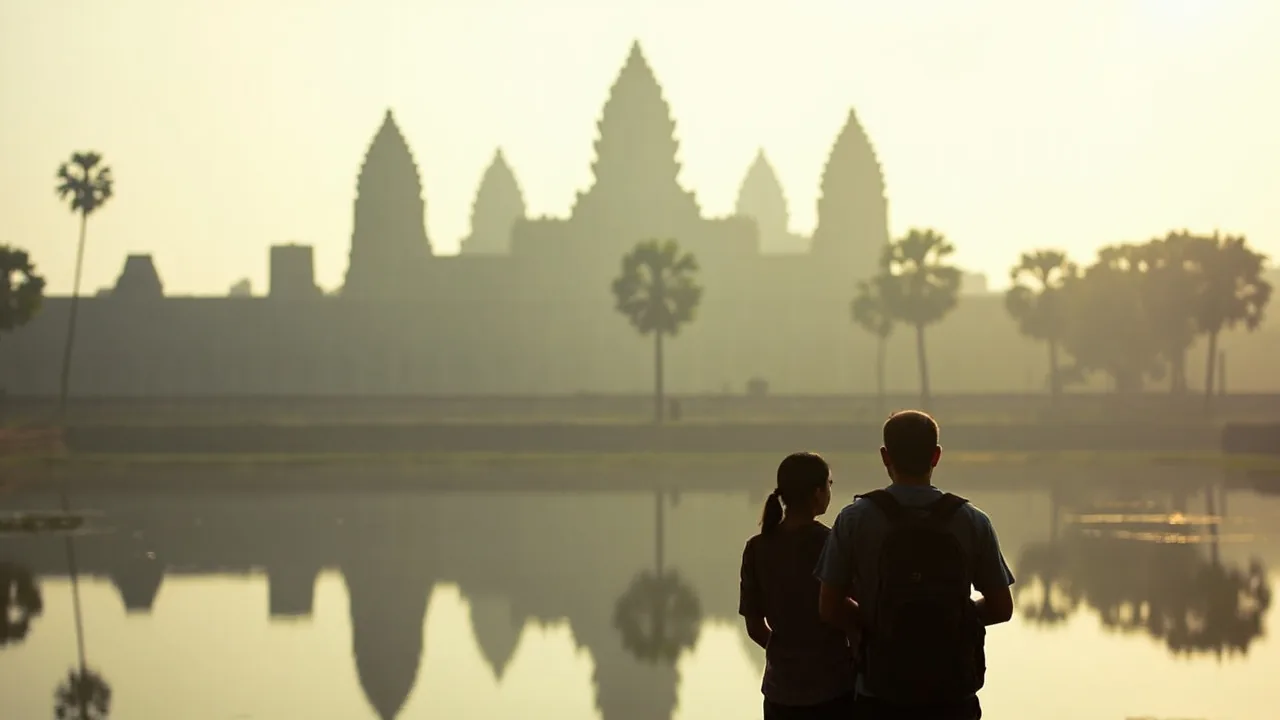
5:15 AM to 7:30 AM Sunrise at the reflecting pool in front of Angkor Wat. Get there early enough to claim a spot on the left side of the pond; the right side is where the bus tour groups congregate.
7:30 AM to 8:30 AM Go inside Angkor Wat itself. The third-floor gallery (Bakan Tower) has the signature lotus-bud towers, but the climb is restricted at certain hours and was closed for restoration work intermittently through 2025-2026. Check the Angkor Wat tour listing for current access before planning around it.
8:30 AM to 12:30 PM Grand Circuit: Preah Khan, Neak Pean, Eastern Mebon, and Pre Rup. Pre Rup has the best afternoon-light silhouette of any temple in the complex; do it last on this loop.
12:30 PM to 2:00 PM Lunch break. The town of Siem Reap is a 20-minute drive back. Most tuk-tuks will wait; agree in advance.
2:00 PM to 4:30 PM Banteay Samre and Banteay Kdei on a smaller loop, or rest at the hostel if your legs are protesting.
Day 2: Ta Prohm + Bayon + Banteay Srei
5:00 AM to 7:30 AM Sunrise at the back of Ta Prohm, where the temple is not yet overrun with tourist groups and the spung trees soak up first light. Ta Prohm is the “Tomb Raider temple”: silk-cotton and strangler fig roots eating through the galleries. Check Ta Prohm tours on GetYourGuide
8:00 AM to 10:30 AM Bayon at sunrise-or-late-morning slot. The 200-plus face towers get less crowded if you arrive between 8 and 9 AM. The bas-reliefs on the outer galleries are underrated: battle scenes, everyday-life scenes, and a king’s-eye-view procession of kings, horses, and elephants. Check Bayon tours on GetYourGuide
10:30 AM to 3:00 PM Drive out to Banteay Srei (the “Pink Temple,” ~25 km from central Siem Reap) and ask your driver to include a stop at Phnom Kulen or the Land Mine Museum on the way back. Banteay Srei is the most ornate temple in the Angkor Archaeological Park; the carvings are smaller than Angkor’s but denser. Allow at least 90 minutes there.
3:00 PM Return to Siem Reap. Hot shower. Optional nap.
6:30 PM Phare, the Cambodian Circus. A Phnom Penh-based social enterprise that has a permanent big-top in Siem Reap, with performances mixing acrobatics, live music, and contemporary Khmer storytelling. Tickets from ₹1,735 (~18 USD) to ₹3,663 (~38 USD) depending on seat. Worth the 38 if your trip is treating itself. Phare is not in the shortlist POIs but it’s the only evening activity most backpackers consistently rate as unmissable.
Day 3: Slow Siem Reap + Side Trip Option
8:00 AM Sleep in. Day three starts late by temple standards.
8:30 AM Breakfast. Either Kuy teav from a street stall or eggs at the hostel.
10:00 AM to 1:00 PM Pick one. The Angkor National Museum is the academic option; pay ₹1,157 (~12 USD) and get a guided audio tour. Check Angkor National Museum tickets on GetYourGuide if you want a local guide to interpret the artefacts.
The Kampong Phluk Floating Village on Tonle Sap Lake is the experiential option. The dry-season (Mar-Aug) visit is a stilted village rather than the flooded version you see in photos, but the boat ride through the flooded forest is still worth the ₹1,928 (~20 USD). Check Kampong Phluk tours on GetYourGuide
The Lotus Silk Farm is the off-tour option. Free entry, donations welcome, and a working production line where silk is extracted from lotus stems, hand-woven, and sold. Check Lotus Silk Farm tours on GetYourGuide
2:00 PM to 5:00 PM Pub Street wandering, foot massage (₹386-₹578 (~4-6 USD) for a full hour at the street-side stalls), and the Old Market for souvenirs. The night market is open during the day and into the evening.
6:00 PM onwards Dinner and drinks. Pub Street has gotten more restaurant options than bar options over the last two years, and the cocktail bars around the corner (Embargo, Barcode) have become the better late-night options.
Travelling with Kids?
Swap the early starts for 9 AM starts. Do Bayon and Ta Prohm on day one (they have shaded galleries that kids can sprint through), do Angkor Wat at sunset on day two, and use day three for the Angkor Putt Miniature Golf course, Happy Ranch horse rides, or the Birdwatching tour (which includes breakfast). The Kulen Elephant Forest has been criticised by animal-welfare groups over the last couple of years; cross-check recent traveller feedback before booking if elephant encounters are on your list.
Check Angkor Putt Miniature Golf tours on GetYourGuide | Check Happy Ranch Horse Farm tours on GetYourGuide | Check Siem Reap Birdwatching tours on GetYourGuide
Getting Connected
Siem Reap’s mobile coverage has improved significantly. Cellcard and Smart are the two main operators; Cellcard is the easier one for tourists at the airport counter because they speak English and accept rupees or USD. A 5 GB / 30-day SIM costs ₹482 (~5 USD). The airport is the easiest pickup; you walk past three competing booths on the way out.
If you’d rather skip the airport queue and the kyc form, the Nomad eSIM arrives by email in five minutes and supports the same networks. It’s the best option if you don’t want to risk swapping physical SIMs at the Cambodian border or at airports where tuk-tuk drivers hound you before you’ve even gotten to arrivals.
Get Nomad eSIM for instant delivery by email, or pick up a Cellcard or Smart SIM at the airport. WiFi is reliable at all the hostels on the Pub Street list; Tipsy Passport, Onederz, and Lub d all have stable connections. Don’t depend on temple-area WiFi.
Daily Budget Breakdown
The table below assumes a mid-range backpacker staying in a dorm, eating one Indian or Asian restaurant meal per day and street food for the rest, and a tuk-tuk driver on days 1 and 2.
| Category | Budget/day |
|---|---|
| Dorm bed | ~₹900 (~$9.34) |
| Food (3 meals) | ~₹700 (~$7.26) |
| Local transport (tuk-tuk) | ~₹900 (~$9.34) |
| Activities (temple pass amortised) | ~₹300 (~$3.11) |
| Misc / drinks | ~₹500 (~$5.19) |
| Total | ~₹3,300 (~$34.23) |
Verified 2026-07-17. Cambodia uses USD for most tourist transactions, so 1 USD = ₹96 is the practical rate. Day 3 with side-trip floating village runs closer to ~₹4,500 (~$46.68).
Where to Go from Here
Most travellers move on after Angkor. The eastbound options head into Vietnam; the southbound options loop to the coast or to Phnom Penh. For the full Cambodia route, see our Cambodia backpacking budget guide.
| Destination | Mode | Duration | Book |
|---|---|---|---|
| Phnom Penh | Sleeper bus | 6 to 7 hours | Book on 12go |
| Sihanoukville | Sleeper bus | 7 to 9 hours | Book on 12go |
| Bangkok | Flight | 1h 10m | Book on 12go |
| Chiang Mai | Flight | 2h 50m with stop | Book on 12go |
| Phuket | Flight | 2h 30m with stop | Book on 12go |
| Koh Samui | Flight | 2h 50m with stop | Book on 12go |
| Kampot | Sleeper bus | 5 to 6 hours | Book on 12go |
The Phnom Penh sleeper is the most common onwards connection and puts you close to the Killing Fields and Royal Palace, a logical next stop. Kampot is the under-touristed alternative if you want pepper farms, river tubing, and a slower pace before rejoining the main trail.
Common Mistakes
Skipping the 3-day pass to “save money.” The 1-day pass is ₹3,567 (~37 USD) and most backpackers trying to cover Angkor in one day clock out by 2 PM with temple fatigue. You’re not saving money, you’re just committing yourself to a sprint that will make you dislike Angkor. The 3-day pass is almost always the better deal.
Hiring a new tuk-tuk every morning. Drivers in Siem Reap work on referral. Your first driver will have a friend. Your friend’s friend will have a cousin. Commit to one driver for the full three days; you’ll pay the same total rate (₹1,446-₹2,410 (~15-25 USD) per day) and get a more honest experience. Drivers who try to push you into specific restaurants or shops are working on commission; a polite no-thank-you is enough.
Going to Tonle Sap expecting it to look like a postcard. The “floating village” Instagram feed you saw was shot in September during peak flood. In the dry season (March through August, including when most backpackers are passing through), it’s a stilted village you walk through, with a half-flooded forest as the boat ride. It’s still interesting; just don’t expect Venice.
Safety Alert: Most of Siem Reap’s safety issues are nuisance-level (aggressive tuk-tuk touts, inflated prices on Pub Street, occasional bag-snatching at the night market). For current advisories, check the MEA travel advisories page (mea.gov.in) before departure and the local Cambodian tourism police line if anything goes wrong on the ground.
FAQ
Is Siem Reap safe for solo Indian women?
Yes. Siem Reap is one of the safer stops on the Banana Pancake Trail. Solo women backpackers report no serious issues beyond normal Pub Street catcalling at night. Travelling in pairs after 11 PM is the only consistent advice.
Can I get Indian food in Siem Reap?
Yes, three reliable spots in the centre: Paratha House, Dakshin’s, and Madira Indian Tapas Bar. All serve North/South Indian and offer vegetarian menus. Paratha House has the highest rating among Indian travellers in current online reports.
Do I need a visa for Cambodia as an Indian?
Yes. Indian passport holders can get a visa on arrival at Siem Reap International Airport and at major land borders. The fee is ₹2,892 (~30 USD). You’ll need one passport-sized photo and 6 months of passport validity. EVisa applications cost an additional ₹675 (~7 USD) in service charge; arriving in person is faster and cheaper. See our full Cambodia visa guide for Indians for the step-by-step.
Should I buy the 2-day or 3-day Angkor pass?
Three days, even if you technically only have two and a half. The price difference (₹3,085 (~32 USD)) is smaller than one extra night in a dorm and you get flexibility to revisit a temple you liked, rest on day two, or take a half-day side trip.
Is 3 days in Siem Reap enough for kids?
Yes, with schedule shifts to avoid the early-morning temple stampedes. Most kids love Ta Prohm (the trees over the rooftops look like a fairy-tale set) and Bayon (the face towers), and will happily skip the more demanding temples on the Grand Circuit. Plan for one rest day at the hotel pool between temple days.
What’s the cheapest way to get from Siem Reap to Phnom Penh?
The sleeper bus, ₹1,157-₹1,735 (~12-18 USD), runs overnight. The Giant Ibis and Mekong Express lines are the most reliable. Book via 12go for guaranteed seats, especially around Khmer New Year (April).
Do I need a tuk-tuk for the temple days?
Yes, for day one and day two of any Angkor visit. The temples are spread across a 25 km radius and there is no central public transit within the park. A full-day driver runs ₹1,735-₹2,410 (~18-25 USD) and saves you from negotiating at every stop.
Subodh’s Take
Three days in Siem Reap is the right answer for almost everyone. It lets you see the temples, eat the food, sleep the sleep, and still have one buffer day. Most importantly, it lets you leave before Angkor burnout sets in. Travellers who stay a full week and try to temple-hop daily usually describe the temples as “blocks” by day four. Leave Siem Reap while the place still feels magical. That’s the test.
