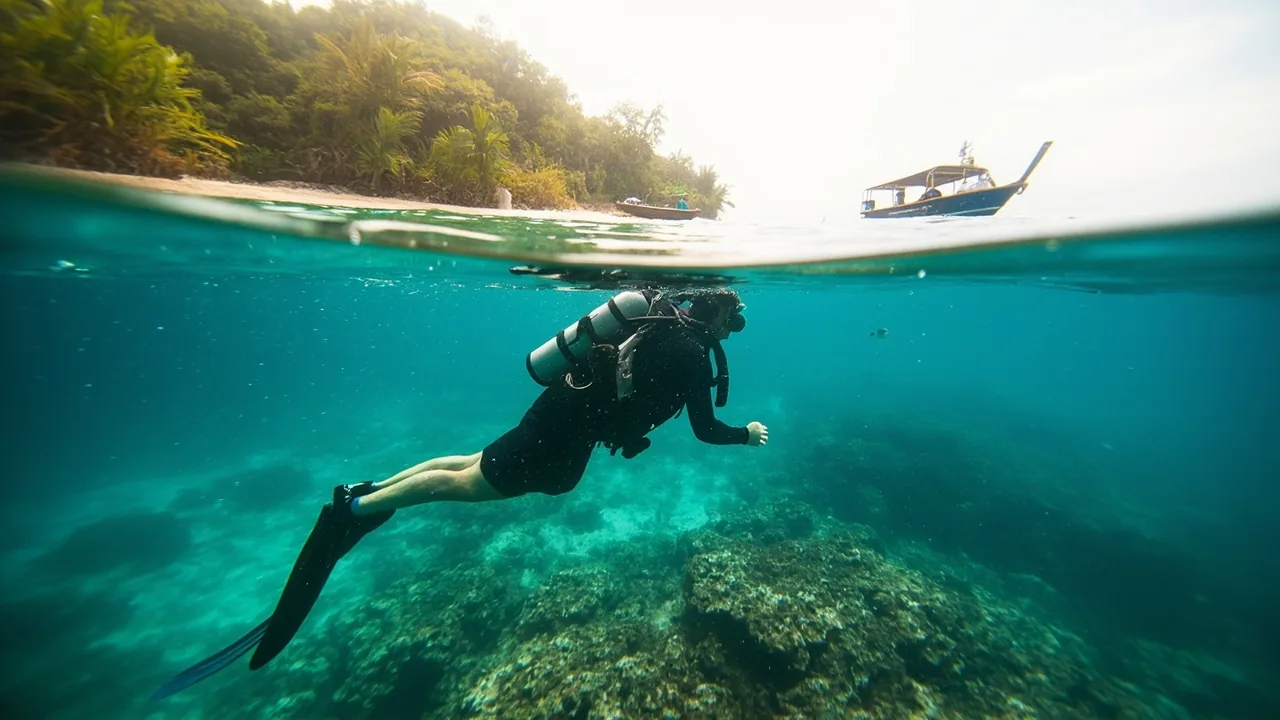
Best Diving in Southeast Asia: A Budget Backpacker Guide
Southeast Asia is where Indian backpackers get certified as scuba divers for under ₹30,000 (~$310.79), then spend the next ten days exploring sites that, in any other continent, cost double to reach and triple to dive. This guide covers the dive sites that genuinely justify the airfare, the four-day Open Water course structure, the season windows for each, and what the total bill looks like when you’re paying in rupees. For related planning, see our guides on Sea Backpacking Hub and 7 Days Thailand Tour Package Price.
Quick Answers
| What | Answer | Price (INR) |
|---|---|---|
| Best entry-level island | Koh Tao, Thailand | ₹27,256-₹34,428 (~9,500-12,000 THB or ~$282.36-$356.66) |
| Best drift dive | Sipadan, Malaysia | ~₹23,587 (~$244.35)+ permit (₹23,587 (~1,000 MYR or ~$244.35)) |
| Best macro/muck diving | Anilao, Philippines | ~₹11,500-₹15,000 (~$119.14-$155.39) |
| Best for pelagics | Tubbataha, Philippines | ~₹74,000 (~$766.61)+ |
| Open Water course (low end) | Perhentian, Malaysia | ~₹21,228 (~900 MYR or ~$219.92) |
| Open Water course (mid) | Gili Trawangan, Indonesia | ~₹59,092-₹69,836 (~$612.17-$723.47) |
| Fun Dive (post-cert) | Koh Tao / Gili Trawangan | ₹2,869-₹4,304 (~1,000-1,500 THB or ~$29.72-$44.58) |
| Best months (regional) | November to April | , |
| Visibility (average) | 15-30 metres | , |
| Indian passport visa | E-visa / visa-free (varies by country) | , |
| Indian SIM option | Get Nomad eSIM | , |
Subodh’s Pro Tip: Book your Open Water course before flying. Most islands (Koh Tao, Gili Trawangan, Perhentian) have daily intakes, but Saturday intakes fill by Wednesday in peak season. A two-day delay means a two-day hotel bill you didn’t budget for. You may also find Average Spend in Thailand Per Day useful for this trip.
What Counts as “World-Class” Diving in Southeast Asia
For the same reason Goa isn’t a wine region, “world-class diving” is a label that gets thrown around loosely. In Southeast Asia, it has a specific meaning: visibility over 20 metres on a calm day, healthy hard coral cover, and a marine biologist on staff at the shop taking you out. The four destination clusters that hit that bar year after year are: See also: How Much Money Do I Need for 5 Days in Thailand.
- Gulf of Thailand (Koh Tao), the certification mill, 50+ dive shops, full infrastructure for first-timers
- Suluwesi and the Coral Triangle (Gili Trawangan, Bunaken, Lembeh Strait). Indonesia sits inside the Coral Triangle, the global epicentre of marine biodiversity, so the species count here is genuinely unusual
- Visayas and Tubbataha (Moalboal, Anilao, Tubbataha), pelagic action, sardine runs, and reef sharks
- East Malaysia (Sipadan, Layang-Layang, Perhentian), wall dives with barracuda tornadoes and green turtles, the deep-water sites Indian divers go to after they’re certified For related planning, see our guide on What to Do in Thailand for 7 Days.
If you’re Googling “best sea diving in the world” and landing on lists from CNN or Condé Nast, four of the top ten are in the Philippines and Indonesia. You’re not being upsold; the bio-diversity numbers genuinely back it up.
How to Get Certified: The Open Water Course
Most Indian backpackers show up uncertified. That’s fine. The Open Water course is the global standard entry-level cert (PADI, SSI, RAID all issue one), takes 3 to 4 days, and gets you diving to 18 metres with a buddy anywhere in the world.
Step-by-Step
Day 1: Theory and pool work. Pick your dive shop, pay the deposit, watch the theory videos or read the manual. Pool session in the afternoon to learn mask clearing, regulator recovery, and buoyancy basics. Cost on Day 1: nothing extra, included.
Day 2: Confined water + more theory. Two more pool sessions, a quiz, and a final exam (multiple choice, 50 questions, pass at 75%). Cost on Day 1: nothing extra.
Day 3: Open water dives 1 and 2. Boat goes out to a shallow reef, you do two dives to 12 metres, supervised by your instructor. Logged as your first two of four qualifying dives.
Day 4: Open water dives 3 and 4. Deeper (18 metres max), navigation dive, then you’re certified. Photo for the card, PDF cert usually arrives in 48 hours.
What it costs in 2026
| Location | Course Price | Includes |
|---|---|---|
| Perhentian, Malaysia | ₹21,228-₹25,946 (~900-1,100 MYR or ~$219.92-$268.79) | All gear, boat, manual |
| Koh Tao, Thailand | ₹27,256-₹34,428 (~9,500-12,000 THB or ~$282.36-$356.66) | All gear, boat, manual |
| Moalboal, Philippines | 22,000-25,000 PHP | All gear, boat, manual |
| Gili Trawangan, Indonesia | ₹8,058-₹13,430 (~1,500,000-2,500,000 IDR or ~$83.48-$139.13) | All gear, boat, manual |
The Philippines and Thailand numbers include the manual and certification fee. Indonesia sometimes separates the manual (₹1,612-₹2,686 (~300,000-500,000 IDR or ~$16.70-$27.83) extra). Malaysia’s Perhentian is the cheapest by a clear margin but has the shortest season (March to November).
Subodh’s Pro Tip: Don’t book the cheapest shop on Google Maps. Read TripAdvisor reviews filtered by Indian traveller, then cross-check on r/scuba. A ₹3,000 (~$31.08) saving on a course with a bad instructor costs you a re-do at full price if you fail.
The Top Dive Sites, Ranked by Experience
1. Koh Tao, Thailand. Best for First-Time Divers
Koh Tao is the world’s largest Open Water certification mill: roughly 50 dive shops on a 21-square-kilometre island, every other backpacker doing the same 4-day course, prices kept low by sheer competition. Sites like Chumphon Pinnacle and Sail Rock are 18-30 metre vis days with frequent whale shark sightings in March-April.
What it costs on the ground:
| Item | Price |
|---|---|
| Dorm bed (per night) | ₹861-₹1,721 (~300-600 THB or ~$8.92-$17.83) |
| Open Water course | ₹27,256-₹34,428 (~9,500-12,000 THB or ~$282.36-$356.66) |
| Fun dive (per dive, after cert) | ₹2,869-₹4,304 (~1,000-1,500 THB or ~$29.72-$44.58) |
| Thai veggie curry (lunch) | ₹230-₹344 (~80-120 THB or ~$2.38-$3.57) |
| Bangkok-Koh Tao bus+ferry combo | ₹2,295-₹3,443 (~800-1,200 THB or ~$23.78-$35.67) |
Safety Alert: Koh Tao’s coral bleaching from the 2024 marine heatwave is partial, not total. Sail Rock and Chumphon Pinnacle recovered faster than the shallow bays. Stick to the boat sites, not the house reef at Sairee.
2. Gili Trawangan, Indonesia. Best Drift Diving and Macro
The three Gili Islands off Lombok have zero motorised vehicles, three dive shops per island, and a healthy mix of muck sites (small stuff: frogfish, seahorses, ghost pipefish at 5-15 metres) and drift dives (current-swept walls with turtles at 18 metres). Open Water courses here are pricier than Koh Tao, but the post-cert fun diving is the best value in Indonesia.
What it costs on the ground:
| Item | Price |
|---|---|
| Dorm bed (per night) | ₹537-₹1,074 (~100,000-200,000 IDR or ~$5.57-$11.13) |
| Open Water course | ₹8,058-₹13,430 (~1,500,000-2,500,000 IDR or ~$83.48-$139.13) |
| Fun dive (per dive, after cert) | ₹2,149-₹3,223 (~400,000-600,000 IDR or ~$22.26-$33.39) |
| Indonesian veggie nasi campur | ₹134-₹269 (~25,000-50,000 IDR or ~$1.39-$2.78) |
| Fast boat from Bali | ₹1,880-₹2,955 (~350,000-550,000 IDR or ~$19.48-$30.61) |
3. Sipadan, Malaysia. Best Wall Diving (Permit-Required)
Sipadan is the single most-requested dive site by Indian backpackers who already have their Advanced cert, and it’s the most restricted to access. Sabah Parks issues only 176 permits per day, and the only way to get one is through a registered Semporna-based operator who bundles it into a 3-day, 9-dive package.
The site itself is a vertical wall dropping from 2 metres to 600+ metres, with barracuda tornado formations, frequent green turtle sightings, and occasional scalloped hammerheads at 30+ metres.
What it costs:
| Item | Price |
|---|---|
| Sipadan permit | ₹23,587 (~1,000 MYR or ~$244.35) |
| 3-day / 9-dive package (permits + boat + island transfers) | ₹106,142-₹153,316 (~4,500-6,500 MYR or ~$1,099.58-$1,588.29) |
| Dorm in Semporna | ₹1,887-₹3,538 (~80-150 MYR or ~$19.55-$36.65) |
| Fun dive elsewhere (Mabul, Kapalai) | ₹5,897-₹9,435 (~250-400 MYR or ~$61.09-$97.74) |
4. Tubbataha, Philippines. Best Pelagics (Liveaboard Only)
Tubbataha is a UNESCO World Heritage atoll in the Sulu Sea, accessible only by 4-6 day liveaboard from Puerto Princesa. The season is narrow (mid-March to mid-June), the boats fill by December, and the cost is the highest on this list. What you get for it: 30-40 metre vis, reef sharks on every dive, manta cleaning stations, and the occasional whale shark.
What it costs:
| Item | Price |
|---|---|
| 5-day/4-night liveaboard | 75,000-110,000 PHP |
| Tubbataha park fee | 5,400 PHP |
| Dorm in Puerto Princesa | 400-800 PHP |
| Manila-Puerto Princesa flight | 3,500-7,000 PHP |
5. Anilao, Philippines. Best Macro/Muck Diving
If you’ve already done Koh Tao and want the smallest marine life on the planet (nudibranchs, pygmy seahorses, blue-ringed octopus), Anilao is where Philippine macro divers go. Day trips from Manila, no liveaboard needed.
What it costs:
| Item | Price |
|---|---|
| 2-tank day trip (boat + guide + lunch) | 5,500-7,500 PHP |
| Dorm in Anilao | 600-1,200 PHP |
| Manila-Anilao transfer | 800-1,500 PHP |
Season Windows for Indian Travellers (2026)
Dive season in Southeast Asia tracks the monsoon, not the calendar.
| Country | Best Months | Avoid |
|---|---|---|
| Thailand (Gulf, Andaman) | Feb-Apr (Gulf), Nov-Apr (Andaman) | Jun-Oct (Andaman) |
| Indonesia | Apr-Oct (north), Oct-Mar (south) | Jan-Feb (north) |
| Philippines | Nov-May (most sites), Mar-Jun (Tubbataha) | Jul-Oct (typhoon season) |
| Malaysia (Sipadan) | Mar-May, Sep-Nov | Dec-Feb (rough seas) |
Indian academic holidays (October-December, May-July) don’t always line up with peak dive season. December is the shoulder for Sipadan and the Philippines, the peak for Komodo. If your dates are fixed, pick the destination that matches, not the other way around.
Common Mistakes Indian Divers Make
Mistake 1: Doing the medical questionnaire dishonestly. The PADI/SSI medical form asks about asthma, heart conditions, sinus issues, and pregnancy. Lying to get on the boat faster is the single most common cause of in-water emergencies for first-time divers. Asthma, in particular, is a contraindication. Don’t hide it.
Mistake 2: Flying within 18-24 hours of your last dive. Decompression sickness risk is highest on the flight home, not on the boat. DCS can theoretically still occur even within no-decompression limits, so the 24-hour buffer isn’t a marketing line. If your flight is the morning after your last dive, you take the risk; if you can shift the flight by a day, you remove it.
Mistake 3: Booking through a hostel that gets a commission, not a verified shop. Hostels in Koh Tao and Gili Trawangan earn 10-15% commission on dive course referrals. The shop they send you to may or may not be a quality operation. Book direct with the dive shop’s website, then ask the hostel if they have a discount code (most do).
Mistake 4: Skipping the dive insurance. Regular travel insurance rarely covers scuba incidents, and a hyperbaric chamber evacuation in Sabah costs ₹353,805-₹589,675 (~15,000-25,000 MYR or ~$3,665.28-$6,108.79) out of pocket. DAN (Divers Alert Network) Southeast Asia coverage runs ~$50/year for the recreational plan.
Mistake 5: Bringing cotton clothing for the boat. Cotton stays wet, cold, and heavy. Quick-dry shirts and board shorts are mandatory on dive boats; a wool or fleece hoodie is worth packing for the surface interval in cooler waters like Sipadan.
What Most Dive Guides Don’t Tell You
Gotcha 1: The medical form needs a doctor in some cases. If you answer “yes” to any medical question, most shops require a dive medical clearance from a doctor trained in diving medicine (not a general GP). In Bangkok, this costs ₹4,304-₹8,607 (~1,500-3,000 THB or ~$44.58-$89.17) at Bangkok Hospital or Bumrungrad. If you’re flying direct to Koh Tao without a stop in Bangkok, get the medical done in India before you fly.
Gotcha 2: The certification is internationally valid, but the depth limit is shallow. Your Open Water cert is good for life, but it limits you to 18 metres. Most of the spectacular pelagic action at Sipadan and Tubbataha happens at 25-40 metres. The Advanced Open Water course (2-3 days, ~₹25,821-₹34,428 (~9,000-12,000 THB or ~$267.50-$356.66) or equivalent) is the get.
Gotcha 3: Underwater cameras ruin your buoyancy. Divers borrowing GoPros on Day 2 of their Open Water course frequently fail the buoyancy assessment. Wait until Dive 6-8 after certification to start carrying a camera.
Safety Notes Specific to Indian Travellers
Beyond the standard Southeast Asia safety advice (use Grab/Bolt, avoid unmarked taxis, watch for bag-snatching on motorbikes), diving adds specific risk layers:
- Reef-safe sunscreen only. Most dive sites in the Philippines and Indonesia are protected areas with mandatory reef-safe sunscreen rules. Bring your own zinc-oxide sunscreen; the boat price for a tube is 3-5x the Indian pharmacy price.
- Drinking water on dive boats. Tap water on most dive boats in Indonesia and the Philippines is not potable. Bring your own bottle.
- Stay updated via the Indian MEA advisory. Before booking, check the current advisory at mea.gov.in for the specific destination.
- DAN Southeast Asia membership. Register before you fly. The medical evacuation insurance is what saves you if a chamber ride is needed.
FAQ
Do I need to know swimming to scuba dive? You need to swim 200 metres and float for 10 minutes. Both are tested on Day 1 of the course. If you can’t pass, the shop won’t certify you.
Is scuba diving safe for someone with asthma? Mild exercise-induced asthma is sometimes cleared by a dive medical; moderate or severe asthma is a contraindication. Get the dive medical done in India first if you have any history.
Which destination is best on a 7-day trip from India? Koh Tao. Bangkok-Surat Thani flight (~₹12,000 round-trip from most Indian metros), then 4-hour bus+ferry to the island, 4 days of course, 2 days of fun dives, fly home. Total trip cost under ₹60,000 (~$621.58).
Can vegetarians eat on dive boats? Yes, but tell the operator the day before. Most Indonesian and Filipino dive boats do a standard Indonesian nasi goreng or Filipino chicken rice lunch. A “no fish, no meat, egg OK” request usually gets you fried rice with vegetables or boiled eggs. Don’t expect Indian-level spice on the boat.
How long does the certification last? Forever, but if you don’t dive for 6-12 months, most shops require a “Refresh” course (1 dive, ~₹7,173 (~2,500 THB or ~$74.30)) before letting you back in the water without supervision.
Should I get PADI or SSI? Both are globally accepted. PADI is the most recognised in India, so your home-country dive centre will accept it more easily. SSI is fine for travel, slightly cheaper in some destinations.
Is it cheaper to do the course in India first? PADI Open Water in India runs ₹22,000-₹28,000 (~$227.91-$290.07). Cheaper than Perhentian and Gili Trawangan, but the sea life you’ll see in training is dramatically less varied. If your goal is to dive while travelling Southeast Asia, certify there.
Subodh’s Take: I’ve watched four backpacker cohorts run this exact plan: fly into Bangkok or Manila, get Open Water certified, then either continue east to Sipadan or fly home. Every one of them said the same thing after: the course was the easy part, picking the post-cert dive sites was the actual planning challenge. Start with Koh Tao because it’s the cheapest, fastest, and lowest-risk. Move to Sipadan or Tubbataha only after you have 15-20 logged dives. Skip Anilao unless you’re already into macro photography.
