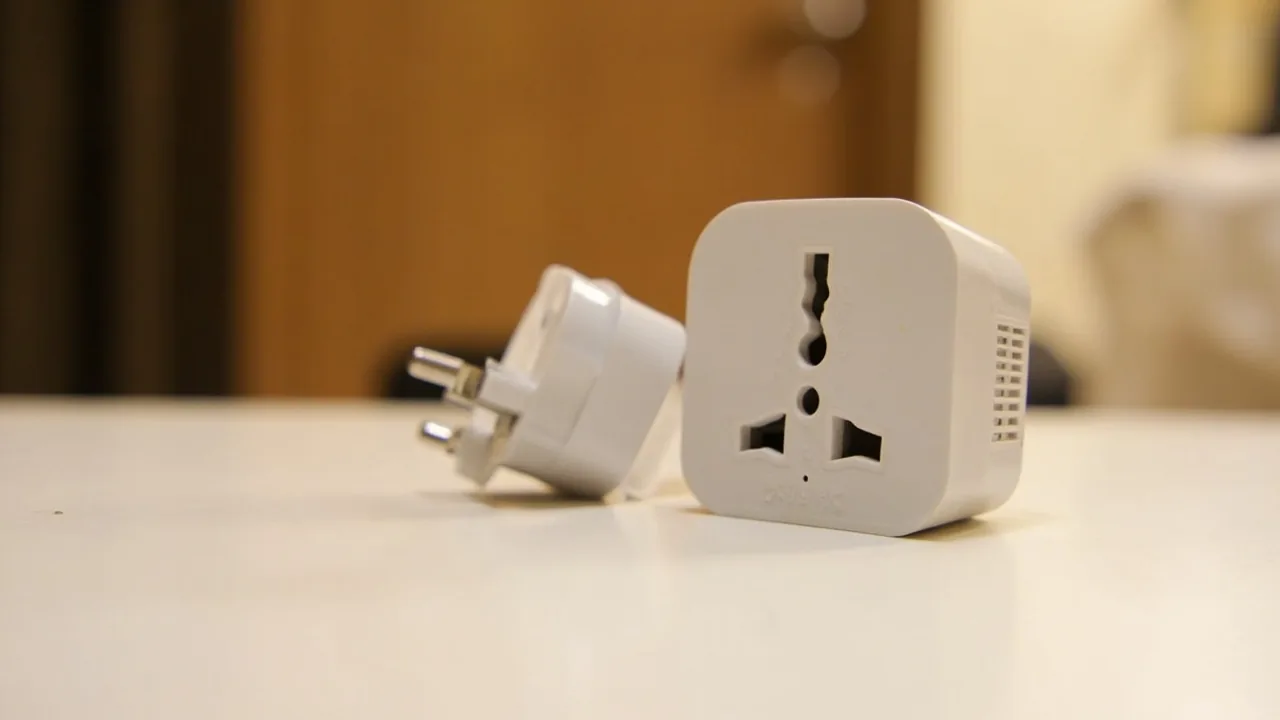
Do I Need a Voltage Converter for the Philippines? India to PH Power Guide
Traveling from India and wondering do I need a voltage converter for Philippines trips? Almost never. Both India and the Philippines run on 220-240V, so voltage is not the problem. The two real issues are plug shape and the 60Hz vs 50Hz frequency gap. Planning the wider region? Our Southeast Asia backpacking hub covers the full multi-country route.
Subodh’s Pro Tip: Don’t waste 800 PHP on a “voltage converter” at the airport duty-free. Ninety percent of the electronics Indian backpackers carry are dual-voltage by design. Save the peso for kare-kare instead.
Quick Answers
| What | Answer | Price (INR) |
|---|---|---|
| Do I need a voltage converter for the Philippines? | No for laptops, phones, cameras (all dual-voltage). Yes only for single-voltage Indian appliances like hair dryers, curlers, irons. | Adapter: ₹253-₹842 (~150-500 PHP or ~$2.67-$8.90) |
| What plug type does the Philippines use? | Type A (two flat pins), Type B (two flat + ground), Type C (two round). India uses Type C/D/M, so most Indian plugs need an adapter. | Universal adapter: ₹421-₹1,011 (~250-600 PHP or ~$4.45-$10.68) |
| Will my Indian phone charger work in PH? | Yes. All modern phone chargers (Apple, Samsung, OnePlus, Xiaomi) are 100-240V / 50-60Hz dual-voltage. | — |
| Will my hair dryer / curler / straightener work? | Only if the label says “100-240V” or “dual voltage.” Most cheap Indian appliances are 220V / 50Hz only and will run slightly faster/hotter, or burn out fast. | Step-up converter (if needed): ₹2,021-₹4,211 (~1,200-2,500 PHP or ~$21.35-$44.48) |
Philippines Plug & Socket Standards (Type A, B, C)
The Philippines follows the US-style Type A and Type B sockets as the primary standard, with Type C (European two-round-pin) also widely accepted. This is confirmed by the IEC 60083 reference sheet and the Philippine Electrical Code. If you’ve travelled to the US, Japan, Canada, or Mexico, you’ve seen these sockets before: two flat parallel blades, sometimes with a grounding pin below.
India, by contrast, uses Type C (two round pins), Type D (three large round pins in a triangle), and Type M (three large round pins, South African style). The Type C overlap is the only saving grace: many Indian three-pin plugs physically fit into a Type C socket because the round pins are smaller than Type D/M, but the socket is ungrounded, so you’re skipping the earth connection. Travellers report this works for phone chargers but advise caution for anything metal-cased.
Safety Alert: Type C sockets in the Philippines are usually ungrounded (two-pin only). Plugging a grounded Indian appliance into an ungrounded socket is not inherently dangerous, but it removes surge protection. During brownouts, which are common outside Metro Manila, this matters. See the brownout survival guide for the full picture.
The most common traveller mistake is assuming that because the voltage (220-240V) matches, the plug will fit. It won’t, because Indian plugs are round-pin and Philippine sockets are flat-pin (Type A/B) or smaller round-pin (Type C). You need a physical plug adapter, and these are cheap in Manila if you forget one (150-500 PHP at SM Cyberzone or any electronics stall in Divisoria). For a complete breakdown of the EU-vs-PH plug question, see Is the EU Plug the Same as the Philippines?.
Voltage: Philippines 220V vs India 230V
Both countries are in the 220-240V “high voltage” range, which is why this question gets asked so often. The nominal rating in the Philippines is 220V at 60Hz; in India it’s 230V at 50Hz. That 10V nominal difference is meaningless for any device that accepts a wide input range (which is most modern switching power supplies). Your phone charger will sip 220V in Manila exactly the way it sips 230V in Mumbai.
But here’s the part the standard “voltage converter” blog posts miss: the 60Hz vs 50Hz frequency difference is the real silent killer, and it doesn’t affect chargers, it affects motors and heating coils.
A 50Hz appliance running on 60Hz will:
- Run about 17-20% faster (motors spin higher RPM)
- Produce slightly more heat in resistive heating elements
- Sometimes run quieter and “feel” better, which is why some people never notice
- Burn out months or years earlier than its rated lifespan
A 60Hz appliance running on 50Hz (the reverse, which doesn’t apply here, but is the math most guides get wrong) will run slower and hotter, and usually fails fast. Since you’re going from 50Hz India to 60Hz Philippines, your Indian appliances will run faster and heat up more, which is the kinder failure mode but still kills hair dryers and irons faster than you’d expect.
The official Philippine electrical standard confirms 220V / 60Hz as the grid frequency nationwide. Travellers in Siargao and parts of Palawan have reported voltage wobble during peak hours (brownouts between 6 PM and 10 PM are routine in tourist areas), so a surge protector strip is worth packing if you’re bringing anything expensive. Travellers to remote islands should check the best time to visit the Philippines for typhoon season because brownouts spike after typhoons.
Will My Indian Electronics Work? The Safe-to-Plug Checklist
Here’s the real test. Before you pack anything, flip it over and read the small print on the back, the charger brick, or the power supply. Look for the input line, which usually reads something like “Input: 100-240V ~ 50/60Hz” or “Input: 100-240V AC, 50-60Hz.” If you see that wide range, the device is dual-voltage and you’re done: it works in the Philippines with just a plug adapter.
| Indian Device | Dual Voltage? | Works in PH? | Notes |
|---|---|---|---|
| Phone charger (Apple, Samsung, OnePlus, Xiaomi, Realme) | Yes, 100-240V | Plug adapter only | Modern smartphone chargers are dual-voltage. |
| Laptop charger (HP, Dell, Lenovo, MacBook) | Yes, 100-240V | Plug adapter only | Same. MacBook chargers are 100-240V. |
| Camera battery charger (Sony, Canon, Nikon) | Yes, 100-240V | Plug adapter only | All major brand chargers are dual-voltage. |
| Power bank (Mi, Ambrane, Syska) | Yes (charges via USB) | Plug adapter only | Charges from any USB source, no voltage concern. |
| Electric toothbrush (Philips Sonicare, Oral-B) | Yes, 100-240V | Plug adapter only | Travel models are dual-voltage. Check the base, not the brush head. |
| Hair dryer / straightener / curling iron | Usually no, 220V / 50Hz only | Needs a converter, or buy local | This is the category that breaks most often. |
| Travel iron / steamer | Check label carefully | Mixed | Some are dual-voltage, most cheap ones are not. |
| Indian market immersion heater / room heater | No, 220V / 50Hz | Do not bring | Single-voltage, high wattage, dangerous on wrong frequency. |
| Indian ceiling fan (if relocating) | No | Do not bring | 50Hz motors run fast and burn out on 60Hz. |
The rule of thumb: if it has a USB output or charges from a wall adapter brick, it’s fine. If it plugs directly into the wall with its own cord and no adapter brick, assume it’s single-voltage and check the label.
Subodh’s Pro Tip: Skip the converter and just buy a 300-500 PHP hair dryer at any mall in Manila (SM, Robinsons, Ayala). It’ll be dual-voltage by default, and at 600 PHP for a decent one, it costs less than a step-up converter anyway. Bring it back home or leave it for the hostel.
The 60Hz vs 50Hz Trap: Appliances That Will Fail
This is the section most guides skip, and it’s the one that determines whether you need a converter at all. Heating coils, motors, and anything with a clock or timer are the categories where frequency matters.
Hair dryers, curling irons, flat irons, and hot-air brushes: Most Indian-market models are 220-240V / 50Hz only, rated for ~2000W. Run one on 60Hz and the fan motor spins faster (noisier, wears faster), the heating coil dissipates slightly more heat per cycle, and the unit’s expected life drops from 5+ years to maybe 18 months. Travellers report their Indian Phillips/Vega/Havells dryers working “fine” in PH for a trip but failing within 6 months of return. The fix: don’t bring it. Buy local, or use the hostel’s dryer if any.
Travel irons and garment steamers: Same story as hair tools. Some premium Indian models (Morphy Richards, Panasonic) are dual-voltage, but the cheap ones are not. Check the label before packing.
Electric shavers: Philips and Braun travel shavers are almost always 100-240V / 50-60Hz dual-voltage, but the Indian-market versions sold at Croma are sometimes 220-240V only. Read the label.
Mechanical alarm clocks and older kitchen appliances with synchronous motors: These will run fast in 60Hz land. A 50Hz clock gains 10 minutes per hour on 60Hz power. Microwaves are fine (electronics, not motors). Induction cooktops are fine (electronics). Old-school mixer grinders with universal motors are fine. Pure synchronous-motor appliances (some ancient record players, some old wall clocks) will run fast.
Ceiling fans and table fans: Leave the fans behind. Motors on the wrong frequency run faster, overheat, and fail. Filipinos buy locally because the local stock is wound for the local grid.
What Adapter Should I Buy?
For 90% of Indian backpackers, the answer is a single universal travel adapter that handles Type A, B, C, D, E, F, G, and the rest of the alphabet soup. Two solid picks:
- Indian-market universal adapter (250-500 PHP equivalent, available at Croma or Amazon India): Lightweight, single-piece, three USB-A ports built in. Works in 150+ countries including PH.
- Anker or Baseus GaN multi-port adapter (1,500-2,500 PHP): If you’re carrying a laptop, phone, watch, and camera, one GaN charger with interchangeable plug heads replaces four separate bricks. The US plug head fits Philippines directly.
Don’t buy a “voltage converter” unless your label says 220V / 50Hz only and the device is something you cannot replace locally. A real step-up/step-down converter (the heavy transformer kind, not the tiny travel adapters) costs 1,200-2,500 PHP and weighs 500g-1kg. That’s too much backpack space to dedicate to a hair dryer.
Power Bank Rules for the Flight
Indian aviation rules and most international airlines cap cabin power banks at 100Wh (about 20,000 mAh at 5V). Above that, the bank goes in checked baggage and gets confiscated at security if you try to carry it on. Stick to 10,000-20,000 mAh models (Mi, Ambrane, Syska, OnePlus) and you’ll clear every airport between Delhi and Manila.
For more packing guidance, see the full Philippines packing list, which covers monsoon vs dry season, beach gear, and tech.
Trip CTA
Outside Metro Manila, Cebu City, and Davao, brownouts are part of daily life. The Philippines grid loses power during typhoons (June-November peak), during the dry-season heat load (March-May), and on islands running on diesel generators. Three practical tips:
- Carry a small power strip with surge protection. A 4-outlet strip with surge clamping costs 300-800 PHP at any Ace Hardware or National Bookstore, and protects your laptop when the power comes back on. Brownouts are followed by voltage spikes that can fry chargers.
- Charge everything during the window when power is on. Power cuts cluster between 6 PM and 10 PM in tourist areas like Siargao and El Nido, according to multiple traveller accounts. Plan laptop work for mornings.
- Pack a small LED torch or headlamp. Blackouts in guesthouses are pitch-dark, and phone flashlights die when their battery does.
For deeper brownout prep including which Manila and Cebu hostels have backup generators, see Philippines brownout survival.
SIM Cards and Connectivity
Power’s not the only thing that needs planning. For data on arrival, a Globe or Smart tourist SIM at NAIA or Mactan-Cebu airport costs (~₹75-₹151) for a 7-day tourist pack with data add-ons around 100 PHP for 5GB. Bring your passport, registration is mandatory under the SIM Registration Act, and the SIM works the moment you slot it in. For unlocked-phone travellers who prefer eSIM, Nomad eSIM ships a data plan before you fly, so you have signal at the airport before you reach the SIM stall. Book direct via the Nomad eSIM Philippines page. Full coverage of tourist SIM plans, registration rules, and number formats is in the PH SIM cards for Indian travelers guide and the SIM registration walkthrough.
The Ultimate Voltage & Power Packing Checklist
- 1 × universal travel adapter (Type A/B/C/D/G compatible)
- 1 × surge-protector power strip (for brownout-prone areas)
- 1 × 10,000-20,000 mAh power bank (under 100Wh for airline compliance)
- 1 × GaN multi-port charger if carrying laptop + phone + watch + camera
- 1 × short extension cord (handy in old hostels where the only socket is across the room)
- 0 × step-up voltage converter (you don’t need it for any modern electronics)
- 0 × Indian-market hair dryer / curling iron / single-voltage appliance
Common Mistakes Indians Make with PH Power
Mistake 1: Buying a “universal adapter/converter” combo at the airport. These are tourist-trap units that weigh 400g, cost 1,800 PHP, and only handle up to 100W (so your hair dryer trips it instantly). A 300 PHP adapter and a fresh-bought PH dryer is cheaper, lighter, and safer.
Mistake 2: Assuming Type C Indian plugs fit Type C PH sockets. They physically fit (both are two-round-pin), but the PH Type C socket is ungrounded. Your grounded Indian laptop brick still works, but you’ve lost the earth connection. This matters during brownouts.
Mistake 3: Bringing the immersion rod or room heater. These are 220V / 50Hz only, draw 1500-2000W, and trip Philippine circuit breakers (which are typically 10A per outlet, so anything over 2200W trips). PH hotels and Airbnb hosts do not appreciate melted sockets.
Mistake 4: Forgetting the surge protector. The PH grid has voltage spikes after brownouts. Travellers report losing laptop chargers and router power supplies during typhoon-season outages. A 500 PHP surge strip is cheap insurance.
Mistake 5: Overloading one outlet. PH hostels often have a single wall outlet per room. A multi-port GaN charger solves this without triggering the breaker. Don’t daisy-chain two extension cords and call it a day.
FAQ
Do I need a voltage converter for the Philippines from India? (already covered above; see intro)
No. Both countries use 220-240V, so voltage is not the issue. You only need a plug adapter because PH sockets are Type A/B (flat-pin) and Indian plugs are Type C/D/M (round-pin). Modern Indian electronics (laptop, phone, camera) are 100-240V / 50-60Hz dual-voltage by default, so they work with just the adapter. Old single-voltage Indian appliances (hair dryers, irons, immersion heaters) should be left at home.
What plug adapter do I need for the Philippines from India? (see ‘What Adapter Should I Buy?’ section)
A universal travel adapter that accepts Type A (two flat pins), Type B (two flat + ground), and Type C (two round) plugs is the safest pick. PH uses Type A and Type B as the primary standard and accepts Type C as a secondary fit. Indian plugs (Type C, D, M) need an adapter to fit. Universal adapters from Indian brands cost around 250-500 PHP equivalent, available on Amazon.in or at Croma before departure. (Pricing varies by brand and retailer.)
Is the Philippines 50Hz or 60Hz? (covered in the 60Hz vs 50Hz section)
The Philippines runs on 60Hz at 220V. India runs on 50Hz at 230V. The voltage is close enough to not matter for dual-voltage electronics, but the 10Hz frequency difference does affect motors, heating elements, and synchronous-motor appliances. Indian-made single-voltage appliances (50Hz) will run faster and hotter on PH power (60Hz) and fail earlier than rated. Indian-made dual-voltage appliances (100-240V / 50-60Hz) are unaffected.
Can I use my Indian hair dryer or curling iron in the Philippines? (see hair tool section)
Only if the label says “100-240V” or “dual voltage.” Most Indian-market hair dryers, curling irons, and straighteners are 220V / 50Hz only, which means they work but run ~20% faster on 60Hz power and burn out 2-3x faster. The cheaper fix is to buy a PH-market dual-voltage dryer at SM or Robinsons for 300-600 PHP and skip the hassle.
Will my Indian laptop and phone chargers work in the Philippines? (see safe-to-plug checklist)
Yes, with just a plug adapter. Major-brand chargers sold in India are rated 100-240V / 50-60Hz. The voltage and frequency difference between India and PH does not affect them. Only the plug shape changes, so an adapter solves it.
Is it safe to charge Indian electronics overnight in a Philippine hostel? (see brownout section)
Generally yes, but use a surge-protector strip if the area has frequent brownouts. Voltage spikes during power restoration can damage laptop chargers and small electronics. Travellers report losing Mi power banks and OnePlus chargers during typhoon-season outages. A 300-800 PHP surge strip from any Ace Hardware covers this.
Subodh’s Take
If you’re carrying a laptop, phone, camera, and power bank, you need one universal adapter and zero voltage converters. If you’re carrying a hair dryer, curler, or immersion rod, leave them at home and replace them locally for under 600 PHP. The 60Hz vs 50Hz trap is real but only bites single-voltage appliances, and the Indian electronics market is largely dual-voltage. Skip the airport “universal converter” ripoff, pack one good adapter, add a surge strip if you’re heading outside Manila, and spend the savings on sisig at Kantina Manila or biryani at Seven Mannah Indian Fusion Food when the power’s out and you’re craving a hot meal. For full packing coverage from tech to temple wear, the Philippines packing list ties it together.
Where to Stay in the Philippines
For hostels and budget stays in Manila, Cebu, and the islands, browse Hostelworld listings for the Philippines, filter by date and you can book a bed in dorms from ~₹800/night before you fly.