Got Scammed in Singapore? Here’s Exactly What Indian Travelers Should Do Next
Verified on 2026-07-17: confirmed SPF e-services portal functionality, checked Anti-Scam Centre hotline hours, and verified Indian High Commission consular procedures. Scams in Singapore hit Indian visitors harder than most destinations, because the city is small, every dollar lost is meaningful, and the reporting process feels unfamiliar from the outside. Here is exactly what to do if you get scammed in Singapore.
Quick Answers
| What | Answer | Price (INR) |
|---|---|---|
| Singapore Police emergency hotline | 999 (from any phone, free) | Free |
| Police anti-scam hotline (anti-scam centre, foreigners welcome) | 1800-722-6688 | Free |
| Online police report (e-services, recommended for non-emergency fraud) | Available 24/7 via SPF portal | Free |
| Indian High Commission emergency number (Consular) | +65-6258-3200 | Free |
| MAS scam-reporting portal for financial fraud | scamalert.sg / MAS page | Free |
First Hour: Stop the Money Leaving Your Account
Every minute counts once a scam is in motion. Singapore’s “kill chain” works the same way as anywhere else: the moment a transfer clears, the recovery odds collapse from “likely” to “almost zero.” So your first set of actions is mechanical, not emotional.
Call your Indian bank immediately. Don’t wait until you’ve filed a police report. From an Indian-issued debit or credit card, the 24x7 helpline on the back of the card can freeze pending transactions and block your card for further use. If you use an HDFC, ICICI, SBI, or Axis forex card, each has a dedicated international fraud line reachable through collect-call (reverse-charge) by dialling the bank’s India number and asking for “international collect” at the Singapore operator. State the last four digits of the card, the merchant or receiving account, and the approximate Singapore-dollar amount you just authorised. The bank can place a “merchant hold” request through Visa or Mastercard if the transaction hasn’t fully settled, which usually buys you 24 to 72 hours.
Freeze UPI and netbanking from your phone. If the scammer is still chatting with you on WhatsApp or Telegram, do not argue. Open your banking app, disable UPI for that specific account, and change your netbanking password and MPIN. Most Indian banks let you do this in under a minute. This step can prevent follow-on drains of ₹20,000 (~$207.62) to ₹80,000 (~$830.48) that the scammer may try to push through under the guise of ” Screenshot everything before you block. Take screenshots of the chat, the payment confirmation, the scammer’s profile, and any UPI handles or bank account numbers they shared. If you’ve already blocked them, the messages still exist on the other side, and WhatsApp can provide them to police via a formal request. Don’t delete the chat.
Subodh’s Pro Tip: Write down the exact time of every event to the minute. Police reports use a timeline, and “around evening” doesn’t help. “I sent ₹89,620 (~1,200 SGD or ~$890) at 21:14, realised at 21:21, called the bank at 21:23” is the kind of detail that gets a case opened.
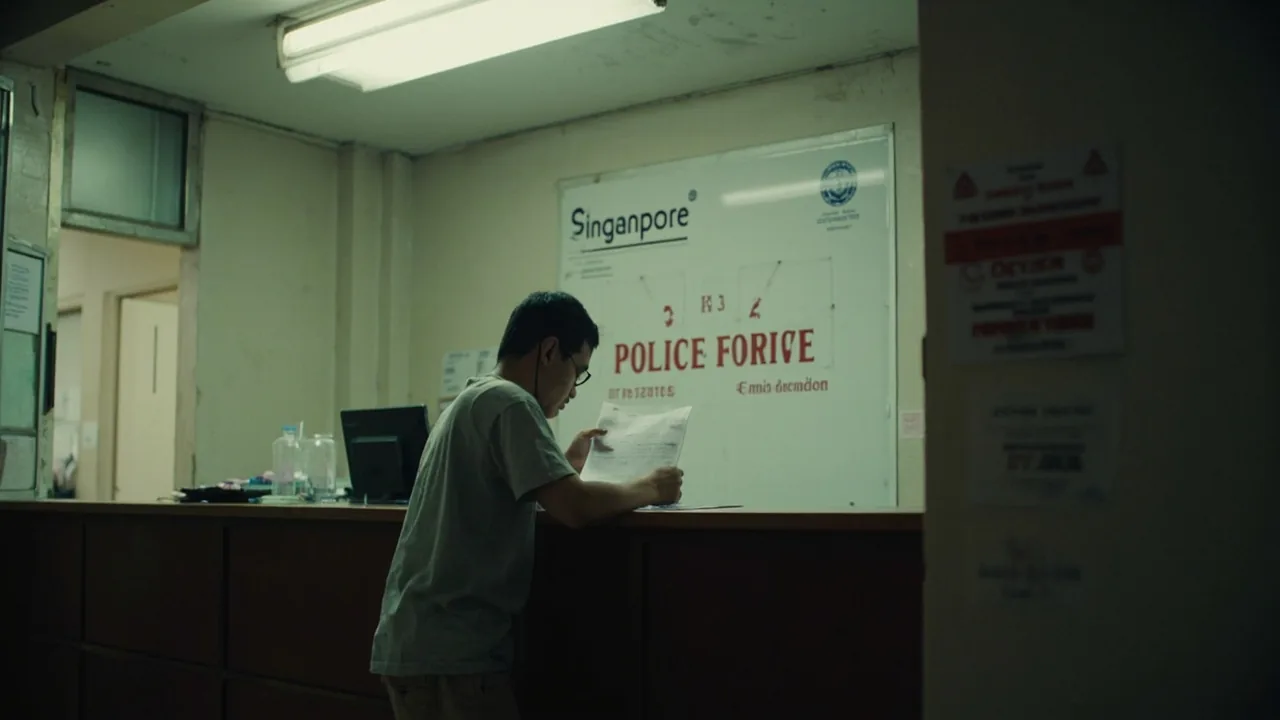
How to File a Police Report in Singapore as a Foreigner
Singapore Police Force (SPF) handles foreign-tourist fraud cases through the same portals as residents. You have three real options, and the right one depends on what just happened.
Option 1: For active theft, ongoing scam calls, or personal danger. Dial 999 immediately. Free from any phone in Singapore, including public phones at MRT stations and Changi Airport. If the crime just happened and a suspect is still nearby (a credit-card skimmer caught in the act, a fake “officer” demanding cash), 999 dispatches an officer. Police response inside the central tourist belt (Orchard, Marina Bay, Little India, Bugis) is usually under 10 minutes.
Option 2: For e-commerce fraud, phishing, fake job offers, online love scams, or anything where the suspect is remote. File through the SPF e-services portal under “Report a Non-Emergency.” Choose “Commercial / E-commerce Fraud” or “Other Crimes.” You can attach screenshots of the chat and the bank transfer confirmation. SPF will email you a reference number within 1 to 3 working days. Including the suspect’s UPI ID, bank account, or wallet phone number in your report can improve traceability.
Option 3: For bank-related or investment scams where you want loss recovery help. Call the National Crime Prevention Council’s Anti-Scam Centre hotline at 1800-722-6688 (free, Monday to Friday 9am to 5pm, with after-hours voicemail triaged next working day). The Anti-Scam Centre works directly with Singapore banks to freeze accounts that received your money.
Safety Alert: SPF will never call you to ask for your banking PIN, OTP, or Singpass password. If someone claiming to be a “police officer” or “MAS officer” asks you to transfer money to a “safe account,” that is itself a scam. Hang up and call 1800-722-6688 to verify.
For a fuller reporting walkthrough, see our step-by-step Singapore scam-reporting guide. For broader street safety patterns, this Indian-traveler safety overview covers what to watch for in the days before anything goes wrong.
Working with Singapore Banks to Recover Money
This is the gap competitors leave open: most generic “what to do if scammed in Singapore” guides stop at “call your bank,” without explaining that Singaporean banks have a specific, named process for foreign-victim fraud. Knowing it can shift your outcome from total loss to partial recovery.
Which bank received your money? If you transferred to someone claiming to have a DBS, OCBC, or UOB account, those banks operate scam response teams. Call DBS at 1800-339-6966, OCBC at 1800-363-3333, and UOB at 1800-222-2121. Each has a “fraud reporting” option on the IVR. State that you are a foreign victim of a scam, give the receiving account number (last 4 digits are enough for them to trace), and ask them to place a “hold” on the receiving account under MAS guidance.
Why timing matters here. When a Singapore bank receives a fraud report within 24 hours, MAS rules allow them to freeze the receiving account pending investigation. After 7 days, the funds typically have moved on. The Anti-Scam Centre’s job is to coordinate this freeze across banks; your bank’s job is to confirm the incoming transfer. Both happen in parallel.
Credit card chargebacks work differently. If you paid via Visa or Mastercard (debit or credit), the 24-hour window for a chargeback dispute opens as soon as you spot the fraud. Indian banks usually allow 60 to 120 days to file, but delays reduce your chances. File the dispute through your bank’s app under “Transaction Dispute” or “Fraudulent Transaction,” attach the police report reference number, and let the bank’s dispute team handle the Visa/Mastercard channel.
Crypto and wallet transfers are largely unrecoverable. Once money goes to a crypto on-ramp like Coinbase, Binance Singapore, or independent wallets, it is gone. Singapore has no guaranteed clawback for crypto transfers, and even the Anti-Scam Centre’s scope ends at the on-ramp. Prevention is the only real defence here, which is why no legitimate “Singtel support agent” or “MOM officer” will ever ask you to send crypto.
Common Scams Targeting Indian Visitors in 2026
The scams hitting Indian travellers in Singapore have a clear pattern: they exploit cultural cues (uniforms, official-looking lanyards, Singlish-fluent callers) and pressure-time decisions (the MRT station is closing, the customs officer is waiting).
The fake “Singtel/M1 technical support” call. You receive a call from a Singapore-number (+65) saying your SIM has a malware issue and you must verify by entering an OTP. Singtel, M1, and StarHub all confirm they never ask for OTPs over phone. Hang up, then call the operator’s published number to verify.
The “I left my wallet” play at MRT stations. A stranger at an MRT top-up machine claims they’ve lost their card and asks to borrow yours to “make a call.” They don’t need your card to make a call, they need your stored value. Keep your card in your front pocket after every top-up, and never hand it to a stranger.
Fake immigration or MOM officers at the airport gantry. A person in a hi-vis vest says your passport has a problem, asks for cash to “clear it,” and walks you past customs into a back corridor. Real Singapore ICA officers never solicit payment at the airport. Walk to the official ICA counter or check the published Changi Airport information number on the gantry sign.
Phishing links in Little India and Mustafa Centre Wi-Fi. Travellers report fake “Singtel login” or “HDB fine payment” portals popping up on open Wi-Fi at Mustafa and around Farrer Park. Use your mobile data or a VPN whenever you’re entering a Singpass or banking page. Singpass itself uses a separate, encrypted channel, never a public-link redirect.
What the Indian High Commission Can and Cannot Do
The Indian High Commission in Singapore (Consular section, +65-6258-3200) supports Indian nationals in distress, but their role is not what many travellers assume. They cannot freeze Singapore bank accounts, they cannot reverse UPI transactions, and they do not run a 24-hour crime helpline. What they do: issue emergency travel documents if your passport is stolen, verify your identity back to Indian authorities if needed for a freeze request, and provide a list of local lawyers if you choose to pursue civil recovery.
For travellers reading from abroad on a related point: Malaysia has its own parallel system. If a scam touches Malaysia (cross-border online fraud, KTM transfers), the Malaysian equivalent is the National Scam Response Centre at 997. You can read the cross-border protocol in our what to do if scammed online in Malaysia companion guide and apply the same first-hour discipline.
SIM Cards and Connectivity: Why It Matters for Scam Response
The first hour after a scam happens from a phone you can call from. Travellers who land in Singapore and skip buying a local SIM end up on roaming, where calls to Indian banks cost around ₹80 (~$0.83) to ₹150 (~$1.56) per minute and to Singapore police cost the same plus connection delays. The fix is cheap and takes five minutes.
Tourist SIM at Changi Airport. Both Singtel and M1 sell a 7-day tourist SIM at their airport counters for ₹1,120 (~15 SGD or ~$11.63), which includes around 50GB of data plus limited local talk time. At current rates (1 SGD = ₹74.69), SGD 15 ≈ ₹1,120. Buy at the official counters in Terminal 2 or Terminal 3 Arrival Hall, never from a “discount SIM” tout walking the baggage-claim area; the tout SIMs are usually prepaid foreign cards that don’t activate.
Get an eSIM before you fly. If you want to land with data already working, an eSIM from a provider like Nomad or Airalo lets you buy a Singapore data pack online that activates on first connect in Singapore. Useful as a backup, since your Indian SIM’s roaming tends to drop in MRT tunnels and underground walkways.
If you have an unlocked phone, the seven-day Singtel/M1 physical SIM plus the Nomad eSIM as fallback is the cleanest combo, and you avoid the cost of Indian-SIM international roaming, which easily runs ₹800 (~$8.30) to ₹1,500 (~$15.57) a day if you use it.
How to Avoid the Scams in the First Place
Most Indian travellers who get scammed in Singapore fall to two or three specific pressure tactics. Forewarning yourself on these is worth more than any reporting guide, because prevention is the only step with a 100% recovery rate.
No legitimate official asks for OTPs, crypto, or remote screen-share. Customs, police, telcos, MOM (Ministry of Manpower), ICA (Immigration), Singpass, and every bank are bound by the same rule: they verify, they do not take instructions from you over the phone. If anyone claims to be official and asks you to “confirm” anything by reading numbers aloud or typing into an app, the call itself is the scam. Hang up.
Use Singapore’s transport apps only. Grab is the official ride-hail. Citymapper and MyTransport.SG are the only mapping apps that show real MRT closures. Anyone offering you a “discount MRT card,” a “tour with free transport,” or a “taxi from the airport at a special price” without showing you the meter or the app screen is running a variation on the same play.
Carry only one card, photograph the back. Keep your primary card on you, the backup in the hotel safe, and a clear photo of both card backs (with the CVV covered if you want to be paranoid) in a password-protected album. If a card goes missing, you can read off the bank line to verify, and you have only one card to dispute.
Treat a “too good to be true” tour or job offer as a scam until proven otherwise. Singapore has a specific scam category called “fake friend” and “fake job” where a contact you just met on Instagram offers you a tour, a part-time gig, or a “data entry” task that requires an upfront payment or a “deposit” of crypto. None of these are real. SPF will tell you the same if you call.
For the broader safety picture beyond scams, our Singapore safety guide for Indian tourists and the Singapore laws and fines Indian travellers should know piece cover the non-scam side of the same risk landscape.
Where to Stay in Singapore
For Indian travellers who want a social base while sorting out a scam or recovery paperwork, hostels with 24-hour reception are much better than hotels, because the staff have handled similar reports before and can help you make the right call. Here are two strong options:
| Hostel | Rating | Best For | Book |
|---|---|---|---|
| Dream Lodge @ Tyrwhitt | 9.2 | Central Lavender location, near MRT, lively common area | Check prices |
| Atelier Hostel | 9.08 | Quieter street, strong for digital-nomad setups, easy MRT access | Check prices |
| Both have 24-hour reception desks where staff can help with calling the police hotline or arranging transport to a police station. They also sit near MRT stations, which matters if you need to reach the nearest police post quickly. |
Quick Eats While You Sort the Paperwork
If you’re in Little India or Boat Quay dealing with follow-ups, two solid Indian spots are good for a working lunch near a police post:
- Chola Cafe - Biryani House (4.9) for Hyderabadi biryani when you need a real meal and a quiet table to make phone calls.
- Zaffron Tandoori @ Boat Quay (4.8) for North Indian tandoori if your meetings are at the High Commission or the CPF building area.
Vegetarians: both have separate veg menus with paneer, dal, and biryani veg options. Travellers report the Chola paneer biryani as a meal for one that runs around ₹1,046 (~14 SGD or ~$10.85) to ₹1,344 (~18 SGD or ~$13.96).
Frequently Asked Questions
Can I get my money back after a Singapore scam? Recovery depends on how the money moved. Bank transfers in the first 24 to 72 hours can be partially frozen through the Anti-Scam Centre. Credit card payments are recoverable through chargeback for 60 to 120 days. Crypto, cash, and wallet transfers are usually gone. The sooner you report, the better your chances, recovery rates drop significantly after the first 48 hours.
Do I need to be in Singapore to file the police report? No. SPF e-services accepts reports from anywhere, including from your hotel in Bangkok or your flight back to Mumbai. You’ll get a reference number by email. Travellers report e-services is faster than walking into a Neighbourhood Police Centre for non-emergency cases.
Will filing a report affect my visa or return to Singapore? No. Singapore doesn’t blacklist tourists for being a fraud victim. The only flag that affects entry is being convicted of, or under investigation for, a crime you committed. Being a victim doesn’t fall into that category.
Should I still go to the Indian High Commission? For lost/stolen passports, yes, it’s almost mandatory (they issue emergency certificates). For fraud recovery, the High Commission cannot move money or freeze accounts, so their value is limited. Save them for cases where the police report and bank dispute need an Indian-side identity Is the 1800-722-6688 hotline free from overseas? No, that’s a Singapore domestic number. From an Indian phone, dial +65-XXXX-XXXX format, or use an international calling card to avoid the per-minute roaming cost. The Anti-Scam Centre can also be reached through the SPF online form if calling is hard.
What if the scammer is still in Singapore? Tell the police immediately, give them any phone numbers or addresses you have, and let SPF handle it. Travellers warn against confrontation, never attempt to confront a scammer yourself.
Is WhatsApp calling still working in Singapore? Yes, WhatsApp, Telegram, and Signal all work fine. The risk isn’t the apps; it’s scammers impersonating officials through them. Verify any “Singtel” or “MOM” call by hanging up and calling back through the official public number.
Subodh’s Take
Singapore is one of the safest places an Indian traveller will visit, but that means the scams that do happen are sharper and more pressure-tuned than the noisy touts you might be used to. The pattern that saves people is the same: freeze the money in the first hour, file the report in the first day, and don’t let an “official” caller move you off your phone. Travellers consistently report that the mistake wasn’t ignorance, it was rushing the caller’s instructions because the caller sounded authoritative. Slow down, take screenshots, and call the bank.
, Subodh