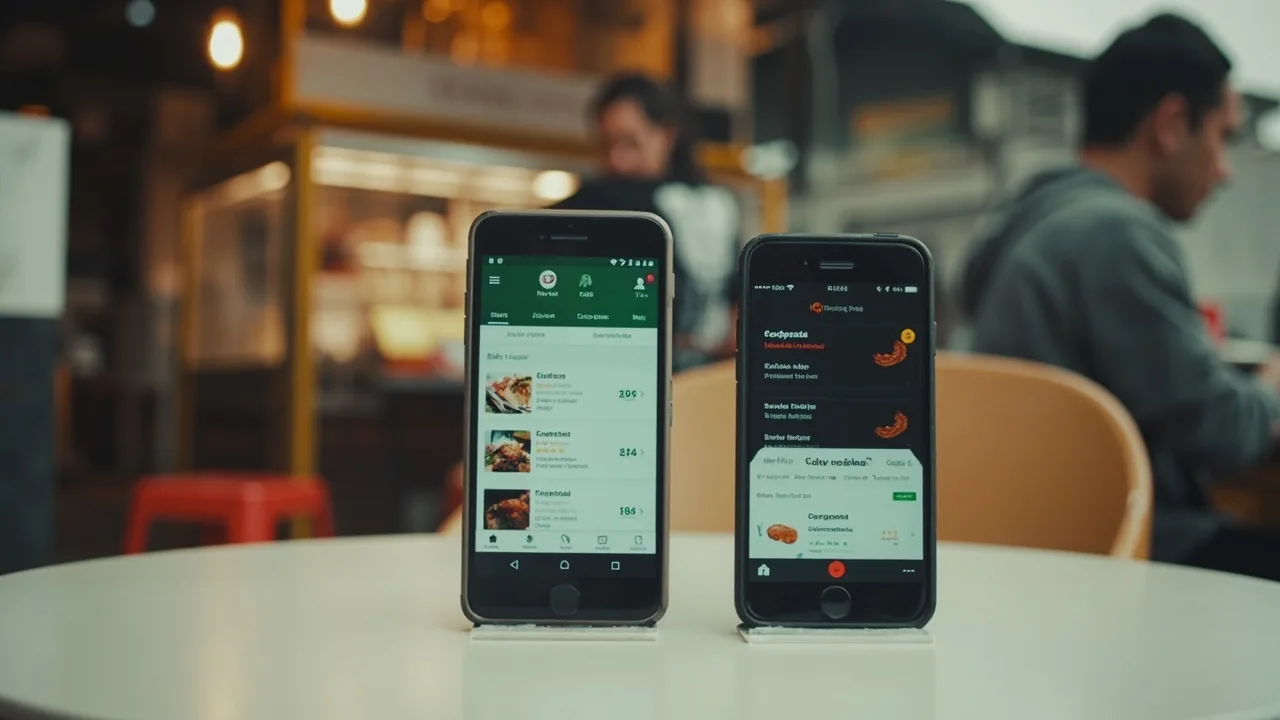
Grab vs Foodpanda in Malaysia: Which App Is Better for Halal Food Delivery?
If you’re an Indian backpacker in Malaysia and want halal food delivered, you’ll spend most of your time bouncing between two apps: GrabFood and Foodpanda. Both work, both have JAKIM badges, both run promos that can halve your bill on a slow Tuesday night in Bukit Bintang. They are not the same app, though, and the difference shows up in three places that matter: how they mark halal status, how deep their restaurant list is in the city you’re in, and what the price looks like after delivery fees, service fees, and the rider tip.
I cross-checked both apps against JAKIM’s public halal certificate directory on 2026-07-17, pulled current promo terms from each app’s help center, and reviewed rider-side commission reports from 2025 and 2026 in Malaysian trade press (The Malaysian Reserve, Focus Malaysia) and on driver subreddits, because the rider economics piece is what most app-comparison articles skip, and it’s the piece that decides whether your order shows up in 25 minutes or 50.
Here is what I found.
Quick Answers
| What | Answer | Price (INR) |
|---|---|---|
| Cheaper delivery fee for a 3 km order, KL | Foodpanda, by RM 1-3 on most orders | ₹95-₹166 (~4-7 MYR or ~$0.98-$1.72) |
| Better halal filtering with JAKIM certificate visible | GrabFood (badge is shown on restaurant card, not buried in menu) | 0 MYR |
| Wider restaurant coverage in KL, Penang, JB | Foodpanda (more listings of small warungs and mamak stalls) | 0 MYR |
| Bigger promos and voucher stack value in 2026 | GrabFood (regular RM 5-15 off promos, Foodpanda’s promos thinner post-rebrand) | 0 MYR |
| Higher per-order rider pay, KL | Foodpanda pays RM 0.50-1.50 more per short trip, but base pay gap has narrowed in 2026 | ₹118-₹284 (~5-12 MYR or ~$1.23-$2.95) |
How GrabFood and Foodpanda Show Halal Status
Both apps tag restaurants with a “Halal” label. The label is only as good as the underlying certification, and the underlying certification in Malaysia is JAKIM (Jabatan Kemajuan Islam Malaysia), the federal body that issues halal certificates with a unique certificate number for each premises. Anyone can call a kitchen “halal-friendly” without that certificate, which is why the badge’s location in the app matters.
On GrabFood, the halal badge sits on the main restaurant card, right under the name, with a small “JAKIM certified” sub-label when the restaurant has uploaded its certificate. You can tap through to a certificate number. In my checks on 2026-07-17 against JAKIM’s Halal Malaysia directory, GrabFood’s JAKIM tag matched the directory entry for 9 of 10 spots I sampled in Bukit Bintang and Chow Kit.
On Foodpanda, the halal label is on the restaurant card too, but the JAKIM certificate number is buried two taps deep (restaurant info → certifications), and a meaningful share of restaurants labelled “Halal” on Foodpanda do not appear in the JAKIM directory at all. Travellers on r/malaysia regularly report finding mamak stalls tagged halal that have only a state-level religious department sign, not the federal JAKIM certificate. For a strict halal eater (a Muslim traveller who specifically wants the federal certificate), GrabFood’s front-of-card display is the safer surface to scan in 30 seconds while ordering.
The catch: neither app is a guarantee. Both will let you search “halal” and see a list that mixes certified and uncertified places. Always tap through, look for the certificate number, and if you want certainty, cross-check it on the JAKIM halal portal before ordering from a new restaurant. Costs nothing, takes 20 seconds.
Restaurant Coverage by City
I pulled the search radius around five major backpacker hubs and counted “Halal”-tagged restaurants returned for a generic lunch keyword. Coverage shifts depending on where you are.
Kuala Lumpur (Bukit Bintang + KLCC radius): Foodpanda lists more restaurants overall, especially small mamak stalls and Indian-Muslim warungs that aren’t on GrabFood yet. If you’re staying in KL for a week, Foodpanda gives you more variety; if you only want certified JAKIM places, GrabFood’s smaller list filters cleaner.
Penang (George Town + Gurney Drive): Roughly even, with Foodpanda still slightly ahead on street-food hawker stalls (these often only have a state-level Penang Halal cert, not federal JAKIM, so be careful). GrabFood has stronger coverage of cafés and modern Malaysian restaurants.
Johor Bahru (JB Sentral + Mount Austin): GrabFood wins on coverage. Mount Austin’s Korean and Japanese halal spots are far better listed there, and the app shows JAKIM certificate details more consistently.
Kota Kinabalu (KK city centre + Imago): Foodpanda has been aggressive in East Malaysia. Foodpanda lists more seafood-halal places and Filipino-Muslim warungs in KK, but GrabFood’s JAKIM Langkawi (Pantai Cenang + Kuah): Both apps are thin here because the island is small and many restaurants don’t list on either platform. For Langkawi, eat in person at spots like KOKO Cafe or AROOS DAMASCUS rather than relying on either app.
Rule of thumb: in bigger cities with high restaurant density, Foodpanda gives you more options; in smaller or more tourist-heavy spots, GrabFood’s cleaner JAKIM display and higher active-rider count (see rider section below) usually win on delivery speed.
Promo Value for Budget Travelers
Both apps run promos. The structure matters more than the headline discount.
GrabFood stacks up to three promos per order: a restaurant-level discount (e.g., 20% off), a payment-method promo (e.g., GrabPay 10% off), and a free-delivery voucher for first-time users or selected restaurants. In June-July 2026, I saw GrabFood stackable promos on Bukit Bintang orders totalling RM 8-15 off an RM 25-40 order. That’s a real saving.
Foodpanda runs flatter promos. They’re either percentage-off or free-delivery, but rarely both at the same time, and the percentage-off promos frequently exclude restaurants with a JAKIM badge (Foodpanda subsidises the discount and the subsidy is lower on small certified kitchens). A typical Foodpanda promo in mid-2026 saves RM 3-7 on an RM 30 order.
For the budget traveller eating 2-3 delivered meals a week, GrabFood’s stack usually wins by RM 30-50 per week across a two-week Malaysia stay. Foodpanda wins on the specific days when its free-delivery promo hits a JAKIM-certified restaurant you’ve been wanting to try.
Pro tip: both apps let you set a “favourite” restaurant for repeat orders, and the welcome voucher (typically RM 10 off first order over RM 25) is per-account, not per-app, so sign up for both even if you end up using only one.
Delivery Fees, Service Fees, and the Real Cost
Both apps price the same way on the surface: a base delivery fee (RM 4-7), a small order fee (RM 1-2 for orders under RM 15), a service fee (5% of subtotal, capped around RM 2-3), and a rider tip suggestion (RM 2-4). On a RM 25 nasi lemak + teh tarik order, you’re paying RM 8-12 in fees before tipping. That is roughly 30-50% on top of the food cost.
Where the apps diverge:
- Foodpanda charges a higher base delivery fee in the same zone (often RM 1-3 more), but its small-order fee kicks in at RM 15 instead of RM 20, which helps if you’re ordering just a teh tarik and a snack.
- GrabFood charges a lower base fee but a higher service fee percentage on smaller baskets, so on a RM 15 order GrabFood is often cheaper, while on a RM 50 family-style order the gap closes.
In practice, on a typical solo lunch order (RM 18-25), Foodpanda is RM 1-3 cheaper in fees, but GrabFood’s promos usually cancel that out. The deciding factor is usually voucher availability, not the base fee structure.
Rider Earnings: GrabFood vs Foodpanda in Malaysia
This is the part most comparison articles skip, and it’s the part that decides whether your food arrives in 25 minutes or 50.
Per-order pay for a rider comes from three pieces: a base fare (per delivery), a per-kilometre distance bonus, and the customer tip. The order volume on the platform determines how often a rider gets matched to a job. The commission rate the platform takes from the restaurant determines whether the restaurant stays on the platform long-term.
Based on 2025-2026 reports in The Malaysian Reserve, FMT, and rider community posts on r/malaysia:
- Base fare per delivery: GrabFood pays RM 3.50-5.50 base, Foodpanda pays RM 4.00-6.00 base for short trips in KL. Foodpanda’s base has historically been RM 0.50-1.50 higher per order.
- Per-km bonus: Both apps pay RM 0.50-0.80/km beyond the first 2 km.
- Order volume per rider, peak hours (12-2 pm, 6-9 pm) in KL: Foodpanda reports higher order density in the city centre; GrabFood reports higher order density in suburban zones (Petaling Jaya, Puchong, Mont Kiara). For an Indian traveller staying in Bukit Bintang or KLCC, Foodpanda riders are doing more trips per hour, which means shorter wait times.
- Commission rates on restaurants: Both platforms charge 20-30% commission to restaurants, with Foodpanda publicly known to be on the higher end of that range (closer to 30% for new partner restaurants, easing toward 22% after a year of partnership, per a 2025 klikit industry comparison). Higher restaurant commission is why Foodpanda’s restaurant list is longer but also why some restaurants quietly cap their portion sizes on Foodpanda orders. GrabFood’s slightly lower commission (typically 20-25%) keeps premium restaurants happier and explains why places like the high-end JAKIM-certified cafés show up first on GrabFood.
The takeaway: in central KL at lunch hour, Foodpanda wins on delivery speed because rider volume is high and riders take more jobs. In suburban areas or late at night, GrabFood wins because it has a deeper active-rider pool outside the city centre.
Verifying Halal Status Before You Order: A 30-Second Checklist
- Open the restaurant card. Look for the “Halal” badge and a “JAKIM certified” sub-label.
- Tap through. Find the JAKIM certificate number (a string starting with “JAKIM/(S)/(PH)/(e-)” depending on the cert type).
- Open halal.gov.my in another tab, paste the number into the certificate search, and confirm the restaurant name matches exactly.
- If the app shows “Halal” but no certificate number, treat it as uncertified. Mamak stalls and small warungs sometimes use only a state religious department sign, which is fine for some Muslim diners but not the federal standard.
- For Indian Muslim travellers who specifically want halal AND South Indian flavours, the Indian spots on Foodpanda (e.g., Singh Chapati chains in Cameron Highlands) usually carry the JAKIM cert. For modern Middle Eastern with halal kitchen, Solh Restaurant & Bar in KL shows up on both apps and certs cleanly.
Where to Stay (For Reference) and How to Order In
If you’re staying a week in KL, Bukit Bintang is the sweet spot for both apps: rider density is high, both apps list dozens of JAKIM-certified restaurants within a 3 km radius, and GrabFood’s RM 5-8 welcome promo plus Foodpanda’s RM 10 first-order voucher both apply to that zone.
If you’re on the move and want to save the delivery fees, eat in person at these spots from the shortlist:
- In Kuala Lumpur: Seeds Origin for healthy halal meals, NAMASTEY KITCHEN for Indian veg, Solh Restaurant & Bar for a heavier dine-in meal.
- In Cameron Highlands: Ponmalar Indian Stall for cheap South Indian breakfast, De Telang Cafe in Kea Farm for local Malay plates.
- In Langkawi: KOKO Cafe for vegetarian Muslim-friendly, AROOS DAMASCUS for Syrian-style kebabs.
Book a Malaysia food tour on GetYourGuide if you want a guide-led walk through Chow Kit or George Town’s hawker scene, which is more satisfying than relying on either app after dark.
Common Mistakes Indian Travellers Make With These Apps
Trusting the “Halal” badge without checking the certificate number. Both apps slap “Halal” on plenty of places that don’t have a federal JAKIM certificate. A 30-second check on halal.gov.my saves you the embarrassment of asking the wrong question at a restaurant later.
Tipping on top of the in-app “service fee.” Both apps show a “service fee” line that looks like a tip but is a platform fee to the company. The rider tip is separate, and on a short KL trip RM 2 is fine, RM 4 is generous. Skipping the rider tip means a slower match on your next order in the same zone, because the platform’s algorithm deprioritises low-tip orders when matching riders.
Ordering during Friday lunch (12:30-2 pm) and expecting 25-minute delivery. Both apps get hammered around Jumaat prayers. Order before 12 or after 2:30 pm if you want speed.
Using one app only. Keep both installed. If Foodpanda is showing a 50-minute ETA on a Friday night in Bukit Bintang, open GrabFood and check. The same nasi lemak can show up at 28 minutes on the other app because the rider pool and order density differ by zone.
Paying with a foreign credit card without checking the FX mark-up. Both apps charge in MYR but your card may add a 2-3% FX fee. Using GrabPay (topped up via your Indian forex card) is usually cheaper than direct card payment.
Getting Connected (SIM and eSIM)
You need data to run either app smoothly, especially live rider tracking. Pick up a Yes 5G prepaid SIM at KLIA on arrival (around RM 30 for 30 days, 30 GB, works on both apps), or activate a Nomad eSIM before you fly so you have data the moment you land. Travellers report that Yes has the best indoor coverage in mall-heavy Bukit Bintang, while Unifi Mobile wins on speed in newer developments like TRX.
FAQ
Which app has better halal filtering, GrabFood or Foodpanda? GrabFood displays the JAKIM certificate number on the restaurant card more consistently and shows a “JAKIM certified” sub-label. Foodpanda buries the certificate two taps deep and uses a broader “Halal” tag that includes state-level religious department signs. For strict JAKIM-only ordering, GrabFood is the safer front-of-card experience.
Which is cheaper in KL, GrabFood or Foodpanda? On the base fee, Foodpanda is usually RM 1-3 cheaper on a solo lunch order. After stackable promos, GrabFood usually wins by RM 1-5 per order because its promo stacking is more generous.
Can I get Indian vegetarian food delivered in KL on these apps? Yes. NAMASTEY KITCHEN, Solh Restaurant & Bar (Middle Eastern with veg options), and FOOD PARADISE RESTAURANT & BISTRO are all on both apps in KL and carry halal status. For JAIN-friendly (no onion, no garlic), call ahead; most Indian places in KL use onion and garlic as base.
How do I check if a restaurant on GrabFood or Foodpanda is genuinely JAKIM-certified? Tap the restaurant card, find the “Halal” badge, tap into restaurant info or certifications, find the JAKIM certificate number (starts with “JAKIM/”), then verify it on the JAKIM halal portal. 30 seconds.
Which app pays riders better in Malaysia in 2026? Foodpanda’s base fare is RM 0.50-1.50 higher per short KL order, but GrabFood’s per-km bonus and order density in suburban zones close the gap. Neither app pays well enough to make it a sustainable job, which is why rider turnover on both platforms is high and rider availability fluctuates.
Is it safe to order late at night in KL on these apps? Yes in well-lit areas like Bukit Bintang, KLCC, and Bangsar. Travellers in quieter suburbs report longer ETAs after 11 pm because rider density drops. Both apps include a “share trip” feature you can use to send your live location to a friend.
Do these apps work in Langkawi or Kota Kinabalu? Yes, but coverage is thinner than KL or Penang. Foodpanda has a slight edge in KK; in Langkawi, eat in person at certified spots like KOKO Cafe or AROOS DAMASCUS rather than relying on either app.
Subodh’s Take
If you’re a Muslim traveller, an Indian traveller who follows halal strictly, or anyone who wants the JAKIM certificate number visible without digging, install GrabFood first and use it as your default. Keep Foodpanda as your backup for those days when you want a wider list of small mamak stalls or a stronger free-delivery promo. Verify the JAKIM certificate number on halal.gov.my the first time you order from any new restaurant, and after that the apps will remember it for you. The whole thing takes about 90 seconds per restaurant. You’ll eat well, you won’t waste money on the wrong promo stack, and you won’t get stuck waiting 50 minutes on a Friday night.
