Indian Restaurants in Malaysia: Where to Find Authentic Food
Malaysia is, statistically speaking, one of the easiest Southeast Asian countries for Indian travelers to eat well in. Roughly 7-9% of the population is of Indian descent, Tamil is a recognized heritage language, and the country has had a working “mamak” restaurant scene (Muslim-Malaysian Indian-run eateries serving roti, dosa, banana leaf rice, and curry) since before independence. The hard part is not finding Indian food, it’s sorting the great from the greasy, the veg-safe from the “we slipped some anchovies in there” places. This guide covers what works for Indian travelers on the ground, from KL hotspots to airport meals between flights. For related planning, see our guide on Sea Backpacking Hub.
A note on FX for this article: 1 MYR ≈ ₹23.59 at time of writing, so a 20 MYR plate of food runs about ₹472 (~$4.90). Keep that ratio in your head when scanning menus.
Quick Answers
| What | Answer | Price (INR) |
|---|---|---|
| Most common Indian cuisine style in Malaysia | Mamak (Muslim-Malaysian Indian, halal-certified, heavy on roti, dosa, banana leaf) | Free to browse menus |
| Cheapest Indian meal in KL | Roti canai + teh tarik at a mamak stall | ₹94-₹165 (~4-7 MYR or ~$0.98-$1.71) |
| Banana leaf rice (veg) at a mid-range spot | Single serve with 4 vegetables, papadum, rice | ₹283-₹424 (~12-18 MYR or ~$2.93-$4.40) |
| Average sit-down North Indian dinner in KL | Thali or 2 curries + naan per person | ₹825-₹1,414 (~35-60 MYR or ~$8.56-$14.67) |
| Indian food at KLIA/KLIA2 airport | Mamu’s, Restoran Sri Melayu, Nirav’s Kitchen (limited hours, 24-hour at selected outlets) | ₹424-₹1,060 (~18-45 MYR or ~$4.40-$11.01) |
The Local Indian Food Scene in Malaysia
Three different “Indian food” cultures run in parallel in Malaysia, and you’ll want to know which is which before you walk into a place:
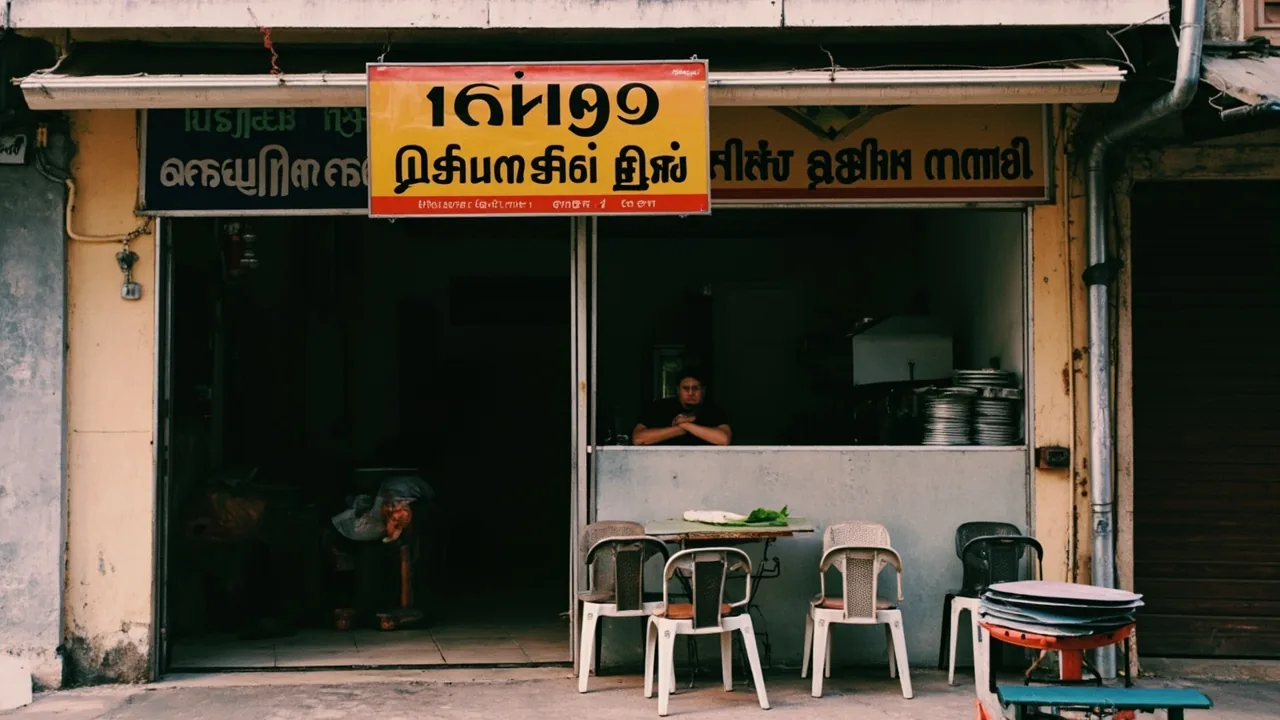
Mamak restaurants are the everyday default. Run by Malaysian-Indian Muslims, they are halal-certified by default, which means the meat is halal-slaughtered but the vegetarian menu is generally safe (no pork, no alcohol used in cooking). Roti canai, roti tissue, maggi goreng, mee goreng, nasi kandar, banana leaf rice with dhal and mixed veg curries, murtabak, and teh tarik are the staples. The atmosphere is open-air, plastic chairs, fluorescent lights, TVs playing cricket, and the food arrives within five minutes. A roti canai is typically ₹47-₹71 (~2-3 MYR or ~$0.49-$0.73), a teh tarik ₹59 (~2.50 MYR or ~$0.61). Mamaks stay open late; many run 24 hours. This is what most Indian travelers will eat 80% of the time.
Tamil / South Indian restaurants cluster around Brickfields in KL (Little India proper), parts of Penang, Johor Bahru, and Kuantan. These tend to be vegetarian-heavy, run by Hindu Tamil families, and serve proper banana leaf rice with unlimited refills (the standard “sapna” style), idli, vada, dosa, sambar, and rasam. Banana leaf rice here is ₹236-₹353 (~10-15 MYR or ~$2.45-$3.67) for a vegetarian spread.
North Indian / Mughlai / fine-dining Indian restaurants are fewer and concentrated in KL’s Bangsar, KLCC, and Bukit Bintang areas. These serve butter chicken, biryani, paneer tikka, dal makhani, and naan, with prices from ₹589 (~25 MYR or ~$6.11) for a main up to ₹1,885 (~80 MYR or ~$19.57) at premium spots. Most of these are not strict-veg by default, so ask about ghee vs. Oil, and whether the paneer is cooked separately.
One specific thing to be aware of as a vegetarian: the word “sayur” (vegetable) on a Malaysian Indian menu often means “vegetable curry with shrimp paste or dried prawns” unless it’s a veg-only restaurant. Say “sayur campur, tanpa udang, tanpa ikan, tanpa bilis” (mixed veg, no shrimp, no fish, no anchovies) at the counter, or look for an explicit “Pure Vegetarian” sign in English or Tamil.
Where to Eat in Kuala Lumpur
KL is where the strongest shortlist of named spots lives, so most of the specifics here are KL-anchored. Penang, Johor Bahru, and Melaka all have functional Indian scenes but are covered in our related guides linked below.
Indian / Veg-Friendly Restaurants
Bombay Grand Indian Cuisine, KLCC Branch is the Maharashtrian and coastal-Indian pick for an upscale dinner in the city centre. Travellers report the Malvani fish curry and paneer Kolhapuri are standouts, and the veg thali runs ₹1,060-₹1,531 (~45-65 MYR or ~$11.01-$15.90) per person. It’s the kind of place you take a non-Indian friend to show what restaurant Indian food looks like.
Bombay Grand Indian Cuisine, Brickfield Branch is the same group’s more casual spot in Little India proper. Brickfields is where you go for the “chai + bun maska + bookshop” morning ritual, and this branch fits that texture, with Mumbai street food like vada pav, pav bhaji, and bhel alongside the North Indian standards. Expect ₹589-₹942 (~25-40 MYR or ~$6.11-$9.78) for a full meal.
Saudagar Heritage Indian Kitchen is the family-run North Indian option. The brief in our notes describes it as paying homage to traditional recipes, and the reviews back that up; travellers report dal makhani that tastes like it was slow-cooked overnight and a butter chicken that doesn’t rely on the usual KL sweet-cream trick. Plan for ₹707-₹1,178 (~30-50 MYR or ~$7.34-$12.23) per person with a naan.
Indian Empire sits in the same upscale bucket as the KLCC Bombay Grand, leaning North Indian with a “royal” plating aesthetic. A safer dinner-only choice if you’re near Bukit Bintang or KLCC after a day out.
Restoran Sentral Spice is the casual fusion pick, mixing Malaysian and North Indian flavours in a vibrant, budget setting. Most useful when you’re somewhere between KL Sentral station and Brickfields and need a fast ₹353-₹471 (~15-20 MYR or ~$3.67-$4.89) lunch. The roti john and murtabak here are reported as solid.
Solh Restaurant & Bar is technically Middle Eastern rather than Indian, but it lands on this list because the saffron biryani and lamb shawarma hit a similar spice register and Indian travellers report it as a useful change-of-pace meal. Useful if you’ve had six days of roti canai and want something different. Mains run ₹707-₹1,296 (~30-55 MYR or ~$7.34-$13.45).
Local / Non-Indian Spots (When You’re Tired of Indian Food)
This is the honest part: even Indian travelers get tired of Indian food by day five. A few non-Indian spots in KL that are worth knowing:
Souled Out is the modern-Malaysian pick, with a reported standout beef rendang and spicy laksa. Useful for when you’re hosting a group with mixed preferences, mains around ₹825-₹1,296 (~35-55 MYR or ~$8.56-$13.45).
The Food Stalls category covers the generic hawker-centre / pasar malam experience, which is the cheapest way to eat in KL. A plate of char koay teow runs ₹141 (~6 MYR or ~$1.47) and teh tarik ₹59 (~2.50 MYR or ~$0.61) at most stalls, and most pasar malam clusters have at least one vegetarian Indian stall set up alongside the Malay and Chinese ones.
For coffee, Seeds Origin (Healthy Food Cafe) is the daytime work-from-cafe option with vegetarian-friendly plates; Pahit is the cocktail bar if you want a single evening drink that’s good (gin-forward, not sweet).
Indian Food at Malaysian Airports
This is a real pain point and worth its own section, because flight times often mean you need a meal at 6 AM or 11 PM, when most of the city is closed.
KLIA (Main Terminal, the one used by Malaysia Airlines and most full-service carriers): Restoran Sri Melayu is the reliable Malay/Indian-ish buffet option in the satellite terminal, open for most flight waves. Nirav’s Kitchen (a North Indian brand with a KLIA presence) covers butter chicken and biryani needs but has restricted hours; check the screen before queuing. A thali runs ₹707-₹1,060 (~30-45 MYR or ~$7.34-$11.01).
KLIA2 (Low-Cost Carrier Terminal, used by AirAsia, Batik, etc.): Mamu’s (a mamak chain) is the go-to, open long hours including overnight. Roti canai ₹94-₹141 (~4-6 MYR or ~$0.98-$1.47), teh tarik ₹118 (~5 MYR or ~$1.22), banana leaf rice ₹424 (~18 MYR or ~$4.40). There’s also a generic “Indian” counter in the food court, but Mamu’s is the consistent option. If you’re transiting overnight, this is one of the few 24-hour Indian options at the airport.
Penang International Airport (PEN): There’s a small Indian counter landside but the selection is thin. Eat in the city (15-20 minutes by Grab to Georgetown) unless your layover is under 3 hours.
Changi is in Singapore, not Malaysia, but many KL-bound Indian travelers transit through it; for that flow, our Singapore Indian food guide covers the Changi Indian food options.
Subodh’s Pro Tip: Most Malaysian airport Indian food is worse than city Indian food. If your layover is 4+ hours, take the KLIA Ekspres (₹778 (~33 MYR or ~$8.07) / ₹779 (~$8.09) one way, 28 minutes) into KL Sentral, eat in Brickfields, and come back. It’s almost always faster and cheaper than eating at the airport.
Key Phrases at a Mamak Counter
Even at mamaks, where staff understand basic Indian-accented English, a few Malay phrases get you better and safer food:
| English Phrase | What it Means | Local Script | Pronunciation |
|---|---|---|---|
| Saya makan sayur sahaja | I eat vegetables only (vegetarian) | Saya makan sayur sahaja | ”sah-yah mah-kahn sah-yoor sah-hah-jah” |
| Tanpa daging, tanpa ayam, tanpa ikan | No meat, no chicken, no fish | Tanpa daging, tanpa ayam, tanpa ikan | ”tan-pah dah-ging, tan-pah ah-yam, tan-pah ee-kan” |
| Tanpa udang dan bilis | No shrimp and no anchovies | Tanpa udang dan bilis | ”tan-pah oo-dung dun bee-liss” |
| Tanpa bawang (Jains) | No onion | Tanpa bawang | ”tan-pah bah-wung” |
| Tanpa telur | No egg | Tanpa telur | ”tan-pah teh-loor” |
| Pedas sikit / Pedas lagi | Less spicy / More spicy | Pedas sikit / Pedas lagi | ”peh-dass see-kit / peh-dass lah-gee” |
| Nescafe tarik, kurang manis | Pulled Nescafe, less sweet | Nescafe tarik, kurang manis | ”ness-kah-feh tah-rik, koo-rung mah-niss” |
If you’re at a Tamil-run South Indian place, switching to “Saiva vegetarian” or “veg only” in English works almost universally.
Safe Indian / Veg-Friendly Dishes to Order Anywhere
These are the dishes that tend to be reliably vegetarian across most Malaysian Indian restaurants, with what to specify:
Roti canai / roti tissue / roti telur: Flatbread, plain or with egg. Order “tanpa telur” for eggless. ₹47-₹94 (~2-4 MYR or ~$0.49-$0.98). Best dipped in dhal or curry on the side.
Banana leaf rice (nasi banana leaf): A banana leaf laid with rice, dhal, mixed veg curry, papadum, and pickles. Vegetarian version is usually marked. ₹236-₹424 (~10-18 MYR or ~$2.45-$4.40) for a single serve. Most places do unlimited rice refills; ask first.
Dosa (thosai): Crispy fermented rice-lentil crepe. Comes masala (with potato filling), plain, paper, or rava. Always vegetarian by default; ask “tanpa telur” for eggless. ₹141-₹283 (~6-12 MYR or ~$1.47-$2.93).
Thali / set meal: A full platter with rice, multiple curries, dhal, roti, and a sweet. ₹424-₹825 (~18-35 MYR or ~$4.40-$8.56) at mid-range spots.
Vegetable biryani: Rice with mixed vegetables and spices. Confirm “no meat stock” at fine-dining places; at mamaks it’s usually pure veg. ₹283-₹518 (~12-22 MYR or ~$2.93-$5.38).
Paneer dishes (butter paneer, palak paneer, paneer tikka masala): At upscale North Indian spots only. Ask “paneer with vegetable oil or ghee?” if you care, and confirm “no cream from non-veg pots.” ₹518-₹895 (~22-38 MYR or ~$5.38-$9.29).
For broader Malaysian vegetarian eating beyond Indian food specifically, our Vegetarian Food in Malaysia guide and the Halal Buffet KL under RM15 guide cover the cheap end of the spectrum.
Common Food Mistakes Indian Travelers Make in Malaysia
Mistake 1: Assuming “sayur” means safe vegetarian. A dish labelled “sayur” at a Chinese-Malaysian stall can contain shrimp paste, dried prawns, or oyster sauce. Always specify “tanpa udang, tanpa bilis, tanpa oyster sauce” or stick to clearly-veg Indian restaurants for full safety.
Mistake 2: Eating banana leaf rice without checking the refills system. Most Tamil banana leaf places refill rice and veg curries free, but a small number charge per refill or for extra sides (papadum, appalam, payasam). Ask first or watch what other tables are doing.
Mistake 3: Going to a “halal” mamak expecting Jain options. Mamaks are halal (no pork, no alcohol in food), but they almost never have Jain-style no-onion-no-garlic options. The roti canai dough itself contains onion in many recipes; ask specifically if you need Jain.
Mistake 4: Treating “veg” at a Malaysian-Indian fine-dining restaurant as safely veg. Some upscale North Indian spots in KL use shared tandoor surfaces and butter chicken pots for paneer dishes. If strict separation matters, ask “veg only kitchen?” or pick a pure-veg place.
Mistake 5: Drinking tap water. Stick to bottled water (1 MYR / ₹24 at any 7-Eleven or mamak); even ice in some less-established stalls is tap-water based. The branded “ice cream” ice cubes in mamak drinks are usually safe (commercially made) but check the cup.
Food Safety & Hygiene
Malaysia’s food safety record is reasonable by Southeast Asian standards, with a few specifics worth knowing:
- Eat at busy stalls. A mamak with full tables at lunch turnover is safer than an empty one at the same hour, because the food is freshly cooked.
- Bottled water only. 1 MYR (₹24) at any convenience store.
- Wash hands before eating or use sanitizer; mamaks usually have a wash basin by the entrance.
- Ice in branded drinks (Coca-Cola, Pepsi, Tiger beer) is factory-sealed and safe. Ice in local fresh juices at stalls can be risky; pick juice stalls with high turnover.
- Avoid pre-cut fruit at roadside stalls unless it’s something you peel yourself (banana, mangosteen, rambutan).
- Diarrhoea treatment: any pharmacy stocks Diatabs (loperamide) and ORS sachets. Bring your own rehydration salts from India if you’re particular.
For broader street-food safety principles that apply across the region, see our Street Food Safety in Southeast Asia guide.
Getting Connected
For looking up menus, checking if a mamak is open late, or translating a Malay dish name on the fly, a working data connection makes everything easier. Most Indian travelers arriving at KLIA grab a local SIM at the airport (Hotlink, Celcom, or Maxis, all ₹589-₹707 (~25-30 MYR or ~$6.11-$7.34) / ₹590-₹708 (~$6.12-$7.35) for 30 days with data), but an eSIM you activate before you fly is cleaner.
eSIM option: Get Nomad eSIM, activate before you fly, no passport handoff at the airport counter.
On-arrival physical SIM: Hotlink Tourist SIM (₹660 (~28 MYR or ~$6.85) / ₹660 (~$6.85) for 30 days, 30GB data) at KLIA official counter, or the same SKU for ₹471 (~20 MYR or ~$4.89) less at any 7-Eleven in town with your passport.
FAQ
Is Malaysian Indian food the same as what I get at home? Mamak food is Malaysian-Indian, which is its own thing: sweeter, less spicy by default, more coconut milk, and heavily influenced by Malay halal rules (no pork, no alcohol in cooking). Tamil-run banana leaf places serve food closer to Tamil Nadu / Chettinad. North Indian restaurants in KL cover most major dishes but the paneer is usually fresh and good; the dal makhani is rarely as slow-cooked as a Delhi dhaba.
Can I find Jain food (no onion, no garlic) in Malaysia? Genuine Jain food is rare outside a few pure-veg Gujarati / Jain pockets. Most mamak food contains onion. Some upscale North Indian restaurants can do no-onion-no-garlic versions on request, but it’s a 50/50 whether the kitchen will commit. If strict Jain is essential, plan for self-catered breakfasts and snacks, and pick pure-veg Indian places for meals.
Is the Indian food in Malaysia halal? Mamak restaurants are halal by default (Muslim-owned, halal-certified). Tamil Hindu-run restaurants are not halal (they serve meat) but offer large vegetarian menus. North Indian fine-dining places vary; some are halal-certified, some serve alcohol and mixed meat. Check before you order if it matters.
Are there Indian restaurants near Bukit Bintang / KLCC for tourists? Yes, dense. Bombay Grand KLCC is right in the Petronas Towers area. Indian Empire is in Bukit Bintang. Saudagar Heritage Indian Kitchen is accessible from both. Plus Brickfields is one LRT stop away on the Kelana Jaya line.
What about Indian food in Penang, Johor Bahru, Melaka? All three have functional Indian scenes. Penang has a strong Little India in George Town with banana leaf places and South Indian spots; Melaka has a small Indian quarter near Jalan Tun Tan Cheng Lock; Johor Bahru has mamaks everywhere. Specific guides for each are on the related-articles list.
How much should I budget per day for Indian food in Malaysia? Travellers eating mostly at mamaks and hawker stalls: ₹589-₹942 (~25-40 MYR or ~$6.11-$9.78) per day covers two meals plus tea. Add ₹471-₹707 (~20-30 MYR or ~$4.89-$7.34) for a sit-down dinner. Total Indian-food-only budget: ₹1,060-₹1,649 (~45-70 MYR or ~$11.01-$17.12) per day, comfortably.
Is there a “food tour” worth booking for KL Indian food? Yes, several operators run Little India walking tours and Brickfields food walks that cover the history and the dishes together. Useful as a half-day orientation if it’s your first time. Book a KL food tour via GetYourGuide.
Subodh’s Take
Malaysia is one of the rare Southeast Asian countries where you don’t have to compromise on Indian food. You can eat three Indian meals a day for a week and not repeat a dish, the quality is honest, the prices are kind to a backpacker budget, and the mamak culture is genuinely warm. The flip side: don’t mistake quantity for safety. A few phrases and a habit of asking “sayur campur, tanpa udang, tanpa bilis” is what separates a smooth trip from a Delhi-belly detour. Learn the phrases on the flight, print them if you have to, and the rest takes care of itself.
