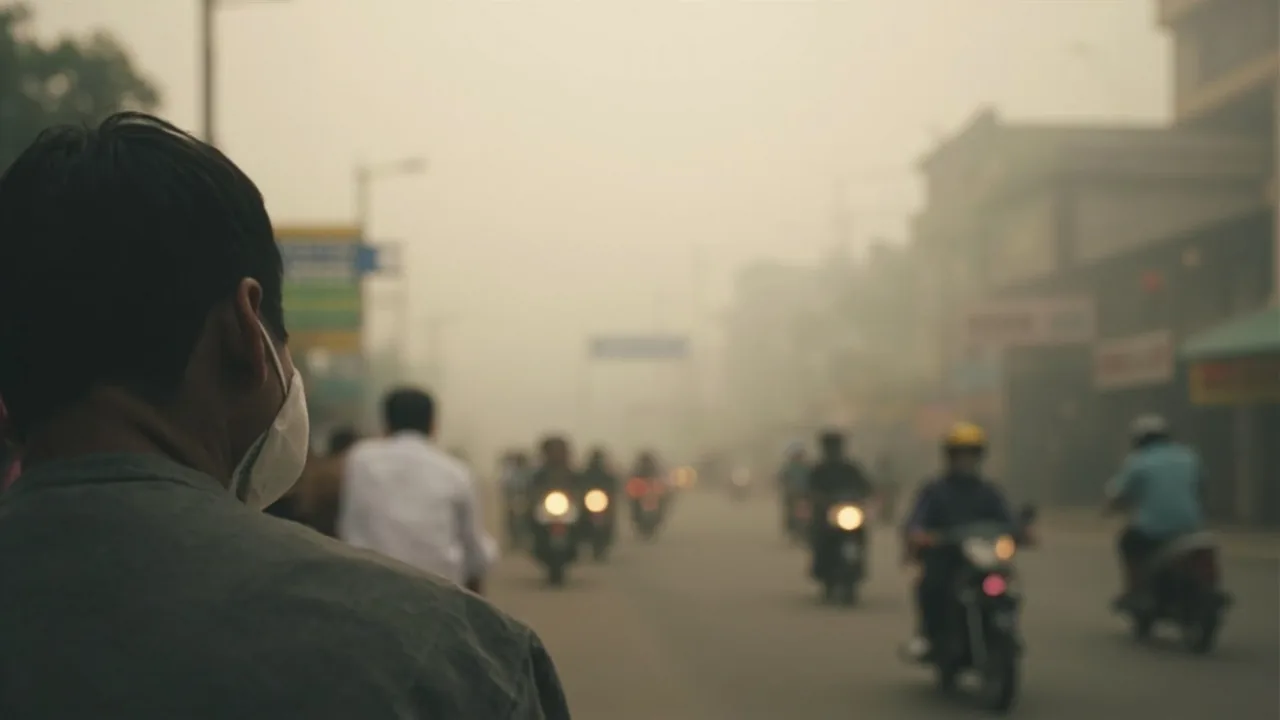
Hanoi Air Pollution, Sun & Heat Stroke: How Indian Tourists Can Stay Safe
Hanoi is one of the cleanest-feeling cities in Southeast Asia on the surface, then you check the live AQI on your phone and realise you’ve been breathing cigarette smoke for three days. The risk isn’t the kind that sends you to hospital mid-trip. It’s the kind that adds up quietly across a two-week Vietnam loop, especially if you’re moving between Hanoi, Ha Long Bay, and Ninh Binh in November when the air turns visibly grey. This guide is the calm version of what to do: when to mask, when to skip the day outside, and when the heat is more dangerous than the pollution. It also covers what Indian travellers specifically tend to underestimate: that PM2.5 is a chronic-exposure issue, not a one-day problem.
Quick Answers
| What | Answer | Price (INR) |
|---|---|---|
| Is Hanoi air pollution dangerous for tourists? | Yes on bad days (AQI >150), mostly a chronic-exposure issue across a 10-14 day trip | , |
| Do I need an N95 mask in Hanoi? | Yes, carry at least 3-5 N95/FFP2 masks from India (₹40-₹80 (~$0.42-$0.83) each) | 40,000-80,000 |
| When is Hanoi air quality worst? | Oct-Feb (winter, agricultural burning + inversion); 4-6 PM daily spike | , |
| What months are Hanoi too hot for Indian tourists? | May-Aug, real feel 38-42°C with humidity; plan Old Quarter walks before 10 AM or after 5 PM | , |
| Is heat stroke common in Hanoi? | Moderate risk for first-time visitors unaccustomed to wet-bulb heat; dehydration is the bigger daily issue | , |
Prices above are the base amount in the local currency of Vietnam. Other currencies are added by a currency conversion tool. For related planning, see our guide on Sea Backpacking Hub.
What Hanoi’s Air Does to You
The shorthand you need: PM2.5 are particles smaller than 2.5 micrometres. They get past your nose hairs, past your bronchi, into the alveoli where gas exchange happens, and from there into your bloodstream. The chronic-exposure data on PM2.5, the kind WHO and cardiology journals have been publishing for over a decade, links long-term exposure to cardiovascular disease, lung cancer, COPD, and earlier mortality. This is a stochastic risk, not a deterministic one, meaning it shifts the odds rather than guaranteeing a specific outcome, but the dose-response curve has no known safe lower threshold. A two-week holiday won’t give you lung cancer. What it can do is aggravate existing asthma, push a borderline BP reading into hypertensive territory, and leave you with a productive cough that takes a month to clear after you land back in Mumbai.
The acute side, the part you’ll feel: scratchy throat by day 3, dark phlegm in the morning, a fatigue that doesn’t match your sleep. Travellers with asthma or any cardiac history should treat Hanoi’s winter AQI the way they’d treat Delhi’s winter AQI, with the same rigour. That means checking the AQI each morning, carrying reliever medication, and being willing to swap an outdoor day for a museum or café day.
The bigger framing: a 2023 academic survey of Hanoi’s PM2.5 levels found mean annual concentrations around 40-50 µg/m³, which is roughly 4-5x the WHO annual guideline of 5 µg/m³ set in 2021. Daily winter readings routinely cross 150. In Indian terms, this is roughly equivalent to a moderate-to-poor Delhi winter day, except Hanoi is geographically compact and you’re often walking or cycling through it rather than sealed in a car with a cabin filter.
Subodh’s Pro Tip: Download AirVisual or IQ Air before you land. The hourly AQI reading at your specific street level matters more than the city-wide average. Hanoi Old Quarter often reads 30-50 points higher than the embassies in the west of the city.
The Three Pollution Windows to Know
- October to February: Worst period. Cold-air inversion traps emissions from construction, traffic, and agricultural burning in surrounding provinces. Plan for an N95 to be a daily accessory, not an emergency item.
- March to May: Improving but still hazy on bad days. Outdoor walking is fine 80% of the time; check before planning a full-day Old Quarter food crawl.
- June to September: Best air of the year, but the trade-off is brutal heat and humidity.
Mask, SPF, Hydration: The Actual Kit
Carry these from India. Vietnamese pharmacies stock some but the prices are 2-3x and brand selection is thin.
- N95 or FFP2 masks: 5 pieces from a Delhi chemist at ₹40-₹80 (~$0.42-$0.83) each beats anything you’ll find locally. Bring one per day of worst-case pollution days, plus spares.
- Sunscreen SPF 50+: The Hanoi sun in April-August pierces through cloud cover. Reapply every 2 hours if you’re walking. Indian brands (Lotus, La Shield, Minimalist) work as well as anything in Boots Vietnam.
- Oral rehydration salts (ORS): Carry 5-6 sachets. The local equivalent (Oresol) is fine but Indian brands (Electral, Prolyte) come in cleaner packaging. Useful for both traveller’s diarrhoea and heat-exhaustion recovery.
- Electrolyte drink mix: A few sachets of Enerzal or Glucon-D dissolve easily in any bottled water. Hanoi humidity flushes sodium out fast.
- Paracetamol (Dolo 650) and Pantoprazole (Pantocid 40): Your standard Indian traveller’s kit works here. Local equivalents are Panadol and Pantoloc.
Safety Alert: If you have any cardiac or respiratory condition, get a pre-trip check-up before booking. Hanoi winter pollution has hospitalised travellers with undiagnosed asthma who didn’t realise they had it until the air triggered an attack.
Heat Stroke vs Heat Exhaustion: Know the Difference
Most “I got sick in Hanoi” stories in summer are heat exhaustion, not heat stroke. Heat exhaustion is the warning shot: heavy sweating, weakness, cold pale skin, fast pulse, nausea. Heat stroke is the emergency: body temp above 40°C, hot dry skin, confusion, possible loss of consciousness. The former you can handle yourself with shade, water, and electrolytes. The latter needs a hospital.
The Vietnamese wet-bulb summer is what catches Indian visitors off-guard, because Delhi and Chennai are also hot, but Hanoi adds 75-85% humidity that prevents your sweat from evaporating. You can be walking at 32°C feeling like 41°C. The Old Quarter’s narrow streets trap it further.
Practical rules:
- Don’t schedule Hoan Kiem Lake walks, Temple of Literature visits, or Ho Chi Minh Mausoleum queues between 11 AM and 3 PM in May-August. Do them before 10 AM or after 5 PM.
- Eat lunch in air-conditioning. This is a legitimate reason to choose a sit-down restaurant over a street stall in summer. Any of the Indian restaurants below will work.
- GrabBike instead of walking when the AQI is bad and the heat is bad. Same call.
Subodh’s Pro Tip: The first 48 hours in Hanoi summer are the danger window. Most travellers arrive from a colder city (HCMC is cooler, Da Nang is breezy, Bangkok is air-conditioned), and they assume they can push through their first day. Don’t. Treat day one as recovery. The next ten days will go better.
The Indian Food Lifeline in Summer
When it’s 38°C with 80% humidity, even committed pho-and-bun-cha fans often end up wanting a dal-rice plate. This is the legit reason to keep a few Indian restaurants on your radar, not because local food isn’t good.
- Rutba Indian Restaurant Hanoi - Pure Veg & Jain Food: A pure-veg and Jain-friendly option in the city, useful if you keep strict vegetarian days.
- Swad Kitchen 5 - Indian Restaurant in Hanoi: In the Old Quarter, a casual Indian eatery. Travellers report butter chicken with freshly baked garlic naan, with meals around ₹734-₹1,102 (~200,000-300,000 VND or ~$7.62-$11.43) per person.
- The Indian Kitchen - Restaurant & Bar Hanoi: In Giang Vo, this North Indian restaurant-bar is another reliable option, with garlic naan noted by diners, around ₹734-₹1,469 (~200,000-400,000 VND or ~$7.62-$15.25) per person.
And for the days you do want local food but want to stay indoors and air-conditioned:
- Hello Hanoi Restaurant: A reliable local spot for traditional Vietnamese dishes in a casual indoor setting.
- The Hanoi Cafe: A quiet café option for a hot afternoon break.
- Comida Hanoi Restaurant & Cooking Class: Combines a meal with a hands-on Vietnamese cooking class, useful if heat keeps you indoors.
- May Hanoi Train Street Restaurant - Coffee & Food: Train Street is famously outdoor, but the indoor section of this place gives you a cooler alternative.
- Hong Hoai’s Restaurant: A family-run Vietnamese restaurant in a relaxed indoor setting.
What the Numbers Mean: Reading Hanoi’s AQI Properly
The AQI scale (US-EPA standard, used by AirVisual):
- 0-50 Good: No mask needed for anyone. Plan your outdoor day.
- 51-100 Moderate: Acceptable. Sensitive groups (asthma, cardiac) consider reducing prolonged outdoor exertion.
- 101-150 Unhealthy for Sensitive Groups: Anyone with heart or lung disease should wear an N95 outdoors. Healthy adults can go without but consider it for cycling days.
- 151-200 Unhealthy: Everyone should mask outdoors. Limit outdoor time to essential trips.
- 201-300 Unhealthy: Stay indoors where possible. N95 mandatory if you go out.
- 301+ Hazardous: Do not plan a Hanoi trip in this window.
The daily pattern matters too. Hanoi’s AQI typically peaks 4-7 PM (rush hour + temperature inversion starts), and is best 6-9 AM. Schedule outdoor walking for early morning. Schedule cafés, museums, and pool time for the afternoon spike.
What to Do If Something Goes Wrong
If you have a heat-related incident (heavy sweating, confusion, sudden headache):
- Move to shade or air-conditioning immediately.
- Remove excess clothing.
- Apply cool water to skin, especially neck, armpits, groin.
- Sip water with ORS.
- If confusion or loss of consciousness: call 115 (Vietnam ambulance) immediately.
If you have an asthma or cardiac event triggered by air quality:
- Use your reliever inhaler (carry it).
- Move indoors with closed windows.
- Call 115 if symptoms don’t improve in 10 minutes.
- For cardiac chest pain, get to Family Medical Practice Hanoi or Vinmec International Hospital, both have English-speaking staff and accept international insurance.
If your passport is lost or stolen: Police report first (required for emergency travel documents), then Indian Embassy in Hanoi at 58-60 Tran Hung Dao Street, +84-24-3824-4989. The Indian Embassy also publishes updated advisories on its website; check before departure for current safety notes.
If you have severe food poisoning or dengue-like symptoms (high fever, joint pain, rash): Get a blood test. Dengue is endemic in Vietnam during rainy season (May-October). The Vietnam emergency medical guide has hospital-by-hospital contact details.
City-by-City Adjustments on the Vietnam Route
- Hanoi: Pollution worst Oct-Feb, heat worst May-Aug. Avoid July-August if heat-sensitive.
- Ha Long Bay: Sea air disperses pollution but the boats have closed cabins; mask up on the deck on hazy days.
- Ninh Binh: Countryside air is better than Hanoi. Worth an extra night if pollution is bad in the capital.
- Da Nang: Cleaner air year-round, but hotter summers. Different risk profile.
Before You Go: The 5-Minute Checklist
- Pack 5 N95/FFP2 masks (₹40-₹80 (~$0.42-$0.83) each in India).
- Carry your regular meds + ORS sachets in original packaging with prescription.
- Check the AQI forecast the week before you fly; if it’s already 200+, reconsider the dates.
- Pre-book travel insurance that covers heat-related and respiratory conditions.
- Get a chest X-ray or pulmonary consultation if you have any history of asthma or breathlessness. Catching it at home is cheaper than catching it in Hanoi.
Getting Connected: Why Working Data Matters Here
If you have a respiratory event and need to pull up the nearest clinic with English-speaking staff, you need working data, not WiFi hunting. A local Vietnamese SIM is the most reliable option; tourist SIMs at Noi Bai airport or any Viettel/Mobifone shop in the Old Quarter are easy to buy. Alternatively, Get Nomad eSIM covers Vietnam and activates before you fly.
Subodh’s Take
The honest framing: Hanoi is not a city to fear, it’s a city to read. The pollution is real, the heat is real, but both are predictable and both have practical workarounds. The biggest mistake I see Indian travellers make is treating Vietnam like Goa, with the same outdoor pace and the same casual clothing choices. Hanoi rewards a slower, more indoor, more air-conditioned rhythm than the Instagram version suggests. Pack the masks. Drink the ORS. Schedule your walks for sunrise. You’ll have a great trip.
FAQ
Is Hanoi air pollution worse than Delhi?
Different profile. Delhi winter spikes higher (400+ on bad days), but Hanoi’s baseline is worse than Mumbai or Bangalore and worse than most of southern Vietnam. If you live in Delhi NCR and cope fine, you’ll cope with Hanoi on a normal day. If you live in coastal Karnataka and have never had a wheeze, don’t assume Hanoi is “just a city.”
Do I need an N95 mask or is a surgical mask enough?
Surgical masks don’t filter PM2.5 effectively. Cloth masks don’t either. You need N95 / FFP2 / KN95 to reduce particulate intake. Surgical masks are fine for blocking visible dust and pollen but won’t protect you from the lung-penetrating particles.
Are pregnant women or children at higher risk in Hanoi?
Yes for both. Pregnant women in particular should treat any AQI over 100 as a “limit outdoor time” signal rather than a “manageable” one. For children under 10, the chronic-exposure literature is concerning enough that the WHO recommends keeping outdoor activity minimal on days above 100. Winter Hanoi trips with young children are a real planning decision.
Is Hanoi safe to visit in November-December for an asthma patient?
It’s manageable but requires discipline. Daily AQI checks, N95 for any outdoor time, reliever inhaler carried at all times, and willingness to spend afternoons indoors. If your asthma is well-controlled and you have reliever medication, you can travel. If you’ve had an asthma hospitalisation in the last year, reconsider the dates.
What about long-term exposure if I’m staying months?
Anyone staying in Hanoi for a month or more should consider an air purifier for their accommodation (₹8,000-₹15,000 (~$83.04-$155.70) per night at many hostels, or buy locally), a sealed N95 for commuting, and a baseline check-up on return. Long-stay Indian freelancers in Hanoi report persistent cough and reduced exercise tolerance that resolves within 6-8 weeks of returning home.
Does Hanoi have worse air quality than Ho Chi Minh City?
Yes, generally. HCMC has industrial pollution but better air circulation. Hanoi’s basin geography traps it.
Are Indian embassy advisories updated for Hanoi pollution?
The Indian Ministry of External Affairs publishes country advisories on mea.gov.in. Air quality isn’t usually a flagged category but it’s worth a check before you fly, alongside political and health advisories.
Should I cancel my trip if AQI is forecast 250+ for the week I’m there?
For a 3-5 day trip, yes, reschedule. For a 14-day trip with flexibility to do museums, cafés, and indoor activities, you can still go but reset expectations. Most of Hanoi’s appeal is walkable streets and lakeside cafes; if the air makes those unworkable, you may end up spending half the trip indoors anyway, which is fine for a Hanoi veteran but wasteful for a first-time visitor.
