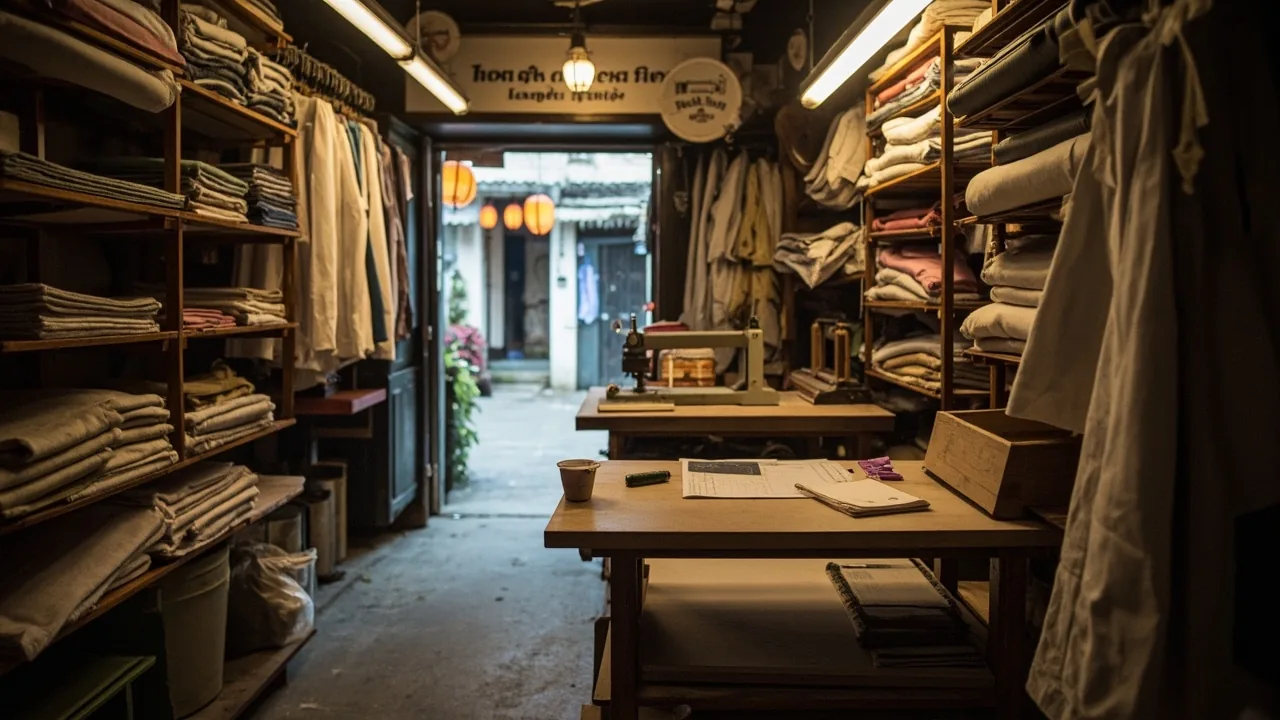
How Much Does It Cost to Custom Tailor a Suit in Hoi An? (Honest Numbers)
A two-piece suit in Hoi An runs ₹5,508-₹12,852 (~1,500,000-3,500,000 VND or ~$57.17-$133.40) for the basic polyester or cotton blend you’ll see quoted on every shopfront. A proper wool suit costs ₹12,852-₹27,540 (~3,500,000-7,500,000 VND or ~$133.40-$285.87), and a fully canvassed Italian-wool number goes from ₹29,376 (~8,000,000 VND or ~$304.92) upward. This article breaks down what each price band includes, what “custom” means in Hoi An versus a true Savile Row bespoke, and the checklist to confirm before you hand over a deposit. For related planning, see our guides on Sea Backpacking Hub and How Much Spending Money for Vietnam.
What Does “Custom Tailor” Mean in Hoi An?
In Hoi An, “custom” almost always means made-to-measure (MTM): a pattern is drafted to your body from a baseline block, then adjusted after one or two fittings. It is not bespoke (where the pattern is cut from scratch for you, with multiple intermediate baste fittings) and it is not off-the-rack alterations (where a factory-made suit gets taken in at the waist). Most shops will tell you they do “custom” when they mean MTM. Ask, in writing on the order form, whether the jacket has a floating canvas through the chest or a fused interlining. Fused = cheaper, often looks flat after six months. Floating canvas = better drape, costs more, only the better shops offer it. You may also find Melaka Temple Etiquette a Practical Guide for Indian Visitors useful for this trip.
Quick Answers
| What | Answer | Price (INR) |
|---|---|---|
| Two-piece suit, basic polyester | Most common quote on the street | 1,500,000 to 2,500,000 |
| Two-piece suit, wool blend | Default upgrade most travellers end up buying | 3,500,000 to 5,000,000 |
| Two-piece suit, full Italian wool, half-canvas | What you’ll get if you push for quality | 5,500,000 to 8,000,000 |
| Two-piece suit, full canvas, Italian wool | Top end in Hoi An | 8,000,000 to 15,000,000 |
| Shirt (made-to-measure) | Add-on, sometimes thrown in with a suit deal | 600,000 to 900,000 |
| Fittings | One or two, sometimes rushed into one | Included in suit price |
| Standard turnaround | ”24-hour” in shop windows means 2 to 3 days realistically | 2 to 5 days |
| Rush job (under 48 hours) | Most shops will do it for +20 to 30% | +300,000 to 800,000 |
| Shipping home (DHL, suit + shirts) | About 2 kg volumetric, paid at shop | 800,000 to 1,200,000 |
1 INR ≈ 270 VND at time of writing. So 2,000,000 VND ≈ ₹7,400 (~$76.81), and a ₹18,360 (~5,000,000 VND or ~$190.58) wool suit ≈ ₹18,500 (~$192.03).
Step-by-Step: How the Process Works
Here’s how a Hoi An suit order usually goes from walking into the shop to wearing the suit home.
Step 1: Pick the shop, not the price. Tailor density on the main streets (Nguyen Dinh Chieu, Tran Hung Dao, Le Loi) is around 1 per 30 metres. Don’t improve on the first quote you hear. Walk the strip, photograph three or four fabric books, and note which shop has a 100% wool book (not just poly blends labelled “wool touch”). The shops with real Italian and English fabric books (Loro Piana, Holland & Sherry, Reda) charge more, but the fabric is the suit.
Step 2: Choose fabric grade. The price is 80% fabric. A shop quoting ₹5,508 (~1,500,000 VND or ~$57.17) for a two-piece is almost quoting polyester. If you want something you’ll wear more than once, push for the wool-blend book at ₹12,852 (~3,500,000 VND or ~$133.40) and up. Ask to feel the swatch against your forearm, then against your palm, the palm is where you feel cheap fabric first.
Step 3: Get measured properly (this is where it goes wrong). A good measurement takes 20 to 30 minutes and includes 15 to 20 measurements: chest, waist, hip, shoulder-to-shoulder, sleeve length with arm bent, back length, crotch depth, thigh, plus posture notes (hunch, shoulder drop). A rushed measurement (under 10 minutes) means corners were cut. Ask the tailor to write each measurement on the order slip with the date, and photograph the slip. This is your only proof if a dispute comes up later.
Step 4: Confirm the construction details in writing. On the order form, specify: jacket construction (fused, half-canvas, full canvas), lining type (full back lining, half lining, sleeveless), button count and material (horn, mother-of-pearl, plastic), lapel type (notch, peak, shawl), pocket style (patch, flap, jetted), trouser break (full, half, no break), and whether the trousers have a curtain or are flat-front. If the tailor can’t fill these in, they’re cutting from a single template and “custom” is theatre.
Step 5: First fitting, usually Day 1 or Day 2. The first fitting is in basted (loosely stitched) form. Expect shoulders, chest, and sleeve pitch to be assessed. Speak up here, not at the final pickup. Travellers often avoid the awkwardness and then complain later that the shoulders are off. Use the tailor’s mirror and your phone camera. Side and back views catch what the mirror misses.
Step 6: Final fitting, usually Day 3 to Day 5. The suit should now be assembled. Walk, sit, reach across, put your phone in the chest pocket, push both hands into the trouser pockets. Sleeves should show about 1.5 cm of shirt cuff. Trousers should sit on your natural waist (navel, not hips) and break once at the shoe. If anything is wrong, this is your last free fix. Adjustments after pickup often cost ₹734-₹1,836 (~200,000-500,000 VND or ~$7.62-$19.06) per change, or the shop will ghost you if you’re already on a bus to Hanoi.
Step 7: Pay and ship. Pay only when satisfied. Most shops take cash (VND), some take card with a 3% surcharge. If you’re shipping home, the shop will pack and DHL/UPS it from their in-house counter. Insist on the tracking number written on the receipt. Box weight around 2 kg for a two-piece suit, volumetric billing will apply.
Subodh’s Pro Tip: If the shop offers “free shirt with suit,” they are subsidising the shirt from the suit margin. Either negotiate the shirt out and ask for a discount on the suit, or use the shirt as the bargaining chip for half-canvas construction. The shirt is the easier item to compromise on.
Common Mistakes Indians Make in Hoi An Tailor Shops
Mistake 1: Going for the “24-hour suit” headline. Shop windows everywhere advertise “SUIT IN 24 HOURS.” Travellers assume this means one fitting at the end. In practice, the 24-hour promise usually skips the basted fitting entirely. The first time you see your suit is at final pickup, which means mistakes get paid to fix later (if at all). If you’re in Hoi An for three nights, ask for a two-day suit, not a one-day suit.
Mistake 2: Quoting “suit” without specifying “two-piece.” “Suit” in a Hoi An shop window means two-piece (jacket + trousers). Three-piece (with a waistcoat) is usually +₹2,938-₹5,508 (~800,000-1,500,000 VND or ~$30.49-$57.17). If you walk out thinking you paid for three-piece and got two, the only proof is the order slip. Specify the count.
Mistake 3: Confusing wool-blend with wool. A “wool blend” can be 50% wool, 50% poly, sometimes 30/70. A “wool” label can still mean 80/20 with polyester. Real 100% wool Super 100s and above costs ₹12,852 (~3,500,000 VND or ~$133.40) minimum. Read the fabric tag (the bolt has a barcode) or ask for the mill name. Italian mills (Loro Piana, Reda, Cerruti) are usually legit. Anything labelled “Hoi An Wool” or “Vietnamese Wool” is almost synthetic.
Mistake 4: Bringing a photograph of a celebrity suit. Tailors will say yes to anything. If you bring a photo of a Tom Ford peak-lapel three-piece and your body and budget are not peak-lapel three-piece, you’ll get a polyester approximation that looks like a costume. Bring two reference photos at most, one of the silhouette you want, one of the fabric/draping, and let the tailor talk you down to what suits your shoulder width.
Mistake 5: Paying full price upfront. Standard practice is 50% deposit, 50% on pickup. If a shop asks for full payment upfront, especially for a multi-day order, that’s a yellow flag. Some will hold your passport scan as “guarantee,” which is unnecessary. Pay in two tranches.
Mistake 6: Skipping the lining choice. Cheap suits have cheap linings (rayon or polyester, slippery, static-y). A bemberg lining costs the shop maybe ₹734 (~200,000 VND or ~$7.62) more, but transforms how the jacket feels over a shirt in Da Nang’s humidity. Ask for bemberg by name, or check the swatch book for it.
What Most Guides Don’t Tell You
The “Hoi An Memories Land” tourist flow affects the same shops you want. Hoi An’s old town sees day-trippers from Da Nang arriving by 10 a.m. Via Hoi An Memories Land Entry Ticket with Show buses, flooding the tailor shops until about 3 p.m. The first two fittings of the day for serious buyers happen between 8 and 9 a.m., before the day-trippers. Show up then if you want the senior tailor, not the junior who’s covering the morning shift.
You will probably be quoted in USD by the better shops. Higher-end shops (those with Holland & Sherry books) often quote in USD, not VND, because the fabric is imported and priced in dollars. A USD quote protects them from dong volatility. If you see “₹28,902 (~300 USD)”, that’s the total suit, not per piece. Confirm currency in writing on the order slip.
The Pagoda Bridge view from the tailor shop is a sales tactic, not a coincidence. Many shops on the riverside face the Pagoda Bridge. The “view” comes with a 20% markup on fabric. Same fabric, same tailor skill, is available 200 metres inland for less. If the riverside is part of the experience for you, fine. If you’re improving on fabric quality per dong, step back from the water.
You’ll need a SIM that works while you’re being measured. You will be asked questions by WhatsApp, sometimes over multiple days, especially if you leave Hoi An and come back (Da Nang, My Son). A Vietnamese tourist SIM (Viettel or Mobifone, ~₹477 (~130,000 VND or ~$4.96) for 14 days with ~6 GB data, available at the airport and any shop on the main streets) is the practical choice. If you’d rather skip the airport queue, get a Nomad eSIM before you fly.
The ₹9,180 (~2,500,000 VND or ~$95.29) suit will not survive a hot Indian summer. Hoi An’s climate is humid but cooler than most of India from November to February. The suit you’re measured for in February will be worn in a 38°C, 80% humidity Delhi June. Polyester suits don’t breathe and will feel like wearing a plastic bag. If you want a wearable-in-India suit, wool or linen, not polyester, full stop.
Getting back to Hanoi or Da Nang with the suit. If your flight home is from Hanoi, you’ll be on the Hanoi to Hoi An sleeper bus for ₹918-₹1,469 (~250,000-400,000 VND or ~$9.53-$15.25) or the equivalent train leg. A suit folded into a carry-on survives this; a suit in a checked bag compressed under souvenirs does not. Pack it last, on top.
The Checklist: What to Confirm Before Saying Yes
Tick these off before you put down the deposit. If the tailor can’t answer four or more of these walk.
- Fabric mill name and composition (read the bolt tag, not just the swatch book)
- Construction: fused, half-canvas, or full canvas (the single biggest price-and-quality variable)
- Number of fittings included (1, 2, or 3)
- Turnaround time in calendar days, not “24 hours”
- Total price in VND written on the slip, with currency
- Trousers: single, double, or triple break; curtain vs flat-front; lined to the knee or full
- Jacket: lapel type and width; pocket style; button stance (single, double, side-vent, centre-vent)
- Lining material (bemberg > viscose > polyester)
- Measurement list: at least 15 measurements with today’s date
- Alterations policy: free within 7 days of pickup, or paid
- Shipping cost and DHL/UPS tracking arrangement
- Payment: deposit %, balance on pickup, card surcharge if any
FAQ
Is it cheaper to get a suit tailored in Hoi An or Bangkok? Hoi An. A Hoi An wool-blend two-piece at ₹12,852-₹18,360 (~3,500,000-5,000,000 VND or ~$133.40-$190.58) is roughly the same Bangkok quote in baht, but Bangkok tailors add a “tourist area” surcharge in Sukhumvit and Silom that Hoi An shops don’t apply as aggressively outside the old town core.
How many days should I budget in Hoi An just for tailoring? Three nights minimum if you want one suit done properly. Four nights if you’re ordering two suits, or one suit plus shirts. One-night stays get the rushed 24-hour job, which is fine for emergency wedding attire, not for a suit you’ll keep for years.
Can I get a wedding suit made in Hoi An? Yes, but book a three-piece (waistcoat + jacket + trousers) and budget ₹20,196-₹33,048 (~5,500,000-9,000,000 VND or ~$209.63-$343.04) for a half-canvas wool that photographs well. Indian weddings involve a lot of movement (standing, greeting, sitting cross-legged at a mandap), so order trousers with a slightly looser thigh and a half-break rather than no-break.
What if the suit doesn’t fit when I get home? This is the real risk. Most reputable Hoi An shops offer free local alterations, but alterations once you’ve left Vietnam cost more than the suit. Two mitigations: (1) ask the shop to do the alterations in their final fitting even if you’re happy, ask for one round of preemptive tweaks, and (2) keep the order slip with measurements, so any tailor in India can adjust using the same numbers.
Are there good Indian-tailoring alternatives near Hoi An? No. The tailoring ecosystem in Hoi An is Vietnamese-trained. If you specifically want a sherwani or a bandhgala, get that done at home in India before flying. Hoi An is for Western-cut suits and shirts, not Indian formalwear.
Do Hoi An tailors do women’s suits and dresses? Yes, but the price and timeline are different. Most shops quote women’s two-piece suits the same as men’s, around ₹6,610-₹14,688 (~1,800,000-4,000,000 VND or ~$68.61-$152.46) depending on fabric. For women’s formal dresses, see the related guide on Hoi An tailor dress price. For men’s suits specifically, the price reference article is Hoi An suit price.
Will I get ripped off as an Indian tourist? Travellers report that being Indian in a Hoi An tailor shop is mostly neutral, neither favoured nor targeted. The bigger variable is whether you’re visibly comparing shops (lower quote, because the tailor knows you’re walking 50 metres to a competitor) or you look committed to one shop (higher quote, because you will pay it). Always compare at least three.
Subodh’s Take
Hoi An’s tailors are world-class value at the wool-blend tier (₹12,852-₹18,360 (~3,500,000-5,000,000 VND or ~$133.40-$190.58), ~₹12,950 (~$134.42) to ₹18,500 (~$192.03)), and not worth the flight at the polyester tier (₹5,508-₹9,180 (~1,500,000-2,500,000 VND or ~$57.17-$95.29), ~₹5,500 (~$57.09) to ₹9,250 (~$96.02)) where you’d get a comparable product at a Mumbai Sarojini shop for the same rupees. Spend the extra, push for the floating canvas, ask the senior tailor the questions on the checklist, and you’ll come home with a suit that cost a third of what it would in Singapore or Bangkok, in fabric that punches well above the bill.
