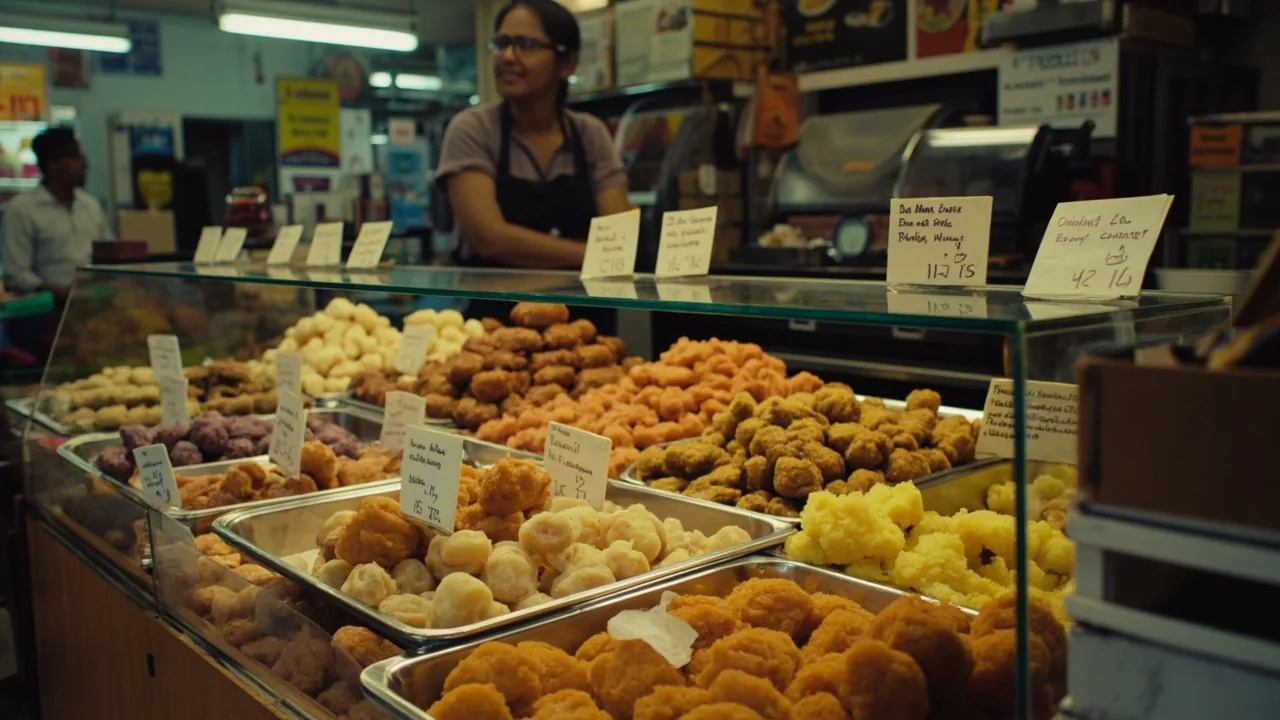
Indian Sweets, Chai & Diwali Special Menus in Singapore: Mithai Shop Guide
Singapore has been one of the easiest places outside India to find Indian sweets mithai shops for Diwali boxes and cutting chai. The sweet shops around Little India, Tekka, and Geylang have been running for decades. The trick is knowing which shop does which sweet well, because the same name can mean different things at two shops three streets apart.
Quick Answers
| What | Answer | Price (INR) |
|---|---|---|
| Where to buy fresh mithai in Singapore? | Little India (Tekka Centre, Mustafa Centre, Campbell Lane) and Geylang Serai | ₹75-₹224 (~1-3 SGD or ~$0.78-$2.33) per piece |
| How much does a 1 kg Diwali sweet box cost? | ₹1,867-₹4,481 (~25-60 SGD or ~$19.38-$46.52) depending on sweets and shop | ₹1,867-₹4,481 (~25-60 SGD or ~$19.38-$46.52) |
| Which Indian city is famous for rasgulla? | Kolkata, West Bengal | (regional info) |
| Best cutting chai near Little India? | Campbell Lane kopitiams and Little India tea stalls | ₹112-₹187 (~1.50-2.50 SGD or ~$1.16-$1.94) per cup |
| Do Singapore sweet shops do home delivery? | Yes, most Tekka and Little India shops deliver via WhatsApp, GrabFood, or their own apps | Free over ₹2,241-₹3,734 (~30-50 SGD or ~$23.26-$38.76) |
The Mithai Scene in Singapore: A Regional Map
Before you walk into a shop, it helps to know which Indian region makes which sweet best, because mithai is not interchangeable. Different cities across North India each claim their own version of gulab jamun, and Singapore’s sweet shops import their recipes along regional lines.
Kolkata and Bengal: rasgulla (the spongy white chenna ball in light sugar syrup), mishti doi (sweet yoghurt, often sold in clay pots), sandesh (the dense, fudgy chenna sweet that comes in a hundred flavours), and nolen gurer sweets made with date-palm jaggery. If you want rasgulla, you want a Bengali sweet shop, not a Punjabi one. The texture difference is enormous.
Lucknow and the Awadh region: galouti kebabs are famous there, but for sweets it’s the Lakhnavi peda, the subtle, slightly grainy milk fudge perfumed with kewra and saffron. Lucknow also does a mean balushahi.
Mathura and Vrindavan (Uttar Pradesh): peda, the brown, dense, caramelised milk sweet you see at every Krishna temple prasad counter. Mathura’s are darker and richer than the Lucknow version.
Jaipur and Rajasthan: ghewar, the disc-shaped flour-and-ghee honeycomb sweet that is the centrepiece of Rajasthani festivals, including Teej and Diwali. Jaipur’s ghewar is the gold standard.
Amritsar and Punjab: pinni (wheat and ghee laddu loaded with dry fruits), atiya laddoo (boondi laddoo), and the famous Amritsari fish-shaped shakarpara. Punjabi mithai tends to be richer and more ghee-heavy than Bengali.
Maharashtra: puran poli (the flatbread stuffed with chana dal and jaggery), modak (the steamed rice-flour dumpling for Ganesh Chaturthi, filled with coconut and jaggery), and the Maharashtrian-style anarse, a ridged sesame seed sweet made for Diwali.
Tamil Nadu and the South: mysore pak (the ghee-soaked gram flour fudge invented in the kitchens of the Mysore palace), kesari (semolina halwa), and adhirasam (the jaggery-soaked lentil flour sweet fried crisp).
Hyderabad: double ka meetha (the bread-and-cream dessert from the Nizami kitchen), and qubani ka meetha (the dried apricot sweet).
If a shop in Singapore tells you their rasgulla is “from Bengal” or their ghewar is “from Jaipur,” that’s the one to pick for that specific sweet. Travellers who just say “Indian sweet” and grab the first box often end up with a generic Punjabi mix that doesn’t highlight anything in particular.
The Sweet Shops Worth Knowing
The shortlist below is built around the Little India and Tekka corridor, which is the densest cluster of Indian sweet shops in Singapore. None of these spots require a reservation. Walk in, pick a box, pay by cash or PayNow, and go.
Tekka Centre (Little India)
Tekka Centre is the wet market and hawker centre on Buffalo Road and Serangoon Road, and the ground floor has been the go-to mithai counter for Singapore’s Indian community for as long as anyone can remember. There are several sweet stalls inside, and they rotate. Expect Bengali-style sandesh, rasgulla, gulab jamun, mysore pak, laddoo, barfi in multiple flavours, halwa, and jalebi. During Diwali season (roughly mid-October to mid-November), the variety doubles and most stalls put up Diwali special boxes.
Price range: ₹75-₹224 (~1-3 SGD or ~$0.78-$2.33) per piece, or ₹1,494-₹3,361 (~20-45 SGD or ~$15.51-$34.89) per kg for a mixed box. Cash and PayNow accepted at most stalls.
Mustafa Centre (Little India)
Mustafa is the 24-hour shopping mall on Syed Alwi Road that Indians either already know about or have heard about from a relative. The basement food hall has a sweet counter that stays open late, which matters if you land at Changi late at night and want barfi in your hotel room. Quality is mid-tier (mass-produced, but fresh enough), and the selection is reliable rather than regional-specialist. Useful for a quick grab-and-go, not for sourcing the city’s best sandesh.
Sweet shops along Campbell Lane and Dunlop Street
Campbell Lane and the surrounding Dunlop Street / Upper Dickson Road cluster has a handful of small Bengali and Tamil sweet shops. Names rotate as leases change, but the pattern is steady: at least one Bengali shop doing rasgulla and sandesh properly, and one Tamil shop doing mysore pak and kesari. Ask the staff what their best-seller is and they’ll point you to the regional speciality.
Geylang Serai and Serangoon Road
Some long-running South Indian vegetarian restaurants along Serangoon Road sell a small mithai counter at the front of the restaurant, pairing a banana-leaf meal with a small mithai selection up front. Geylang Serai (the Malay-Indian neighbourhood near Paya Lebar MRT) also has sweet shops during Ramadan and Diwali, with a Malay-Indian flavour profile (more coconut, palm sugar, and kuih-style sweets alongside North Indian mithai). For a sit-down Indian meal with mithai on the side, Shahi Maharaja at Boat Quay and We Desi at City Gate Mall near Lavender are the shortlisted options worth booking.
Deepavali Pre-Order Boxes
Every September, most of the Little India sweet shops open Diwali pre-orders. You WhatsApp or walk in, pick your box size (usually 500g, 1kg, 2kg, 5kg), choose your mix (the shop suggests, but you can swap), and pick up 2-3 days before Diwali. Pre-ordering saves you the queue and guarantees the regional sweets you want before they sell out. Expect to pay ₹1,867-₹4,481 (~25-60 SGD or ~$19.38-$46.52) for a 1kg mixed box, with the upper end for pure ghee-loaded Punjabi boxes like pinni and ghewar.
Pro Tip: WhatsApp a photo of the box you want from any Indian family WhatsApp group (your maa, chacha, or that one cousin who forwards everything). Show it to the shopkeeper. Saves ten minutes of “I want the round one, no, the bigger round one” pointing.
Cutting Chai: Where the Real Chai Is
Cutting chai is the half-cup, sweet, milky, ginger-cardamom chai sold at every street corner in Mumbai and Pune, and Singapore has adapted the format at a handful of spots. The default is the ₹112-₹187 (~1.50-2.50 SGD or ~$1.16-$1.94) cup at any Little India kopitiam (coffee shop), but if you want it done properly, here is where to go.
Campbell Lane kopitiams (cutting chai)
Long-running Indian-Muslim kopitiams near Little India serve a Mumbai-style cutting chai in a small glass, sweet by default (ask for kurang manis / less sugar if you want), strong, and gingery. Pairs with a piece of bun (bread) or a roti prata from the next-door stall.
Price: ₹112-₹187 (~1.50-2.50 SGD or ~$1.16-$1.94) per cup.
South Indian café chains (filter coffee and chai)
Several small South Indian café chains in central Singapore do both filter coffee and cutting chai. The chai is the Chennai-Mumbai hybrid style, slightly less sweet than a pure Mumbai cutting chai but with the same ginger-cardamom backbone. Useful if you are in the Novena or Dhoby Ghaut area and don’t want to trek to Little India.
Price: ₹149-₹261 (~2-3.50 SGD or ~$1.55-$2.71) per cup.
Roti prata shops and 24-hour kopitiams
Most roti prata shops in the Geylang and Joo Chiat areas serve masala chai alongside the prata, and the chai is usually the Singapore-Mamak style (lighter, less sweet, sometimes with condensed milk). It is not cutting chai, but it is a decent late-night cup at ₹75-₹149 (~1-2 SGD or ~$0.78-$1.55) when everything else is closed.
Safety Alert: Singapore tap water is drinkable, but for chai always ask for “hot water, boiled” if you are unsure of a stall’s hygiene. The hawker centres are inspected, but tiny shophouse kopitiams vary.
Diwali Special Menus at Indian Restaurants
Indian restaurants in Singapore run Diwali special menus in the 2-3 weeks before Deepavali (the Singapore spelling of Diwali). The menu is usually a thali or a fixed-price multi-course set with festive specials like:
- Paneer tikka masala and paneer lababdar
- Dal makhani slow-cooked overnight
- Special biryanis (Hyderabadi and Lucknowi)
- Festive sweets: kaju katli, motichoor laddoo, ghewar, rasmalai
- Mithai platters for takeaway
The Indian restaurants in the shortlist that run Diwali specials most years are:
- Shahi Maharaja: (शाही महाराजा) @ Authentic North Indian Restaurant & Bar (rating 4.8): runs a Diwali thali and a sweet box pre-order around October. Tandoori mains are ₹1,867-₹2,614 (~25-35 SGD or ~$19.38-$27.14) per dish.
- Sahebs - The Indian Restaurant | Orchard Road | Indian Cuisine | Singapore (rating 4.7): does a festive set menu with North Indian kebabs and kaju katli for dessert.
- Black Pepper Multicuisine Restaurant Singapore (rating 4.8): does a multi-cuisine Diwali spread that mixes North and South Indian festive dishes.
- Zaffron Tandoori Restaurant @ Boat Quay Singapore (rating 4.8): the riverside Punjabi spot that runs a Diwali kebab-and-mithai platter.
- KUBES Indian Restobar (rating 4.8): contemporary Indian street food with Diwali-themed cocktails and a festive snack menu.
We Desi - Indian Bistro (rating 4.6) inside City Gate Mall near Lavender MRT also does Diwali specials, often with their tandoori momos (about ₹1,494 (~20 SGD or ~$15.51) for the dish) as the centrepiece of the festive menu.
For the full list of Indian restaurants across Singapore’s neighbourhoods, see indian-food-by-neighborhood-singapore and indian-food-singapore-vegetarian-halal-hawker-guide.
Pro Tip: Book Diwali week dinners 1-2 weeks ahead. Walk-ins during Diwali weekend at popular Boat Quay and Orchard Indian restaurants routinely wait 45-90 minutes.
Sweet Box Prices: What to Budget
Diwali sweet box prices in Singapore, verified against current shop rates (2026):
| Box Size | What’s Inside | Price Range (SGD) |
|---|---|---|
| 500g mixed box | 6-8 varieties, regional mix | ₹1,120-₹2,241 (~15-30 SGD or ~$11.63-$23.26) |
| 1 kg mixed box | 10-15 varieties, mostly Punjabi/North Indian | ₹1,867-₹4,481 (~25-60 SGD or ~$19.38-$46.52) |
| 1 kg premium box | Kaju katli, barfi, laddoo, dry fruit sweets | ₹3,734-₹5,975 (~50-80 SGD or ~$38.76-$62.02) |
| Pure ghewar box (Rajasthani, Diwali only) | Disc-shaped ghee sweets | ₹2,241-₹3,734 (~30-50 SGD or ~$23.26-$38.76) per kg |
| Pure rasgulla tin (Bengali) | Spongy chenna balls in syrup | ₹747-₹1,344 (~10-18 SGD or ~$7.75-$13.96) per kg |
| Mysore pak box (Tamil) | Ghee gram flour fudge | ₹1,120-₹1,867 (~15-25 SGD or ~$11.63-$19.38) per kg |
Premium dry-fruit sweets like kaju katli and badam katli are ₹5,975-₹8,962 (~80-120 SGD or ~$62.02-$93.04) per kg, so a 500g box of pure kaju katli runs ₹2,987-₹4,481 (~40-60 SGD or ~$31.01-$46.52).
For Indian food buffet prices and full meal budgets, see singapore-indian-food-buffet and how-to-eat-cheap-in-singapore.
Food Safety and Hygiene
Singapore’s hawker centres and Indian sweet shops are inspected by the National Environment Agency (NEA) and display a grading. Look for the A or B grade sticker on the front of the stall. Most Tekka Centre and Little India shops are A or B.
A few specifics for mithai and chai:
- Avoid mithai left unrefrigerated in open trays for more than 4-6 hours, especially rasgulla and sandesh (milk-based sweets spoil fast in Singapore’s humidity).
- Pre-ordered boxes: pick up on the day you plan to eat them. If you’re travelling, ask for an insulated bag.
- Chai from street carts: Singapore has few street carts. Most chai is sold from kopitiams with proper kitchens. Safe.
- Diwali gift boxes: if you’re flying back to India with a box, declare dairy and ghee products at customs (some countries restrict dairy imports).
- PayNow vs cash: most Little India sweet stalls take PayNow, which means you don’t need to carry large amounts of cash. Useful if you’re buying a 5kg box.
For a full breakdown of food safety around Little India, see little-india-singapore-food-safety-authenticity.
Getting Connected
A local SIM or eSIM helps with Grab (for delivery), Google Maps (for finding the right shop on Campbell Lane), and WhatsApp (for Diwali pre-orders). Get Nomad eSIM is the easiest option if your phone supports eSIM. Physical SIMs are also available at Mustafa Centre and Changi Airport.
For broader Singapore travel logistics, see singapore-mrt-24-hours-timing. For the full Southeast Asia backpacking route, see sea-backpacking-hub.
Common Mistakes Indians Make
- Asking for “mithai” without specifying the sweet → shopkeeper picks whatever is leftover or generic. Say “rasgulla, please” or “kaju katli, 500g box” instead.
- Buying a mixed box from a Bengali shop expecting Punjabi sweets → you get sandesh and rasmalai in a Punjabi-shaped box. Match the shop’s regional speciality to the box you want.
- Pre-ordering Diwali boxes too late → the popular boxes sell out 3-5 days before Diwali. Order at least a week ahead for the regional-specialist boxes.
- Assuming GST is included → at restaurants it is (8% GST is shown in menu prices), but at sweet stalls sometimes not. Ask for the final price before paying.
- Leaving mithai unrefrigerated in the hotel → Singapore hotel rooms run warm. Use the minibar or ask the front desk for a fridge.
FAQ
Which Indian city is famous for which sweet? Kolkata for rasgulla and sandesh, Jaipur for ghewar, Mathura for peda, Amritsar for pinni, Mysore for mysore pak, Lucknow for Lakhnavi peda, and Pune/Mumbai for cutting chai and puran poli.
Do Singapore sweet shops deliver mithai? Yes, most Tekka and Little India shops deliver within Singapore via WhatsApp, GrabFood, or their own apps. Free delivery threshold is usually ₹2,241-₹3,734 (~30-50 SGD or ~$23.26-$38.76).
Can I get Jain-friendly mithai in Singapore? Yes, but call ahead. Most shops can do no-onion-no-garlic versions of North Indian sweets, but Jain-specific sweets (no root vegetables, no honey) are rare. The larger Indian restaurants are generally more accommodating for advance Jain requests.
Is the chai in Singapore cutting chai or masala chai? Most of it is closer to masala chai (full cup, slightly less sweet) than Mumbai-style cutting chai (half cup, sweet). The Campbell Lane kopitiams do the closest cutting chai version.
When is Diwali in Singapore in 2026? Diwali / Deepavali 2026 is expected to fall in November 2026. The official public holiday is typically the day after. Diwali special menus usually run from late October to mid-November (confirm exact dates with individual restaurants closer to the season).
Are the Indian restaurants in Singapore vegetarian-friendly? North Indian restaurants (including Shahi Maharaja and Sahebs) commonly have substantial vegetarian sections, with clear veg markings. Confirm with the staff for Jain or no-onion-no-garlic requirements. See where-to-find-vegetarian-food-in-singapore-best-restaurants-dishes-tips for the full veg-by-neighbourhood map.
Subodh’s Take
The mithai in Singapore can rival what you’d pay a premium for back home, once you stop overpaying for “imported” sweets when relatives ask you to bring boxes. The Bengali shops around Tekka do a rasgulla that’s 90% of what you get in Kolkata, and the Punjabi ghewar and pinni are the real thing. The trick is regional matching: pick the shop that specialises in the sweet you want, not a generic Indian sweet counter. Go during Diwali week if you can, pre-order a box, and don’t leave it in the hotel minibar overnight.
