Indonesia for Vegetarians: What Indian Backpackers Can Eat (And Where to Find It)
Indonesia is a vegetarian minefield for Indians. The good news: indonesia veg food options exist, especially in Bali, where the Hindu majority eats fully vegetarian temple offerings daily. Get it wrong and you’ll spend five days eating plain rice and fried eggs. Planning the wider region? Our Southeast Asia backpacking hub covers the full multi-country route.
This guide is the one I wish I’d had on my first Bali trip. It’s not a “10 best Indonesian dishes” roundup. It’s a street-level safety manual for Indian vegetarians, with the exact phrases in Bahasa, the exact dishes to order, the exact ones to refuse, and the exact restaurants where Indian travelers have eaten safely.
Quick Answers
| What | Answer | Price (INR) |
|---|---|---|
| Is Indonesia safe for Indian vegetarians? | Yes, if you say “sayur saja, tanpa terasi, tanpa kecap ikan” (vegetables only, no shrimp paste, no fish sauce). Avoid most warungs otherwise. | — |
| What’s the cheapest veg meal? | Nasi goreng vegetarian at a local warung, ₹80-₹134 (~15,000-25,000 IDR or ~$0.83-$1.39) | ₹75-₹125 (~$0.78-$1.30) |
| Bali’s best city for vegetarians? | Ubud. The Hindu population eats plant-based daily, so vegan cafes and warung sayur are everywhere. | — |
| Is gado-gado safe? | Yes, but ask “tanpa terasi” (no shrimp paste). Default version has it. | ₹100-₹150 (~$1.04-$1.55) |
| Are McDonald’s fries veg? | No, cooked in beef-fat oil in Indonesia. Skip the Indo McDonald’s entirely. | — |
The Local Culinary Landscape
Indonesian food is one of the world’s most flavour-dense cuisines. Padang rendang, Javanese gudeg, Balinese bebek betutu, Manado spicy fish, all of it is built on a base of terasi (fermented shrimp paste), kecap ikan (fish sauce), santan (coconut milk), and bawang (shallots and garlic). For a vegetarian, three of those four are lethal.
Here’s the cheat sheet of what to watch for:
- Terasi (shrimp paste): Used in sayur asem, many gado-gado versions, sambal, and Balinese lawar. The smell is unmistakable once you know it. Always ask “ada terasi?” and refuse if yes.
- Kecap ikan (fish sauce): Goes into most stir-fries, fried rice (nasi goreng), and noodle dishes by default. Even “vegetable” cap cay often has it.
- Santan (coconut milk): Fine for vegetarians, not for Jains. Check the dish.
- Kaldu ayam (chicken stock): Sneaks into almost every savoury dish, including soups and fried rice. The tell is flavour depth. If a “plain” dish tastes rich, stock is in there.
The key thing Indians get wrong is assuming that because Indonesia is a rice-and-vegetable culture, it’s vegetarian-friendly. It isn’t. The Muslim majority eats chicken, fish, and beef daily. Fish sauce is treated like salt. A dish that looks like pure tofu and greens can have shrimp paste, anchovies, or chicken stock as its entire flavour base.
The exception is Bali. Because the island is Hindu, not Muslim, it has a parallel plant-based food culture centred on temple offerings (canang sari) and daily Hindu rituals. Ubud specifically is a vegetarian paradise, with more dedicated vegan warungs per square kilometre than anywhere else in Indonesia, including Chiang Mai. Kuta and Seminyak are hit-and-miss. Canggu is solid for plant-based cafes but expensive. Ubud wins on both safety and price.
Key Phrases in Bahasa Indonesia
Print this table, screenshot it, or save it in Google Translate offline mode before you land. These five sentences will save you a week of accidental shrimp paste.
| English Phrase | What it Means | Local Script | Pronunciation |
|---|---|---|---|
| I am vegetarian | Saya vegetarian | Saya vegetarian | SAH-yah veh-geh-teh-ree-AHN |
| No meat or seafood | Tanpa daging dan seafood | Tanpa daging dan seafood | TAHN-pah DAH-ging dahn SEE-food |
| No fish sauce | Tanpa kecap ikan | Tanpa kecap ikan | TAHN-pah KEH-chap EE-kahn |
| No shrimp paste | Tanpa terasi | Tanpa terasi | TAHN-pah teh-RAH-see |
| No egg (for Jains/vegans) | Tanpa telur | Tanpa telur | TAHN-pah teh-LOOR |
| No onion, no garlic | Tanpa bawang | Tanpa bawang | TAHN-pah BAH-wahng |
| Is there shrimp paste in this? | Ada terasi di sini? | Ada terasi di sini? | AH-dah teh-RAH-see dee SEE-nee |
A few notes on pronunciation. Bahasa is phonetic, so what you see is what you say. The “ng” in “bawang” is a single sound, like the end of “sing.” Stress is usually on the second-to-last syllable. Most warung owners, even those who don’t speak English, will understand “tanpa terasi” and nod seriously. If they look confused, pantomime: hold up a shrimp, shake your head, draw an X.
Subodh’s Pro Tip: When in doubt, point at the dish you want on someone else’s table, then say “sayur saja, tanpa terasi.” Show, don’t tell. It cuts through any language gap instantly.
Safe Local Street Food Dishes
These are the Indonesian dishes that are either vegetarian by default or can be made vegetarian with a single “tanpa terasi, tanpa kecap ikan” request.
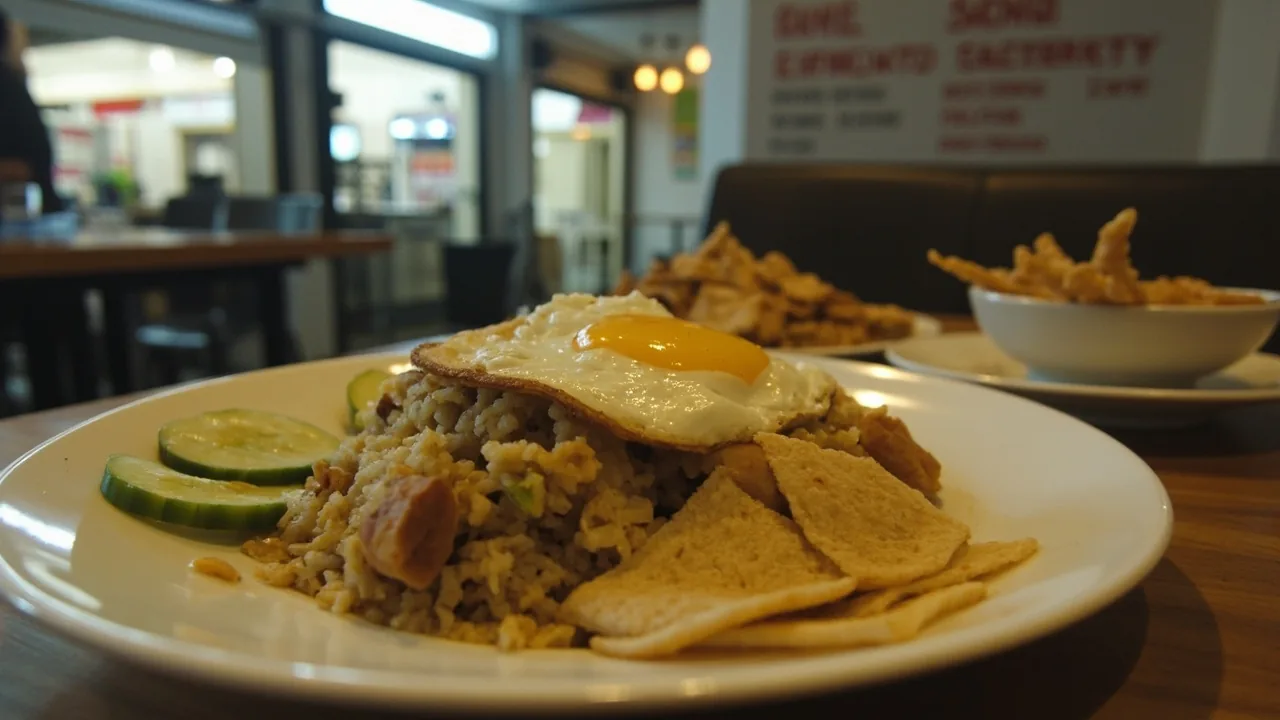
Nasi Goreng Vegetarian The national dish. Fried rice with a fried egg on top, cucumber, krupuk, and a small amount of kecap manis. Most street vendors add kecap ikan and terasi by default, so you have to ask. When customised, it becomes a safe, filling meal. The egg is on top, so you can see it and ask them to leave it off for a fully vegan plate. Expect to pay ₹80-₹134 (~15,000-25,000 IDR or ~$0.83-$1.39) at a warung, double that in tourist areas. For the most authentic version, eat at a busy Padang-style warung, where the turnover is high and the food is fresh.
Gado-Gado Boiled or blanched vegetables (cabbage, long beans, bean sprouts, spinach) with fried tofu, tempeh, and hard-boiled egg, all smothered in peanut sauce. The peanut sauce is the trap. It’s almost always made with terasi, sometimes with kecap ikan. “Gado-gado tanpa terasi” gets you a 90% version; the rest is at the cook’s discretion. ₹80-₹134 (~15,000-25,000 IDR or ~$0.83-$1.39) at most warungs. In Ubud, the Hindu-Balinese versions (called “sayur urab”) are often 100% plant-based by default.
Tahu and Tempeh Indonesia’s gift to the vegetarian world. Tahu is tofu, usually fried crispy; tempeh is fermented soybean cake with a nutty, mushroomy flavour. Both are protein-rich, cheap, and vegan. Order “tahu goreng” or “tempe goreng” (fried tofu or fried tempeh) as a side, ₹27-₹54 (~5,000-10,000 IDR or ~$0.28-$0.56) per piece, and add it to any rice meal. Be cautious of “tempe mendoan,” which is a battered, deep-fried version sometimes containing small fish. Ask to confirm.
Sayur Lodeh A Javanese vegetable stew in coconut milk with long beans, eggplant, chayote, tofu, and tempeh. This is one of the few dishes that’s often vegetarian by default, especially in Central Java (Yogyakarta, Solo). The catch: the spices (bawang merah, bawang putih) are heavy on onion and garlic, so Jains need to skip it. For lacto-vegetarians, it’s a perfect main. ₹80-₹107 (~15,000-20,000 IDR or ~$0.83-$1.11) at a Yogyakarta warung.
Nasi Campur Bali A Balinese mixed rice plate with small portions of vegetables, tempeh, lawar (coconut and vegetable salad), and sambal. The default version often has lawar with minced pork or chicken, so you need to specify “tanpa daging” (no meat). The temples in Bali, where this dish is prepared as offering food, often have a fully vegetarian version called “nasi campur vegetarian” or “nasi kuning vegetarian.” ₹107-₹188 (~20,000-35,000 IDR or ~$1.11-$1.95) in Ubud. At restaurant level near the monkey forest, you might pay double, but the experience is worth it once.
Pisang Goreng (Fried Banana) The safest snack in Indonesia. Ripe banana, battered, deep-fried, sometimes with cheese or chocolate. Fully vegetarian by default, usually vegan too. ₹27-₹54 (~5,000-10,000 IDR or ~$0.28-$0.56) per portion.
Recommended Vegetarian Restaurants
The shortlist splits into two lanes. The first is the on-the-ground Indonesian food scene, the warungs, cafes, and local restaurants where you can eat authentic local food with the right customisations. The second is the safety net: actual Indian restaurants where you can get dal, roti, and the flavours of home when you’re tired of translating phrases.
Local & Regional Spots
SEMAJA Menteng, Jakarta (rating 4.8) A cosy Menteng eatery serving Indonesian comfort food with enough menu clarity that you can pick the vegetarian items without a long conversation. The peanut sauce version of gado-gado here is one of the cleanest in Jakarta. The gado-gado at SEMAJA comes with tempeh, tofu, and long beans, and the kitchen knows what “tanpa terasi” means. Expect to pay around ₹188-₹268 (~35,000-50,000 IDR or ~$1.95-$2.78) for a main with a drink. Worth the Gojek ride from central Jakarta.
Kalluna Cafe & Restaurant, Yogyakarta (rating 4.7) In Yogyakarta, Kalluna is where Western and Indonesian cooking meet. The truffle mushroom pasta is a strong vegetarian pick, and the ayam betutu (Balinese-style spiced chicken) has a fully vegetarian counterpart made with tempeh and mushrooms. The vibe is the kind of place you go after a day of Borobudur or Prambanan. ₹268-₹429 (~50,000-80,000 IDR or ~$2.78-$4.45) for a main, which is on the higher end for Yogyakarta, but the portions and the flavour justify it.
Private Guided Sightseeing & Street Food Night Tour, Jakarta (rating 4.8) This one’s a tour, not a restaurant, but it’s the single best way to eat safely in Jakarta as a vegetarian. A local guide takes you through the night markets, translates every order, ensures your dishes are shrimp-paste-free, and explains the ingredients. Book the street food night tour. The price is higher than a self-guided meal (around ₹2,679 (~500,000 IDR or ~$27.79) for the tour), but the food is included and the language barrier disappears entirely. Best done on night one in Jakarta, when you have no other context.
Street Food Tour with a Local Guide (rating 4.7) Similar concept, different operator. The local guide model is what I recommend to every Indian vegetarian going to Indonesia for the first time. It solves the language gap, the ingredient gap, and the “is this warung safe” gap all at once. Book a local-guide street food tour in the city you’ll spend the most time in (Ubud is the best fit). The price varies by city, but figure ₹2,143-₹3,215 (~400,000-600,000 IDR or ~$22.23-$33.35) including food.
Subodh’s Pro Tip: If you only have time for one local food experience, do it in Ubud. The Hindu-Balinese plant-based food culture means the warungs here are far more vegetarian-aware than anywhere else in Indonesia, including most of Bali.
Indian & Veg-Friendly Spots
When the phrases stop working, the customisation goes sideways, or you need a dal-chawal break, head to one of these.
Shahi Tadka, Jakarta (rating 4.7) North Indian tandoor meets Indo-Chinese fast food. The dal makhani and the paneer tikka are both safe, the menu has clear veg markers, and the staff understands Indian dietary needs. Expect to pay around ₹429-₹643 (~80,000-120,000 IDR or ~$4.45-$6.67) per person. The casual vibe means you can drop in for lunch without dressing up.
The Royal Kitchen Signature, Jakarta (rating 4.9) The upscale option. The lamb Raan Sikandar is the signature, but the vegetarian section is solid: paneer lababdar, dal bukhara, vegetable biryani. ₹804-₹1,607 (~150,000-300,000 IDR or ~$8.34-$16.67) per person. Best for a treat-yourself dinner after a few days of warungs.
Queen’s Tandoor, Jakarta (rating 4.4) The family-run pick. Run by an Indian family, so the kitchen fully understands Jain restrictions, no-onion-no-garlic requests, and pure-veg-only households. The butter chicken is the standout (not for vegetarians, but the smell tells you the spice work is legit), and the veg options follow the same standard. ₹1,072 (~200,000 IDR or ~$11.12) per person is roughly the average.
Ganesha Ek Sanskriti Kemayoran, Jakarta (rating 4.8) Traditional Indian at a casual price. ₹536-₹1,340 (~100,000-250,000 IDR or ~$5.56-$13.89) per person, with a menu that leans North Indian, and a kitchen that does pure-veg meals well.
The Indian Flame (rating 4.8) Punjabi and North Indian flavours in a family-friendly setting. Standard fare done well: dal, paneer, naan, biryani. Average meal around ₹804 (~150,000 IDR or ~$8.34) per person.
Happy Banana (rating 4.7) A dedicated plant-based spot that rounds out the shortlist. Useful when you want a fully vegetarian meal without customising or negotiating ingredients.
Safety Alert: Almost every Indian restaurant in Indonesia is concentrated in Jakarta. If you’re in Bali, Yogyakarta, or anywhere east, your options drop sharply. Stock up on phrases and Google Translate before leaving Jakarta.
Food Safety & Hygiene
Bali belly is real, and it’s not just a Western backpacker thing. Indian travellers get hit too, especially if this is your first Southeast Asia trip. A few rules:
- Bottled water only. Tap water in Indonesia is not safe to drink, period. Even in branded restaurants, ask for “air mineral” (mineral water). ₹27 (~5,000 IDR or ~$0.28) for a 600ml bottle.
- Ice in tourist areas is fine. In established warungs and restaurants in Bali, Jakarta, and Yogyakarta, the ice is factory-made and safe. In random street stalls, skip it.
- Eat at busy warungs. High turnover = fresh food. An empty warung at 7pm is a red flag; a full one is the opposite.
- Avoid raw vegetables unless you can see them washed in bottled water. Skip unless you’re sure.
- Carry ORS. One sachet in your bag, dissolved in bottled water, is the fastest fix if you do get sick. Pharmacies (apotek) sell it everywhere for ₹27-₹54 (~5,000-10,000 IDR or ~$0.28-$0.56).
- Skip the unpeeled fruit from street vendors. Banana, mango, papaya: peel them yourself. Watermelon, pineapple: avoid pre-cut from unknown sources.
For a more detailed water-and-hygiene breakdown, see our Indonesia street food safety guide, and for the full landscape of dishes across the country, our Indonesia food guide covers must-try dishes and vegetarian options region by region.
Getting Connected
A local SIM or eSIM is genuinely useful here, both for Google Translate (offline Bahasa pack) and for Gojek to find warungs outside your immediate area. Telkomsel is the most reliable network, and a tourist SIM with 25GB data runs around ₹536-₹804 (~100,000-150,000 IDR or ~$5.56-$8.34) for 30 days. Pick one up at the airport or at any Grapari (Telkomsel store) with your passport.
If you’d rather not queue at the airport on arrival, Get Nomad eSIM gives you data the moment you land, with no passport handoff at a counter. Activate before you fly.
Common Food Mistakes Indians Make
Mistake 1: Ordering “vegetarian” without specifying shrimp paste. What happens: The kitchen makes the dish with terasi, the base flavour of most Indonesian savoury food. You eat it, you feel sick, you blame the whole cuisine. How to avoid: Always say “tanpa terasi, tanpa kecap ikan” (no shrimp paste, no fish sauce), even if the menu says vegetarian. Most menus in Indonesia don’t list terasi as an ingredient.
Mistake 2: Trusting “sayur” (vegetable) dishes blindly. What happens: You order “sayur asem” or “sayur lodeh” assuming it’s safe. Sayur asem almost always has terasi; sayur lodeh sometimes has chicken stock. How to avoid: Ask specifically about shrimp paste and stock for every sayur dish. Or stick to lodeh in Yogyakarta, where it’s more often fully vegetarian.
Mistake 3: Assuming “no meat” means no fish sauce. What happens: You say “vegetarian” in English. The warung staff hear “no meat” and leave the fish sauce in. The dish tastes fine, you eat it, you don’t feel great. How to avoid: Use the exact phrase “tanpa daging dan seafood” (no meat and no seafood) and “tanpa kecap ikan” (no fish sauce). Both, not just one.
Mistake 4: Eating at Kuta warungs and assuming all Bali is like Kuta. What happens: You land in Kuta, eat at a random beach warung, get a shrimp-paste version of everything, conclude that Indonesia is terrible for vegetarians. You skip Ubud entirely. How to avoid: Get to Ubud on day 2. The food culture is different, the warungs are more plant-based, and the rest of your trip will read differently.
Mistake 5: Skipping the Indian restaurants in Jakarta because “I came here for local food.” What happens: You spend six days in Jakarta eating nasi goreng variants. By day 7, you need a dal fix and the only option is an airport KFC. How to avoid: Plan one Indian meal in the middle of the Jakarta stretch. The Queen’s Tandoor or Shahi Tadka option is your reset button, or pull up our where to eat in Bali like a local guide for rendang warungs and fine-dining picks across Bali. For a full list, see our Indian restaurant guide for Indonesia.
How Much Does a Day of Vegetarian Food Cost in Indonesia?
At current rates (1 IDR ≈ ₹0.0053, or 1 INR ≈ 188 IDR), here’s what a realistic vegetarian day looks like outside Jakarta.
| Meal | What You Eat | Price (IDR) |
|---|---|---|
| Breakfast | Pisang goreng + kopi (Indonesian coffee) from a warung | 15,000 |
| Lunch | Nasi campur vegetarian with tempeh, tofu, sayur, and sambal | 35,000 |
| Afternoon snack | Fresh fruit (mango or papaya) + bottled water | 20,000 |
| Dinner | Gado-gado + tahu goreng + nasi putih at a local warung | 40,000 |
| Total | 110,000 |
₹585 (~$6.06) a day for three full meals plus snacks. Add ₹268-₹536 (~50,000-100,000 IDR or ~$2.78-$5.56) for a dinner at an Indian restaurant once a week and you’re still under ₹1,000 (~$10.36) a day for food. Indonesia is one of the cheapest countries in Southeast Asia for vegetarians, once you know the right dishes.
FAQ
Is McDonald’s safe for vegetarians in Indonesia? No. The fries in Indonesia are cooked in beef-tallow oil, and the egg products often have non-veg seasoning. The McDonald’s vegetarian options (Egg McMuffin) are also cooked on shared grills. Skip it. If you need a Western fast-food fix, the Indonesian A&W has better vegetarian options (curly fries are veg), but local food is the right move anyway.
Can I get Jain food in Indonesia? Jain food (no onion, no garlic, no root vegetable) is unavailable in mainstream warungs. The Indian restaurants in Jakarta (Queen’s Tandoor, Ganesha Ek Sanskriti) are your best bet; their kitchens understand the request. Outside Jakarta, expect to live on plain rice, dal, and fruit.
Is fish sauce in everything? Not everything, but most savoury dishes. Nasi goreng, mie goreng, cap cay, and most stir-fries have it. Soto (soup) usually does too. The exceptions are sweet dishes, fresh fruit, and pure peanut-based sauces. When in doubt, ask.
Are there fully vegan restaurants in Bali? Yes, especially in Ubud and Canggu. The “vegan cafe” scene in Ubud is one of the densest in Asia. Look for the small warungs with English menus listing “100% plant-based” or “no animal products.” Expect to pay ₹268-₹536 (~50,000-100,000 IDR or ~$2.78-$5.56) for a main, double the local warung price, but the safety is worth the premium for your first few days.
Is tempeh safe for vegetarians? Yes, tempeh is fully plant-based. It’s fermented soybean cake, high in protein, and a staple across Indonesia. The only version to watch out for is tempeh mendoan (battered, deep-fried), which sometimes has small fish in the batter. Ask to confirm.
Should I carry snacks from India? A small stash of protein bars, instant upma packets, or your favourite namkeen is genuinely useful for long bus rides (Yogyakarta to Mount Bromo, Bali to Lombok) where the food stops are limited. Don’t rely on it day-to-day; you’ll be eating local food 90% of the time. But for emergencies, it’s cheap insurance.
Subodh’s Take
Indonesia is one of the most underrated vegetarian countries in Southeast Asia, but the gap between “looks vegetarian” and “is vegetarian” is the widest of any country I cover. The Hindu-Balinese plant-based food culture is a real gift, and once you cross into Ubud or central Java, the food scene opens up in a way that Bali beach clubs and Jakarta street food don’t suggest. Print the phrase table, learn the five key Bahasa sentences, plan one Indian-restaurant meal in Jakarta, and you’ll eat better than 80% of the non-veg travellers around you. The trick isn’t finding vegetarian food in Indonesia. It’s finding vegetarian food without spending the first three days of your trip learning the hard way.
