Is There Crime in Vietnam? A Safety Guide for Indian Travelers (2026)
Is there crime in Vietnam? Yes, but violent crime against tourists is rare and it’s one of the safer Southeast Asian destinations for Indian travelers. Petty theft, bag snatching, and taxi scams are the real risks; racism is uncommon. Stay alert in HCMC and Hanoi night markets, use Grab for transport, and keep your passport in the hotel safe.
Verified against the Indian MEA advisory page and traveller reports from Hanoi, Da Nang, and Ho Chi Minh City as of July 2026.
What “Crime in Vietnam” Means for Tourists
When Indian travelers ask whether there is crime in Vietnam, they usually mean: will I get mugged, scammed, or harassed because of how I look? The honest answer is layered. Vietnam is statistically safer than Thailand, the Philippines, and Malaysia for violent street crime (full safety comparison), but it has a thriving petty-scam economy built around tourists, especially in Ho Chi Minh City’s District 1 and Hanoi’s Old Quarter.
The three categories that matter for Indian travelers are: (1) bag snatching and phone theft from motorbikes, which is the single most reported crime against tourists; (2) taxi and tour scams, where drivers and touts inflate prices or invent fees; and (3) traffic, which is statistically the biggest killer of foreign visitors in Vietnam. Random violence against Indians, racial targeting, or anti-Indian sentiment is rare and not a reported pattern.
Quick Answers
| What | Answer | Price (INR) |
|---|---|---|
| Overall safety for tourists | Safer than most of SEA for violent crime | , |
| Most common crime against tourists | Bag snatching from motorbikes | , |
| Most dangerous thing in Vietnam | Traffic (crosswalks are decorative) | , |
| Racism against Indians | Rare, not a documented pattern | , |
| Drink-spiking risk | Low but exists in backpacker bars | , |
| Travel insurance for India → Vietnam | SafetyWing | ~$62/month (~₹5,900) |
Step-by-Step: How to Stay Safe in Vietnam
1. Treat Bag Snatching as Your #1 Real Risk
Bag snatching from motorbike riders is the most-reported crime against tourists in Vietnam, and HCMC’s District 1 is the worst offender. The thief rides past, grabs a shoulder bag or phone, and disappears into traffic before you can react.
What to do:
- Use a crossbody bag with a zipper that opens toward your body, not outward
- Never wear your bag on the road side of a sidewalk
- Keep your phone in your front pocket, never in your back pocket or held in your hand at the roadside
- Walk at least one step back from the curb when you’re on a busy street
Travellers report that phones held up to take photos at the roadside are the most common snatch target. Hold the phone with both hands and stay aware.
2. Skip Street Taxis, Use Grab Everywhere
Traditional Vietnamese taxis have a long, well-documented history of running the meter fast, “forgetting” to turn it on, or taking tourists to the wrong hotel to collect a commission. Mai Linh and Vinasun are the two reputable taxi companies, but Grab is the only way to guarantee the price before you get in.
What to do:
- Download Grab before you land in Vietnam (it works without a local SIM if you have roaming)
- For a short city ride, expect ₹37-₹92 (~10,000-25,000 VND or ~$0.38-$0.96); for a longer ride across districts, ₹147-₹295 (~40,000-80,000 VND or ~$1.53-$3.06)
- If a taxi driver refuses to use the meter, get out and take the next one
- Hotel staff will often call a trusted taxi for you if you ask
The rule is simple: any taxi that approaches you at the airport with a “special rate” is a scam. Walk past them and book a Grab.
3. Cross Streets Like a Local, Not a Tourist
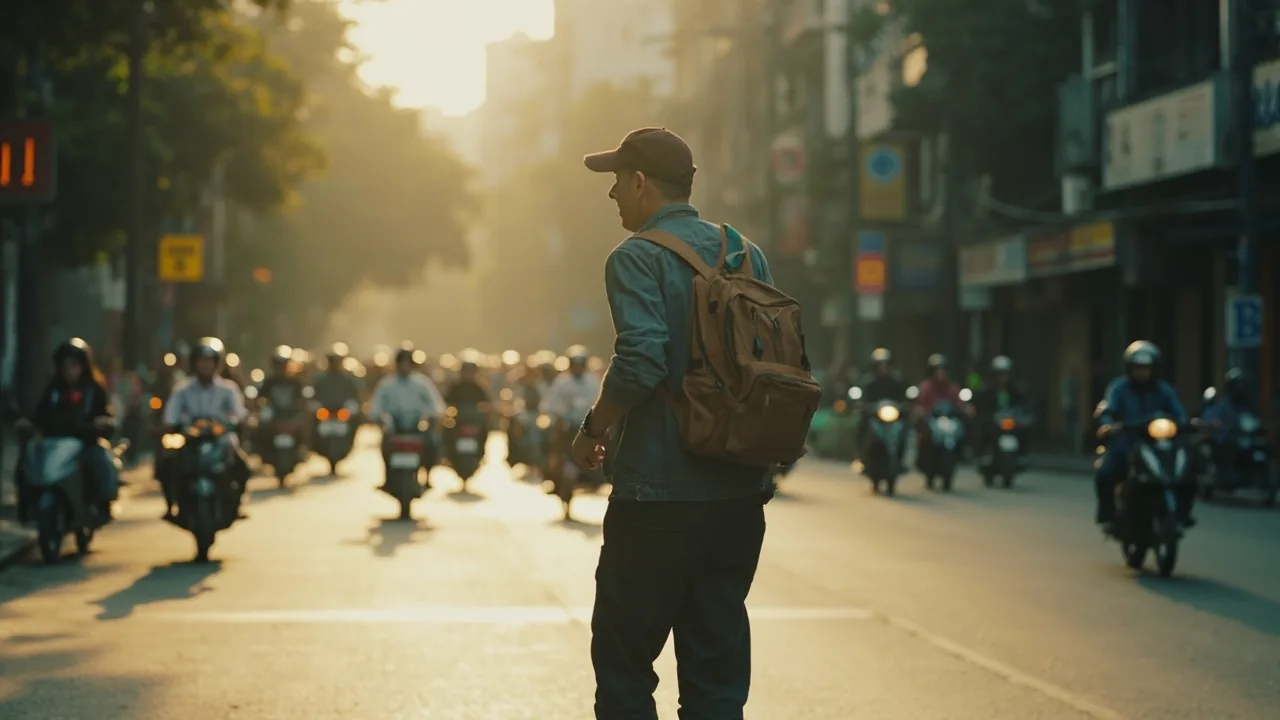
Crosswalks in Vietnamese cities are decorative. The traffic flow is constant, lanes are suggestions, and turning vehicles come from every direction. The biggest single cause of foreign tourist death in Vietnam is traffic, not crime.
What to do:
- Cross slowly, predictably, and never stop or reverse mid-crossing
- Make eye contact with oncoming riders so they adjust their path
- Hold your phone down and look up at traffic, not at the screen
- If you have luggage, cross at a traffic light even if it means walking 200m
Even a “slow” Vietnamese city like Da Nang has serious traffic. The traffic is louder than the danger feels, so don’t let the noise lull you into crossing without looking.
4. Watch for the Big Four Scams
The same four scams hit tourists in Vietnam over and over (full scam survival guide). Knowing them by name is the difference between a calm trip and a ruined day.
The rigged taxi meter. Driver flips the meter to a fast rate or pretends it’s broken. Fix: Grab, or insist on the meter before sitting down.
The overfriendly stranger. A local “just wants to practice English” and walks you to a bar, a shop, or a tailor where they get a 30–50% commission on whatever you buy. Fix: be polite, keep walking.
The inflated bill at a small restaurant. You order ₹184 (~50,000 VND or ~$1.91) of food, the bill arrives for ₹552 (~150,000 VND or ~$5.73) with mysterious “extras.” Fix: check prices on the menu, photograph the menu before ordering, pay in small bills.
The “closed today, follow me instead” trick. A shop or attraction is mysteriously closed; the tout takes you to a “better” version that’s three times the price. Fix: walk away, find the place yourself on Google Maps.
5. Protect Your Passport and Cash
Vietnam is much safer than, say, parts of Europe for violent theft, but petty hotel-room theft is reported. Most hostels and budget guesthouses have lockers; use them.
What to do:
- Carry a photocopy of your passport and the e-visa printout, leave the original in the hotel safe
- Split your cash across two places (wallet + hidden pouch) so a single pickpocket doesn’t clean you out
- Use a Visa or Mastercard with no foreign transaction fee (HDFC, ICICI, and Axis debit cards work at most ATMs)
- Withdraw from bank-affiliated ATMs (Vietcombank, BIDV, Techcombank) inside bank lobbies, not standalone street ATMs
The other option is a forex card from Niyo, BookMyForex, or HDFC ForexPlus, which gives you a much better rate than the airport counters (full money guide).
6. Handle Food and Water Cautiously, But Not Paranoidly
Vietnamese food is one of the best reasons to visit, and street food is the food you came for (full street food safety guide). Almost no Indian traveler gets seriously sick from eating at busy stalls, but the rules still apply.
What to do:
- Eat at stalls with a high turnover of locals (Bún chả carts in Hanoi, bánh mì vendors in HCMC)
- Skip uncooked vegetables and unpeeled fruit if you have a sensitive stomach
- Drink bottled water only; ice at reputable restaurants is fine because Vietnamese ice is factory-made
- Carry ORS and a course of norfloxacin from a chemist back home
Phở at a ₹15 (~4,000 VND or ~$0.15) bowl and a ₹479 (~130,000 VND or ~$4.97) SIM card are both real, but the food poisoning risk is real too. A ₹1 (~200 VND or ~$0.01) sachet of ORS is cheaper than a ₹4,820 (~50 USD) clinic visit.
7. Stay Connected So You Can Get Help
A working phone with data is your single biggest safety tool in Vietnam. You can call Grab, translate a sign, find an ATM, or call your embassy.
What to do:
- Buy a Viettel or Mobifone tourist SIM at the airport (₹479 (~130,000 VND or ~$4.97) for 14 days, ~6GB data) or pick one up in any city
- Activate it with your passport at the shop; the staff will do it for you in 5 minutes
- If you’d rather not swap physical SIMs, get a Nomad eSIM before you fly and activate on landing
Save these numbers in your phone before you land: 113 (police), 115 (ambulance), 84-24-3934-0662 (Indian Embassy in Hanoi).
Common Mistakes Indians Make
Mistake 1: Carrying the whole cash stack in one pocket. People coming from India often keep 4–5 million VND in a single wallet because it “feels like play money.” A single bag-snatch wipes you out. Split the stack: 1.5M VND in the wallet for the day, 2M VND hidden in a pouch, the rest in the hotel safe.
Mistake 2: Trusting the “student” or “tour guide” who approaches in District 1. HCMC’s District 1 has a dense network of commission touts, often young, often polite, often English-speaking. They are not your friend; they are working. Be friendly, say “no thank you,” and keep walking.
Mistake 3: Riding a motorbike without a license or insurance. Scooter rental shops in every Vietnamese tourist town will rent to anyone with a passport and a deposit. If you crash without a Vietnamese license or travel insurance, you are 100% liable and your Indian insurer will refuse the claim. Either get an International Driving Permit before you fly, or skip the scooter entirely and use Grab bikes.
Mistake 4: Crossing on a red light because “no one is coming.” Traffic never stops; it just thins. If you cross on a red, a motorbike you didn’t see will appear from behind a bus. Use the lights.
Mistake 5: Drinking tap water because the hotel doesn’t have a kettle. Vietnamese tap water is not potable for tourists. Bottled water is sold everywhere for ₹18-₹37 (~5,000-10,000 VND or ~$0.19-$0.38); the small cost is worth the avoided stomach bug.
What Most Guides Don’t Tell You
Racism against Indians is not the issue, but dress code is. Indians don’t get targeted as a racial group in Vietnam; the only recurring complaints in traveller reports are around dress at temples (cover shoulders and knees, remove shoes) and loud group behaviour at night markets. A small reduction in volume and a covered shoulder fixes 90% of friction.
HCMC District 1 and Hanoi Old Quarter are the crime hotspots, not the countryside. Almost every reported tourist crime happens in those two specific neighbourhoods. Once you leave for Da Nang, Hoi An, Sapa, or Phong Nha, the risk profile drops sharply. Travellers report walking alone at night in Hoi An with no issues; the same walk in District 1 at 1am is a bad idea.
Petty theft rises during Tet (Lunar New Year, late January/early February). Crowds at markets and tourist sites get dense, and pickpockets work the flow. If you travel during Tet, treat every crowded market like a Delhi wedding: zip front pockets, keep the bag in front, no phone in the back pocket.
The “unmarked fine” at a roadblock is sometimes real. Police checkpoints occasionally stop foreigners on motorbikes without proper paperwork. The fine is real, but the amount is usually ₹737-₹1,842 (~200,000-500,000 VND or ~$7.64-$19.10); if a “fine” is quoted at 2,000,000+ VND with no receipt offered, ask to go to the station. Most travellers report that a polite, patient attitude gets the fine reduced or waived.
Where to Stay in Vietnam
Budget hostels in Hanoi’s Old Quarter and HCMC’s District 1 start at ₹479–₹737/night (~13,000–20,000 VND). In Hoi An and Da Nang, you’ll find quieter stays for less. Book through Stay22 for the best hostel and hotel deals across Vietnam.
FAQ
Is Vietnam safe for solo female Indian travelers? Yes, solo female travel in Vietnam is generally safe, with the same petty-theft precautions you’d take in any major city. Common-sense rules: don’t walk alone in District 1 after 1am, use Grab instead of walking, and avoid accepting drinks from strangers in backpacker bars.
Will I get scammed in Vietnam as an Indian? You will encounter at least one scam attempt per day in HCMC and Hanoi. Most are low-stakes (inflated taxi, “free” tour, “special price” souvenir). Knowing the four common scams by name keeps you a step ahead.
Is there racial tension between Indians and Vietnamese? No, there is no documented pattern of racial targeting of Indians in Vietnam. You may get stared at in rural areas (you’re visibly foreign), but hostility, hate crimes, or organized discrimination are not reported issues.
What should I do if I get robbed in Vietnam? Go directly to the nearest police station and file a report (even if you don’t recover the items, you need the report for your travel insurance claim). Call the Indian Embassy in Hanoi (84-24-3934-0662) for passport replacement, and call the SafetyWing 24/7 line for guidance on medical or evacuation cover.
Is Vietnam safer than Thailand for tourists? For violent street crime, yes, Vietnam is generally safer than Thailand. For traffic, scams, and bag snatching, they are roughly comparable. For nightlife safety (drink spiking, fights), Thailand’s bad reputation is slightly worse.
Do I need a Vietnam visa as an Indian? Yes, you need an e-visa applied for in advance at evisa.xuatnhapcanh.gov.vn. Cost is ₹2,410 (~25 USD) for 90 days, multiple entry, processed in 3 business days (step-by-step e-visa guide). No visa-on-arrival is available for Indian passports.
Subodh’s Take
Vietnam is genuinely one of the safer countries in Southeast Asia for Indian travelers (full Vietnam travel guide), and the worry that “I’ll get targeted for being Indian” is misplaced. The real risk is the same one every tourist faces: a snatched phone, a rigged taxi, or a scooter you shouldn’t have rented. Travel with your head up, use Grab, keep the cash split, and Vietnam is easy.
