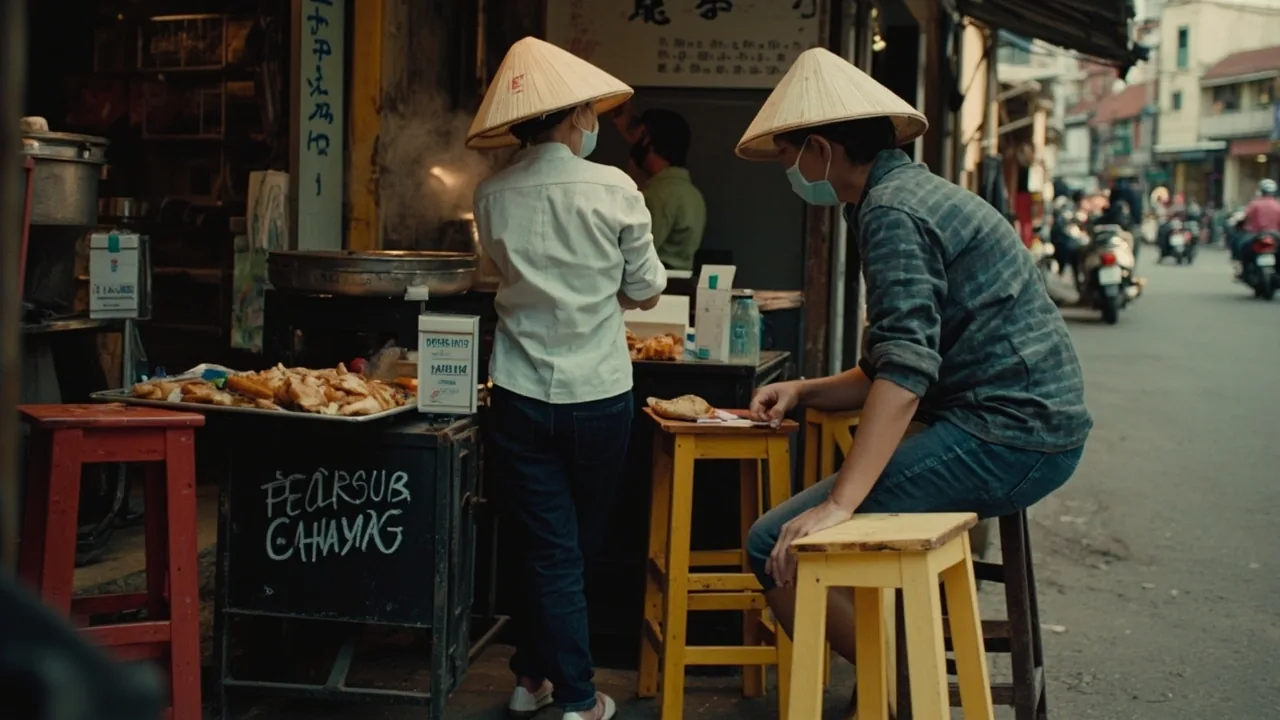
Vietnam Street Food for Indian Stomach: Complete Safety Guide 2026
Vietnam runs on street food. The country eats more meals on plastic stools by the curb than in air-conditioned restaurants, and that is exactly why the food is usually safe: turnover is high, ingredients don’t sit around, and you can watch everything get cooked. For Indian travellers, the bigger risk isn’t the soup or the grilled meat, it’s the cold water, the raw herbs, and a handful of dishes that stretch beyond a normal Indian stomach’s tolerance. This guide covers what to eat, what to skip, and what medicines to carry. For related planning, see our guide on Sea Backpacking Hub.
Quick Answers
| What | Answer | Price (INR) |
|---|---|---|
| Is Vietnamese street food safe for Indian travellers? | Yes, generally, if you follow the busy-stall rule and avoid tap water and raw herbs you didn’t see washed. | ₹0 |
| Can vegetarians eat safely in Vietnam? | Yes, but more difficult than in Thailand. Look for “chay” (vegetarian) signs or stick to Indian restaurants in Hanoi’s Old Quarter and District 1 of Saigon. | ₹0 |
| What is the most common travellers’ complaint? | Traveler’s diarrhoea, usually from ice, raw salad, or undercooked pork. | ₹0 |
| Should I take prophylactic antibiotics? | Not recommended. Carry a course of Ciprofloxacin or Azithromycin for self-treatment instead. | ₹350 (~$3.63) to ₹700 (~$7.26) |
| Is bottled water enough to stay safe? | Yes for drinking, but watch out for ice and anything washed in tap water (salads, fresh herbs). | ₹37 (~10,000 VND or ~$0.38) |
The Real Risks (What to Worry About)
Ranked by likelihood for an Indian backpacker eating street food for two to four weeks in Vietnam. You may also find Vietnam Motorbike Safety Tourist Scams useful for this trip.
| Risk | Likelihood | Impact | How to Avoid |
|---|---|---|---|
| Traveler’s diarrhoea (“Delhi belly”) from ice, raw herbs, undercooked pork | High | Low to Moderate | Drink only bottled or filtered water; skip ice in small bars; avoid raw salad; eat only fully cooked pork. |
| Stomach upset from spice mismatch (Vietnamese food is mild by Indian standards, but oils and herbs can surprise) | Moderate | Low | Start slow, especially with central Vietnamese dishes loaded with fish sauce. |
| Allergic reaction to shrimp paste, peanuts, or sesame in sauces | Low | Moderate | Ask before ordering; allergy cards in Vietnamese are easy to draft. |
| Hepatitis A from contaminated food or water | Low | High | Get vaccinated before flying. Two doses give long-term protection. |
| Typhoid from street food in unhygienic conditions | Low | High | Vaccine available; mainly relevant if eating outside tourist circuits for long periods. |
The single most useful sentence in this guide: busy stalls are safe stalls. A plastic-stool pho shop with a line of locals is a safer bet than an empty air-conditioned place in the tourist district, because turnover means nothing sits around. See also: Is Vietnam Safe a Practical Safety Guide for Indian Travelers Scams Women Solo Travel Emergency Help.
Prevention and Preparation
Vaccines to get before flying
Hepatitis A is the only one most Indian travellers genuinely need for a short food-focused trip. Typhoid is optional but cheap insurance if you’re heading anywhere off the main Hanoito-Saigon corridor. Your doctor may also recommend Hepatitis B booster, tetanus, and Japanese encephalitis if you are staying longer or heading to the Mekong Delta in monsoon season.
Subodh’s Pro Tip: Walk into your local government district hospital, not a private clinic. The government hospital’s travel-vaccination OPD charges a fraction of what Manipal or Apollo charge, and the vaccines are the same brands from the same distributors.
Medicines to pack
Carry these from India. The Vietnamese equivalents exist but the brand names trip you up, and during a 3 a.m. Bout of food poisoning you don’t want to be squinting at a box labelled “Metronidazol”.
| Medicine (Indian brand example) | What it’s for | Pack count |
|---|---|---|
| ORS (Electral or Glucon-D) | Dehydration, the real killer in diarrhoea | 10 to 15 sachets |
| Loperamide (Eldoper) | Symptom relief for non-bloody diarrhoea, lets you finish a bus ride | 1 strip |
| Ciprofloxacin or Azithromycin | Antibiotic for confirmed food poisoning with fever or blood in stool | 1 course |
| Rantac / Pantocid (PPI) | Acidity from unfamiliar oils, especially late-night street food | 1 strip |
| Econorm (Saccharomyces boulardii) | Probiotic, helps gut recover after a bad meal | 1 strip |
| Paracetamol (Dolo 650) | Fever, body ache | 1 strip |
| Electrobian / Rehydrat | Stronger rehydration with electrolytes | 3 to 5 sachets |
Safety Alert: Loperamide is fine for a bus ride, dangerous if you have fever above 101°F or blood in stool. Stop taking it the moment your temperature spikes and start the antibiotic course instead.
What to skip on the street
- Raw herbs and salad on the plate (rau song). They look fresh because they were just rinsed in tap water.
- Anything washed in a communal bucket, including fruit you didn’t peel yourself.
- Tiet canh (blood pudding) and undercooked pork in any dish. Vietnam’s classic thit heo quay (roasted pork) is fine if it’s crackling hot.
- Tap water, even filtered without boiling. Mineral water is ₹37 (~10,000 VND or ~$0.38) and available everywhere.
- Ice from unmarked bags in tiny cafes. Ice from big brands (the tube-shaped ones with the brand printed on the ice) is generally made from filtered water and safe.
What to eat with confidence
- Pho at a stall with a line. Boiling broth kills everything.
- Banh mi from a vendor with visible turnover, ideally the baguette toasted in front of you.
- Com tam (broken rice) and grilled pork in District 1 of Saigon.
- Bun cha in Hanoi’s Old Quarter, north of Hoan Kiem Lake.
- Vegetable-heavy bun (vermicelli) bowls. Just ask them to skip the fish sauce.
For more on tap water across Vietnam’s cities, see the Vietnam tap water guide. For broader emergency contacts in case things go sideways, keep the Vietnam emergency medical help page bookmarked.
Where to Eat (And Where to Eat Safe)
The shortlist below is divided into local Vietnamese spots and dedicated Indian or vegetarian-friendly restaurants. Either is safe; the Indian list exists for travellers who need a guaranteed veg meal or a dal-chawal reset.
Local Vietnamese spots worth knowing
Vietnamese Soul Food in Hoi An (rating 4.5) is a good entry point for travellers nervous about street stalls. It’s a sit-down restaurant serving traditional dishes but with the same flavours you’d find at a plastic-stool counter. Order the cao lau and the white-rose dumplings.
Nhà An - Vietnamese local food restaurant and vegan (rating 4.8) is vegan-friendly in Da Nang, useful when you want a break from fish sauce.
In Hanoi, May Hanoi Train Street Restaurant (rating 4.9) is a fun novelty meal, but the food itself is straightforward bun cha and pho cooked in front of you.
If you want to learn what you’re ordering rather than just eat it, XO Tours - Saigon Food Tours and City Tours Led by Women (rating 5) in Ho Chi Minh City does guided motorcycle food tours. Cost is around ₹6,077 (~1,650,000 VND or ~$63.04) for the half-day experience. You’ll cover banh xeo, bun thit nuong, and a half-dozen things most tourists never try.
In Da Lat, Hoang’s Restaurant - Vietnamese Restaurant & Vegan Food (rating 4.9) is a reliable spot for hotpot and vegetable-heavy regional dishes.
Indian and vegetarian-friendly restaurants (your safety reset)
Now Restaurant - Nhà hàng Cơm Niêu - Lẩu Gia Đình Ngon Dalat (rating 4.7) in Da Lat has the comfort-food rice-pot dishes and is friendly to Indian palates.
In Ho Chi Minh City’s backpacker district (District 1), De Tham Restaurant (rating 4.9) offers vegetarian Vietnamese options and Indian-influenced dishes. De Tham Street is a fallback area for any vegetarian traveller, several veg restaurants cluster here.
In Hanoi’s Old Quarter, A Taste Of Saigon - Old Market (rating 4.9) also has a vegetarian menu with dishes built around tofu and mushrooms.
Subodh’s Pro Tip: Don’t eat at Indian restaurants every night in Vietnam. Vietnamese food is so good that treating it as a fallback misses the point, and the restaurants I’ve seen run into hygiene complacency after the tourist dinner rush ends. Use them when you need a guaranteed veg option, otherwise get into the street stalls.
What to Do If You Get Food Poisoning
Step-by-step, the Indian-traveller version.
Step 1: Don’t panic
Most travellers’ diarrhoea in Vietnam is self-limiting. It clears in 24 to 48 hours if you stay hydrated and avoid solid food for the first few hours.
Step 2: Rehydrate aggressively
This is what saves you. Mix an ORS sachet with bottled water after every loose motion, plus an extra litre of plain water over the day. Total fluid intake should hit 3 to 4 litres until symptoms settle.
Step 3: Use loperamide (Eldoper) for transit emergencies only
If you need to take a 6-hour bus ride tomorrow, 2 mg of loperamide after each loose motion (max 8 mg a day) will let you travel. But stop it the moment you have a fever or blood in stool, that’s when antibiotics matter.
Step 4: Start antibiotics if symptoms are severe
Confirmed cases (fever above 101°F, blood in stool, persistent for 48+ hours) need Ciprofloxacin 500 mg twice a day for three days, or Azithromycin 500 mg once a day for three days if you’re in southern Vietnam (resistance patterns differ by region). Doctors in Saigon told me in 2024 that Azithromycin is increasingly the first-line choice.
Step 5: Get to a clinic if any red flag appears
Go to a clinic or hospital immediately if:
- Fever above 102°F
- Blood or mucus in stool
- Signs of dehydration (dizziness, no urination for 8+ hours, dry mouth)
- Diarrhoea lasting more than 5 days
A private clinic visit in Vietnam costs roughly ₹4,420-₹9,208 (~1,200,000-2,500,000 VND or ~$45.84-$95.51). Hospital admission with IV rehydration runs ₹14,732-₹36,830 (~4,000,000-10,000,000 VND or ~$152.82-$382.04). Travel insurance covers all of this if you have a plan with emergency medical coverage.
Step 6: Pay attention to typhoid and hepatitis A symptoms
If you get a sustained fever 7 to 14 days after a suspect meal, with abdominal pain and a slow pulse, that’s not food poisoning, that’s typhoid. Get a blood test at any clinic (₹921-₹1,842 (~250,000-500,000 VND or ~$9.55-$19.10)) immediately.
Indian-Specific Considerations
Medicine brand map
Vietnamese pharmacies stock generic equivalents, but the packaging looks unfamiliar. The Vietnamese word for diarrhoea is “tieu chay”, stomach pain is “dau bung”, and “thuoc khang sinh” means antibiotic. Show this to the pharmacist or they’ll try to sell you a herbal mix.
Indian embassy and clinic contacts
The Indian Embassy in Hanoi is at 58-60 Tran Hung Dao Street. Phone: +84 24 3824 4989. The Consulate General in Ho Chi Minh City is at 25 Ly Tu Trong Street, District 1. Phone: +84 28 3822 7380.
Keep digital copies of passport, visa, and insurance cards on WhatsApp and Google Drive. In a food-poisoning emergency the first thing the clinic asks for is your insurance policy number.
Hospital and clinic deposit costs
Most private Vietnamese clinics require a ₹7,366-₹18,415 (~2,000,000-5,000,000 VND or ~$76.41-$191.02) deposit before treatment. Public hospitals accept insurance upfront but queues are brutal. For tourists, the private clinics are the realistic option. Family Medical Practice (Hanoi and Ho Chi Minh City) and Vinmec are the two networks with English-speaking staff.
Vietnamese Food Vocabulary for Travellers
Useful phrases when you don’t speak Vietnamese. Show these on your phone if needed.
- “Khong them nuoc ma”, no ice
- “Khong an cay”, not too spicy (Vietnamese food rarely is)
- “Chay”, vegetarian
- “Khong nuoc mam”, no fish sauce
- “Cay qua, khong an duoc”, too spicy, I can’t eat it
Getting Connected
A working phone in your pocket is half the safety story. With data you can pull up this article, call the embassy, or book a Grab to the nearest clinic. Buy a Vietnamese SIM at the airport kiosks (Viettel or Mobifone, ₹368 (~100,000 VND or ~$3.82) for 30 days of 4G data) or skip the airport queue with Get Nomad eSIM, which activates before you land.
FAQ
Is Vietnam street food safe for Indian travellers?
Yes, for the most part. Vietnamese street food is generally safe if you stick to busy stalls with high turnover, avoid tap water and ice from unknown sources, and skip raw herbs and salads washed in tap water. Most cases of travellers’ diarrhoea come from ice, salad, or undercooked pork, not from the broth-based dishes that Vietnam is famous for.
What Vietnamese dishes should vegetarians try?
Bun (vermicelli) bowls without fish sauce, com tam with grilled vegetables, banh mi with tofu, and banh xeo are your best bets. Most cities have a “chay” (vegetarian) section of the market, especially during the monthly Vu Lan festival when many street stalls go fully vegetarian. Big cities have dedicated Indian restaurants as a reliable backup.
Should I take antibiotics before eating street food in Vietnam?
No prophylactic course is recommended by current CDC or WHO guidance. Carry a self-treatment course (Ciprofloxacin or Azithromycin) instead, and take it only if symptoms cross the threshold into fever or bloody diarrhoea. Over-using antibiotics is what creates resistant strains, the same strains that already make Azithromycin a better choice than Cipro in southern Vietnam.
Is ice safe in drinks in Vietnam?
Generally yes in licensed cafes and restaurants, the tube-shaped ice from major brands is factory-made with filtered water. In small bars and street stalls, ask for “khong them nuoc ma” (no ice) if you’re uncertain. Cold drinks in a hot climate are tempting but a warm beer costs you nothing extra.
How much does it cost to see a doctor in Vietnam for food poisoning?
A private clinic consultation runs ₹4,420-₹9,208 (~1,200,000-2,500,000 VND or ~$45.84-$95.51), with IV rehydration adding another ₹5,524-₹11,049 (~1,500,000-3,000,000 VND or ~$57.31-$114.61). Hospital admission with full treatment can run ₹14,732-₹36,830 (~4,000,000-10,000,000 VND or ~$152.82-$382.04). Travel insurance with emergency medical coverage pays all of this back, keep receipts and policy numbers.
Can I drink tap water in Hanoi or Saigon?
No. Both cities have municipal treatment but the water is not safe at the tap for foreign stomachs. Bottled water is ₹37 (~10,000 VND or ~$0.38) a litre. Use bottled or filtered water for brushing teeth as well, your mouth absorbs water too.
Should I pack ORS or just drink water?
Both. Plain water alone doesn’t replace the electrolytes and glucose you lose in diarrhoea, which is what ORS does. Carry 10 to 15 sachets of Electral or Glucon-D from India.
Subodh’s Take
Vietnam’s street food is genuinely one of the best food cultures you’ll ever eat from, and missing it because you’re scared of Delhi belly is a real cost. The framework is simple: eat where locals eat, eat food that’s hot and freshly cooked, drink only bottled water, and keep the antibiotic strip in the top of your bag. The 90 percent of Indian backpackers who go home fine are the ones who follow those four rules. The ones I see in clinics are the ones who rolled in with a 14-day hostel plan and no medicine kit.
