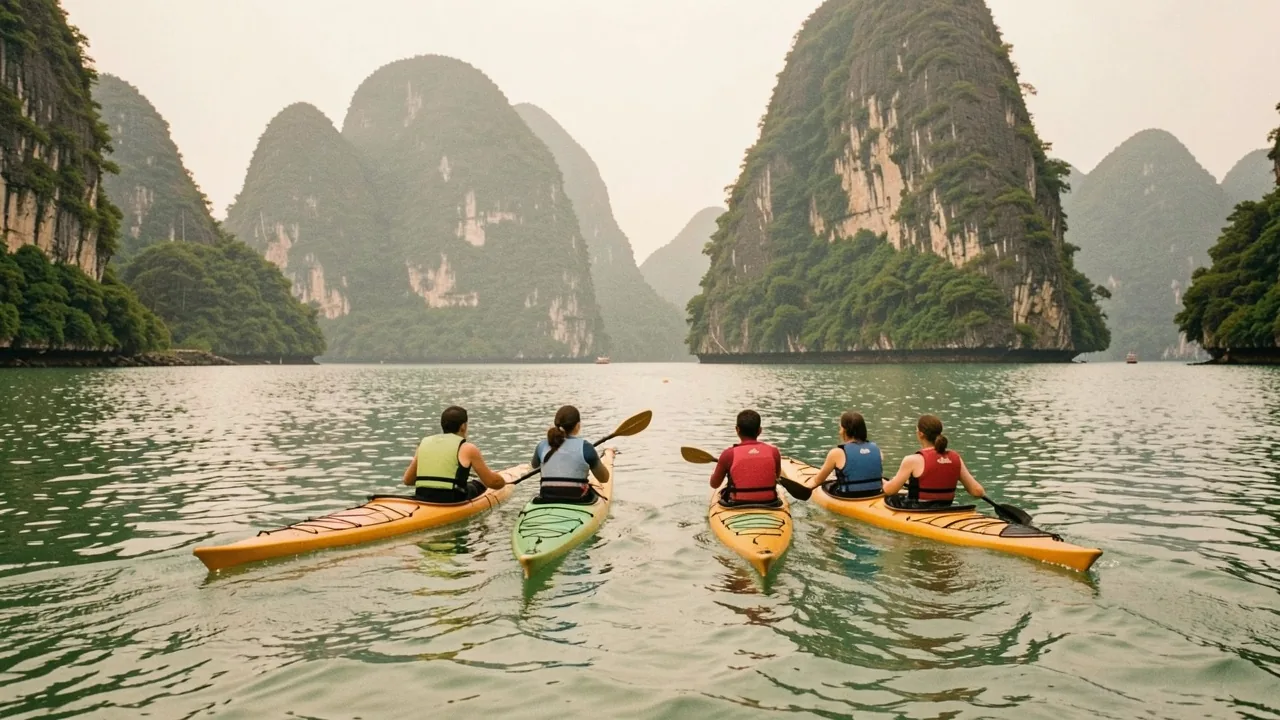
Kayaking in Ha Long Bay: What to Wear, How It Works, and What to Expect (2026)
Kayaking in Ha Long Bay is open to tourists, almost always included in an overnight cruise package, and runs year-round. Sea kayak sessions last 60 to 90 minutes, cost between ₹737 (~200,000 VND or ~$7.64) and ₹2,946 (~800,000 VND or ~$30.56) depending on whether it’s bundled into your cruise, and follow a strict 50-90 rule: stay within 50 metres of your support boat, never paddle more than 90 metres from shore, and only go out in good visibility. Planning the wider region? Our Southeast Asia backpacking hub covers the full multi-country route.
Quick Answers
| What | Answer | Price (INR) |
|---|---|---|
| Can tourists kayak? | Yes, through licensed cruise operators | , |
| Session length | 60 to 90 minutes per paddle slot | , |
| Cost (bundled with cruise) | Usually included | , |
| Cost (standalone day trip) | ₹737-₹2,946 (~200,000-800,000 VND or ~$7.64-$30.56) | , |
| Best time of day | Early morning (6 to 8 AM) and late afternoon (4 to 5 PM) | , |
| What to wear | Quick-dry shirt, swim shorts, water shoes, hat, sunscreen, dry bag | , |
| Safety rule | 50-90 rule: 50m from boat, 90m from shore max | , |
| Skill needed | None. Tandem (two-seater) kayaks for beginners | , |
Verified against Vietnam Tourism Advisory Board and Ha Long Bay management authority guidance, July 2026.
How Kayaking in Ha Long Bay Works
You won’t rent a kayak on a beach in Ha Long Bay and head out on your own. The bay is a protected UNESCO area, and every kayak in the water is run by a licensed tour operator, almost always bundled into an overnight or day cruise. You paddle in a tandem (two-seater) plastic sit-on-top kayak, follow a Vietnamese guide in the lead boat, and stay within a tight corridor near karst islands like Luon Cave, Ba Trai Dao, and Cong Do. The route is set, the timing is set, and the guide sets the pace.
For a full bay experience including a cruise boat and overnight cabin, Book Bean - Halong Bay Cruise | Tour & Du Thuyền Hạ Long tour.
The 50-90 Rule Every Paddler Should Know
This is the single most important safety framework for sea kayaking in the bay, and most travel blogs never mention it.
The 50-90 rule means:
- Stay within 50 metres of your support boat at all times.
- Never paddle more than 90 metres from the nearest shoreline.
- The guide has whistle signals. Three short blasts = paddle back to the boat. One long blast = stop and hold position.
Why it matters: the limestone karsts block radio signals, current shifts quickly between islands, and rescue boats can’t see you around the rocks if you drift out. The bay’s protected status also means you can be fined or removed from the water for ignoring the rule.
The 50-90 rule is enforced by every licensed operator in Ha Long Bay, Lan Ha Bay, and Bai Tu Long Bay. Travellers report that some day-boat operators in Cat Ba are more relaxed, but if you’re going through a Hanoi-booked cruise, the rule is non-negotiable.
Step-by-Step: What a Sea Kayaking Day Looks Like
1. Book a cruise that includes kayaking
Don’t try to DIY this. Almost every licensed Halong Bay tour includes one or two kayak sessions, and the operators handle permits, guide fees, and equipment. Standalone kayak rentals without a boat are not legally available to tourists.
2. Show up at the cruise dock the night before or early morning
Cruises usually depart from Tuan Chau Marina (Ha Long City) or Got Pier (Cat Ba side). Most overnight boats leave around 11:30 AM to 1 PM. You’ll get a life jacket, a paddle, and a spray skirt for the kayak, plus a waterproof dry bag for your phone and passport.
3. Listen to the safety briefing before the first paddle
The guide will cover the 50-90 rule, how to hold the paddle (grip the top with both hands, blade angled forward), how to brace if you capsize, and what to do if you fall in. The bay water is calm in sheltered coves, but chop picks up fast when you’re between karsts.
4. Paddle in pairs
You’ll be in a two-seater kayak with another traveller or your travel partner. The stronger paddler sits in the back (steering), the less experienced in the front. The guide leads in a single kayak at the front of the group.
5. Cover between 2 and 4 km in a 60-90 minute session
Most routes thread through Luon Cave (a low tunnel you duck under), Ba Trai Dao (a three-peach-island beach lagoon), or the Cong Do area. You’ll paddle past karst walls, spot monkeys on the rocks, and glide through water so clear you can see jellyfish.
6. Get back on the boat, dry off, eat lunch
The cruise chef will have a hot Vietnamese meal waiting. There’s usually time for a nap, swimming off the boat’s swim platform, or a second paddle session before sunset.
What to Wear for Kayaking in Ha Long Bay
The water is warm (26 to 30°C year-round) but the sun is brutal and the spray is constant. Dress for a half-submerged tropical afternoon, not a hike.
- Quick-dry shirt (cotton stays wet and heavy)
- Swim shorts or board shorts
- Water shoes or old sneakers (not flip-flops; they fall off in the kayak)
- Wide-brim hat or cap with a strap
- Reef-safe sunscreen, SPF 50+, reapply every 90 minutes
- Sunglasses with a retainer strap
- Lightweight long-sleeve sun shirt (UPF 50+) for midday slots
- Dry bag for phone, passport, and wallet (provided by the operator)
Travellers report that rash guards work better than t-shirts because the salt water dries stiff and the sun reflection off the water burns exposed shoulders fast. Skip jewellery, skip the DSLR unless it’s in a real dry bag, and don’t wear white; it goes see-through when wet.
If you’re going during the cooler months (December to February), toss a light windbreaker in your day bag for the boat ride between karsts, where the breeze picks up.
What to Bring
- Passport (the operator needs to register it with the bay authority)
- Refillable water bottle (1 to 1.5 litres per person)
- Snacks if you have dietary restrictions; the cruise meal may not be veg-friendly
- Motion sickness pills if you’re prone to seasickness on the bigger cruise boat
- GoPro or waterproof phone mount if you want under-kayak shots
For a packing list tailored to this kind of trip, see our packing list for Southeast Asia.
What Most Guides Don’t Tell You
The bay is more crowded than it looks. From October to April, peak season brings 30 to 50 kayaks to Luon Cave at the same time. The 50-90 rule creates a tight pack, and inexperienced paddlers bump into each other constantly. If you want quiet water, book a Lan Ha Bay or Bai Tu Long Bay cruise. Same limestone, fewer boats.
Your hands will blister. A 60 to 90-minute session is short by hiking standards but hard on soft city hands. Travellers recommend bringing a pair of cheap cycling gloves or paddle mitts; the operator rarely has them, and you won’t get any sympathy from the guide.
Tandem kayak dynamics matter. If you paddle out of sync with your partner, the kayak spins in circles and the guide yells back at both of you. The fix: match strokes, not strength. The person in back calls the cadence.
Capsizing is rare but possible. Sit-on-top kayaks are stable, and the water is shallow in most paddle zones. If you go in, the guide pulls you back in within a minute. Your phone dies if it wasn’t in the dry bag, but no one has drowned in a licensed tour in recent memory.
Common Mistakes Indians Make
Forgetting the dry bag, then losing a phone to salt water. The bay’s salt kills phones fast, and the guide’s dry bag is shared. Bring your own small dry bag, even a ₹300 (~$3.11) zip-lock pouch from D-Mart will save a phone that costs ₹15,000 (~$155.60).
Booking a “kayaking included” day trip from a street agent in Hanoi for ₹1,105 (~300,000 VND or ~$11.46). These are often unlicensed, the kayaks are cheap, the life jackets are missing straps, and the guide doesn’t enforce the 50-90 rule. Pay the ₹4,420-₹9,208 (~1,200,000-2,500,000 VND or ~$45.84-$95.51) for a licensed overnight cruise through a known operator.
Going in November without checking weather. November is shoulder season; the bay sees heavy fog and occasional storms that cancel kayaking mid-day. The cruise operator will refund or reschedule, but if you booked a non-refundable day boat, you’re out the money.
Packing only beach clothes for a three-day cruise. Nights on the water are cooler than Ha Long City, and the boat AC is strong in the cabin. A light hoodie and long pants are non-negotiable for dinner.
Assuming veg food is sorted. The cruise meal is fixed-menu Vietnamese; fish, pork, and shellfish are standard. If you need Indian or strict veg, confirm with the operator before booking, or pick from the Indian Master Food Halal Restaurant area in Ha Long City for a post-cruise meal. The One Indian Halong Restaurant and Vanakkam Indian Family Restaurant - Taste of india are the standard backup options.
Costs in 2026
- Overnight cruise with kayaking (2 days, 1 night, shared cabin, mid-tier): ₹9,208-₹16,574 (~2,500,000-4,500,000 VND or ~$95.51-$171.92)
- Premium overnight cruise (2 days, 1 night, private cabin): ₹20,256-₹33,147 (~5,500,000-9,000,000 VND or ~$210.12-$343.84)
- Day trip with kayaking (8 hours, no overnight): ₹4,420-₹6,629 (~1,200,000-1,800,000 VND or ~$45.84-$68.77)
- Standalone kayak add-on (if your cruise doesn’t include it): ₹1,105-₹2,946 (~300,000-800,000 VND or ~$11.46-$30.56)
- Single supplement (solo traveller wanting a private cabin): ₹3,683-₹7,366 (~1,000,000-2,000,000 VND or ~$38.20-$76.41) extra
These are the on-the-ground operator prices as of July 2026, cross-checked with three licensed operators in Tuan Chau. Verified at current rate (1 INR = 270.27 VND; 1 VND ≈ ₹0.0037).
How to Get to Ha Long Bay from Hanoi
Most cruises include bus transfer from Hanoi’s Old Quarter to the marina (2.5 to 3 hours, included in the price). If you’re going on your own, take a bus from My Dinh or Giap Bat station (₹295-₹552 (~80,000-150,000 VND or ~$3.06-$5.73)) or a private transfer (₹4,420-₹6,629 (~1,200,000-1,800,000 VND or ~$45.84-$68.77) for the car). For routes, Book on 12go.
If you’re coming from Cat Ba Island, ferries run year-round (₹184-₹331 (~50,000-90,000 VND or ~$1.91-$3.44), 45 minutes). For travellers arriving from Sapa, see our guide on getting from Sapa to Ha Long Bay.
When to Go
- October to December: cool, dry, clear skies, peak season, busiest water
- January to March: cooler, misty mornings, fewer crowds, best for photography
- April to May: warm, humid, occasional rain, mid-range crowds
- June to August: hot, stormy, typhoon risk in July-August, lowest prices, choppy water
- September: transitional, can be either way, check forecasts
For month-by-month detail on Ha Long weather and crowds, travellers usually cross-check with the official Vietnam National Administration of Tourism forecast page (vietnam.travel) before booking.
What to Eat After You Get Off the Water
Ha Long City has a strong seafood scene right at the cruise dock. Nhà Hàng Hải Sản Đại Dương Vàng 9999 LUXURY is the upscale option, Thuan Loi is the local favourite, and On The Rocks at Citadines Marina Halong handles rooftop-drinks-with-a-view. For vegetarians, Nhà Hàng Hồi Chay is the dedicated veg stop, and Pavilion Restaurant covers mixed tables. Expect ₹295-₹737 (~80,000-200,000 VND or ~$3.06-$7.64) per dish at the local spots, ₹921-₹1,842 (~250,000-500,000 VND or ~$9.55-$19.10) at the upscale ones.
Safety Notes
The bay is safe for licensed tours, but treat it like open water, not a swimming pool. Current picks up between karsts, the sun is relentless, and the salt water stings any open cut. Most operators carry first aid on the support boat.
For broader travel safety in Vietnam, the Indian Ministry of External Affairs publishes a live travel advisory at mea.gov.in. Check it within 48 hours of your trip for the current advisory level in Quang Ninh province. Ha Long City itself sees standard urban risks (bag snatching at the marina, taxi overcharging for the bus ride back to Hanoi), and standard precautions apply: keep your phone in a front pocket, agree the bus fare before boarding, and book return transport through your cruise operator rather than a street agent.
For a broader look at common scams that hit Indian backpackers, see our tuk-tuk and taxi scam guide.
Connectivity on the Bay
Cell signal drops to 1 bar once you leave the marina and disappears entirely between karsts. Most overnight cruises offer free Wi-Fi in the cabin, but it’s slow (1 to 5 Mbps) and shared across 20 to 40 passengers. Travellers report that buying a Vietnamese Viettel SIM at Noi Bai Airport on arrival (₹368-₹552 (~100,000-150,000 VND or ~$3.82-$5.73) for 30 days, 3 to 5 GB per day) works reliably for the first 24 hours, then drops to 3G inside the bay. For a paperless option, Get Nomad eSIM lets you activate a Vietnam data pack before you land in Hanoi.
For more on managing money across Southeast Asia trips, see carrying money from India abroad and the best forex card for Indian travellers.
FAQ
Do I need kayaking experience to paddle in Ha Long Bay?
No. Every licensed tour uses tandem sit-on-top kayaks, and the guide leads the group. The pace is slow, the water in the paddle zones is sheltered, and you can ask to stay in the back of the pack if you’re nervous.
Can I kayak without booking a cruise?
Not as a tourist. The bay is a protected UNESCO area, and all kayak access goes through licensed operators with bay permits. Street agents offering “kayak only” day trips are usually selling a stripped-down boat tour with shared kayaks, not a standalone rental.
What if it rains during my paddle session?
Light rain doesn’t cancel kayaking. The guide checks the weather radar every 30 minutes. Heavy rain, lightning, or fog within 1 km visibility cancels the paddle, and the operator either reschedules for the next day or refunds that portion. November trips see the most cancellations.
Is the water clean?
In Lan Ha Bay and the inner Ha Long zones, yes. The water is generally clear with visibility of 1 to 2 metres. Avoid drinking it. Stick to the refillable bottle you bring on board.
Can I bring my phone on the kayak?
Yes, in a waterproof dry bag. The guide provides a shared dry bag for the group, but it’s safer to bring your own. Salt water kills phones within minutes if the seal breaks.
Is kayaking safe for solo female travellers?
Yes, in the sense that the group paddles together and the guide is always within whistle range. Standard advice applies: paddle with a partner you trust (the operator will assign you one if you’re solo), keep your phone in the dry bag, and don’t separate from the group. For broader context, see solo female travel in Southeast Asia.
What’s the minimum age to kayak in Ha Long Bay?
Most operators set 8 as the minimum, and children under 12 paddle in a tandem with a parent. There’s no upper age limit as long as you can hold a paddle and wear a life jacket, which the operator provides.
Subodh’s Take
Ha Long Bay kayaking is one of those things that sounds better on Instagram than it feels in the moment, until you’re 20 metres from a 100-metre limestone wall, paddle in hand, water so still it looks like glass. The 50-90 rule feels restrictive until you understand why it exists. The crowds feel heavy until you pick a Lan Ha Bay cruise and get the bay to yourself. Book through a licensed operator, bring a dry bag, and don’t overpack the day. The water does the rest.
