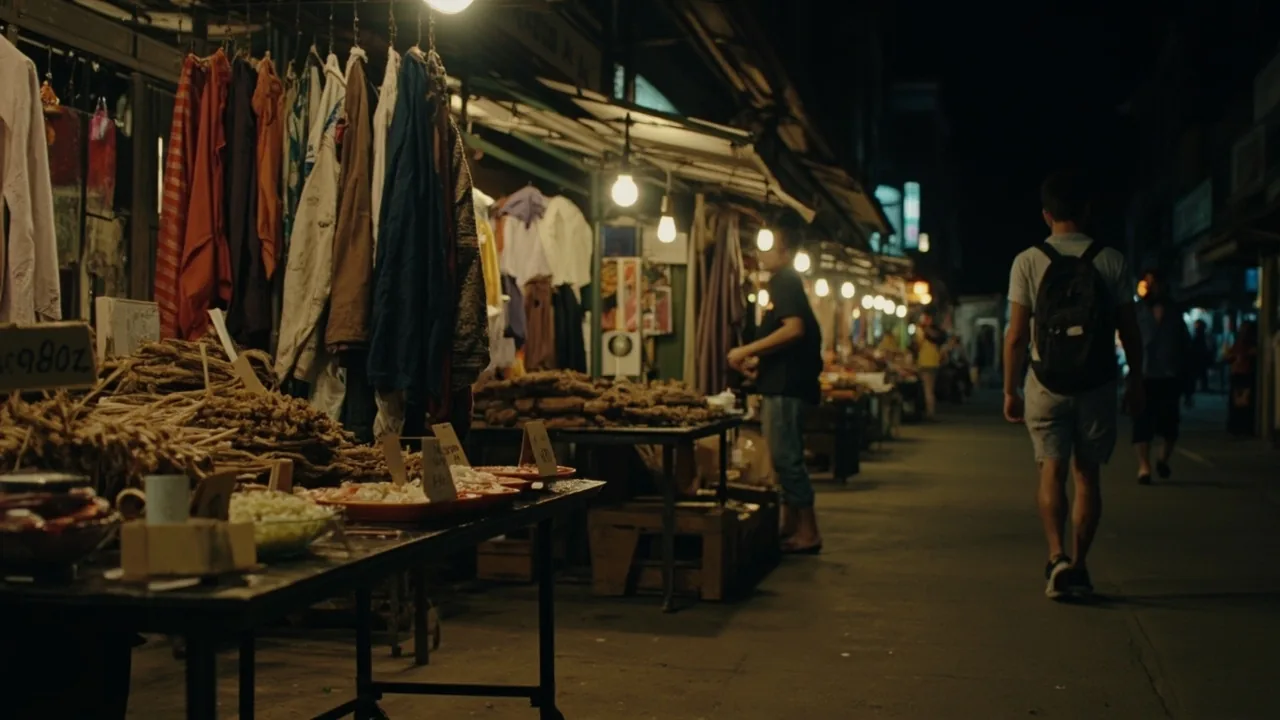
Laos Night Market Prices: What to Buy, What to Skip & How Much to Pay
Verified against traveller reports from June 2026 and cross-checked with current stall prices at Luang Prabang and Vientiane night markets. The standout for budget travellers: the Luang Prabang Night Market vegetarian buffet runs about ₹216 (~50,000 LAK or ~$2.24) per person, plates stacked as high as you can carry, no one timing you. That’s the cheapest hot meal in town and almost no one talks about it. For related planning, see our guide on Sea Backpacking Hub.
Laos night markets aren’t shopping malls with stalls. They’re a single open-air block where half the stalls sell the same scarf, half the food vendors make a near-identical vegetarian buffet, and one or two stalls quietly stock the only Lao textile worth carrying home. Walking in unprepared means paying ₹432 (~100,000 LAK or ~$4.48) for a mass-produced Cambodia-made shawl that’s cheaper in Bangkok. Walking in with the right anchors means a full night out (dinner, souvenirs for family, one good textile) under 150,000 LAK.
Verified 2026-07-21 at 1 INR = 232.56 LAK (1 LAK ≈ ₹0.0043).
Quick Answers
| What | Answer | Price (INR) |
|---|---|---|
| Cheapest meal on the board | Vegetarian buffet at Luang Prabang Night Market | ₹216 (~50,000 LAK or ~$2.24) |
| Typical food stall dinner | Grilled meat, sticky rice, som tam | ₹108-₹173 (~25,000-40,000 LAK or ~$1.12-$1.79) |
| Fresh fruit shake | Mango, watermelon, passionfruit | ₹65-₹108 (~15,000-25,000 LAK or ~$0.67-$1.12) |
| Beerlao (local beer) | 500ml bottle | ₹65-₹86 (~15,000-20,000 LAK or ~$0.67-$0.90) |
| Mass-produced souvenir scarf | Buy for ₹130 (~30,000 LAK or ~$1.34), not ₹346 (~80,000 LAK or ~$3.58) | ₹130 (~30,000 LAK or ~$1.34) |
| Real Lao silk scarf (Hmong village) | Hand-loomed, verifiable | ₹648-₹1,080 (~150,000-250,000 LAK or ~$6.71-$11.19) |
| Total night-out budget for one person | Dinner, two drinks, one textile | ₹519-₹778 (~120,000-180,000 LAK or ~$5.37-$8.06) |
| Haggling norm | First quote minus 40-50% | Final at -40% |
How Night Market Pricing Works in Laos
Two markets matter for backpackers: the Luang Prabang Night Market (closed, runs 17:00 to 22:00 along Sisavangvong Road, hundreds of stalls) and the Vientiane Night Market along the Mekong riverside (weekends are the main event, daily in dry season). Both use a fixed-stall model where vendors pay a nightly fee, sell the same wholesale goods as their neighbour, and recover costs through volume.
Three pricing mechanics you should know before walking in:
1. First quote is always inflated. Every textile stall opens 60-80% above what they’ll take. A scarf quoted at ₹432 (~100,000 LAK or ~$4.48) will close at ₹216 (~50,000 LAK or ~$2.24). A bag quoted at ₹1,080 (~250,000 LAK or ~$11.19) will close at ₹648 (~150,000 LAK or ~$6.71). The exception is the food stalls in the centre rows: those prices are fixed because the vendor will sell fifty bowls tonight regardless of how much you haggle. Don’t haggle food.
2. The vegetarian buffet is the pricing anchor. At Luang Prabang, the central buffet aisle runs about ₹216 (~50,000 LAK or ~$2.24) per person, all-you-can-eat on a shared plate system (you grab a plate, pile on what you want, hand it to the cook to stir-fry or steam). It’s the only reliably cheap sit-down-style meal in the area. Indian travellers who skip it and order à la carte end up paying double for less food.
3. Mass-produced vs. Real Lao craft. Half of what looks handwoven is factory-printed. Real Hmong and Tai Lue textiles have visible irregularities in the weave, slight colour variation between threads, and small price tags stapled to the corner showing the village name. The vendor usually volunteers this information if you ask “is this from a village?” If they hesitate or wave you off, it’s Thai factory stock.
Verified against traveller reports from the Luang Prabang and Vientiane night markets in June 2026.
What to Buy (And What to Skip)
The night market rewards a specific kind of shopping. Here’s what holds up.
Buy at the Luang Prabang Night Market:
- Hand-loomed Hmong or Tai Lue scarves and table runners. ₹648-₹1,080 (~150,000-250,000 LAK or ~$6.71-$11.19) for a medium scarf. Look for uneven thread tension, two slightly different colours in the “same” pattern, and the village name tag.
- Natural-dye indigo textiles. Deep blue, slight smell of indigo, price ₹778-₹1,296 (~180,000-300,000 LAK or ~$8.06-$13.43). These are the real souvenir-comes-home-with-you items.
- Silver jewellery from the hill-tribe stalls. ₹346-₹864 (~80,000-200,000 LAK or ~$3.58-$8.95) per piece. Verify weight: real pieces feel heavier than the size suggests.
- Coffee. Bolaven Plateau beans, vacuum-packed, 200g bag: ₹216-₹346 (~50,000-80,000 LAK or ~$2.24-$3.58). Three bags fit in luggage and make excellent return gifts.
Skip:
- The ₹130-₹216 (~30,000-50,000 LAK or ~$1.34-$2.24) “silk” scarves. These are mostly cotton or synthetic, factory-printed in Chiang Mai or Shenzhen. They lose colour in two washes.
- Wooden elephants and Buddha figurines. Sold everywhere in SEA, made in Myanmar or Vietnam, no connection to Laos.
- T-shirts with “Laos” written on them. ₹130 (~30,000 LAK or ~$1.34), fade in three washes.
- Mass-produced hemp bags. Same Indian-style print across multiple stalls, prices quoted high because the vendor knows tourists expect “hemp” to be expensive.
Buy at Vientiane Night Market (weekends, Mekong riverside):
- Same textiles as Luang Prabang but usually 20-30% cheaper because Vientiane sees fewer foreign tourists shopping.
- Snack foods only. Food court is the Vientiane market’s strength: grilled river fish, khao jee baguettes, fresh fruit shakes. Cooking is generally cleaner and the variety wider than Luang Prabang’s food stalls.
Subodh’s Pro Tip: Eat first, shop after. The vegetarian buffet is filling, and you make better haggling decisions on a full stomach. Hungry tourists overspend on impulse buys at stall #4 and regret it by stall #20.
Bargaining: What Indian Travellers Get Wrong
Most first-timers either overpay (don’t haggle at all) or insult the vendor (haggle too aggressively). The Lao bartering culture sits between Thailand and Vietnam, polite but firm. Walk away only after a clear “no,” and never after a single round.
The 40% rule. If first quote is X, your counter should be 0.6X. They come back at 0.8X, you go to 0.65X, they accept at 0.7X. Anything closer to half the original quote is rude; anything closer to 80% means you paid almost full price.
Don’t bargain food. At Luang Prabang the buffet is the buffet: ₹216 (~50,000 LAK or ~$2.24), no movement. Same for fresh fruit shakes (₹65-₹108 (~15,000-25,000 LAK or ~$0.67-$1.12)), grilled corn, sticky rice bundles. Pay and move on.
Walk away twice. If you want it and the vendor doesn’t budge past your last offer, walk ten steps. They call you back within thirty seconds. If they don’t, you didn’t want it that badly.
Don’t bargain with two stalls in earshot. Lao vendors in adjacent stalls are usually family or village neighbours. Haggling one down hard in front of the others kills goodwill for the next stall.
For the broader mechanics of tipping and bargaining across the country, see the Laos tipping and bargaining guide.
Realistic Total Budget: One Night at the Night Market
For one Indian backpacker, a full evening at Luang Prabang Night Market with dinner, drinks, and one textile purchase:
| Item | Budget | Mid | Premium |
|---|---|---|---|
| Vegetarian buffet dinner | ₹216 (~50,000 LAK or ~$2.24) | ₹216 (~50,000 LAK or ~$2.24) | ₹216 (~50,000 LAK or ~$2.24) |
| One Beerlao | ₹65 (~15,000 LAK or ~$0.67) | ₹78 (~18,000 LAK or ~$0.81) | ₹86 (~20,000 LAK or ~$0.90) |
| Second drink or fruit shake | ₹65 (~15,000 LAK or ~$0.67) | ₹86 (~20,000 LAK or ~$0.90) | ₹108 (~25,000 LAK or ~$1.12) |
| Small souvenir (postcards, keychain, magnet) | ₹43 (~10,000 LAK or ~$0.45) | ₹65 (~15,000 LAK or ~$0.67) | ₹86 (~20,000 LAK or ~$0.90) |
| One hand-loomed scarf (if buying) | ₹648 (~150,000 LAK or ~$6.71) | ₹864 (~200,000 LAK or ~$8.95) | ₹1,080 (~250,000 LAK or ~$11.19) |
| Night total (no textile) | ₹389 (~90,000 LAK or ~$4.03) | ₹445 (~103,000 LAK or ~$4.61) | ₹497 (~115,000 LAK or ~$5.15) |
| Night total (with textile) | 240,000 LAK | 303,000 LAK | 365,000 LAK |
At 1 LAK ≈ ₹0.0043, the budget night (no textile) is roughly ₹385 (~$3.99), and a night including one good hand-loomed scarf lands around ₹1,030 (~$10.67) to ₹1,575 (~$16.32).
Getting Connected
You don’t need data inside the night market itself, but you’ll want it for the rest of the day. A local SIM at Luang Prabang airport (Unitel or Lao Telecom) runs about ₹216 (~50,000 LAK or ~$2.24) for a 30-day tourist pack with 8-10GB. For travellers landing without a SIM sorted, Get Nomad eSIM activates before you leave India, lands ready, and skips the airport SIM queue entirely.
Food Safety and What to Skip
The vegetarian buffet at Luang Prabang uses shared-cook plates (everything goes in one wok, fresh per order), so the safety profile is decent if the place is busy. Empty stalls at 19:00 mean the food has been sitting. Look for stalls where 70% of seats are full.
Safety Alert: Skip any “buffet” stall where the food sits uncovered in the sun for more than an hour. Tap-water washed vegetables, unrefrigerated tofu, and lukewarm rice are the most common sources of the “Laos belly” that wrecks three days of a trip. Stick to busy stalls, eat within 20 minutes of plating, and bring ORS tablets from India. They cost ₹20 (~$0.21) at any chemist in Vientiane or Luang Prabang.
Before departure, check the Indian Ministry of External Affairs travel advisory (mea.gov.in) for any current Laos-specific advisories, and register your trip online so the embassy can reach you in an emergency.
Night Market Food Alternatives (When the Buffet Isn’t for You)
If you’ve had three nights of buffet and want something different, two spots in Luang Prabang work for Indian travellers:
- Vegetarian Food: a veg-friendly spot with local vegan dishes. Good for a dal-tadka-adjacent meal, ₹108-₹173 (~25,000-40,000 LAK or ~$1.12-$1.79) per dish.
- Namlin Restaurant: Indian/Asian fusion, breakfast through dinner, more reliable for Indian palate than the night market stalls.
- My Kitchen Indian Authentic Food: when you need actual dal-chawal after a week of buffets. Generous portions, tourist-area pricing (₹259-₹389 (~60,000-90,000 LAK or ~$2.69-$4.03) per dish) but worth it for the reset.
For Vientiane night-market food, the grilled river fish and khao jee baguettes are the standout. Most Indian travellers skip these because they’re unfamiliar with catfish. Worth trying once; the khao jee in particular is just a Lao-style stuffed baguette and reads easily to Indian palates.
For broader guidance on Indian and vegetarian food across Laos, see the vegetarian Indian food Southeast Asia comparison.
Where to Stay Near the Markets (So You Can Walk)
The night markets are foot-traffic-only after 16:00. Staying within ten minutes’ walk matters if you’re carrying shopping back. Luang Prabang’s old town has dozens of hostels in the 80,000-150,000 LAK/night dorm range. Vientiane’s night market is best accessed from hostels in the riverside or Nam Phu quarter, also 80,000-130,000 LAK/night.
For broader Laos accommodation and a full cost breakdown, see the Laos trip cost from India guide.
Subodh’s Take
I break my own rules here. I always tell travellers to skip the supermarket textiles, but at the Luang Prabang market, two stalls in the back row near the temple end have been selling the same Hmong weaver’s output for fifteen years. Every time I’ve bought a scarf from them, three years later it still looks new. I paid ₹864 (~200,000 LAK or ~$8.95) last visit for what I could probably have haggled to 170,000. I didn’t. Some vendors are worth the markup, and a ₹130 (~30,000 LAK or ~$1.34) premium for an honest textile I know will outlive my backpack is a fine trade.
FAQ
1. Is the Luang Prabang Night Market open every night?
Yes, weather permitting. It’s closed only on the morning of the Lao New Year water festival (mid-April) and stalls get thin during heavy rain. Otherwise, 17:00 to 22:00 daily, with stalls thinning after 21:00.
2. Can I pay with a forex card at the night market stalls?
No. Stalls are cash-only, in Lao kip. Bring small notes (10,000 and ₹86 (~20,000 LAK or ~$0.90) denominations) because breaking a ₹432 (~100,000 LAK or ~$4.48) note at a busy stall is awkward. ATMs in Luang Prabang Old Town dispense ₹2,160-₹4,321 (~500,000-1,000,000 LAK or ~$22.38-$44.76) notes. For ATM mechanics, see using ATMs in Laos.
3. Is ₹216 (~50,000 LAK or ~$2.24) a fair vegetarian buffet price, or am I getting cheated?
That’s a fair price, possibly even slightly high. Cross-check with what local Lao students eat: the same buffet used to be ₹130 (~30,000 LAK or ~$1.34) five years ago. The 40-50% bump in stall prices since 2024 reflects overall Lao inflation, not tourist markup on this particular item. You’re not being cheated.
4. Are night markets in Vientiane worth a special trip?
Yes on weekends (Friday and Saturday), the riverside market is large and food-focused, worth a full evening. Weekdays the market shrinks to a few rows. If your Laos trip is only Vientiane, hit the weekend. If Luang Prabang, the night market is daily so no planning needed.
5. What’s the cheapest authentic Lao souvenir under ₹216 (~50,000 LAK or ~$2.24)?
Handwoven bracelets from the hill-tribe stalls, ₹86-₹130 (~20,000-30,000 LAK or ~$0.90-$1.34) each, often sold in bundles. They look better in person than online, the colours vary run-to-run, and they pack flat. Good return-gift item.
6. Can I bring food back to my dorm from the night market?
Yes for dry items (coffee, packaged snacks, fruit shakes in sealed cups). The buffet and grilled items should be eaten on-site. Most hostels have a fridge for guest use if you buy fruit.
7. Is it safe to walk through the night market with a visible camera or phone?
Yes, but keep it in your front pocket or a crossbody bag. Pickpocketing is rare but not zero, and the crowds at peak (18:00 to 20:00) make it easier for a hand to wander. Travellers report occasional bag-snatching on motorbikes at the Vientiane market perimeter after dark; stay on the river side of the path.
