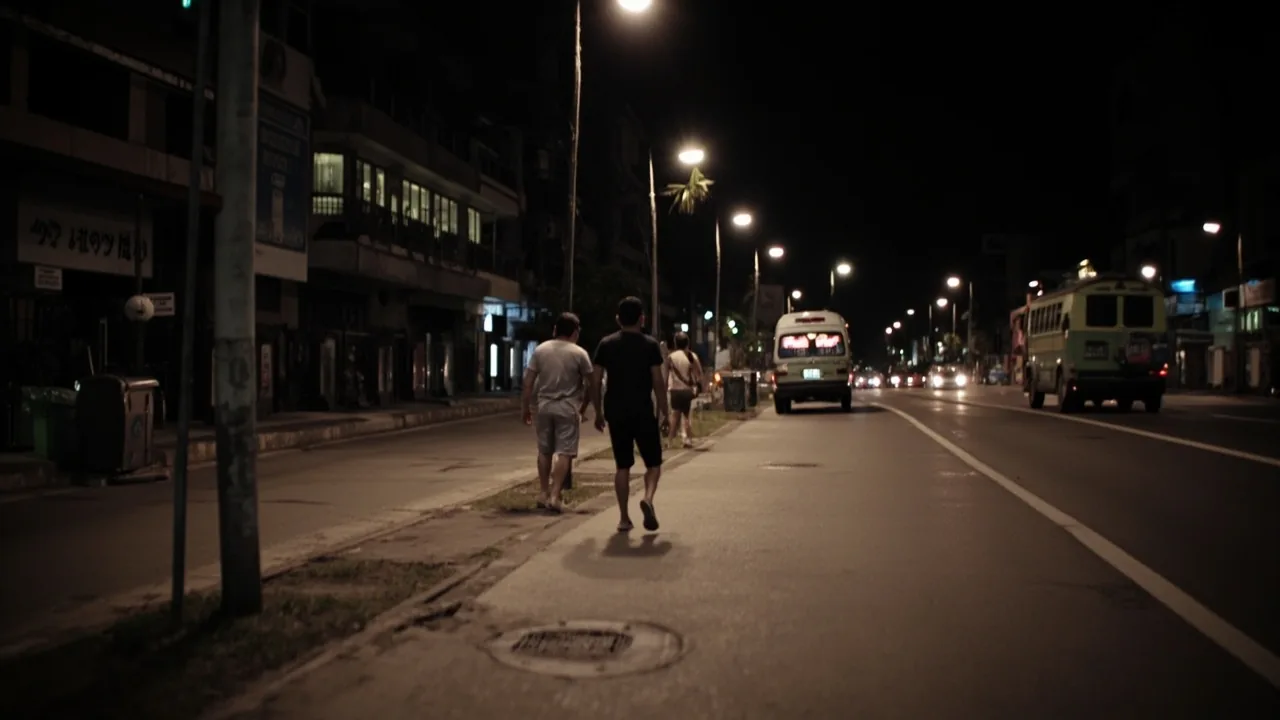
Is Manila Safe at Night? Makati, Quiapo & Baguio Bus Safety Guide for Indians
Manila is not a single city for safety purposes. Makati’s Ayala Avenue at 11 PM is a different country from Quiapo’s Quezon Boulevard at the same hour, and the overnight bus to Baguio is a third thing again. Indian backpackers arriving on a late NAIA flight, transiting through Cubao, or boarding a 22:00 bus out of Manila need to know which Manila they are stepping into before they land. This guide sorts those three Manilas out, with real scam warnings, the SIM card you should buy before leaving the airport, the Grab-vs-taxi call at midnight, and the travel insurance paperwork to keep on your phone before you board that Baguio bus. For related planning, see our guide on Sea Backpacking Hub.
The Philippines Bureau of Immigration gives Indians 30 days visa-free on arrival (extendable at any BI office for PHP 3,030 per month), and NAIA’s terminal fee of PHP 550-850 is paid separately at the airport. Both numbers are stable as of mid-2026, and the full entry checklist is on our what-to-do when travelling to Philippines page.
Quick Answers
| What | Answer | Price (INR) |
|---|---|---|
| Is Manila safe for Indians at night? | Yes in Makati/BGC, mixed in Malate, avoid Quiapo/Ermita after dark | , |
| Cheapest night transport (Grab) | Book a Grab, never a flagged airport taxi | PHP 100-300 (~₹150-450) |
| Best SIM on arrival | Globe or Smart tourist SIM at NAIA, 7 days | PHP 50 (~₹75) |
| Manila to Baguio overnight bus | Genesis/Partas, 6-7 hours, keep passport on body | PHP 700-900 (~₹1,050-1,350) |
| Travel insurance for Indian tourists | SafetyWing, ~$62/month | ~₹5,900 (~$61.24) |
The Three Manilas at Night
Manila rewards you for being specific about which district you are in. The “is it safe” question does not have a citywide answer, so here is the district-level breakdown that Indian backpackers need.
Makati and BGC: The Yes Zone
Makati (especially around Ayala Avenue, Greenbelt, and Salcedo Village) and Bonifacio Global City (BGC) are Manila’s safest pockets after dark. Well-lit, security guards at every office tower, plenty of late-night diners and convenience stores with foot traffic until 2 AM. Indian travellers land here frequently because hostels and business hotels cluster in this area, and walking back from a Greenbelt restaurant at 11 PM is normal for solo women and first-time visitors.
The honest caveat: a Grab from Makati to anywhere else after midnight still costs PHP 100-300, and it is worth every peso compared to walking the underpasses near EDSA.
Subodh’s Pro Tip: If your hostel is in Salcedo Village or BGC’s central blocks, you can walk to a 7-Eleven, Jollibee, or Korean BBQ at midnight without thinking twice. Anywhere else in Manila, default to Grab after dark.
Malate and Ermita: The Mixed Zone
Malate and Ermita (the old tourist belt near Rizal Park and the US Embassy) is a coin flip after 10 PM. The streets around Remedios Circle and Mabini Street have hostels and restaurants that are fine, but blocks further from Roxas Boulevard get quieter and rougher quickly. Travellers report the standard late-night risks here: street kids asking for money aggressively, occasional bag-snatching on the side streets off Mabini, and taxi drivers who “forget” to turn the meter on. Treat Malate the way you would treat Bangkok’s Patpong side alleys after 1 AM: fine in the main drag, do not wander.
Quiapo, Divisoria, and Tondo: The Skip Zone After Dark
Quiapo is famous for the Church of the Black Nazarene and the bargain markets on Quezon Boulevard, both worth visiting during the day. After dark, it is the part of Manila Indian backpackers should skip outside of organised transport. The same is true of Divisoria (huge market, narrow alleys, heavy pickpocketing reports) and Tondo (one of the densest urban poor districts in the world, no tourist reason to be there at any hour). If you have to visit Quiapo Church, do it before 17:00, take a jeepney to and from, and keep your wallet in your front pocket.
Safety Alert: The Philippines Embassy of India and the Department of Foreign Affairs both publish live advisories. Before you fly, check the MEA travel advisory page and the Philippine DFA advisory page for your specific dates. Conditions shift faster than guidebooks get updated.
Scams That Hit Indian Backpackers at Night
Manila’s taxi and Grab ecosystem is the main risk surface after dark, not the streets themselves. These are the four scams that show up in traveller reports consistently.
1. The NAIA “fixed price” taxi tout At NAIA terminals 1, 2, 3, and 4, men in plain shirts will approach you inside or just outside arrivals offering a “discounted” taxi to Makati, BGC, or Pasay for PHP 500-800. The metered Grab is PHP 100-300. These tout taxis are not metered, the cars are often unmarked, and your bag goes in the boot of a vehicle with no company sticker. Walk to the Grab pickup bay (well-signed at every terminal, 30-60 metres from arrivals), book through the app, and the price is locked before the driver sees your face. Full walkthrough on the Manila airport taxi scam page.
2. The “broken meter” taxi in Ermita and Malate If you do end up in a flagged yellow airport taxi, the driver will switch the meter off and claim it is broken. He will then quote you PHP 400-500 for a PHP 150 ride. Get out, take the next one, or switch to Grab mid-ride. Travellers report arguing in Tagalog works; arguing in English often makes the driver pretend not to understand.
3. The Quiapo “guide” who walks you to a closed shop In Quiapo and Divisoria, a friendly local will offer to take you to a specific camera repair shop, pharmacy, or forex counter that turns out to be closed (never existed). He then steers you to a different shop where prices are triple. Politely decline, walk to your own destination by Google Maps, and ignore anyone who insists they “know a better place.”
4. The ATM “helper” at the convenience store A bystander at a 7-Eleven or BPI ATM offers to “help” you with the foreign-card menu. He is shoulder-surfing your PIN. Cover the keypad with your free hand, refuse help, and if anyone touches the machine, cancel the transaction and find another ATM. The ATM fee comparison guide covers which Indian bank cards have the lowest withdrawal fees in the Philippines.
Manila to Baguio: The Overnight Bus Question
The Manila to Baguio overnight bus is one of the most common routes for Indian backpackers who want to escape Manila’s heat and head to the mountains. It is also the route where most “Manila at night” disasters start, because you spend the first three hours of your night in Cubao or Pasay terminal, not on the bus.
Bus operators worth booking: Genesis Transport and Partas both run evening departures from Manila (Pasay and Cubao terminals) to Baguio between 19:00 and 22:00, arriving between 02:00 and 05:00. Fare is PHP 700-900 for an air-con regular bus, PHP 1,200-1,500 for a deluxe with a wider seat and footrest. Book through 12go or directly at the terminal a day before. Do not trust anyone at the terminal offering “VIP” seats at half price.
Terminal safety at night: Cubao terminal and Pasay terminal are both busy and lit at night, but they are not safe to loiter in. Arrive 30 minutes before departure, stay inside the waiting area near the operator counter, and keep your bag on your lap, not on the floor between your feet. Travellers report petty theft is the main risk at both terminals, not violence. After you board, your bag goes in the underbus compartment only if you have a lock on it.
Safety Alert: Keep your passport on your body (a money belt under your shirt is the standard Indian-backpacker setup), not in the bag in the underbus hold. The bus to Baguio is six to seven hours, and at the 03:00 Baguio stop you do not want to find that your main bag has been unzipped.
On the bus: The overnight Manila-Baguio bus is generally safe. Take an upper berth if you can, sleep light, and keep valuables (passport, phone, cash, insurance PDF) in a daypack that stays under your head or on your lap. The bus stops once or twice at a roadside restaurant for 20 minutes. Food is overpriced; the bathroom is a squat and a bucket. PHP 50 buys you a cup of noodles and PHP 30 buys you a bottle of water, so bring PHP 200 in small notes just in case.
SIM Cards and Connectivity
You want a working data connection the second you land, before you step outside the terminal. The Grab app needs data, the Maps.me offline map needs to be loaded while you still have Wi-Fi, and the Indian Embassy emergency line needs to be reachable at midnight if anything goes wrong.
Globe and Smart tourist SIM at NAIA: Both Globe and Smart have counters inside every NAIA terminal arrivals hall, before you exit into the public area. The 7-day tourist SIM with data runs PHP 50 (~₹75), with a data add-on of roughly PHP 100 for 5 GB. This is the canonical price for both networks, and you will pay the same at the counter as at a 7-Eleven in town. Bring your passport for registration. The airport counter is faster than the queue at a city store, especially late at night.
eSIM alternative: If your phone supports eSIM and you do not want to swap physical SIMs (handy if you are also keeping an Indian Jio or Airtel SIM active for WhatsApp), an eSIM from Nomad loads before you even board your flight from India and is active the moment you land. This is the cleanest option if you are arriving at NAIA at 02:00 with no kiosk open.
Practical tip: Buy the SIM before the taxi queue. Do not queue for a taxi first and then realise you cannot book a Grab because you have no data. The airport’s free Wi-Fi works but is slow and unreliable during peak arrivals.
Getting Around Manila at Night
Transport is the safety decision in Manila after dark. Here is the practical breakdown.
Grab (the default safe choice): PHP 100-300 for most city rides, PHP 300-500 from NAIA to Makati or BGC at night. The price is locked in the app, the driver’s name and plate are recorded, and you can share the trip with a friend in real time. For Indian women travelling solo or for anyone arriving after midnight, Grab is the only answer.
Jeepneys and tricycles: Jeepneys (PHP 9-20) and tricycles (PHP 20-50) are daytime transport. They are fine within Manila’s mid-sized neighbourhoods during daylight but do not take them between districts after 21:00. The jeepney and tricycle guide covers the daytime system in detail.
Airport taxis (the fallback): Yellow airport coupons from the desk inside arrivals are legitimate and metered, PHP 500-700 to Makati. They are more expensive than Grab but useful when the Grab queue is 40 minutes long, when you have no data, or when the app is glitching. Avoid any taxi that approaches you inside the terminal without you having gone to the coupon desk first.
Common Street Mistakes Indians Make in Manila
A few patterns Indian backpackers fall into that the locals and seasoned travellers do not.
Mistake 1: Trusting touts at NAIA arrivals because they “speak good English.” English fluency does not equal legitimacy. The Grab bay is past the touts, by 30-60 metres, and it is the only counter where the price is fixed before you get in.
Mistake 2: Carrying the passport in the backpack all day. The single biggest mistake. Your passport, your travel insurance PDF, and your main cash should always be in a money belt under your shirt or in a zipped inner pocket. The backpack is the bag thieves target because it is the visible one.
Mistake 3: Treating Manila’s heat like Bangkok’s heat. Manila is two to three degrees hotter and more humid than Bangkok or Singapore. Travellers from India are used to 35-45°C, but the Manila heat combined with jeepney crowding and 90% humidity knocks people out within a day. Carry 1.5 litres of water minimum during the day, more if you are walking Ermita or Intramuros.
Mistake 4: Drinking tap water anywhere. Even at high-end Manila hotels, the tap water is not safe to drink. Use bottled water for everything, including brushing teeth if you have a sensitive stomach. The tap water safety guide goes deeper.
Mistake 5: Skipping travel insurance because “the Philippines is cheap.” The Philippines is cheap until you need a private hospital in Makati or a helicopter medevac from a provincial island. A dengue hospitalisation runs PHP 50,000-150,000 out of pocket. Travel insurance covers this for under ₹5,973 (~62 USD) a month. This is not optional, especially for the overnight Baguio bus, where the road has sharp mountain curves and accidents do happen.
Travel Insurance: The Pre-Arrival Step Most Indians Skip
Most of the safety advice in this guide assumes you are already in Manila. The single biggest safety decision you can make is the one you make in India, before you fly: buying travel insurance that covers the Philippines specifically.
For Indian backpackers, the two realistic options are:
SafetyWing Nomad Insurance: ~$62/month (~₹5,900), covers medical, emergency evacuation, trip interruption, and COVID. The standard Indian backpacker choice for Southeast Asia loops.
HDFC Ergo or ICICI Lombard travel policies: For Indians buying a domestic travel insurance policy in INR, a one-month Philippines trip runs roughly ₹1,500-₹3,500 (~$15.57-$36.33) depending on age and sum insured. The advantage is the policy is in INR and the claim is processed in India, which is faster for routine cases. The disadvantage is the medical evacuation ceiling is usually lower than SafetyWing’s $250,000 default.
Either way, you need three things in your phone before you land:
- The insurance company’s 24-hour emergency number (not the Indian landline, the international one).
- The policy PDF, saved offline, so you can show it at the hospital reception.
- The Indian Embassy Manila number: +63-2-8843-0101, and the MEA’s 24-hour emergency line in Delhi.
The full claims walkthrough is on the travel insurance claims guide.
Subodh’s Pro Tip: Buy insurance that covers “adventure activities” if you plan to scooter in Baguio or surf in Siargao. Standard medical-only policies exclude motorbike accidents, and scooter mishaps are the single biggest claim category for Indian backpackers across Southeast Asia.
Where to Eat Near Manila’s Safe Night Zones
If you are ending the night in Makati or BGC, you are sorted for food. Both districts are dense with late-night restaurants, and the food runs cheap by Indian standards.
Filipino food: Kantina Manila is the headline sisig and adobo spot in the city, with a 4.9 rating from local diners. Order the sizzling sisig (PHP 250-350) and the garlic rice. EMILIA, House of Filipino Food is a quieter alternative for kare-kare and sinigang, both classic Filipino home-style dishes. Cafe Ilang-Ilang in the Manila Hotel area is a step up in formality if you want a sit-down dinner with a varied Asian and Western menu.
Indian food and vegetarian: Royal Indian Curry House is the go-to for North Indian curries and dal-chawal in Manila. Seven Mannah Indian Fusion Food is the casual pick with chicken biryani (PHP 300-500 per person) and good vegetarian options. Flavours Indian & Mediterranean Cuisine in Bel-Air covers tikka masala and Mediterranean plates for PHP 101-500, the cheapest of the three and solid for vegetarian travellers.
For the Baguio bus stop at 03:00, buy snacks at the terminal: boiled egg and rice (PHP 50), banana (PHP 20), bottled water (PHP 30). The bus does not feed you.
Quick Pre-Departure Checklist
Before you board your flight to Manila, save this on your phone:
- NAIA terminal number (check your airline, terminals 1-4)
- Grab app installed and payment method added
- Travel insurance policy PDF saved offline
- Indian Embassy Manila number: +63-2-8843-0101
- MEA 24-hour emergency number in Delhi
- Globe or Smart eSIM purchased, or eSIM from Nomad installed
- Maps.me Manila map downloaded offline
- PHP 2,000 in cash for the first 24 hours (taxi, food, SIM if not pre-bought)
- Passport photo on phone + printed photocopy in the bag
- Hostel address written on paper, not just in the booking app
Subodh’s Take
Manila is the most underestimated first impression in Southeast Asia. Most Indian backpackers arrive expecting chaos and find that Makati at 10 PM is safer than many parts of Mumbai, that the Grab app works better than Ola, and that the food is cheap enough to recover from a long-haul flight in three meals. The trick is to learn which Manila you are in before you step outside. Stay in Makati or BGC for your first two nights, take the Grab to anywhere you have not been before, and treat Quiapo as a daytime destination with a clear exit time. The Baguio bus is safe and a wonderful way to start the rest of your Philippines route, but only if your passport and insurance paperwork are on your body, not in the underbus hold. Get the insurance before you fly, not after.
FAQ
Is Manila safe for Indian tourists at night? In Makati and BGC, yes, and these are the districts most Indian backpackers stay in anyway. In Malate and Ermita, use Grab after 22:00. In Quiapo, Divisoria, and Tondo, skip them after dark.
What is the safest area in Manila for Indians to stay? Makati (Greenbelt, Salcedo Village, Poblacion) and Bonifacio Global City (BGC) are the two safest districts for Indian travellers. Both are well-lit, guarded, and have hostels and restaurants open late.
Is the Manila to Baguio overnight bus safe? Yes, with normal precautions. Use Genesis or Partas, keep your passport on your body, and arrive 30 minutes early at the terminal. The ride is 6-7 hours, and the road is winding in the last hour, so motion sickness pills if you need them.
Should I buy travel insurance for the Philippines as an Indian tourist? Yes, mandatory in practice. A single dengue hospitalisation or scooter accident runs into five figures in PHP. SafetyWing at ~$62/month covers the basics including medical evacuation, which standard domestic Indian travel policies often cap low.
Are Indian tourists targeted for scams in Manila? No more than any other foreign traveller. The main risks are NAIA taxi touts, “broken meter” taxis in Ermita, and pickpocketing in crowded markets. None of these are India-specific.
Can I use UPI or Indian debit cards in Manila? UPI does not work in the Philippines. Indian Visa and Mastercard debit cards work at BDO, BPI, and Metrobank ATMs, with a PHP 200-250 foreign transaction fee per withdrawal. Carry PHP cash as backup.
Is Grab available 24/7 in Manila? Yes, and the price does not surge as badly as in Bangkok or Singapore. PHP 100-300 covers most city rides, PHP 300-500 from NAIA to Makati even at 03:00.
