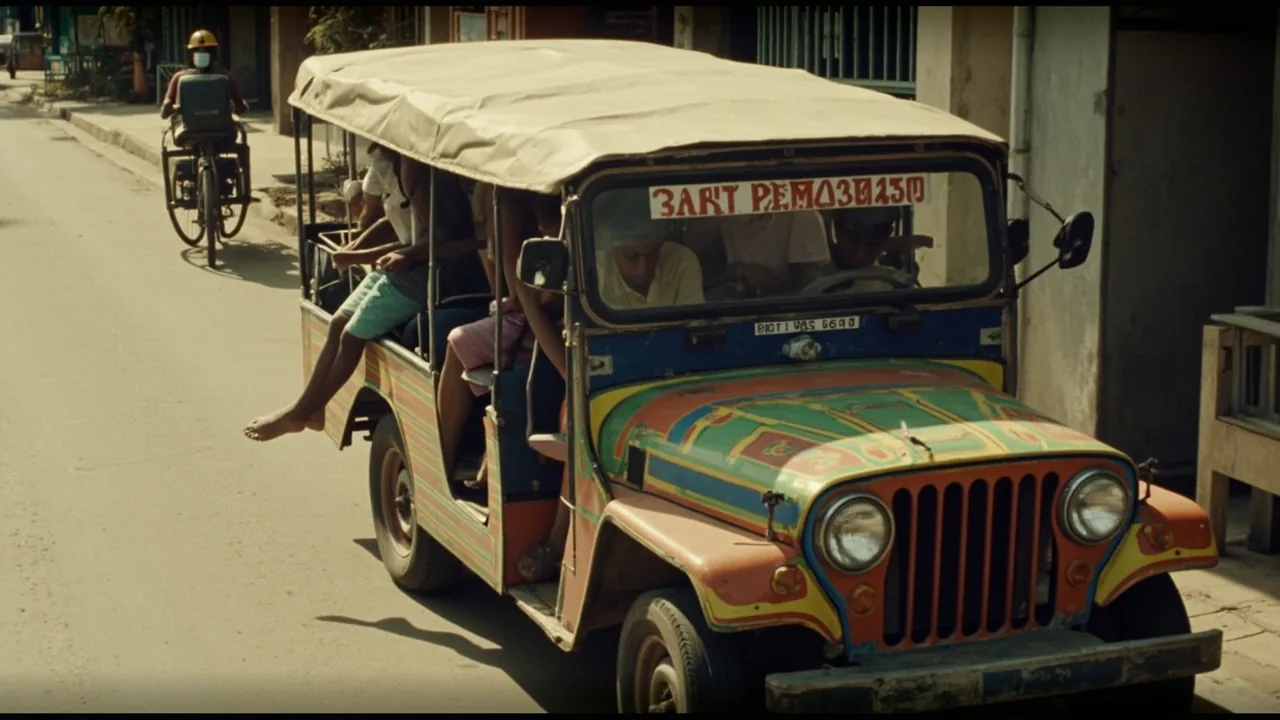
Jeepney, Tricycle & Habal-Habal in Philippines
Philippine public transport looks chaotic from the bus window, but the system underneath is simple: jeepneys for set routes, tricycles for short hops, habal-habal for steep roads, UV Express vans between cities, and Grab for emergencies. Indian backpackers usually get stuck on three questions. How do I flag down a Manila jeepney without looking like a lost foreigner? Why does the Boracay tricycle driver refuse to turn on the meter? Is it safe to climb onto the back of a habal-habal with my bag? This guide answers all three, with the actual fares, the actual scams, and the actual Filipino words you need so you don’t pay double. Planning the wider region? Our Southeast Asia backpacking hub covers the full multi-country route.
Quick Answers
| What | Answer | Price (INR) |
|---|---|---|
| Base jeepney fare (Manila, first 4 km) | PHP 13 for regular, PHP 15 for aircon | PHP 13-15 |
| Boracay tricycle short hop (Cagban port to Station 1) | PHP 20-50 per tricycle (whole vehicle, not per seat) | PHP 20-50 |
| Habal-habal single passenger (Batanes, Sagada, Baguio outer roads) | PHP 50-150 per person, fixed before mounting | PHP 50-150 |
| UV Express van Manila to Clark | PHP 350-450 one-way | PHP 350-450 |
| Grab ride within Metro Manila | PHP 100-300 depending on traffic and distance | PHP 100-300 |
Blockquote: All fares above come from the September 2026 LTFRB fare matrix and verified traveller reports from Boracay, Sagada, and Manila. Drivers will sometimes quote “tourist rates” 3-4× higher; the table shows the local-resident baseline so you know what to push back to.
The Three Vehicles in Plain English
Filipino public transport is built from three vehicle types that show up in every province. Each one has a totally different boarding ritual, payment method, and scam profile. Once you understand the three, the whole country opens up.
Jeepney is the workhorse. Colourful, rebuilt US military jeeps with two long bench seats and a roof rack for luggage. They run fixed routes with a route number painted on the side and a placard on the windshield listing every street the jeepney will pass through. You flag one down by raising your arm when it approaches, hand your PHP fare forward to the other passengers (they pass it hand-to-hand to the driver), and press a button or tap the metal roof to signal “let me off here.” Base fare in Manila is PHP 13 for a regular jeepney and PHP 15 for aircon, per the canonical transport reference. Distances over 4 km add roughly PHP 1.80 per km. Drivers don’t give change for big notes out of the jeepney’s passenger pool, so keep PHP 20s and coins ready.
Tricycle is the auto-rickshaw of the Philippines. A motorcycle with a sidecar attached, painted in loud colours, usually operating within a single barangay (village) or short hop between nearby areas. In Manila proper they’re rare on the main roads (Grab handles that), but in Boracay, Cebu City, Dumaguete, Vigan, and most provincial towns the tricycle is the default short-distance vehicle. Drivers in tourist areas often refuse meters and quote a “special” PHP 100-300 fare for what should be a PHP 20-50 hop. The trick is to ask “Bayad po?” (how much?) before you get in, and if the quote is more than double the local rate, walk to the next tricycle on the rank. There’s almost always another one.
Habal-habal is the motorcycle taxi without the sidecar. The name means “ride the back” in Cebuano, and that’s exactly what you do: you sit on the pillion behind the driver, often with no helmet, sometimes with luggage strapped to the handlebars. Habal-habal fills the gaps where jeepneys don’t run: steep mountain roads in Sagada and Banaue, island loop roads in Batanes, remote beaches outside El Nido, and rough barangay roads where tricycles can’t reach. Rates run PHP 50-150 per person on short routes, PHP 200-500 per person for half-day mountain loops. Drivers are usually registered through the local tourism office, but the bike itself is rarely in great shape. We’ll cover the safety tradeoffs in detail below.
How to Ride a Jeepney in Manila: Step by Step
Manila jeepneys look intimidating, but the ritual is the same everywhere.
- Find the route number on the jeepney’s side. Common ones: Pasig-Pateros via Ayala, Cubao-Quiapo, Divisoria-Moncada, Baclaran-Project 4. Ask any standing local “Saang jeepney po para sa [place]?” and they will point you to the corner to wait at.
- Wait on the curb side, not in the middle of the road. Jeepneys pull over to the right lane.
- When one approaches, extend your arm straight out, palm down. Driver sees you, slows down. The jeepney never fully stops; you board while it’s moving at walking pace, one foot on the back step.
- Once inside, find a seat or stand holding the overhead rail. Hand your fare to the passenger next to you, say “Bayad po” (pay please) and the destination or “Para sa [street].” Pass it forward.
- To get off, press the bell button (some have a rope), tap the metal roof twice, or shout “Para po!” (Stop here). The driver slows, you step off the back step while it’s moving.
The most common newbie mistake is handing a PHP 500 note to the passenger chain expecting change. Drivers don’t carry a float inside the jeepney; the conductor does, and he’ll hand your change back the same way the fare went in. Keep small bills and coin out: PHP 20, PHP 50, PHP 100, plus a few PHP 5 and PHP 10 coins.
A second common mistake is boarding an aircon jeepney thinking the fare is the same as a regular. Aircon routes charge PHP 15 minimum (versus PHP 13 for regular), the windows stay closed, and the driver can be more selective about stops. If you have a long ride and it’s noon, aircon is worth the extra PHP 2.
Boracay Tricycle Fares: What the Driver Won’t Tell You
Boracay introduced a fixed tricycle fare matrix in 2024 and reinforced it in early 2026. The official rates per the Boracay Tricycle Regulatory Board are:
- Single tricycle, up to 3 passengers: PHP 20-50 for one short hop (e.g., Cagban Port to Station 1)
- Single tricycle, up to 3 passengers: PHP 100 per tricycle (not per seat) for a Cagban-to-Station 3 cross-island run
- Per-person basis, 3-4 passengers sharing: PHP 50 per head for the same Cagban-to-Station 3 run
The catch: tricycles on Boracay are not allowed to use meters, so every fare is negotiated. Drivers at the Cagban Port jetty often quote PHP 200-300 for a Station 1 hop, which is 4-6× the official rate. The correct pushback: walk to the tricycle rank past the first wave, board a tricycle that already has local passengers going your way, and pay per person (PHP 50) instead of hiring the whole vehicle.
For Boracay-specific rates by zone, check our Boracay tricycle fare breakdown and our Siquijor transport guide, which covers the same tricycle bargaining culture on neighbouring islands.
Habal-Habal Safety: Honest Risk Assessment
Habal-habal is the highest-risk transport option in the Philippines, and no guide should pretend otherwise. Here’s what the data shows.
Tropical cyclone season (June-November) makes habal-habal rides riskier. The canonical source on this is the Philippines’ own PAGASA weather bureau, updated daily with storm signals. Before booking any habal-habal in Sagada, Batanes, or Banaue during monsoon months, check the signal level: Signal 1 means winds of 30-60 km/h, which is fine for short rides; Signal 2 (60-120 km/h) means cancel the trip. Our typhoon season breakdown has the month-by-month risk curve.
Driver vetting: in tourist towns (Sagada, Banaue, Batanes, El Nido, Coron), habal-habal drivers operate through a tourism office-issued ID card clipped to the mirror or printed on the vest. Ask to see it before mounting. If the driver doesn’t have one, walk. If the bike has bald tyres or no mirrors, walk. If the driver offers beer on the ride, walk.
Helmet availability: helmet law applies on habal-habal but enforcement is patchy. Drivers carry a single half-shell helmet for two passengers. A traveller who wants better protection should buy a half-shell at the nearest Ace Hardware or Decathlon outlet (PHP 400-800) before riding in mountainous areas.
Luggage handling: bags go on the handlebars, balanced across the front, or strapped across your own torso. A backpack on your back while riding pillion makes the centre of gravity unsafe; drivers will usually strap it to the front themselves. If they don’t, ask.
Daytime mountain loops in dry season (December-May) with a vetted driver are statistically safe. The accidents on record happen at night, in rain, with unlicensed drivers, or with passengers who panic mid-ride. Stay calm, keep your feet on the pegs, and lean with the driver through corners instead of against them.
Local Scams to Watch Out For
The “no change” jeepney fare scam. Driver or conductor claims he has no change for your PHP 100 note and pockets the surplus. Counter-tactic: have exact change or a PHP 20 ready. PHP 20 notes are common enough that drivers break them routinely.
Tricycle driver doubling the fare mid-ride. Driver quotes PHP 50 at pickup, then claims the destination was “across the zone” and demands PHP 100 at drop-off. Counter-tactic: agree the fare verbally before mounting. “Magkano po hanggang Station 2?” “PHP 50 po.” Once PHP 50 is agreed, that PHP 50 is paid.
Habal-habal “insurance fee.” Driver adds PHP 50-100 per passenger for “road fee” or “insurance” that does not exist. Counter-tactic: ask for the receipt. If no receipt, no fee. Official tourism office IDs have a hotline number you can text to report overcharging.
Grab surge at Manila airports. NAIA Terminals 1-3 have a Grab pick-up zone, but exit queues can be 30-45 minutes during peak hours, and drivers sometimes cancel. Manila airport taxi scam covers the pre-paid coupon system at the airport as a backup.
The full scam list for Indian travellers is in our Philippine scams guide.
Haggling & Market Etiquette
Filipino markets are gentler than Thai or Balinese ones. Bargaining is expected at sari-sari stores (tiny neighbourhood shops), public markets (palengke), and beach souvenir stalls. It’s not expected at convenience stores (7-Eleven, Ministop), fast-food chains (Jollibee, McDonald’s), or fixed-price malls (SM, Ayala).
Rule of thumb: start at 50-60% of the asking price for tourist-y items (bracelets, T-shirts, ukulele). Aim for a final 30-40% discount. For local goods (rice, fruit, fish) start within 10% of the asking price. Most of the bargaining is conversational and friendly; the worst thing you can do is go silent or walk away offended. Always smile, always say “Sige na, pre” (come on, friend), and the seller will usually fold within two rounds.
For scooter rentals (Siquijor, Boracay, Panglao), the rental is usually a fixed rate posted on the wall: PHP 350-500 per day for a 125cc automatic. No bargaining needed. Asking for a discount on safety gear like helmets (PHP 50-100) is fine. Our scooter safety tips explains what to check before riding.
SIM Cards & Connectivity
Globe and Smart both run tourist SIM packages valid for 7, 15, or 30 days. At Manila NAIA airport, the official Globe/Smart tourist counter charges PHP 50 for the SIM itself, with data add-ons of PHP 100 for 5 GB (7-day validity). This is the same price you pay in a 7-Eleven in the city, so there’s no premium at the airport. The upside of buying at the airport is that you have data the moment you land; the downside is the queue at immigration.
The data add-on model is worth understanding. The PHP 50 SIM gives you a local number but no data. You then load data via the GoSAKTO (Globe) or Giga (Smart) apps. PHP 100/5 GB / 7 days is the cheapest per-GB pack for short trips. Longer stays benefit from the PHP 300 / 25 GB / 30 days pack. Both apps accept GCash, credit card, or load from a sari-sari store.
GCash, the country’s mobile wallet, opens up once you have a Philippine number. Indian travellers can register with their passport; our GCash for foreigners guide walks through the eKYC steps in detail.
If you’d rather skip the airport counter, an eSIM from Nomad arrives before you fly, activates on landing in Manila, and includes 1-30 GB plans starting around ₹482 (~5 USD) for 7 days. Useful if your India number is on roaming and you want a backup data line.
Essential Language & Cultural Taboos
Five phrases carry you through 90% of Philippine transport encounters:
- “Bayad po” - Here is the payment / How much?
- “Saan po?” - Where (is)?
- “Para po” - Stop here (to driver/conductor)
- “Magkano po?” - How much?
- “Salamat po” - Thank you (polite form; “po” raises the politeness level)
The “po” particle is what makes Filipino politeness work. Adding it to every sentence you say to drivers, tricycle operators, and jeepney conductors signals respect, which translates into fair fares and route advice. Dropping “po” gets you charged tourist price on the next transaction.
Cultural taboos specific to jeepney/tricycle interactions:
- Don’t snap fingers to call a driver. Beckon with palm down, like hailing a jeepney itself.
- Don’t slam the door of a tricycle. The sidecar’s metal frame bends if you treat it roughly.
- Don’t photograph a jeepney driver’s face without asking. Some drivers refuse on religious grounds; a “Pwede mag-picture?” is enough.
- Pass fare with the right hand only, or both hands. Left hand alone is considered rude (it’s the hand used for hygiene).
Common Street Mistakes Indians Make
- Mistake: Carrying all cash in a single wallet. Reality: on crowded jeepneys and tricycles, pickpockets target the back pocket of tourists. Use a front cross-body pouch (PHP 150 at the Decathlon SM Aura) for daily spending; carry the bulk of your money in your hotel safe. Our street safety guide covers night-specific risks.
- Mistake: Paying a tricycle driver PHP 100 when the matrix says PHP 50. Reality: the driver pockets the surplus and you fund overcharging for the next Indian traveller. Pay the local rate, even if the driver argues.
- Mistake: Assuming the fare shown on the jeepney route placard is per-person. Reality: it is per-person, but the route listed is exact; boarding one going the wrong direction is a common Indian-traveller confusion. Confirm the route at the jeepney’s front window before flagging.
- Mistake: Drinking tap water on a long jeepney ride to avoid buying bottled. Reality: jeepney stops are every 200-300 metres, and 7-Eleven PHP 20 bottles are everywhere. Tap water in Metro Manila is officially safe (Manila Water Concessionaires treats to Philippine National Standards), but most locals drink bottled, and our tap water analysis suggests you do the same.
- Mistake: Losing your temper publicly when scammed. Reality: Filipino culture is non-confrontational. Yelling at a jeepney driver or tricycle operator causes bystanders to side with the local, not the foreigner. Walk away, note the jeepney number, and report to the LTFRB hotline 1342 if it’s egregious.
FAQ
Is it safe to ride a habal-habal with luggage? For daytime mountain rides with a registered driver, yes. Bags strap to the front handlebars or across your torso. Avoid habal-habal at night, in rain, or with unlicensed drivers; these are the conditions where most accidents happen.
Do jeepneys run 24/7 in Manila? Major Manila routes run from roughly 5 AM to 11 PM. After 11 PM, only UV Express vans, point-to-point buses (P2P), and Grab are options. There are no overnight jeepneys.
Can I use Indian UPI to pay jeepney or tricycle fares? No. Jeeps, tricycles, and habal-habal are cash-only. Carry small PHP notes. For intercity buses, UV Express vans (PHP 350-450 Manila to Clark, for example), and Aircon shuttle vans, GCash is increasingly accepted. GCash setup takes 10 minutes if you have a Philippine SIM.
What if I leave a bag on a jeepney? Report it to the LTFRB hotline (1342 in Metro Manila) with the route number, time boarded, and your contact number. Bags left on jeepneys are usually handed in at the route’s terminal, and drivers keep a small “found items” log. Recovery rate is decent because jeepneys run on the same route every day.
Should I tip jeepney or tricycle drivers? Tipping is not expected. Drivers are not paid by the hour; they earn based on passenger count, so adding a tip isn’t part of the culture. If a driver went out of their way (took a detour to drop you at a hotel entrance in a jeepney-only area), rounding up to the next PHP 10 is a kind gesture.
Are Grab and Angkas safer than habal-habal? For city rides, yes. Angkas is a motorcycle-taxi app (habal-habal with a registered driver, helmet, and insurance). PHP 60-150 for a Manila short trip, more transparent than street habal-habal. For mountain routes, neither operates; you need the local habal-habal there.
Subodh’s Take
Filipino public transport is one of the warmest in Southeast Asia once you crack the entry-level awkwardness. Drivers will help you find your seat, passengers will pass your fare forward with a “Sigan na, kuya” (hold on, brother), and a polite “po” alone saves you from 80% of the overcharging tourists complain about. Don’t try to improve everything with Grab; the jeepney is half the country’s soul, and the tricycle drivers remember the regulars. Show up with small bills, two phrases of Tagalog, and a backpack light enough to ride pillion. The rest sorts itself out.
