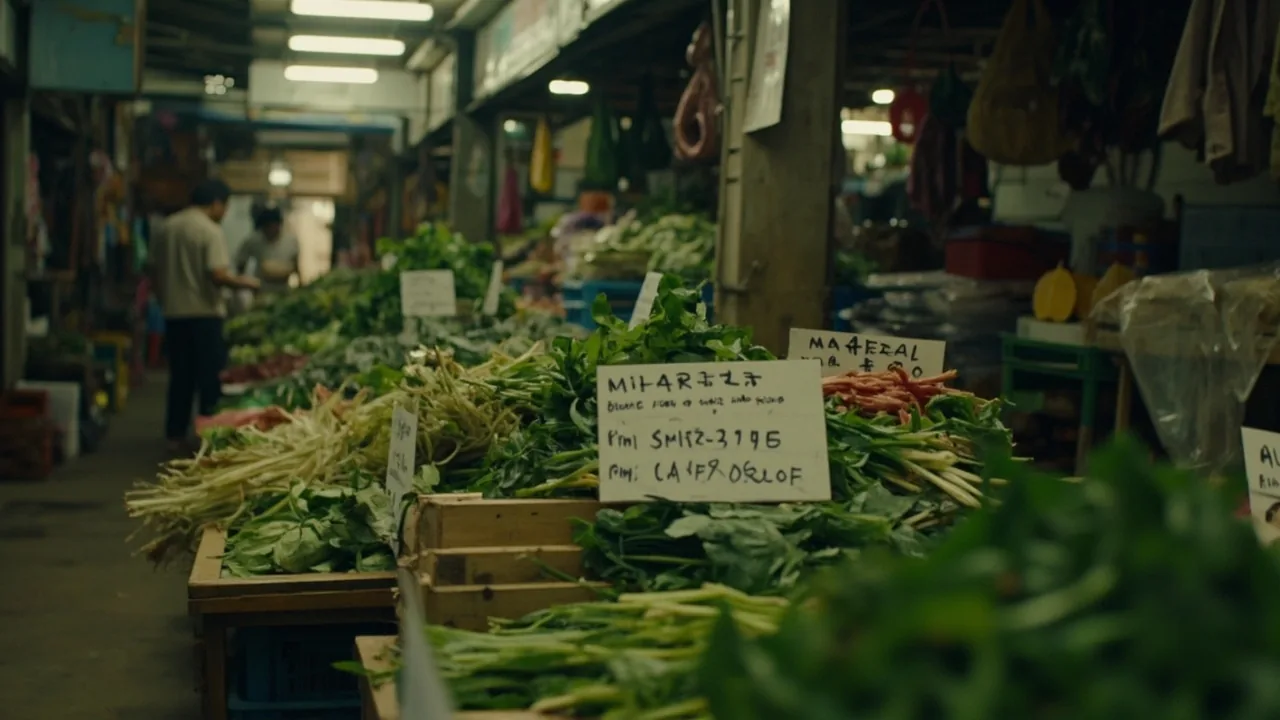
Myanmar Vegetable Markets: A Backpacker’s Guide to Fresh Produce and Local Bargains (2026)
Myanmar’s morning markets are where the country eats. For backpackers, they are the cheapest, freshest source of produce and a chance to eat the way Burmese families do. This guide covers where to go, what to buy, how to bargain in MMK, and what to try on the spot. See our Sea Backpacking Hub for regional planning.
What Is a Myanmar Vegetable Market?
A Myanmar vegetable market is a covered, often single-storey wholesale-and-retail hall where farmers, traders, and shoppers meet before 9 a.m. Vendors lay produce directly on the ground or on low wooden platforms, weighed on brass scales with hand weights, paid for in Myanmar Kyat (MMK) cash. The biggest markets (Yangon’s Thiri Mingalar, Mandalay’s Zay Cho) function as both the national distribution hub for the surrounding region and a daily grocery run for households. You may also find Jain Food Guide for Backpackers Complete Vegetarian Rules Allowed Avoided Foods India Se Asia useful for this trip.
Quick Answers
| What | Answer | Price (INR) |
|---|---|---|
| Main hub | Yangon Thiri Mingalar Market | , |
| Where to bargain | Anywhere except supermarkets and chain cafés | , |
| Currency | Myanmar Kyat (MMK) | 1 MMK ≈ ₹0.05 at current rates |
| Cash only? | Yes, for vendors | Carry clean small notes |
| Best time to go | 5:30 to 8:00 a.m. | Vendors wind down by 10 a.m. |
| Bargaining discount | 10 to 30 percent off first quote | Be polite, smile, walk away once |
| What to try fresh | Mango, pomelo, watermelon, pennywort, eggplant | , |
| SIM card at airport | MPT/Ooredoo 7-day tourist SIM, 5 GB data | $3 USD (~₹250) |
“1 MMK ≈ ₹0.05 at current rates” is the headline number. A 1,000 MMK bunch of greens is about ₹48 (~$0.50). A 5,000 MMK fruit haul is roughly ₹240 (~$2.49). See also: Best Vegetarian Restaurants in Southeast Asia S Top Cities a City By City Guide for Indian Backpackers.
Step-by-Step: How to Use a Myanmar Vegetable Market
1. Get your SIM and cash sorted before market day
Markets are cash-only, in MMK, and vendors cannot break large notes cleanly. The cheapest way to get MMK is to bring clean, unmarked USD bills (any crease or stamp gets refused) and exchange at a Yangon or Mandalay moneychanger, not the airport. Airport rates run 5 to 8 percent worse than town. The MPT/Ooredoo 7-day tourist SIM at Yangon airport costs ₹289 (~3 USD) for about 5 GB of data, enough for Grab, Google Maps, and translation apps for a week. ESIM support is limited in Myanmar, so Get Nomad eSIM works as a backup data line for unlocked phones but expect to fall back to a local physical SIM if your device does not register. For related planning, see our guide on Cooking Class Guides By City How to Find the Best Chef Led Cookery Classes for Travelers.
2. Arrive before 7 a.m.
Markets are a sunrise business. By 8:30 a.m., the wholesale trucks have left, the best produce is gone, and the heat sets in. Plan your morning around it: stay within walking distance the night before, set an alarm, bring a tote bag and a small bottle of water.
3. Walk the perimeter once before buying
Every Myanmar market has the same rough layout: dry goods and pulses at the entrance, vegetables and leafy greens in the middle, fruit and flowers toward the back, and the wet/meat section in a separate corner. Walk the full loop first. Prices for the same tomato can vary by 15 to 20 percent between stalls, and the cheapest stall is rarely at the front entrance.
4. Bargain the Myanmar way: smile, ask, walk
The standard technique works in Myanmar too, with two small adjustments. First, vendors expect a back-and-forth only on whole-bunch quantities, not on a single mango. Second, the polite end of a negotiation is a small laugh and a thank you, not a hard no. A 10 to 20 percent discount is normal on vegetables, 20 to 30 percent on larger fruit baskets if you are buying in volume. If the vendor says no, accept it; many quoted prices are already close to wholesale. For more general haggling tactics across the region, see our Haggling Guide: Street-Smart Negotiation Tactics for Southeast Asia Markets.
Subodh’s Pro Tip: Hold your wallet, not your phone, when paying. Phone-wallet scams (a vendor palming your phone while you fish for cash) are rare but have been reported at crowded stalls in Mandalay’s Zay Cho market. Keep the phone in your front pocket until you walk out.
5. Eat on the spot or in the hostel
Most Myanmar markets have a tea-leaf salad vendor, a mohinga (fish noodle soup) stall, and a fried-snack corner within the same building. Eat what is hot and being served fast. Anything raw you buy, wash under bottled water or peel it. Stick to cooked market food for your first three or four days.
6. Cross-check weights and prices
Brass scales in Myanmar are honest by tradition, but the weights used (often marked only in Burmese numerals) can confuse tourists. If you buy by the viss (a traditional unit, about 1.6 kg), ask the vendor to write the kg equivalent on a scrap of paper. A 1 kg bag of tomatoes should run between 1,500 and 3,000 MMK depending on season.
Common Mistakes Indians Make
Mistake 1: Bringing torn, creased, or marked USD notes
Myanmar’s exchange offices refuse any USD note that has a fold, a stamp, a tear, an ink mark, or even a slight crease along the short edge. The reason is that Myanmar’s central bank has rejected several series, and changers won’t take the risk. Bring pristine ₹4,817 (~50 USD) and ₹9,634 (~100 USD) bills from a fresh ATM withdrawal or forex card cash pickup, not the worn notes from a wedding season gift envelope.
Mistake 2: Bargaining too aggressively on small quantities
A 500 MMK discount on a single bunch of greens is not a win, it is an insult. Burmese vendors will often refuse to sell rather than lose face over a few dozen rupees. Save bargaining for 5,000 MMK+ purchases, and you will be offered better prices on smaller items the next morning as a regular customer.
Mistake 3: Treating vendors like a tourist attraction
The morning market is a working space. Do not block aisles, do not photograph vendors up close without asking, and do not lean over the produce to point. Step aside, ask, and the market becomes a friendly place fast.
Mistake 4: Carrying large notes for small purchases
A 50,000 MMK note for a 2,000 MMK bunch of coriander means the vendor has to disappear for change, and you may end up overpaying while they “round up” the math. Bring a small stack of 1,000 and 5,000 MMK notes.
Mistake 5: Eating raw market food the first week
Raw salads and cut fruit sold open-air are the single most common cause of the classic Myanmar traveller stomach. Mohinga and tea-leaf salads from a busy stall are fine; pre-cut watermelon from a quiet corner is not, at least for the first few days.
What Most Guides Don’t Tell You
Edge case 1: Markets close on full-moon and new-moon days
Many traditional markets scale down operations or close entirely on Buddhist holy days, which fall on the full moon and new moon of each lunar month. Check the local calendar before planning a market-heavy morning. Vendors will be back the next day but with a smaller stock.
Edge case 2: The “tourist rate” is real, but softens fast
First-time foreigners are routinely quoted 30 to 50 percent above the local price on fruit baskets and packaged goods. Two things help. Returning to the same stall two or three days in a row shifts you into “regular” status quickly. And pointing at the produce and asking “ta-ka-yo be-lay?” (how much?) in Burmese, however mangled, drops the first quote by 10 to 15 percent immediately.
Edge case 3: Visa and safety situation changes fast
The Myanmar e-Visa is the only reliable option, and VoA is suspended. The official ₹4,817 (~50 USD) fee, 28-day max stay, and single-entry terms apply, applied at https://evisa.moip.gov.mm. Beyond logistics, the broader safety and travel-advisory picture has shifted multiple times since 2024, with some border regions seeing periodic tension and a few flights intermittently suspended. Before you book, check the Indian MEA travel advisory for Myanmar (mea.gov.in) and your airline’s route status. Do not assume last year’s route is still operating this month.
What to Eat (and Buy) at the Market
Vegetables and herbs worth picking up
Pennywort (mynahk), garlic chives, coriander, Thai basil, eggplant (the small round Burmese variety), okra, tomatoes, and yard-long beans are the staples. They appear in nearly every Burmese soup and salad. A mixed bunch of daily greens for two costs 1,500 to 3,000 MMK.
Fruits in season
Mango season runs March to June. Pomelo is best October to December. Watermelon is available year-round and ridiculously cheap in the dry months. A whole pomelo for 3,000 MMK, a kilo of mangoes for 2,500 to 4,000 MMK, a five-kilo watermelon for 6,000 to 8,000 MMK are reasonable market rates.
Snacks to eat on the spot
Tea-leaf salad (lahpet thoke), mohinga from the in-market stall, fried chickpea fritters, and samosa-style Burmese patties. Anywhere from 500 to 2,000 MMK per portion. Bring cash, sit on the shared benches, and eat with your hands or a shared spoon.
Where to Stay (and Eat) Around the Markets
Markets are spread across Yangon and Mandalay, so most backpacker hostels and the city centres themselves are a short ride away. In Yangon, the area around Thiri Mingalar Market has several budget stays within walking distance. In Mandalay, Zay Cho market sits close to the budget accommodation cluster east of the Royal Palace.
A few Indian-friendly and vegetarian-friendly food spots worth knowing about if you want a break from market cooking, all of which appear in this article’s shortlist:
- The Moon Vegetarian Restaurant (rating 4.4): a charming vegetarian spot, useful for a dal-rice or paneer-style break between market mornings.
- Unique Mandalay Tea Room (rating 4.2): a local tea room for light snacks, brewed Burmese tea, and a quiet sit-down.
- Izakaya AKIMOMI Mandalay Branch (rating 5): not a market stall but a casual Japanese-leaning spot in Mandalay for a sit-down meal with vegetarian options.
For traditional Burmese restaurant meals around market days, the shortlist also includes Unique Myanmar Restaurant (rating 4.2), ရွှေမြန်မာထမင်းဆိုင်(၁) ShweMyanmar(1) (rating 4.2), Aung Thu Kha Traditional Myanmar Food House (rating 4.2), Kyal Sin Thit (rating 4.7), and Elodie Restaurant (rating 4.6), all of which serve straightforward local dishes.
Subodh’s Take
A Myanmar market at sunrise is one of the best food shows in Southeast Asia, and the price is right. Bring clean USD, get small MMK notes, show up early, bargain lightly, and eat the cooked stuff on the spot. The biggest mistake is treating it as a tourist detour instead of your actual breakfast plan for the week.
FAQ
What is the best Myanmar vegetable market to visit?
Yangon’s Thiri Mingalar Market is the largest and most varied. Mandalay’s Zay Cho market is the best for dried goods, pulses, and Shan State produce. Both are open daily before dawn.
Can Indian travellers bargain in Myanmar markets?
Yes, politely, and only on whole-bunch or volume purchases. Vendors respect a friendly walk-away more than a hard counter-offer.
Is bargaining at Myanmar markets different from Thailand or Vietnam?
It is softer and more relationship-based. Regulars get the best prices. Newcomers pay the posted rate for small purchases, which is usually only 5 to 15 percent above wholesale.
Do Myanmar markets accept cards or apps?
No. Cash only, in MMK. Some larger wholesale stalls accept KBZPay mobile transfers, but for backpackers cash is the rule.
What fruits should I try in Myanmar markets?
Mangoes in summer, pomelo in winter, watermelon year-round. Star fruit, custard apple, and the small green oranges that appear in November are also worth a try.
Is Myanmar safe to visit right now?
The MEA advisory for Myanmar has shifted several times since 2024. Check mea.gov.in before booking, and confirm your specific flight or land border route is operating. The e-Visa is the only reliable entry method.
Should I buy SIM at the airport or in town?
At the airport, if you land before 9 p.m. MPT/Ooredoo 7-day SIMs at the counter cost ₹289 (~3 USD) and save you the hassle of hunting a SIM shop on day one.
