Pchum Ben Festival in Cambodia: Dates, Meaning & How to Experience It
If you time your Cambodia trip wrong, you’ll land in a country with skeleton bus schedules, restricted alcohol sales, and markets near every wat heaving with families. That’s Pchum Ben, and understanding it gives you a deeper trip than ten temples and a Pub Street crawl. See our SEA Backpacking Hub for the full festival calendar.
Quick Answers
| What | Answer | Price (INR) |
|---|---|---|
| When is Pchum Ben 2026? | 14-16 October 2026 (public holiday); full 15-day ceremony runs roughly 3-17 October | ₹0 |
| How many days is Pchum Ben? | 15 days (15 Robos), but only the last 3 are public holidays | ₹0 |
| Is alcohol sold during Pchum Ben? | Restricted in most provinces during the final 3 days; some tourist bars in Phnom Penh still serve | ₹0 |
| Do I need a visa just to be in Cambodia for Pchum Ben? | Yes, standard visa-on-arrival ₹2,892 (~30 USD) | ₹2,892 (~$30) |
What Pchum Ben Means
The name translates roughly to “gathering” or “mass” (Ben) of the “offering” (Pchum). It’s a fifteen-day Theravada Buddhist ceremony rooted in the ancient belief that the souls of dead relatives wander in a lower plane called Bavet Barami for a full year after death. Seven gates lock them in, broken open only on Pchum Ben, when monks from every Khmer wat throw a rope of merit to pull them out.
The symbolism is gruesome in the source texts and gentle in practice. Cambodians believe that if you skip the offering, your ancestor’s ghost will haunt your home, curse your family, or cause illness. If you feed them, they are released from suffering, they reach a better rebirth, and your own karma improves. The Khmer Rouge tried to ban the festival during 1975-79, executions over Pchum Ben observance have been documented in the Tuol Sleng archives, and the modern revival is treated as both religious duty and quiet political act.
The phrase you’ll hear everywhere from late August onward is “bay ben”. That’s “to make the offering.” You’ll see it on banners over restaurants, painted on tuk-tuks, embroidered on t-shirts sold at markets.
The 15-Day Calendar (Robos)
The festival splits into fifteen separate ceremonies called Robos, each tied to a different category of dead. Most Cambodian families attend at least four. The full sequence:
- Robos 1-7 (early period): Offerings for relatives who died violently or by accident.
- Robos 8-13 (middle period): Offerings for relatives who died of illness or old age.
- Robos 14-15 (peak, public holidays): Offerings for monks, teachers, and patrons. Most important for attendance.
Subodh’s Pro Tip: The 15th and final day is Ben Thom, “great offering day.” Aim to be at a wat on this day or the day before. The chanting, the food piles, and the candle procession are at their peak, and most local families are physically present.
You don’t need to attend every day. Aim for the public holiday window. That’s when the ceremony is at full scale.
Pchum Ben 2025 vs 2026: Exact Dates
| Year | Public Holidays (3 days) | Full Festival Window |
|---|---|---|
| 2025 | 5-7 October 2025 | roughly 21 September - 5 October 2025 |
| 2026 | 14-16 October 2026 | roughly 3 October - 17 October 2026 |
These dates shift every year because the festival follows the lunar Khmer calendar, not a fixed Gregorian schedule. The Royal Government announces the exact public holidays each September through the Ministry of Culture. Always re-check in the month before you fly.
What You’ll See at a Wat
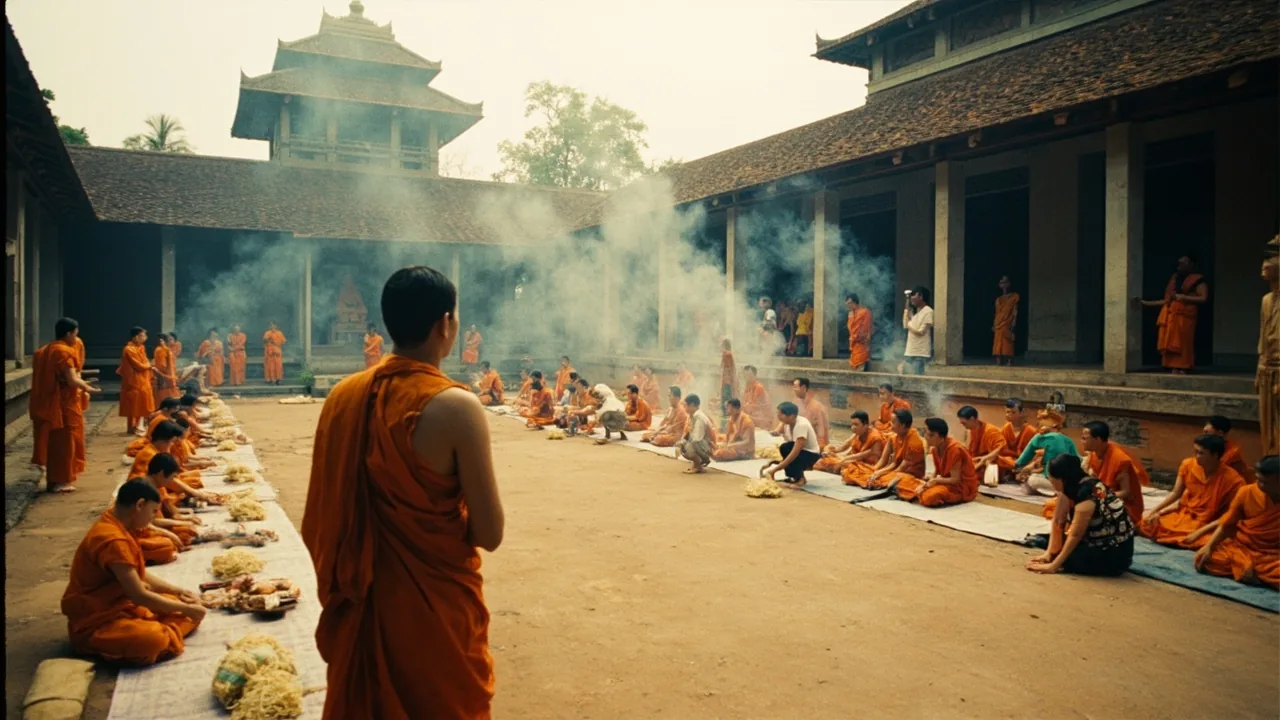
Picture a long Khmer wooden hall lined with monks in saffron robes. Outside, a low wooden table with seven stacked tiers, each loaded with rice, bananas, sticky rice cakes (num ansom wrapped in banana leaves), and small mounds of cooked sticky rice shaped into cones the size of your fist. The number of tiers matters: seven tiers represent the seven gates of Bavet Barami in traditional accounts.
Families sit cross-legged on mats, candles flickering, the air thick with incense. A senior monk chants from a Pali-language sutra translated into Khmer. The chant has a low, hypnotic drone. Then a family member stands and walks around the table three times clockwise, scattering marigold petals, dropping tiny sesame seeds onto small banana-leaf bowls, and laying a single stick of incense at each tier.
The act of feeding the dead is the literal translation. The food is later given to the monks. The sesame seed trick is the magic: each seed is one specific ancestor, and a clean bowl means you remembered them all.
Subodh’s Pro Tip: Bring your own small pack of marigolds, a few sticks of incense, and a bag of sesame seeds if you want to participate. Vendors sell these outside every wat for around 5,000 KHR (~₹120 or ~$1.24). You don’t need to convert, just hand them the notes. The monks won’t accept cash for the ceremony, but the offerings are the point.
How to Respectfully Attend as a Traveller
The first rule: do not wear shorts above the knee, no shoes inside the hall, no hat, no pointy shoes toward the Buddha image, no photos of monks while chanting.
The second rule: ask before you photograph any family. Most Khmer families are honoured that you came. Some will refuse. Some will invite you to share the sticky rice. Accept. Smiling and bowing with hands together (sampeah) goes further than any phrasebook.
A small gift that travels well: a bag of sesame seeds (for sale at most wats for around ₹95 (~4,000 KHR or ~$0.99)), bananas, or a packet of incense. Don’t bring meat. Don’t bring alcohol.
The afternoon of Ben Thom often features large-scale monk gatherings at major wats. Hundreds of monks from nearby temples line up to accept offerings in bulk, and the scale of the chanting and food distribution is impressive. Many Cambodians travel to their city’s largest wat for this part of the ceremony.
Safety Alert: During Pchum Ben, traffic in Phnom Penh and Siem Reap becomes chaotic. Tuk-tuks ignore lanes. Motorbikes carry entire families on one bike. Cross the road with the same instinct you would in Hanoi: walk slowly, never stop, let the traffic flow around you.
Where to Witness It: Best Locations
Wat Phnom, Phnom Penh. The hilltop wat in the centre of the capital is the most accessible viewing spot. Surrounding streets close to vehicles. Local families stream in from early morning. The walk up the steps is itself a small pilgrimage.
Any wat, anywhere. Every Khmer village has at least one temple, and every temple is open to respectful visitors during Pchum Ben. Don’t feel you have to be at a famous wat. The smallest wats often give the most intimate experience.
Where to Stay During the Festival
Accommodation in Siem Reap and Phnom Penh gets booked out around the public holiday window, especially the dorm beds catering to backpackers. Phnom Penh and Siem Reap have the densest supply.
Use Phnom Penh hostel listings and Siem Reap hostel listings to browse options. Both cities follow the canonical Cambodia dorm range of ₹482-₹1,157 (~5-12 USD) per night in a shared dorm, which gets tight as families travel to be near their ancestral temples.
Where to Eat During the Festival
After a morning at the wat, food options near Phnom Penh’s temple district include ហាងបាញ់ឆែវនីននីន Bahn Chao Nininin for Khmer dishes, អាហារដ្ឋាន/កាហ្វេ បាកាន-Bakan Restaurant & Coffee for a quick bite, and Koundomrey farm café for a relaxed meal. For Indian food, there is a basic Indian Restaurant in the area, or head to Poipet for Saffron Indian Restaurant Poipet and Galaxy Indian Restaurant,Poipet if you’re crossing the border from Thailand.
Subodh’s Pro Tip: Book at least two months out for late September travel to mid October. During the public holiday window, dorm beds in Siem Reap tend toward the upper end of the range. Last-minute walk-ins during Pchum Ben are usually disappointing.
Getting Around During Pchum Ben
Most inter-city bus services either reduce frequency or suspend entirely during the three public holiday days, with the heaviest disruption on the final day (Ben Thom). Within the last week of the festival, especially the day before and the day of Ben Thom, expect near-empty departures for outbound buses and sold-out bookings for return trips.
The Phnom Penh to Siem Reap route runs between ₹771-₹1,446 (~8-15 USD) under normal conditions. During the holiday window that range can climb toward the upper end, with most operators suspending service on day 14. Verify schedule directly with Giant Ibis, Mekong Express, or the operator you’re using. The standard cross-border bus from Bangkok to Siem Reap is the most disrupted route: many operators block tickets during the festival because border queues on the return leg can be significantly longer than usual.
Tuk-tuks within city centres become scarcer because drivers also go home for the festival. Plan to walk the final kilometre if you’re staying outside the city core.
What Happens to Tourists
A common Indian backpacker question: “Will tourists be allowed in? Will it be safe?”
Yes, and yes. Cambodia is proudly Buddhist, and tourists are welcome. Pchum Ben is not a protest. It’s a family event with deep religious roots. As long as you dress modestly, remove your shoes, don’t point feet at Buddha imagery, and let the family take the lead, you’re a welcome guest.
The only “rule” tourists run into is alcohol. Most provinces restrict alcohol sales during the final three days. In Phnom Penh and Siem Reap, tourist bar zones like Pub Street usually still serve, but stock is limited, so expect your favourite brand to be out of stock on Ben Thom.
Pchum Ben vs Other Cambodia Festivals
Pchum Ben falls in late September or early October, about six months after Khmer New Year in April. They’re the two most important Cambodian festivals. They differ sharply in energy:
- Khmer New Year is a water-throwing, party-in-the-street celebration. Loud, public, chaotic.
- Pchum Ben is a quiet, family-oriented memorial. Indoor, candle-lit, repetitive chanting.
If you only have time for one, picking Pchum Ben gives you a more authentic slice of Khmer life. Khmer New Year gives you a more spectacular photo album.
Practical Tips for Your Cambodia Trip in October
October is also the tail of the rainy season. Expect short tropical downpours in the morning, clearer skies by afternoon. Temperatures stay hot, around 27-32°C. Pack for rain, a long-sleeved modest layer for temples, and slip-on shoes for wats.
If you’re crossing the border from Bangkok to Siem Reap for the festival, allow at least an extra day on each side of the border for delays. The full month-to-month weather and crowd breakdown is in our best time to visit Cambodia guide.
A Short, Honest History
The festival has pre-Angkorian roots. The Preah Bot, a 14th-century stone inscription from the time of King Jayavarman VIII, describes elaborate food offerings to ancestors at dedicated temple spaces. Over Khmer Empire and French colonial periods the ceremony got formalized into the 15-day structure most Cambodian families follow today.
The Pol Pot years saw Pchum Ben banned. The Khmer Rouge viewed Buddhist ceremony as counter-revolutionary. Public observance was forbidden, executions were used as examples, and an entire generation of Cambodians lost the family members who would have taught them the chanting. The 1980s and 90s saw a quiet revival, partly through monks who had survived the genocide in Thailand refugee camps teaching younger Cambodians the layout of the offering tables from memory.
Today Pchum Ben is part national memory, part religious revival, part simple family reunion. Attending means standing in a tradition that almost got erased.
Subodh’s Take
If you’re doing a Cambodia trip and your dates are flexible, move Pchum Ben to the top of the list. Khmer New Year gets all the social media attention, but Pchum Ben is the festival that tells you what Cambodian families care about. The candle light, the sesame seed pile, the chanting of monks in saffron robes filling the hall: that’s the country. Spend one evening at a wat, don’t take photos of the chanting, accept the sticky rice when someone offers it, and you’ll understand Cambodia in a way the guidebook can’t deliver.
FAQ
When exactly is Pchum Ben 2026? 14-16 October 2026 are the public holidays. The full 15-day ceremony starts around 3 October and finishes on 17 October. Re-check the Ministry of Culture calendar in September for any royal decree adjustments.
Is Pchum Ben the same as the Day of the Dead? Only in the basic “honour your ancestors” idea. The Mexican Day of the Dead is a Catholic-rooted harvest festival with sugar skulls. Pchum Ben is a Theravada Buddhist ritual with monks, chanting, food offerings, and sesame seeds. They share a theme but not an origin.
Can I take photos at the wat? Outside and around the offering area, yes. Inside the chanting hall, no, not during the chant. Ask the family next to you before photographing them. Even better: ask the monk if a foreign visitor can take a single photograph to remember the day.
Will my bus still run? Most inter-city buses suspend service during the three public holiday days, with the heaviest disruption on the last day. Plan around the day before or the day after. For Phnom Penh-Siem Reap service, see our Cambodia budget guide.
Is alcohol banned? Effectively, yes, in most provinces during the last three days. Tourist bars in central Phnom Penh and Siem Reap usually still serve, but stock is low. In practice, even in tourist bar zones like Pub Street, expect limited stock on Ben Thom.
Do I need a Cambodia visa to attend? Yes, normal visa rules. Indian passport holders can get a ₹2,892 (~30 USD) visa-on-arrival on arrival at any international airport or get an e-visa online for ₹3,471 (~36 USD) via evisa.gov.kh. Both give 30 days single entry. Verify current rules in our Cambodia visa guide.
Where should I stay in Siem Reap? Book a hostel at least two months out. Standard dorm beds are ₹482-₹1,157 (~5-12 USD) per night; expect the upper end during Pchum Ben. Top picks live in the Siem Reap section.
- Subodh
