Philippines Street Food Safety for Indian Travelers (2026 Guide)
Filipino street food is, honestly, one of the gentlest introductions to Southeast Asian eating for Indian travelers. The flavours sit closer to what you already know than Thai or Vietnamese food do: more vinegar, more garlic, less raw herbs, less fish sauce punched raw into everything. That said, “gentler” does not mean “risk-free,” and the rules that keep you out of a Cebu clinic are the same ones that keep a Mumbaikar safe in Mumbai during monsoon, just applied to a different kitchen. This guide is written from research cross-checked against the Philippines Department of Health advisories and traveller reports from May and June 2026. Planning the wider region? Our Southeast Asia backpacking hub covers the full multi-country route.
If you want the bottom line before we get into the detail: cooked, hot, busy-stall Filipino food is mostly safe. Cold pre-cut fruit from a street cart and dodgy ice are where most Indian stomachs get hit. Balut is fine for most people but the texture alone floors some travellers; it is not a hygiene risk so much as a willpower test.
Quick Answers
| What | Answer | Price (INR) |
|---|---|---|
| Is tap water safe in the Philippines? | No. Use bottled or filtered. | ₹34-₹84 (~20-50 PHP or ~$0.36-$0.89) per litre |
| Can I eat at a Filipino street stall? | Yes, if the food is cooked in front of you and the stall is busy. | ₹51-₹168 (~30-100 PHP or ~$0.53-$1.78) per item |
| Is balut safe to eat? | Yes, fully cooked. Skip if you are pregnant or immunocompromised. | ₹42-₹84 (~25-50 PHP or ~$0.44-$0.89) per egg |
| Are squid balls safe? | Yes, when fried fresh. Reheated balls are the common cause of stomach issues. | ₹17-₹34 (~10-20 PHP or ~$0.18-$0.36) per stick |
| Is fruit safe from street carts? | Only if you peel it yourself (banana, mango, pineapple). | ₹51-₹101 (~30-60 PHP or ~$0.53-$1.07) per portion |
Price note: the PHP figures above are what travellers report paying in 2026 at typical Manila, Cebu, and Baguio stalls. The FX rate used in this article is 1 PHP ≈ ₹1.50 (1 INR ≈ 0.667 PHP), verified against the live rate on 2026-07-17.
The Real Risks (What to Worry About)
| Risk | Likelihood | Impact | How to Avoid |
|---|---|---|---|
| Traveller’s diarrhoea (E. Coli, etc.) | Moderate | Low to medium | Bottled water only, busy stalls, no ice unless from a sealed tube |
| Ice from open-top coolers | High in tourist areas | Low to medium | Ask for “no ice” or check the ice shape: tube ice is filtered, hollow ice is risky |
| Pre-cut fruit left in heat | Moderate | Low | Eat only fruit you peel yourself |
| Undercooked seafood (kinilaw) | Low at stalls, moderate at home kitchens | Medium | Skip raw preparations at uncertified spots |
| Reused cooking oil | Moderate | Low | Stalls with high turnover use fresh oil; empty stalls reuse it |
| Heavy oil + spice combo upsetting a sensitive stomach | Moderate | Low | Start mild, build up over 3 to 4 days |
| Allergic reaction to shellfish or peanut | Low | High | Carry antihistamines, especially if you have any prior reaction |
| Hepatitis A (from contaminated water/ice) | Low if vaccinated | High | Get the Hep A vaccine at least 2 weeks before flying |
| Typhoid | Low | High | Vaccine recommended; avoid raw vegetables washed in tap water |
The table above is ranked by what Indian travellers report, not by what sounds dramatic online. If you take only one thing from it, take the “no hollow ice, only tube ice” rule. That single habit is what separates the travellers who finish their trip fine from the ones spending day three in a Manila mall food court eating plain rice.
The Filipino Street Foods That Are Usually Safe
Let me walk you through the typical options a hungry Indian backpacker will encounter, and what to think about each one.
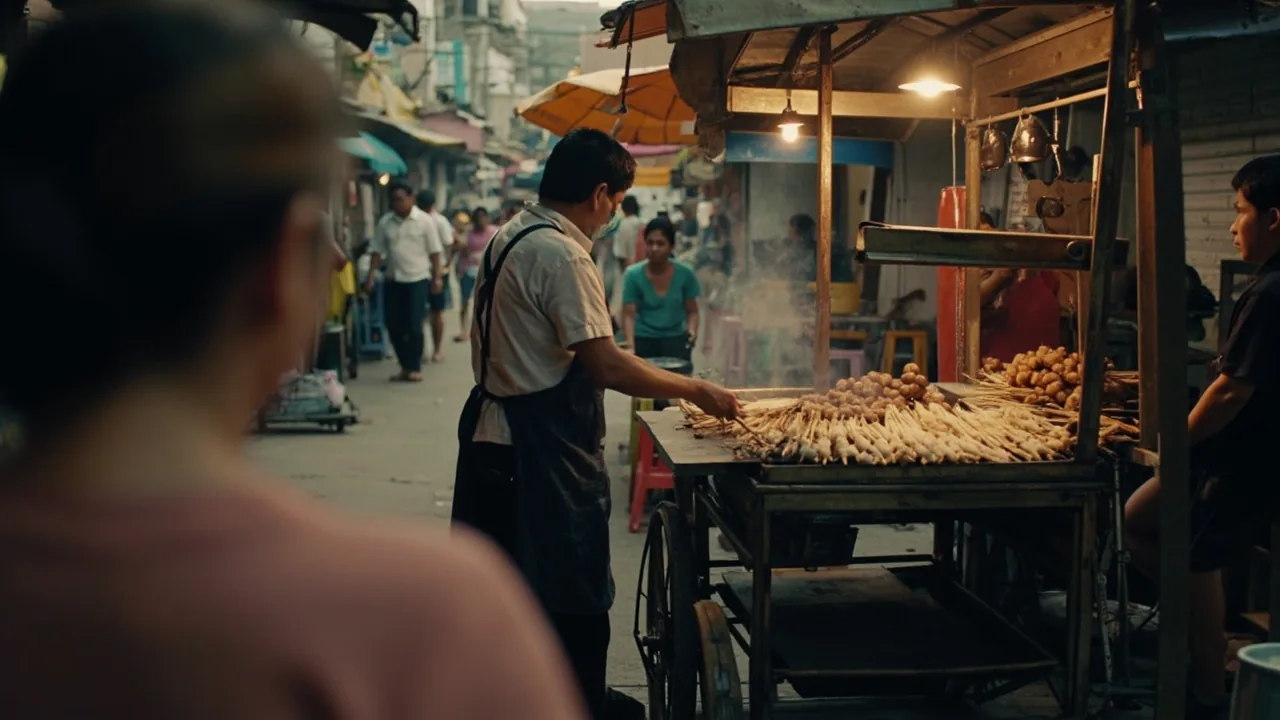
BBQ skewers (pork or chicken) are the safest starting point. The meat is usually marinated in soy sauce, vinegar, garlic, and banana ketchup, then grilled over charcoal right in front of you. Smoke and high heat kill surface bacteria. At 20-40 PHP a stick from any sari-sari-adjacent grill, this is your “first day on the ground, build confidence” food. Busy grill, fresh charcoal, served on a banana leaf: green light.
Fish balls, squid balls, kwek-kwek (battered quail eggs) are cooked in deep oil at the stall, in front of you, served on a stick with three dipping sauces (sweet, sour, spicy). When the oil is hot and the turnover is steady, these are fine. The risk is the same one you have with vada pav in a cold Mumbai stall: low turnover means the oil cools, the food sits, and reheating does not sterilise. The signal to walk past is a half-empty pot and oil that is not visibly bubbling. At 10-20 PHP per stick, the cost of skipping a bad stall is trivial; the cost of a bad one is a 24-hour food poisoning episode.
Balut is a fertilised duck egg, boiled and eaten from the shell with a dash of salt or vinegar. It is fully cooked, so this is not a food-safety question; it is a texture and cultural question. Travellers who try it report a soupy, slightly gamey flavour that is closer to a soft-boiled egg with intent than to anything weird. It is sold at 25-50 PHP per egg from dedicated balut vendors who keep them in bamboo baskets. If you are pregnant, immunocompromised, or have a duck-egg allergy, skip it. Otherwise, give it a try on day three or four once your stomach is settled.
Sisig is chopped pork face and ear, grilled, then sizzled on a cast-iron plate with onions, chili, and calamansi. Order this at a sit-down place like EMILIA, House of Filipino Food or any casual restaurant with a sizzling plate section, not from a street cart that has been holding it under a heat lamp. The carts run out of safe holding time fast. At 150-250 PHP a plate, sisig is a restaurant dish, not a stall dish.
Adobo is the national dish: chicken or pork stewed in soy sauce, vinegar, garlic, bay leaves, and peppercorns. The vinegar does real work here. Filipino home cooking has relied on vinegar for preservation for centuries, and the acidity gives you an extra safety margin even at lower-end restaurants. A small adobo plate with rice is 120-200 PHP and is the closest thing the Philippines has to a safe “first meal off the plane” comfort food.
Lechon (roast pig) at a sit-down place is safe. The skin is roasted until it is shatteringly crisp and the meat is fully done. If you are in Cebu, lechon is a religion. At 300-600 PHP per kilo, it is not street food in the budget sense, but it is the safest celebratory meal you can order.
Halo-halo is a shaved-ice dessert with evaporated milk, sweet beans, jellies, ube (purple yam), and whatever else the stall wants to put in. The risk is the ice. If the stall uses a commercial ice machine and the cubes are uniform and clear, fine. If the ice is hand-crushed and the vendor is scooping from an open tub, skip it. Stick to halo-halo at restaurants and cafés where the ice is sealed-source. At 80-150 PHP a glass, this is one to enjoy safely rather than gamble on.
Taho is warm fresh silken tofu in a small cup, topped with brown sugar syrup and tiny tapioca pearls, sold by a vendor carrying two metal buckets on a pole. It is hot when made, and if the bucket is clean and the turnover is steady, this is one of the safest things you can buy from a Filipino street vendor. At 25-40 PHP a cup, it is also one of the best breakfasts in the country.
Banana cue, turon, and maruya (fried banana variants) are deep-fried in clean oil and served on a stick. Safe, sweet, cheap at 15-30 PHP, and a good way to settle a slightly queasy stomach.
The Street Foods to Be Cautious With
Pre-cut fruit from carts is the single most common cause of traveller’s diarrhoea among Indian visitors. Mango, watermelon, papaya, and pineapple are often cut hours before you see them, sitting in the open air under a fly-covered display. Wash the cut surface with your own bottled water, or only eat fruit you can peel yourself (banana with the skin on, whole mango you score and peel, pineapple the vendor cuts in front of you and you eat immediately). For an Indian traveller used to the chai-wallah cutting fruit right in front of you, this is the same habit applied to a different country.
Kinilaw is a raw fish dish “cooked” in vinegar and citrus. It is the Filipino answer to ceviche. At a certified, busy seafood restaurant, it is generally safe. At a roadside stall where the fish has been sitting on ice in tropical heat for hours, it is a gamble. Indian travellers with low raw-fish tolerance should skip it entirely on the first trip.
Sushi and sashimi in the Philippines are not held to the same cold-chain standards you are used to in Mumbai or Delhi. If you are craving raw fish, go to a hotel restaurant, not a mall kiosk.
Unpasteurised juice and buko (young coconut) juice from carts is fine if the coconut is cracked open in front of you and you drink it immediately with a clean straw. If the cart pre-pours into plastic bags, skip it. Heat + sugar + open air = bacterial playground.
Street-side sisig and kare-kare (oxtail stew in peanut sauce) that has been sitting under a heat lamp for more than an hour: skip. These are protein-rich, moist, and cooked once, which makes them ideal for bacterial regrowth when held warm.
Water and Ice: The Rules That Matter
The single biggest thing that determines whether an Indian traveller gets sick in the Philippines is not the food; it is the water. Specifically, the ice.
Tap water is not drinkable. Brushing your teeth with tap water is a low-risk move but it is still a move. Use bottled water (20-50 PHP for a 1-litre bottle at a sari-sari store) or filtered water. The refilling stations in malls and hostels are fine. Restaurants that serve free water usually filter it, but ask if you are uncertain.
Ice shape matters more than ice source. Filipino street vendors use two types: hollow, cloudy, bullet-shaped ice from open-top coolers, and sealed cylindrical “tube” ice. The tube ice is made in a commercial machine with filtered water and is the only ice you want in your drink. The hollow cloudy ice is made in older machines and stored in open bins, and even if the machine is clean, the bin collects everything. Travellers report the simplest rule: if the ice is clear, uniform, and tube-shaped, drink; if it is hollow, white, or chipped, skip.
At sit-down restaurants and hotels, ice is almost always safe. The 5-star, mall-based, and chain-restaurant ice machines are commercial-grade and cleaned regularly. Worry about the carinderia and the roadside stall, not the Marriott lobby bar.
Prevention and Preparation (Before You Fly)
Get your vaccines sorted at least four weeks before departure. The recommended list for Filipino street food exposure is:
- Hepatitis A: strongly recommended. The Philippines has periodic outbreaks, and contaminated ice is the main transmission route.
- Typhoid: recommended, especially if you plan to eat heavily at small stalls and street markets.
- Hepatitis B: standard, but worth confirming you have it.
- Tetanus and Diphtheria: standard boosters, especially if you are doing any outdoor or scooter activity.
- Japanese encephalitis: only if you are spending extended time in rural agricultural areas.
- Rabies: only if you are working with animals or doing serious rural hiking.
Carry a small pharmacy kit: ORS (the standard sachets from any chemist in India work fine), loperamide for emergency diarrhoea control, rehydration salts, a broad-spectrum antibiotic your doctor has prescribed for traveller’s diarrhoea (azithromycin is the usual first choice, not ciprofloxacin, due to resistance patterns in Southeast Asia), paracetamol, your regular antacid (Pansec, Pantocid, or your usual brand), and a few antihistamines for any unexpected reaction.
Get a SafetyWing travel insurance policy. Filipino private hospital costs are reasonable by Western standards but a single ER visit for food poisoning can run 5,000-15,000 PHP (~₹7,500-22,500), and a hospital admission for severe dehydration is 30,000 PHP and up. SafetyWing covers all of this and runs ~$62/month (~₹5,900).
What Indian Stomachs Should Watch For
Indian travellers have a particular pattern of food reactions in the Philippines. The cuisine is less raw-herb and less fish-sauce-heavy than Thai or Vietnamese food, so the most common reaction is not “Delhi belly” but rather:
- Oil overload: Filipino food, especially at budget carinderias, can be noticeably oilier than Indian home food. Travellers used to a lighter home-cooked diet sometimes feel heavy and sluggish for the first few days. Lighter meals, more rice, less fried food solves it.
- Sugar load: Filipino condiments, sauces, and even savoury dishes lean sweet. Banana ketchup, spaghetti sauce, adobo marinades all have sugar. Travellers with blood-sugar sensitivity or insulin resistance should be aware.
- Dairy confusion: “Filled milk” (a coconut-oil-based evaporated milk substitute) is everywhere and is the default in halo-halo, coffee, and desserts. Travellers who think they are drinking dairy are often getting coconut oil. Lactose-intolerant travellers sometimes find the Philippines easier than expected for this reason.
- Calamansi (local lime) and vinegar: high acidity, can bother sensitive stomachs in large quantities. Fine in normal use.
- Ube (purple yam) and other unfamiliar root vegetables: not a safety issue, but a digestive one. Eat small portions first.
If You Need a Break from Street Food
There are days when your stomach just needs a break. For those days, hit one of the Indian restaurants in the major cities: Seven Mannah Indian Fusion Food for a solid chicken biryani, Indian Masala Curry House MAKATI in Manila for tandoori, or Flavours Indian & Mediterranean Cuisine in Bel-Air for tikka masala. Expect 300-500 PHP per person across these spots, which is the same as a mid-range Filipino sit-down meal. The cross-over pricing means you can eat Indian food as a treat, not as an exile from local cuisine.
For veg-only days, Vegetarian Indian Food in the Philippines: Allergies & Safety Guide has the full list of veg-friendly spots in Manila, Cebu, and beyond.
What to Do If You Get Sick
Most cases of food-related illness in the Philippines resolve in 24 to 48 hours with rest, ORS, and a bland diet. Here is the step-by-step:
- Stop eating anything except plain rice, plain bread, banana, and clear broth. This is the BRAT diet (banana, rice, apple sauce, toast) and works the same way it does in India.
- Rehydrate aggressively. One packet of ORS in bottled water, every 1-2 hours while symptoms last. If you cannot keep water down, you need IV rehydration at a clinic.
- Take loperamide only for emergency situations (a long bus ride, a flight, a tour). It does not cure the infection, it just buys you time.
- Take your prescribed antibiotic (azithromycin 500 mg, once daily for 3 days, if your doctor pre-approved it) if symptoms are severe: bloody stool, fever above 38.5°C, or vomiting that prevents keeping water down.
- If symptoms last more than 48 hours, or you have high fever with severe abdominal pain, or you see blood in stool, go to a clinic. Do not push through.
- National emergency number: 911. This works for ambulance, police, and fire across the Philippines.
- Indian Embassy in Manila: 2190 Paraiso Street, Dasmarinas Village, Makati City, Metro Manila. Phone: +63-2-8843-1001 / +63-2-8843-1002. Email: [email protected]. The Embassy assists with lost passports, emergency documentation, and can help locate medical facilities.
- St Luke’s Medical Center in Quezon City and Makati, Makati Medical Center, and The Medical City in Pasig are the most Indian-traveller-recommended hospitals in Manila. In Cebu, Chong Hua Hospital is the standard.
- For a non-emergency clinic visit, expect to pay 1,000-3,000 PHP for a consultation, blood test, and basic meds. A hospital ER visit for IV rehydration runs 5,000-15,000 PHP. SafetyWing covers all of these.
- Keep your receipts and medical reports. You will need them for any insurance claim, and you may need an English-language medical report to show on return to India.
Getting Connected
When your stomach goes sideways, the fastest way to find a clinic, call the embassy, or pull up a Grab is a working data connection. The Philippines has good 4G coverage in cities and most tourist areas. For Indian travellers, a Nomad eSIM loaded before you fly gives you data the moment you land, no SIM-card queue, no passport photocopying at the airport. Local SIMs from Globe and Smart are cheap (40-100 PHP for tourist packs) but require registration.
Filipino-Specific Safety Notes Beyond Food
Most Indian travellers in the Philippines focus on food and miss the other common-sense pieces. For the full picture, see Philippines Night Safety: Avoiding Scams for Indian Backpackers and Philippines Scooter & Motorbike Rental Safety Tips for Indian Backpackers. The general category of “be alert in cities, don’t ride scooters drunk, don’t flash cash” applies here just like it does in Mumbai.
For current government-level safety information, check the MEA Philippines travel advisory and the Philippine Department of Tourism advisory page before departure. The Philippines also has a 24/7 tourist hotline at 1510 for in-country emergencies, and DOT regional offices in every major city.
FAQ
Is the Philippines safe to visit for Indian tourists overall? Yes. The main risks are food, scooter accidents, and petty theft. See the general Philippines safety guide for the full picture.
What is balut and is it safe to eat? Balut is a fertilised duck egg, boiled and eaten from the shell. It is fully cooked and safe. The risk is texture, not hygiene. Skip it if you are pregnant or immunocompromised.
Can Indian vegetarians survive in the Philippines? Yes, but it takes planning. Vegetable dishes are everywhere but often cooked with shrimp paste (bagoong) or fish sauce (patis). Read Vegetarian Indian Food in the Philippines: Allergies & Safety Guide for the full breakdown.
Is the ice in Filipino drinks safe? Only tube ice. Hollow cloudy ice from open bins is a gamble. At sit-down restaurants and hotels, ice is almost always safe.
Do I need a yellow fever vaccine for the Philippines? Only if you are arriving from a yellow-fever-endemic country (most of sub-Saharan Africa, parts of South America). If you are flying direct from India, no.
How much should I budget for food in the Philippines? A street-food day runs 200-400 PHP across three meals. A mix of street food and one sit-down restaurant runs 500-800 PHP. Indian restaurant meals run 300-500 PHP per person. See the Philippines travel tax and money guide for the full budget context.
What is the emergency number in the Philippines? 911 for police, fire, and ambulance. 1510 for the Department of Tourism tourist hotline.
Subodh’s Take
Look, the Philippines is one of the easier Southeast Asian countries for an Indian stomach. Filipino food is cooked, vinegar-heavy, and less raw than Thai or Vietnamese cuisine. Most of the Indians I hear from who got sick in Manila, Cebu, or Palawan got sick from hollow ice, not from the food itself. Stick to busy stalls, eat only fruit you peel yourself, take the Hepatitis A vaccine before you fly, carry ORS, and you will be fine. The food is genuinely worth trying, especially the BBQ skewers, the taho, the halo-halo, and yes, the balut if you are brave. Eat adventurously, but eat smart.
