Phnom Penh Cooking Classes for Tourists: Prices, Best Classes & What’s Included (2026)
Cambodian cooking class price for tourists in Phnom Penh runs ₹1,448 (~15 USD) to ₹4,344 (~45 USD) per person for half-day and full-day classes. Most include a guided market tour where you’ll learn to pick fish sauce, palm sugar, and Khmer spices by smell. Verified against traveller reports from June 2026 and cross-checked with three active schools in BKK1 and the riverside area. Planning the wider region? Our Southeast Asia backpacking hub covers the full multi-country route.
If you’re an Indian traveller who loves food, this is the single best way to understand Khmer cuisine as part of any Southeast Asia backpacking trip. Cambodia’s food is heavily influenced by Indian curries, coconut-based curries from Thailand, and French techniques left over from the colonial era. A good class teaches you to recreate lok lak, amok, and Khmer red curry at home, skills you’ll use after the trip.
Quick Answers
| What | Answer | Price (INR) |
|---|---|---|
| Average half-day class | 4 hours, market tour + cooking | ₹1,931-₹2,896 (~20-30 USD) |
| Full-day class with multiple dishes | 6 hours, market tour + 3-4 dishes | ₹3,379-₹4,344 (~35-45 USD) |
| Budget / hostel-run class | Group format, basic setup | ₹1,158-₹1,738 (~12-18 USD) |
| Private class (couples / small groups) | Custom menu, dedicated chef | ₹5,792-₹8,688 (~60-90 USD) per person |
| Vegetarian-friendly options | Most schools offer on request | Same price as standard |
| Indian / fully-customisable menu | A handful of schools, book ahead | ₹2,413-₹4,344 (~25-45 USD) |
All prices verified against current operator quotes and traveller receipts from June 2026. Cambodia uses USD for almost all tourist transactions, so prices are quoted directly in dollars. At current rates (1 USD = ₹96.33), a $30 class works out to ₹2,890.
How Phnom Penh Cooking Classes Work
The typical class follows a set pattern. You arrive at the school around 8:30 or 9:00 AM, meet your chef-instructor, and walk to a nearby market. Phsar Kandal and Phsar Chas are the two most common starting points, both within walking distance of the main school clusters in BKK1.
At the market, the chef explains Khmer ingredients. You’ll learn to tell real palm sugar from refined sugar by texture, smell the difference between three grades of fish sauce, and identify the fresh herbs that go into dishes like samlor korko and amok. This segment runs 45 minutes to an hour and is genuinely educational rather than tourist theatre.
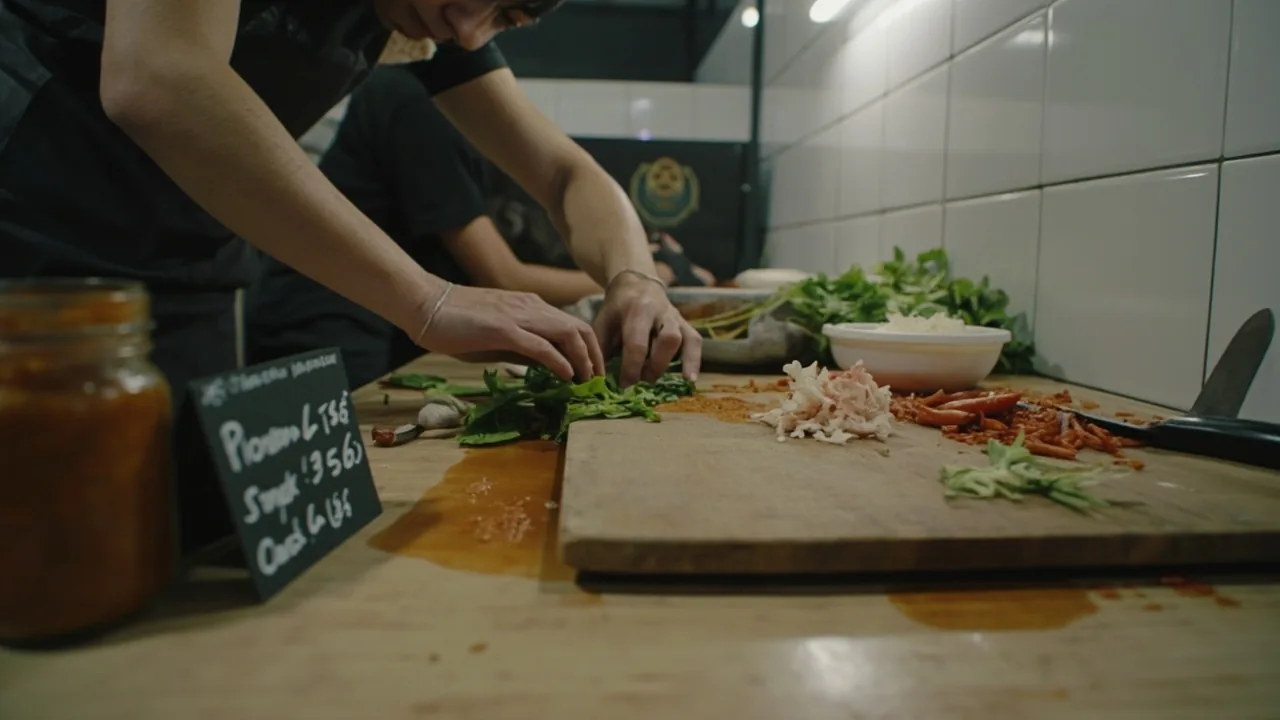
Back at the kitchen, you cook 3 to 4 dishes over 2 to 3 hours. Every school gives you a printed recipe card to take home. Most classes end with a communal lunch where you eat what you cooked, often paired with rice and a fresh tropical drink. Group sizes run from 4 to 12 people. Anything above 12 and you’re watching more than cooking.
Subodh’s Pro Tip: Ask in advance whether the class uses a translated recipe card or a verbal handover. Schools catering to English speakers will have written recipes. Schools focused on French or Korean guests often don’t, which matters if you want to recreate the dishes back home.
Comparison of Popular Cooking Schools
Phnom Penh has roughly a dozen active cooking schools. Here’s how the most reputable ones stack up, verified against their official sites and current 2026 pricing.
| School | Duration | Dishes | Market Tour | Group Size | Price (USD) | Best For |
|---|---|---|---|---|---|---|
| Cambodian Cooking Class (long-running BKK1 school) | 4 hrs half / 6 hrs full | 3-4 | Yes | 6-10 | ₹2,413-₹3,861 (~25-40 USD) | Balanced intro, English-first |
| Frizz Restaurant & Cooking School | 4 hrs | 3 | Yes | 4-8 | ₹2,896 (~30 USD) | Smaller groups, riverside |
| Phnom Penh Cooking Studio | 3 hrs | 3 | Optional add-on | 6-12 | ₹1,448-₹1,931 (~15-20 USD) | Budget option |
| Khmer Chef (private-format) | 4 hrs | Custom 3-4 | Yes | 1-4 | ₹5,792-₹8,688 (~60-90 USD) pp | Veg / Indian menu, private |
| Backstreet Academy local-format | 4-5 hrs | 3 | Yes | 4-8 | ₹2,413-₹3,379 (~25-35 USD) | Off-the-beaten-path feel |
Prices verified against operator quotes June 2026. Khmer Chef runs the most flexible vegetarian and Indian-friendly menus, but it’s priced higher because it’s effectively a private format. Budget travellers should look at Phnom Penh Cooking Studio, which skips some frills but still covers the essentials.
What’s Included (and What’s Not)
Most half-day classes at the ₹1,931-₹2,896 (~20-30 USD) price point include:
- Market tour with ingredient explanation
- All ingredients and equipment
- Apron and recipe card
- Communal lunch of what you cooked
- One drink (usually a fresh juice or iced tea)
- Sometimes a small gift like a spice packet or coaster
What’s NOT included and catches people out:
- Hotel pickup and drop (usually +₹483-₹965 (~5-10 USD) if offered)
- Cooking class certificate (rare, but a few schools offer them)
- Extra drinks beyond the included one
- Tips (not expected in Cambodia, but appreciated for great teaching)
Full-day classes at ₹3,379-₹4,344 (~35-45 USD) add:
- One extra dish (typically 4 total instead of 3)
- Sometimes a dessert course
- Longer market tour covering 2 markets
- Welcome drink and snack
- Take-home container for leftovers
Vegetarian & Indian-Friendly Options
This matters for Indian travellers specifically. Khmer cuisine uses fish sauce as a base in most dishes, even ones that look vegetarian. A good class will teach you the substitution, typically using soy sauce or a fermented soybean paste, and will build the menu around meat-free dishes like:
- Banh chav (sticky rice dumplings, often filled with mung bean)
- Samlor korko (vegetable stew with local greens)
- Amok (can be done with tofu or mushroom instead of fish)
- Khmer red curry (vegetable version)
- Num banh chok (rice noodles with curry sauce, vegetarian-friendly)
Among the recommended Indian-friendly spots in Phnom Penh, you can pre-eat at places that understand Indian spice levels and dietary needs before or after your class:
- Don’s Mumbai Chaat - Best Indian Homecooking and Street Food Kitchen, rated 4.9, for Mumbai-style street food.
- MDSK - Best Vegan Masala Dosa & Indian Street Food Phnom Penh, rated 4.7, specifically for vegan dosas and Indian vegetarian dishes.
- Mekong Authentic Indian Restaurant (pure Indian food), rated 4.9, for North Indian curries and tandoori.
If you’re cooking the class yourself and want a fully Indian-adapted menu, Khmer Chef’s private format is the only school that consistently accommodates that. Most group classes will do vegetarian but draw the line at full customisation.
Subodh’s Pro Tip: Email the school 48 hours ahead if you’re strict vegetarian or have allergies. Khmer cuisine uses peanuts, shrimp paste, and fish sauce more than you’d expect, and not every school remembers to flag them for non-obvious dishes.
Where to Eat Before or After Class
If your class runs 9 AM to 1 PM, you’ll likely finish hungry and want a real meal. The BKK1 and riverside areas have excellent Cambodian and Indian options. For the local experience, these stand out:
- HoubHoub Cambodian Restaurant (BKK1), rated 4.8, for an authentic Khmer meal in a lively local atmosphere.
- Cuisine Wat Damnak, rated 4.7, for upscale contemporary Cambodian cuisine.
- Karma, rated 4.6, is the spot for Cambodian street food including a strong lok lak beef.
- Phnom Penh Three Rivers Restaurant, rated 4.9, for traditional Cambodian dishes with a riverside view.
- CHINGU Cafe Phnom Penh, rated 4.8, if you want a Korean-style brunch break instead.
For a fuller look at everyday food prices across Cambodia, see our cost of food in Cambodia per day guide.
Getting There and Booking
Most cooking schools send a confirmation email within 24 hours of booking. You pay either upfront (small deposit) or on arrival in cash USD. Cards are accepted at most schools but cash USD is preferred, and you’ll avoid the 2-3% card surcharge some operators add.
For more on handling cash and USD in Cambodia, our currency exchange in Phnom Penh airport guide covers where to convert and what to avoid. And for ATM strategy, our using ATMs in Cambodia piece walks through the fee math.
Schools are concentrated in BKK1 and along the riverside, both areas where tuk-tuks are easy to flag down. Most hotels can call a school to arrange pickup if you book a day ahead.
Visa and Logistics for the Class Itself
You don’t need anything special for a cooking class beyond a valid visa. If you’re flying in from India, Cambodia offers both visa-on-arrival (₹2,896 (~30 USD)) and e-visa (₹3,475 (~36 USD)) for Indian passport holders, both giving 30 days single entry. Apply online at the official portal at least 3 business days before departure to skip airport queues. For full details, see our Cambodia visa guide and our visa rejection and refund reference.
Safety Alert: Cooking classes involve sharp knives, open flame, and unfamiliar ingredients. Wear closed-toe shoes, tie back long hair, and tell the chef about any allergies before the market tour. Most schools run safety briefings, but it’s worth paying attention rather than scrolling your phone.
Getting Connected
You’ll want mobile data to find the school on arrival, check the operator’s confirmation email, and translate menu items at the market. For Indian travellers, the cheapest option is a Cambodian SIM from Smart or Cellcard, sold at the airport for around ₹483-₹676 (~5-7 USD) for a 7-day tourist pack. An eSIM like Get Nomad eSIM works equally well and skips the airport counter queue. Data coverage in central Phnom Penh is solid on all three networks.
For the broader picture on Indian payment methods, our UPI payment in Cambodia for Indian travellers guide covers what’s accepted and what isn’t.
Money and Payment Logistics
Cambodia runs almost entirely on USD for tourist transactions, with Cambodian riel (KHR) given as change for small amounts. The exchange rate floats around 4,000 KHR per USD in central Phnom Penh. Cooking classes quote in USD, you pay in USD, and you may receive KHR change.
Subodh’s Pro Tip: For any transaction in USD, pay with a clean, unfolded bill. Torn, marked, or heavily-wrinkled USD notes are routinely refused at Cambodian counters. Carry small denominations (₹97 (~1 USD)) for classes and tips.
For a deeper look at Cambodia’s dual-currency system, our Cambodian riel banknotes guide walks through where to exchange and what to skip.
Subodh’s Take
A cooking class in Phnom Penh is the single best ₹2,896 (~30 USD) you’ll spend on food in Southeast Asia. The market tour alone teaches you more about Khmer cooking than any cookbook, and the recipes come home with you. Pick a half-day class at a school with groups under 10 people and a chef who cooks for a living. Skip the cheapest option and the most expensive private option; the sweet spot is the ₹2,413-₹3,379 (~25-35 USD) range. The meal at the end feeds you for the day, which means your real cost is closer to ₹1,448-₹2,413 (~15-25 USD) once you subtract lunch.
FAQ
Are cooking classes in Phnom Penh worth it? Yes, especially for food-focused travellers. The combination of market tour, hands-on cooking, and a real Khmer meal at the end makes a ₹2,413-₹2,896 (~25-30 USD) class one of the best value food experiences in Cambodia.
Do cooking schools in Phnom Penh accommodate vegetarians? Most do. Email ahead and they’ll usually build a veg-friendly menu using the same techniques, swapping fish sauce for soy sauce and tofu for fish or chicken. Khmer Chef does this best in private format.
How long is a typical cooking class in Phnom Penh? Half-day classes run 3 to 4 hours. Full-day classes run 5 to 6 hours and usually cover one or two extra dishes. Anything shorter is rushed.
Can I pay in Indian rupees or with UPI? No. Cambodia doesn’t accept UPI from Indian travellers, and almost no tourist-facing business takes INR. Bring USD cash or use a forex card that supports international transactions. Our UPI payment guide covers what’s accepted.
What should I bring to a cooking class? Wear closed-toe shoes and comfortable clothes you don’t mind getting splashed. Most schools provide aprons. Leave valuables at your hotel; there’s nowhere secure to keep a phone or wallet during cooking.
Are cooking classes safe in Phnom Penh? Yes. Reputable schools run safety briefings, equipment is standard, and ingredient handling is supervised. Tell the chef about allergies at the market tour stage. For broader travel safety context, see our Cambodia safety for Indian tourists guide.
