Rock Climbing and Deep Water Soloing in Railay: A Practical Guide for Beginners
✅ Last verified on-the-ground: 2026-07-17
Rock climbing Railay is one of the best first-timer spots in Southeast Asia. A half-day beginner session starts at ₹5,169 (~1,800 THB or ~$53.62). Deep water soloing (DWS) costs more, and you don’t need prior experience. This guide covers the difference, what to expect, and how to pick a shop.
Quick Answers
| What | Answer | Price (INR) |
|---|---|---|
| Where | Railay West & Tonsai, Krabi, Thailand | , |
| Best for beginners | Sport climbing (top-rope) | , |
| Cost: sport half-day | ₹5,169-₹6,317 (~1,800-2,200 THB or ~$53.62-$65.53) | ₹5,169-₹6,317 (~1,800-2,200 THB or ~$53.62-$65.53) |
| Cost: DWS half-day | ₹7,179-₹10,050 (~2,500-3,500 THB or ~$74.47-$104.25) | ₹7,179-₹10,050 (~2,500-3,500 THB or ~$74.47-$104.25) |
| Full-day (sport) | ₹8,040-₹10,050 (~2,800-3,500 THB or ~$83.40-$104.25) | ₹8,040-₹10,050 (~2,800-3,500 THB or ~$83.40-$104.25) |
| Experience needed | None for sport; must swim confidently for DWS | , |
| Season | Nov-Apr (dry); sport runs in rain, DWS doesn’t | , |
| Group size | Usually 4-6 per guide | , |
| Booking | Walk-up the day before, or the morning of | , |
What Is Railay Climbing?
Railay is a small limestone peninsula in Krabi, Thailand, cut off from the mainland by sheer cliffs. You cannot drive here. You take a longtail boat from Ao Nang or Krabi Town and walk off into a backpacker village with five climbing shops within a ten-minute stroll. The limestone, the access, and the village setup have made it one of the most-visited single-pitch sport climbing areas in the world since the 1990s.
For Indian travellers: this is a four-day detour from the standard Bangkok-Pai-Chiang Mai loop. Most people hit it on a 7-day Krabi stop between Bangkok and the islands. If this is your first trip abroad, start with our Southeast Asia backpacking hub for the full route breakdown.
If you want the Bangkok-to-Surat Thani overnight leg into Krabi, read our Thailand sleeper train guide - it saves a flight and drops you right at the Krabi coast.
Sport Climbing vs Deep Water Soloing: What’s the Difference?
Sport climbing and DWS use the same muscles but are set up differently. Pick the right one for your first session.
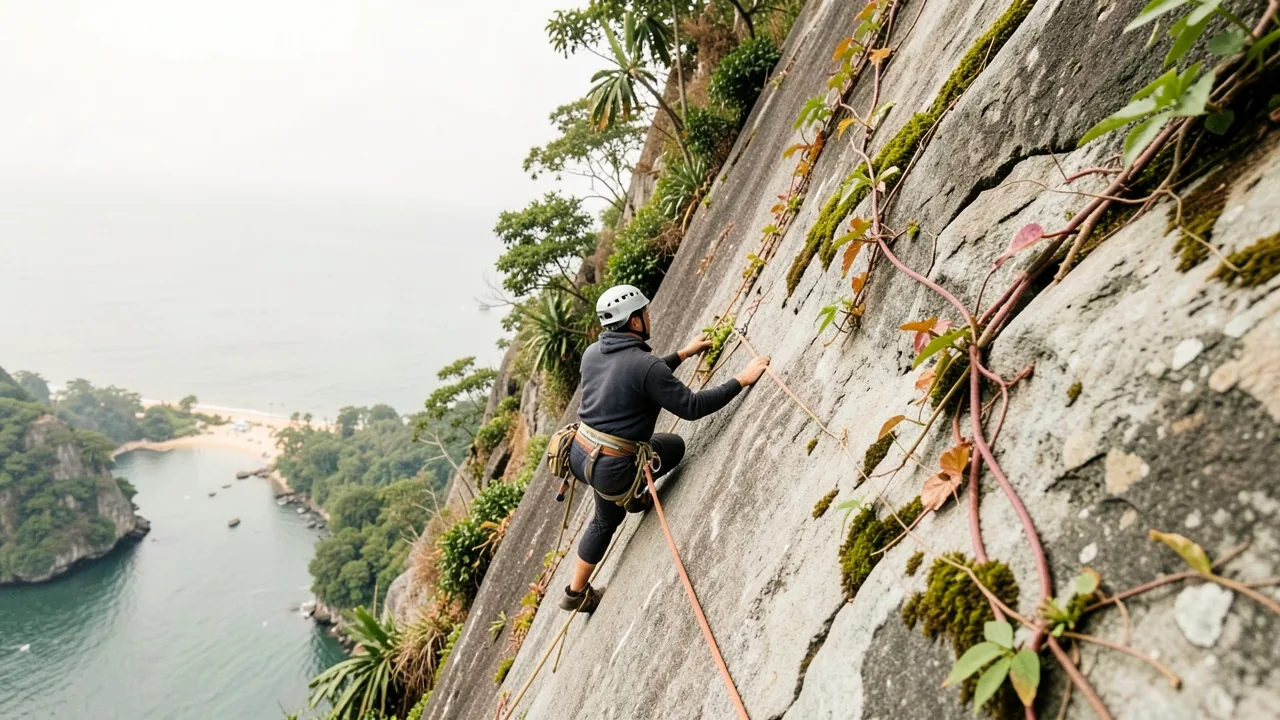
Sport climbing (top-rope) is climbing with a rope already attached above you, anchored to the top of the route. A belayer stands below, holds the rope through a device, and catches you if you fall. The falls are short, the rope catches you, and beginners can succeed on a route within ten minutes of trying.
Deep water soloing (DWS) is climbing over the sea with no rope at all. You climb up to 8-15 metres, then jump or fall into deep water below. There is no rope system, no belayer, no safety gear above you. Your only safety is the water, which means you must be a confident swimmer.
For your first session, pick sport climbing. DWS sounds more fun in photos, and it is, but it costs more, requires real swimming ability, and the shops will refuse you if you say you can’t swim. Get one half-day of sport under your belt, then decide if DWS is for you.
| Factor | Sport Climbing | Deep Water Soloing |
|---|---|---|
| First-timer friendly? | Yes | Only if you swim well |
| Safety | Rope + gear + belayer | Water only |
| Cost (half-day) | ₹5,169-₹6,317 (~1,800-2,200 THB or ~$53.62-$65.53) | ₹7,179-₹10,050 (~2,500-3,500 THB or ~$74.47-$104.25) |
| Where it happens | Limestone walls behind Railay West | Karst towers over the sea |
| Affected by rain | Usually still runs | Cancelled if swell is up |
| Age/height limits | None strict | Some shops cap weight at ~110 kg |
Step-by-Step: Booking Your First Session
Step 1: Get to Railay. Longtail boats run from Ao Nang Pier (₹574 (~200 THB or ~$5.96)) and Krabi Town (₹574 (~200 THB or ~$5.96)). The boat from Ao Nang takes 15 minutes. There are no roads into Railay, so this is your only option unless you arrive by kayak.
Step 2: Walk the strip. Railay West has four climbing shops within a five-minute walk of each other. They all offer similar products. Walk past, ask what’s included, and pick the one that feels right. Most shops also have boards out front with tomorrow’s availability and prices.
Step 3: Book the day before, or the morning of. Same-day morning bookings usually work in low season (May-Oct). In high season (Nov-Apr), book the day before. Most shops hold a 09:00 slot and a 13:00 slot.
Step 4: Wear what you’d wear to a gym. T-shirt, shorts, trainers or climbing shoes if you have them. The shops provide shoes, gear, and helmet. Don’t climb in flip-flops or sandals, and don’t climb in heavy cotton trousers that restrict leg movement.
Step 5: Show up 15 minutes early. The shop does a quick safety briefing, fits your shoes and gear, and walks you to the cliff. Sessions are 3-4 hours including walking time.
Step 6: Climb, fall, repeat. A typical first session: 8-12 routes, ranging from “I can’t move off the ground” to “I just topped a 5.9.” Your guide will set up top-ropes, demonstrate, and lower you down. You don’t need to be fit, you need to be willing to try.
What Most Guides Don’t Tell You
Climbing shoes fit tight. If you have wide feet, ask for the softer beginner shoes. The tight European-fit shoes will cut off circulation within 20 minutes and ruin your session.
The wall faces east. Morning sessions (09:00) are cooler and get morning shade. Afternoon sessions (13:00) can be brutally hot from March onward. If you’re climbing in March-April, book the morning.
Tonsai runs in the rain; Railay West does not. If you arrive during monsoon (May-Oct), ask specifically which cliff the shop is using. Some shops quietly cancel on grey mornings and you only find out at 08:30. Confirm by WhatsApp the night before.
You’re not paying for instruction. At ₹5,169 (~1,800 THB or ~$53.62) for a half-day, you’re paying for the guide’s rope-rescue certification, liability insurance, and gear. The actual coaching is decent but not personalised. If you want real technique feedback, book a private (₹10,050-₹14,358 (~3,500-5,000 THB or ~$104.25-$148.93)).
Honeypot time is 09:00-11:00. Every shop sends their groups to the same beginner wall at the same time. If crowds bother you, ask for a 13:00 slot or pay extra for a private guide who can take you somewhere quieter.
Common Mistakes Indians Make
Booking a “full day” thinking it’s value for money. A full day is ₹8,040-₹10,050 (~2,800-3,500 THB or ~$83.40-$104.25) and includes a 1-hour lunch break. For most beginners, hands and forearms give out by hour 3. Half-day is the right call. You can always extend on-site if you’re fresh.
Going straight to DWS because the photos look good. DWS requires you to swim 50m confidently, tread water for 30 seconds, and fall from 3-5 metres on your first jump. The shops screen for this. Indian travellers who grew up around swimming pools are fine; those who learned at the beach are usually fine; non-swimmers should not book DWS, full stop.
Skipping the gear fit. A loose fit rides up under your arms on overhangs. If it feels loose, say so. The guide can re-fit in 30 seconds.
Climbing with rings, watches, and loose jewellery. Take them off. The limestone is sharp, and a watch strap caught on a hold can twist your wrist badly.
Booking through a hotel in Ao Nang. Ao Nang travel agents mark up Railay climbing by 30-40%. Walk up in Railay and pay the shop rate. Every baht saved here goes further when you see what a day actually costs in Thailand.
Bringing a big backpack. The shops have small lockers. Bring water, sunscreen, and a towel. Leave the rest at your hostel.
What to Bring
Pack light for a climbing session. Our full SEA packing list covers everything, but for a half-day at the crag you only need:
- 1.5L water
- Sunscreen (reef-safe if you can find it; the Thai 7-Eleven ones work fine)
- Small towel
- Tight-fitting shorts or leggings (loose cotton trousers get caught on the gear)
- Hair tie if you have long hair
- Phone in a zip-lock bag for cliff photos
The shop provides shoes, gear, helmet, chalk bag, and the guide.
Where to Stay in Railay
Railay is small enough that any hostel puts you within a 10-minute walk of the climbing shops. There is no Uber, no Grab, no scooter hire. You walk everywhere.
Verified 2026-07-17 at 1 INR = 0.349 THB (1 THB = ₹2.8691).
SafetyWing Footer
FAQ
Can I try rock climbing in Railay with zero experience?
Yes. Sport climbing sessions are designed for first-timers. The guide sets up a top-rope, shows you three basic moves, and you climb. Most people top a 5.8 or 5.9 by the end of a half-day.
What's the difference between sport climbing and deep water soloing?
Sport climbing uses a rope anchored above you, with a belayer catching falls. DWS has no rope; you climb over the sea and fall into the water. DWS is more photogenic but requires confident swimming and costs more.
How much does rock climbing in Railay cost?
A half-day sport climbing session costs ₹5,169-₹6,317 (~1,800-2,200 THB or ~$53.62-$65.53). A half-day DWS session costs ₹7,179-₹10,050 (~2,500-3,500 THB or ~$74.47-$104.25). Full-day sport is ₹8,040-₹10,050 (~2,800-3,500 THB or ~$83.40-$104.25). Private guides are ₹10,050-₹14,358 (~3,500-5,000 THB or ~$104.25-$148.93) for a half-day.
Is Railay climbing safe for solo female travellers?
Yes. Group sessions are 4-6 people, mixed groups are standard, and the guides are professional. Most shops have been operating 10-20+ years. The bigger risk is sun exposure, not the climbing itself. Wear sunscreen and bring 1.5L water.
When is the best time to climb in Railay?
November to April (dry season). Morning sessions year-round. DWS is best December to March when the sea is calmest. The monsoon (May-Oct) still works for sport climbing, especially in the morning.
Do I need to book Railay climbing in advance?
In high season (Nov-Apr), book the day before. In low season, same-day morning works. Walk-up is fine if you’re flexible on time. Hotel bookings in Ao Nang cost more.
What's the age limit for Railay climbing?
Most shops take climbers from age 8-10 for sport, depending on height. DWS is usually 16+ because of the swimming requirement. There’s no strict upper age limit; fitness matters more than years.
Subodh’s Take
Railay is the single best place in Southeast Asia to try climbing for the first time. The village is small, the shops cluster in a five-minute walk, the routes are bolted specifically for beginners, and the cliffs are right behind the beach. Book a half-day sport session, don’t skip the gear fit, and book DWS only if you swim. Everything else sorts itself out once your hands are on the rock.