Si Phan Don Temple Etiquette Guide 2026: Do’s and Don’ts for Buddhist Shrines in 4000 Islands
Short answer: shoes off before entering any temple hall, shoulders and knees covered, ask before photographing monks, never point your feet at a Buddha image, and leave a small offering. The do and don t in temple basics are straightforward: shoes off, shoulders covered, feet tucked. Si Phan Don’s wats are relaxed but the same ground rules apply.
Si Phan Don (literally “4,000 Islands”) sits in the slow, brown stretch of the Mekong where Laos meets Cambodia. The temples here are quieter than the postcard wats up north: a few painted concrete shrines, a temple-school combo on Don Det, and wooden village monks’ houses where the orange robes dry on the railing. This guide covers the do’s and don’ts in temple rules Indian backpackers most often get wrong, from dress code to monk etiquette. Planning the wider trip? Our Southeast Asia backpacking hub covers the full multi-country route.
Quick Answers
| What | Answer | Price (INR) |
|---|---|---|
| Dress code | Shoulders + knees covered, shoes off inside the hall | , |
| Best time to visit | Early morning (6-8 AM) or just before sunset, when monks are around | , |
| Photography of monks | Ask first; never touch or pose beside them | , |
| Photography of Buddha images | Usually fine, no flash, never climb on statues | , |
| Donations | Offering box standard amount | ₹43-₹86 (~10,000-20,000 LAK or ~$0.45-$0.90) |
| Shoes | Remove at the threshold; carry them or leave outside | , |
| Women touching monks | Avoid; pass objects indirectly or via a male intermediary | , |
| Entry fee | Free at all Si Phan Don village temples; small donation appreciated | Free |
Laos is Buddhist-majority (Theravada), and the same rules that govern temple behaviour in Vientiane or Luang Prabang apply here.
What Counts as a “Temple” in Si Phan Don?
A wat (ວັດ) in Laos is more than a building. It’s usually a walled compound: a sim (ordination hall with the Buddha image), a viharn (prayer hall), monks’ quarters (kuti), sometimes a school, sometimes a cemetery. In Si Phan Don, expect small, working temples, not tourist showpieces. The most-visited ones sit on Don Det and Don Khon, with smaller shrines on the mainland at Nakasong village. Most are open from around 6 AM until dusk. Some have locked sim halls outside prayer times; knocking at the monks’ quarters will usually get you a friendly greeting from a monk who can open the hall. For the full lowdown on getting to and around the islands, see our Si Phan Don complete guide.
Do’s: What to Do Right
1. Dress for the threshold, not the weather
Cover shoulders and knees. A loose cotton tee plus long pants or a midi skirt works for most Indian travellers; a shawl draped over a tank top is fine for the walk up if you throw it on before stepping inside. Sarongs are sold at every guesthouse on Don Det for around ₹129-₹216 (~30,000-50,000 LAK or ~$1.34-$2.24) if you forget. Packing light for the temples? Our SE Asia packing list covers what to bring.
2. Take your shoes off at the threshold
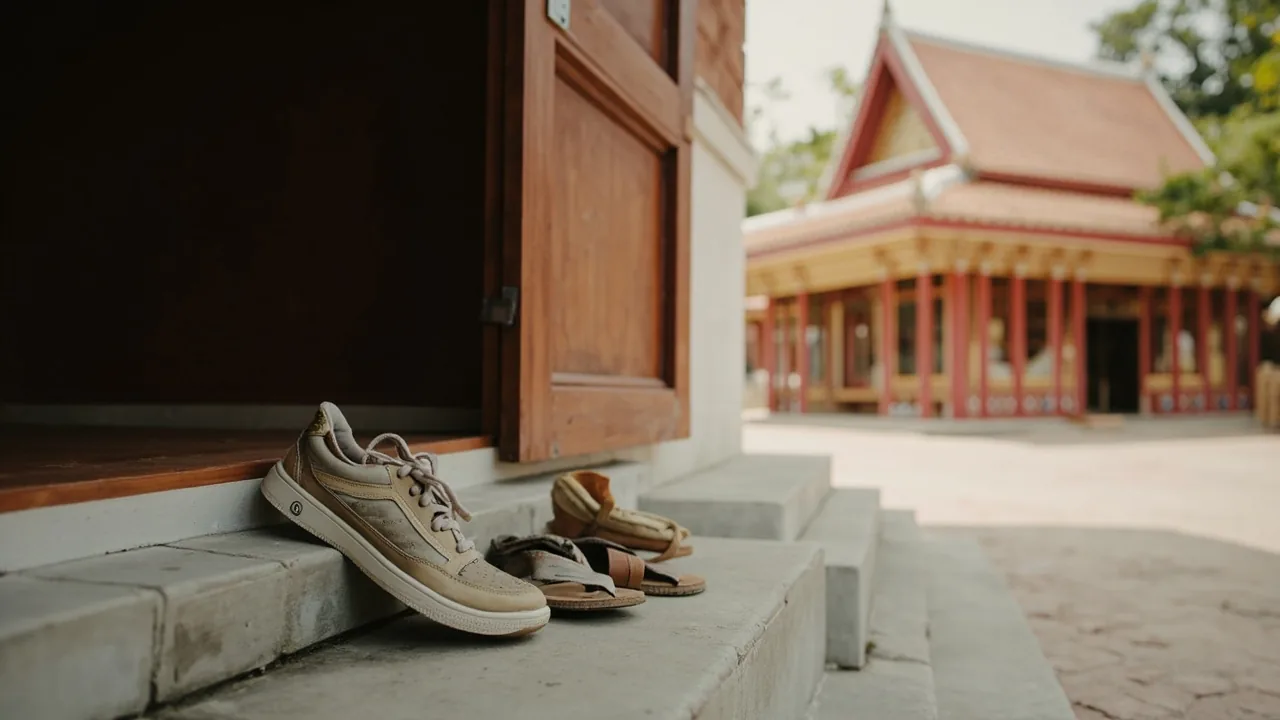
Shoes off at the threshold of the sim or viharn, never on the steps outside. Most temples have a row of sandals and Crocs by the door. Carry yours or leave them next to the cluster. If you’re at a smaller shrine with no other shoes, just place yours neatly to one side; someone will notice if you leave them blocking the entrance.
3. Walk in low and slow
When you enter the hall, dip your head slightly past the threshold, walk with a soft step, and don’t turn your back on the main Buddha image. Sit on the floor with your feet tucked behind you, soles pointing away from the Buddha and the monks. Men usually sit cross-legged; women tuck both legs to one side.
4. Bring a small offering
Drop ₹43-₹86 (~10,000-20,000 LAK or ~$0.45-$0.90) in the offering box, light a stick of incense if there’s a burner, and if a monk is chanting, sit quietly until the round finishes. Even a single incense stick at the side altar goes a long way. Cash in small notes is best; torn bills are fine for the box.
5. Greet monks the Lao way
If you meet a monk on the path, a slight nop (palms together at chest level, small bow) is the universal sign of respect. No need to kneel, no need to speak more than a soft “sabai dee.” At morning alms rounds (less formal in Si Phan Don than Luang Prabang), kneel if you participate, and never stand over a seated monk.
6. Use your right hand for offerings
When handing food, candles, or money to a monk or lay attendant, use your right hand or both hands. The left hand is reserved for “unclean” tasks in Lao custom. This applies to paying at the temple stall for incense too.
7. Stay quiet during chants
If you walk in during a chanting session, freeze at the threshold, wait for a pause, then find a spot on the floor away from the monks. Phones silent, photos off. You can stay till the chant ends; just don’t cross in front of anyone.
Don’ts: Mistakes Indians Most Often Make
Don’t turn the temple into a photo studio
Flash is forbidden inside the sim. Tripods and selfie sticks come across as offensive. Video of chanting is fine if quiet and unobtrusive; flash photography of Buddha images is not. If asked to delete shots, especially during ceremonies, just say sorry, delete the clip, and move on.
Don’t touch the monks
The shoulder-to-shoulder selfie is a hard no. If a monk agrees to a photo and offers a sap khor (the string blessing bracelet) afterward, accept it with both hands and let him tie it, don’t reach for his arm. For women: don’t hand a monk anything directly. Pass objects to a male intermediary, set them on a cloth in front of you, or place them on the offering tray. This is a Theravada convention across Thailand, Laos, Cambodia, and Myanmar, and Indian travellers who grew up greeting sadhus with a direct handshake get caught out here.
Don’t point your feet at anything sacred
In a Lao (and broader Theravada) temple, feet are the lowest, dirtiest part of the body. Don’t sit with your legs stretched out toward a Buddha image, a monk, or the altar. Tuck them under you. If you can, sit on a low bench provided along the wall rather than on the main floor.
Don’t wear shoes inside, and don’t carry them
The “I’ll just hold them” move clutters the doorway. Either leave them at the row outside or carry them in a small bag. The same applies to umbrellas and hats: off at the threshold.
Don’t climb, sit on, or pose beside a Buddha statue
Even an empty outdoor shrine. Instagram poses on top of meditation Buddha statues are a recurring sight across Southeast Asia temple grounds. It’s the fastest way to get escorted out and banned from the wat.
Don’t argue with the temple keeper
If you’re told to remove shoes, lower your sarong, cover a tattoo, or stop photographing, comply first. Explanations come later, in a calm voice, outside. Tempers ruin visits; grace keeps the door open.
Real Etiquette Edge Cases No One Mentions
The “alms bowl” problem
If you join an alms round or a monk hands you a bowl during a blessing, don’t eat from it, don’t pour it back, and don’t pass it to anyone else. The bowl is a sacred object tied to that monk’s morning. The correct response is to give it back with both hands or set it gently on the cloth in front of you.
Covering tattoos
Long-sleeved tops or shawls help. Tattoos of Buddha images are considered disrespectful in Laos even off-temple grounds. Large religious tattoos on the shoulder or arm should be covered at the temple. Some Lao temples will quietly ask visitors to cover large religious imagery.
Mixed-religion company
Travelling with friends who want to go in but aren’t taking it seriously? Coordinate before you reach the threshold. Whisper-only voices, no chewing gum, no laughing at the Buddha statue. If someone can’t meet those basics, wait outside.
Smell and cleanliness
Skip the heavy perfume, the cigarette before entry, and any strong-smelling street food right before you walk in. You’ll be sitting on the floor. Many Indian travellers find their normal daytime hygiene is plenty; just don’t carry cooking smells into a sacred space.
Where to Eat Nearby (the Post-Temple Reset)
Temple visits and slow-Mekong mornings pair well with a quiet breakfast downstream. Mrs Khamla Fish Noodle Soups (4.8) is a small soup shop serving the local khao poon-style fish noodle bowls at affordable prices, perfect after a dawn alms walk. The Herb Garden (4.9) sits in a tranquil garden setting with herb-inspired dishes if you want a sit-down lunch. Mouy’s (4.6) and Adam’s (4.3) are local mainstays for an unhurried meal between islands. For a vegetarian or familiar Indian plate, Hathim Indian Restaurant (4.8) on the mainland side covers dal-rice and roti without breaking the trip’s rhythm. If you have a half-day and a scooter on the mainland, the riverside kitchen stops between Nakasong and the northern piers do local dishes on a scenic stretch of road.
Getting Around to the Temples
Temple-hopping in Si Phan Don is mostly boat + bicycle. The mainland temples at Nakasong are reachable by motorbike (rentals are ₹216-₹345 (~50,000-80,000 LAK or ~$2.24-$3.58) a day on Don Det); Don Det and Don Khon temples are walkable from any guesthouse on the two islands, with the old French railway bridge between them doubling as the path. Boats to the smaller islands run on demand and cost ₹86-₹173 (~20,000-40,000 LAK or ~$0.90-$1.79) per crossing.
If you’re continuing north to Pakse or crossing into Cambodia afterwards, the buses and slow boats on the Mekong all leave from Nakasong or the mainland piers. Book on 12go for the cross-border Mekong connections; verify the schedule locally because the slow boat only runs in high water.
Getting Connected
Laos coverage on Don Det and Don Khon is patchy. Unitel and Lao Telecom are the main operators; a local SIM is ₹129-₹216 (~30,000-50,000 LAK or ~$1.34-$2.24) with a few GB of data. If you don’t want to queue at the Nakasong shop, the Get Nomad eSIM covers most of Laos on a single regional plan and lands in your inbox before you fly.
What Most Guides Don’t Tell You
The school-temple combo. Many Si Phan Don wats double as primary schools. If you walk in during class, kids will run up, ask your name, and want selfies. This is welcome, but step out of the prayer hall while doing it. Don’t pull kids across the threshold for photos; the teachers will (politely) shoo you back.
The “blessing for tourists” upsell. At some larger ceremonies, monks offer a string blessing and a small envelope is expected in return. The envelope is for the temple, not the monk. ₹86-₹216 (~20,000-50,000 LAK or ~$0.90-$2.24) is standard; you don’t have to accept the blessing if you’d rather not pay.
Pocket warnings. Lao village monks are famously patient, but their patience is not infinite. Listen the first time.
FAQ
Can I wear jeans into a Lao temple? Yes, as long as your knees are covered and your top covers your shoulders. Clean, non-ripped jeans are standard for travellers across Southeast Asia.
Are women allowed inside Lao temples? Yes, no restriction on entry. Women just don’t touch monks or hand objects directly to them.
What if I forget to take my shoes off? A monk or attendant will quietly point at the threshold. Just comply, smile, and step back outside to remove them.
Can I take photos of the Buddha image? Usually yes without flash. Never climb on, sit on, or block the altar for a photo.
Is there an entry fee at Si Phan Don wats? No. Donations in the box (₹43-₹86 (~10,000-20,000 LAK or ~$0.45-$0.90)) keep them running.
Do I need to chant or pray? No. Sitting quietly during a session is enough. You can also just observe from the doorway without sitting.
What about the temple festivals? Boat Racing Festival (Boun Suang Heua) in October pulls crowds; temple rules tighten during this period. Dress extra carefully.
Subodh’s Take
Look, the temples here are easy to mess up because they look casual. No fences, no ticket booth, a wooden sign, a tin roof. That casualness is the point. The looseness is built on a long list of small habits everyone around you has internalized. You don’t need to chant in Pali. You need to take your shoes off at the door, cover your knees, not point your feet at anything, and treat the monks like the working clergy they are. Do that, leave a ₹86 (~20,000 LAK or ~$0.90) note in the box, and the doors stay open for the next traveller, including you on the way back from Cambodia.
