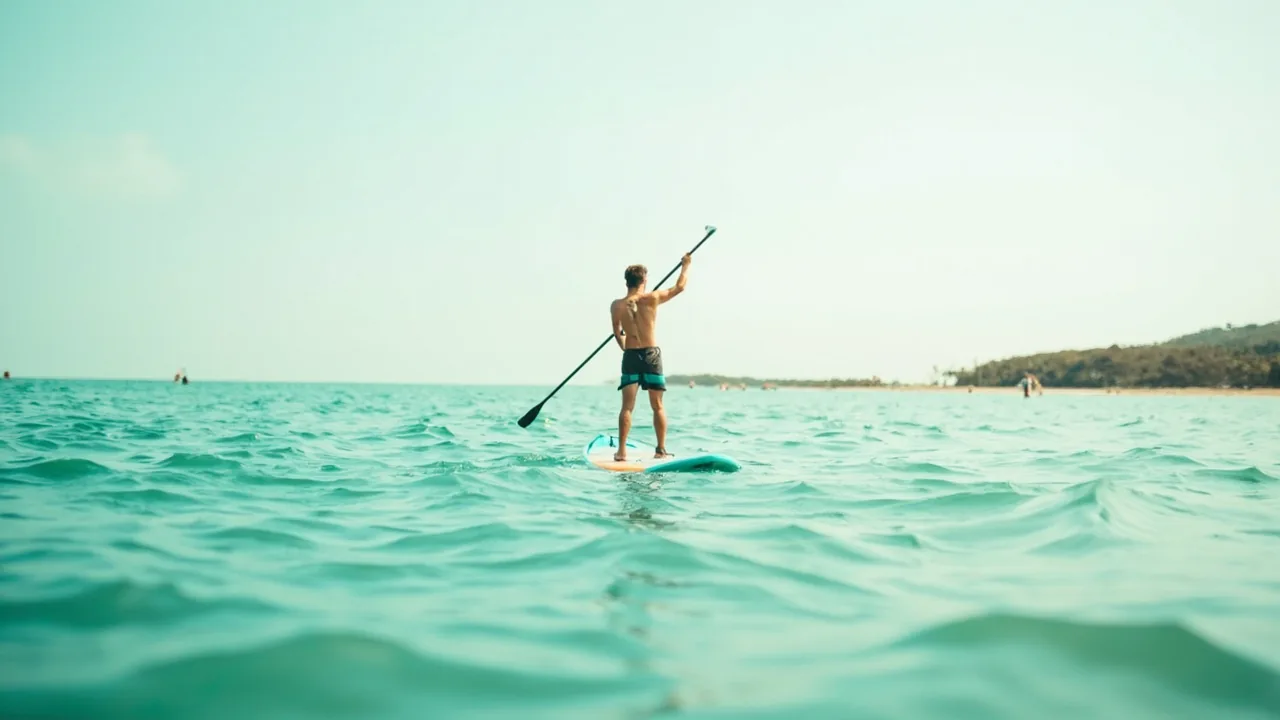
Stand Up Paddleboarding in the Sea Around Phuket: Safety, Spots & What to Know
Yes, you can stand up paddleboard in the sea around Phuket, and the easiest, safest sessions happen inside sheltered bays on the east coast (Chalong, Rawai, Ao Yon) or in the early-morning glass-off hours at Nai Harn and Kata. Open Andaman paddling around the headlands is a different game: currents run 1-3 knots, longtail and speedboat traffic is constant, and the southwest monsoon (May to October) puts most of the west coast off-limits for beginners. This guide walks through the spots locals launch from, the months that work, what to do when you fall in, and what it costs. For related planning, see our guides on Sea Backpacking Hub and 7 Days Thailand Tour Package Price.
What is open-sea SUP around Phuket, really?
Open-sea SUP means launching from a beach into water that has tide, current, swell, boat traffic and marine life, instead of the calm, enclosed conditions of a lake or lagoon. The Andaman Sea on Phuket’s west side faces the Indian Ocean, so it picks up long-period swells and has rips along the headlands. The east side (Chalong Bay, Phang Nga side) is sheltered by the island’s bulk and behaves more like a large bay, with smaller chop and gentler tidal flow. Most Phuket operators run their “sunset SUP” and “sunrise paddle” sessions from one of the east-side beaches for exactly this reason. You may also find Average Spend in Thailand Per Day useful for this trip.
The short version: protected bay SUP and open-ocean SUP are different sports in the same place. Pick the first one for your first session. See also: How Much Money Do I Need for 5 Days in Thailand.
Quick Answers
| What | Answer | Price (INR) |
|---|---|---|
| Is SUP safe in the sea? | Yes, inside sheltered bays on the east coast during the dry season | , |
| Can you use a SUP in the ocean? | Yes, with a leash, life vest and current awareness | , |
| Best months | November to March (dry season, calmer Andaman) | , |
| Avoid months | June to September (southwest monsoon, west coast closed) | , |
| Rental per hour (board only) | Most beach operators | ₹858 (~300 THB or ~$8.90) |
| Guided sunrise/sunset tour | 2 hours, group of 6-10 | ₹3,431-₹5,146 (~1,200-1,800 THB or ~$35.61-$53.42) |
| Lesson (1.5-2 hrs, group) | Beach school, board + brief | ₹4,288-₹7,147 (~1,500-2,500 THB or ~$44.51-$74.19) |
| Private lesson (1.5-2 hrs) | One-on-one with instructor | ₹8,577-₹12,865 (~3,000-4,500 THB or ~$89.03-$133.54) |
| Mandatory safety gear | Leash + PFD; some operators throw in a dry bag | usually included |
| Main risks | Current, boat traffic, jellyfish, sun, monsoon swell | , |
| Tour booking | See Phuket SUP tours on GetYourGuide | , |
Subodh’s Pro Tip: Book your first session through a school, not a beach chair rental. A school briefs you on the local currents, fits a proper leash, and paddles with you for the first 10 minutes. The ₹572-₹1,144 (~200-400 THB or ~$5.94-$11.87) you save going DIY is not worth the cost of being the person being towed back to shore by longtail.
Step-by-Step: How to Paddleboard in the Sea Around Phuket
1. Pick the right season (this decides everything)
- November to March is the dry season. The Andaman is calmer, the wind is mild, and most west-coast beaches (Nai Harn, Kata Noi, Surin) are usable. This is when the “sunset SUP” tours run from the west side.
- April to early May is the shoulder. Doable, but the winds pick up in the afternoon. Go in the morning.
- Late May to October is the southwest monsoon. West-coast surf gets heavy, with shore-break and rips, and most beach SUP rentals close. East-coast Chalong stays workable year-round, but afternoon squalls are common.
- Travellers report that the worst sessions they ever had were launched at 2 pm in July, when the wind turned a flat bay into 30 cm chop in 20 minutes. Morning launches are the rule. For related planning, see our guide on What to Do in Thailand for 7 Days.
2. Choose a launch spot that matches your level
If you’ve never SUP’d in the sea before, do not start at a west-coach beach with swell. Use one of these:
- Chalong Bay: the most sheltered open water on the island. Operators run sunrise and sunset sessions here, boat traffic is in a marked channel, and the water stays flat. Good for first sessions.
- Rawai and Ao Yon: smaller, quieter, protected. Longtails anchor offshore but stay clear of the swim line.
- Nai Harn (early morning, dry season only): the prettiest paddle in Phuket, with the headland as a backdrop, but only in the first two hours after sunrise before the wind comes up.
- Kata and Kata Noi (dry season, early morning): similar to Nai Harn, with a small swell that’s manageable once you’ve paddled a few times.
Avoid launching from Patong, Kamala or Bang Tao on a windy day. The beaches face west and the wind fetch is long. Even experienced paddlers call it churn.
3. Book a guided session for your first go
A guided session (group of 6-10, ₹4,288-₹5,718 (~1,500-2,000 THB or ~$44.51-$59.35) per person for 2 hours) gives you:
- A board with a proper coil leash (not the flimsy straight leash some shops hand out)
- A life vest, even if you’re a confident swimmer. Travellers in Phuket say operators will refuse to take you out without one when winds pick up.
- A safety briefing on the local currents and which direction to drift if you fall off
- An instructor paddling alongside, which means someone to signal a boat for you if a situation develops
- A small dry bag for phone and keys, included at most schools
For ₹8,577-₹12,865 (~3,000-4,500 THB or ~$89.03-$133.54) you can book a private 1.5-2 hour lesson with one instructor. Worth it if you want to learn stroke technique and self-rescue, not just take photos.
You can see what’s running on Phuket SUP tours on GetYourGuide for current operators and reviews, then book directly with the school for a slightly lower rate if you want.
4. Gear up before you push off
- Leash: coiled for flat water (less drag, less chance of snagging reef), straight for surf (so the board doesn’t snap back at you). Most Phuket operators use coiled.
- PFD / life vest: not optional. Coast Guard rules for most tour operators require one. Inflatable belt-pack PFDs (₹4,288-₹7,147 (~1,500-2,500 THB or ~$44.51-$74.19) to buy) are a popular compromise if you don’t want a bulky vest.
- Rash guard or long-sleeve swim shirt: the sun on flat water is brutal. SPF 50 + UPF shirt is the local combination.
- Reef shoes or strapped sandals: some launch sites have sharp coral rubble at the entry.
- Waterproof phone pouch: ₹572-₹1,144 (~200-400 THB or ~$5.94-$11.87) at 7-Eleven. The Andaman is not kind to iPhones.
- Reusable water bottle: 1.5 litres minimum for a 2-hour paddle. Heat exhaustion sneaks up on people who don’t feel thirsty because the breeze is cooling them.
5. Launch safely
- Walk the board out knee-deep before mounting. Don’t try to step on from the sand, you’ll fall in the first wave.
- Keep your knees soft, eyes forward, not down at your feet. The board is most stable when your weight is centred over the midline.
- Paddle with your core, not your arms. Long, smooth strokes on alternating sides.
- Stay 50-100 metres off the beach unless you’re crossing a channel. Boats can’t see a single paddler at the surface.
6. Know what to do if you fall in
- Fall away from the board. The board can hit you in the head if you fall towards it.
- Cover your head with both hands as you surface. The leash will pull the board back to you in 2-3 seconds.
- If you’re being pushed by current, don’t fight it sideways. Paddle downstream at an angle to the shore you want to reach.
- Signal your instructor with a whistle (most PFDs have one) or by waving the paddle over your head. Shouting is hard to hear over wind and boat noise.
7. Read the conditions before you book
If any of these are true on the day, cancel or move to a sheltered bay:
- Small craft advisory posted by the Phuket Marine Department
- Visible whitecaps more than 50 metres from shore
- Tide going out through a narrow channel (rip current forming)
- Heavy longtail or speedboat traffic at the launch point
- Lightning visible on the horizon
- You’ve never paddled in the sea and the swell is over knee-high
8. After the paddle
Rinse the board and leash with fresh water if you rented, or you’ll be charged a cleaning fee (usually ₹572-₹1,429 (~200-500 THB or ~$5.94-$14.84)). Most schools rinse for you. Tip the instructor ₹286-₹572 (~100-200 THB or ~$2.97-$5.94) if they were good. Walk 5 minutes up the beach to one of the Old Town cafes for a late breakfast; NumNum Old Town Cafe & Restaurant or Su Va Na both do a strong Thai set menu for under ₹572 (~200 THB or ~$5.94) if you want to stay local.
Common Mistakes Indians Make on SUP in Phuket
- Booking a “sunset tour” in September and being surprised the operator cancels. The monsoon doesn’t care what your itinerary says. Check the season before you book, and keep a refundable backup plan.
- Renting a board from a beach chair vendor with no safety briefing. The ₹858 (~300 THB or ~$8.90) hourly rate is cheap because there’s no leash, no PFD, and nobody watching you. If you fall offshore with no leash, the board drifts and you swim.
- Paddling west-coast beaches at midday in February. The morning glass-off is real, and by 1 pm the wind has often built to the point where you spend 50% of the session fighting chop. Tourists do this every day, and every day a few get rescued.
- Wearing flip-flops strapped to your feet. They catch on the board and twist your ankle. Wear reef shoes or go barefoot.
- Skipping the PFD because you “swim well.” The risk isn’t drowning, it’s cardiac arrest from the cold-water shock of an unexpected fall. PFDs are for everyone, and most operators won’t let you out without one.
- Underestimating sun exposure. Flat water reflects UV from below as well as above. Even with SPF 50 and a rash guard, a 2-hour paddle can burn the backs of your knees.
What Most Guides Don’t Tell You
- Jellyfish blooms are real and they cluster in sheltered bays during the inter-monsoon (April-May and October-November). They are usually the small, pink, stinging kind, not the deadly box jellyfish, but they ruin a session. Ask locally the morning of, or wear a light long-sleeve rash guard.
- Currents around the headlands (Promthep, Laem Phromthep area) run 2-3 knots during ebb tide. That’s faster than a beginner can paddle. Stay inside the headland unless you are with a guide.
- Longtail boats have right of way in marked channels, but their drivers are looking for other boats, not for paddleboarders. Make eye contact before crossing a channel. Don’t assume they’ve seen you.
- Most SUP schools in Phuket are run by foreign expats who came for one season and stayed five. They know the local conditions better than any guidebook. Ask them which beach they’d paddle tomorrow, not which one looks good on Instagram.
- The cheapest “sunset paddle” tours use inflatable rental boards that are 4-5 years old and visibly soft in the middle. They flex underfoot and feel unstable. If the board feels like a trampoline, ask for a different one or pick a different operator.
Where to Eat After (Without Wandering Around Hungry)
Most Phuket SUP schools end sessions by 8 am or 6 pm, and the launch beaches cluster in the south of the island. These are the spots that are close to the action and feed you properly:
- NumNum Old Town Cafe & Restaurant: a Phuket Old Town cafe with local Thai dishes and a Western breakfast menu. The standouts are the khao tom (rice soup) and the pad krapow. Solid fuel after an early session.
- Su Va Na: same stretch of Old Town, more of a sit-down Thai place. Try the gaeng keow wan if you’ve been paddling all morning and want a curry fix.
- Cafe Delight Phuket Old Town: the place to go if you want a slow coffee and a Western breakfast after a sunset session. The vintage fit-out makes it feel like the rest of Phuket has been switched off.
- Local Canteen Phuket: a no-frills local canteen with affordable Thai dishes, the kind of place where the menu is on the wall and the locals eat. Good post-paddle if you want authentic Thai at canteen prices.
If you’re craving Indian food or strict-veg (Phuket’s local cuisine leans heavily on fish sauce and shrimp paste, and most Thai curries aren’t vegetarian unless you specifically ask), these three cover you:
- PAPAJI BANGKOK in Phuket: North Indian and Arabic dishes on Patong Beach Road, biryani at around ₹858 (~300 THB or ~$8.90) per person. Walking distance from Patong if you’ve paddled at the south end.
- Amritsr Restaurant Patong: right by Patong Beach, North Indian menu focused on dishes like aloo kulcha with chole. Mid-range prices, easy to walk to.
- Amritsr Restaurant Phuket Kalim Beach: a sea-view branch on the north end of Patong Bay, North Indian Punjabi food, with a signature stuffed Amritsari Kulcha in the ₹572-₹1,429 (~200-500 THB or ~$5.94-$14.84) range per person.
For non-paddling evenings, the Old Town also has So Xorry Phuket Old Town for a slower wander through the historic streets, and the Chalong Bay viewpoint for sunset if you don’t feel like being on the water yourself.
What About the Day You’re Not Paddling?
Phuket is more than beaches. If you’ve got a rest day (or the monsoon has cancelled your session), the island has dry-land activities that fill the same morning. Most of these book through the same operators you used for SUP:
- Oto Play Park Chalong Phuket: an amusement park in Chalong, good if you’re travelling with friends who don’t want to paddle.
- O-OH Farm Suanluang: an eco-farm outside the main tourist strip. Half-day, easy to combine with a south-coast morning.
- Fulfill Phuket: an adventure park with ziplines if you want the same adrenaline hit from a different angle.
- Formula Fun Indoor Karting Phuket: indoor karting, useful for wet afternoons.
- Adrenaline Rush Show Phuket: World-Class Live Action: a staged live-action show, family-friendly, evening timing.
Safety Notes for Indian Travellers on the Water
- Always carry your travel insurance details on you, in a waterproof pouch. The standard policy for most Indian travellers is around ₹5,973 (~62 USD) a month, and the SafetyWing Nomad Insurance plan covers emergency medical, evacuation, and trip interruption across Southeast Asia. Phuket has good hospitals (Bangkok Hospital Phuket, Mission Hospital) but as a foreign patient you’ll be asked to pay upfront or show insurance, so keep the policy number reachable.
- Before you paddle, check your government’s official travel advisory for Thailand (the Indian MEA page at mea.gov.in) and Phuket’s own marine weather forecast. Conditions change weekly, and a flat-calm forecast can flip with a single squall.
- Indian rupees are not exchangeable in Phuket at a useful rate. Carry a forex card or use UPI via apps like Wise or Niyo that support Thai merchant QR payments. ATMs in 7-Eleven and at the beach operators dispense THB at around ₹629 (~220 THB or ~$6.53) per ATM fee on top of your bank’s own charge.
- For connectivity, an eSIM is the easiest option for Indian travellers landing at Phuket airport. Get Nomad eSIM gets you data on arrival without a passport stamp at a Thai mobile counter. AIS and dtac tourist SIMs are also sold at the airport for similar prices, but only the AIS counter is open at odd hours.
- Most operators will ask for a passport or photocopy at check-in. Carry it, or a photo of the bio page on your phone.
- Jellyfish stings are the most common injury on Phuket SUP. Vinegar works; urine does not. Most beach schools carry vinegar in their first-aid kit.
FAQ
Is paddleboarding safe in the sea for someone who has only done it on lakes?
Yes, if you start in a sheltered bay (Chalong, Rawai, Ao Yon) with a school, in the morning, during the dry season (November to March). Don’t start at a west-coach beach with swell, and don’t start in the afternoon when the wind has come up.
Can you use a stand up paddle board in the ocean with waves?
Yes, but you need a different setup: a straight leash (not coiled), a surf-specific SUP, and ideally some prior flat-water experience. Most Phuket schools offer surf-SUP lessons in the dry season at Kata and Nai Harn. Beginners should stay in the whitewater, not paddle out to the lineup.
What is the best month for sea SUP in Phuket?
February and March are the calmest months on the Andaman side. November and December have slightly stronger winds but are still workable. Avoid June to September, when the southwest monsoon makes the west coast unsafe and the east coast sees frequent afternoon squalls.
Do I need a life jacket for stand up paddleboarding in the sea in Phuket?
For a guided tour, yes. The operator will provide one, and they will refuse to take you out without it. For self-rented sessions, you’ll be on your own judgement, but the standard advice is to wear one. Inflatable belt-pack PFDs are the compromise most paddlers end up buying.
Are there jellyfish in Phuket that can hurt you?
Small stinging jellyfish appear in the bays during the inter-monsoon months (April-May and October-November). They cause skin irritation but are not usually dangerous. The box jellyfish occasionally seen off the west coast in the wet season is a more serious concern; that is also the season most west-coach SUP operators close. Ask locally the morning you paddle.
Can I take a SUP from the beach and paddle to a nearby island?
Not without experience and a guide. Currents around the headlands run 2-3 knots, boat traffic in the channels is heavy, and rescue services are slow to reach open water. Travellers have ended up in the shipping lane south of Phuket and needed longboat assistance back. If you want to paddle between islands, book an island-hopping SUP tour, which uses support boats.
What happens if I get caught in a storm while paddling?
Drop to your knees and paddle perpendicular to the wind towards the nearest shore. Lightning on flat water is the bigger danger than the wind. If you see lightning or hear thunder, get off the water. Most Phuket operators carry portable weather radios and will call sessions before storms arrive.
Subodh’s Take
The honest version: stand up paddleboarding in the sea around Phuket is one of those activities where the picture on Instagram and the reality on the water are not the same sport. A sunset SUP on a glassy Chalong Bay at golden hour, with the longtails anchored offshore and the hills turning pink, is genuinely one of the best 90 minutes you can spend in Thailand. An afternoon paddle into a 20-knot headwind on Kamala Beach with no PFD is the kind of memory that makes people fly home early. The difference is the season, the launch spot, and whether someone briefed you on the local conditions. Book a school for your first session, paddle in the morning, wear the PFD, and the sea will give you the photo you came for.
