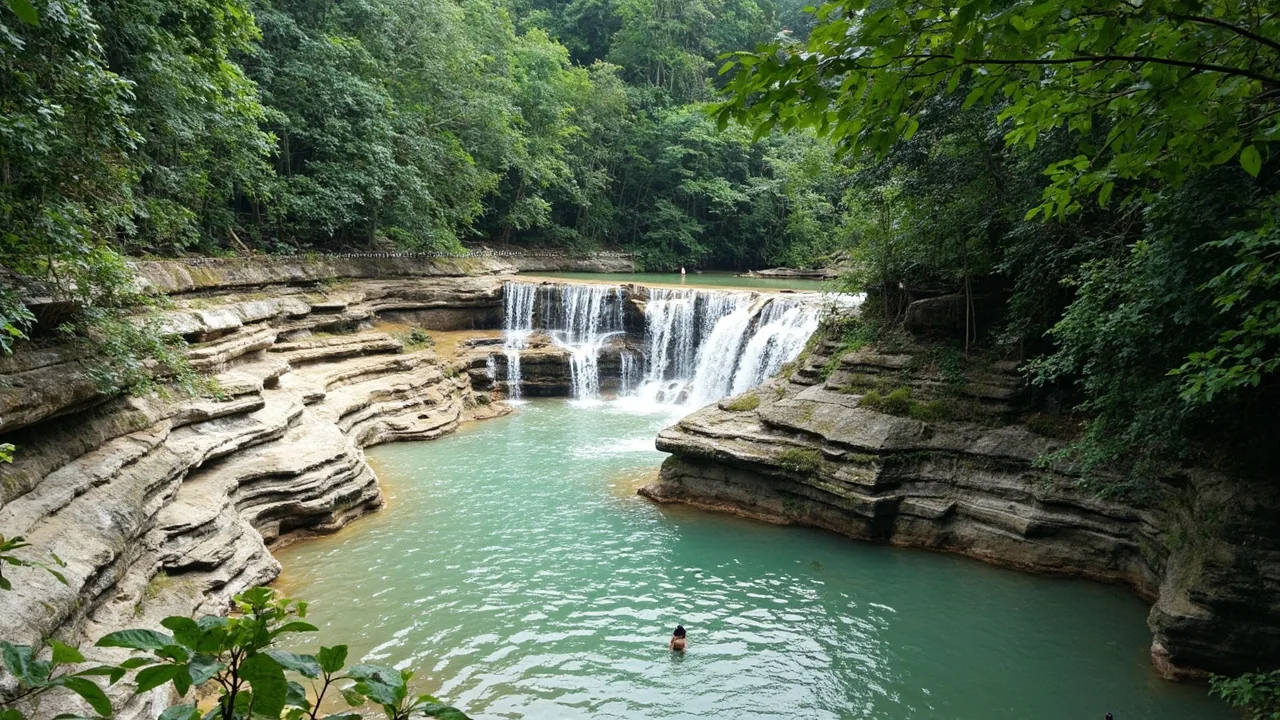
Tad Sae & Kuang Si: The Complete Waterfall Guide for Luang Prabang, Laos
The short answer: Kuang Si is the most famous of the waterfalls in Luang Prabang, the multi-tiered turquoise pools are widely considered the most famous waterfall in Laos. Pick Kuang Si if you have one day. For related planning, see our guides on Sea Backpacking Hub and Koh Lipe Temple Etiquette a Respectful Visitor S Guide.
Tad Sae, about 30 minutes east by longtail boat, is a softer, swim-friendly set of limestone cascades that’s only worth the trip between July and December, when the Nam Khan river has water in it. Add Tad Sae if you’re in town in peak wet season and want a quieter swim spot.
Below: how to reach each one, what it costs on the ground in LAK and ₹, where to eat on the way back, and the small mistakes Indian travellers keep making on this exact day trip. You may also find Ngapali Temple Etiquette Guide How to Respect Local Customs At Pagodas Near the Beach useful for this trip.
What Are Tad Sae and Kuang Si?
Kuang Si Falls (sometimes written Kuang Xi or Kuang Xe, sometimes spelled Tat Kuang Si) is a three-tiered limestone waterfall about 30 km south of Luang Prabang, fed by a spring that runs through travertine rock and deposits the calcium carbonate that gives the lower pools their bright turquoise color. The upper tiers cascade roughly 60 meters total; the lowest pools are shallow enough to swim in and are roped off into a bathing area. The site is run as a national protected area by a community tourism committee, and entry fees are reinvested into village upkeep. It’s the postcard image of Laos, the one that ends up on every Lonely Planet cover.
Tad Sae Waterfalls is a smaller, multi-step cascade on the Nam Khan river, about 12 km southeast of the city by road. The falls drop in tiers of about 5 to 10 meters through a forested valley and have several natural pools at the base. Because the source is river-fed rather than spring-fed, the water level swings hard with the season: full and spectacular from roughly July through December, down to a sad trickle by March and April. Visitors reach it by longtail boat from the Mekong/ Nam Khan confluence, a 30- to 40-minute ride each way.
These are the two named waterfalls backpackers ask about in Luang Prabang. If you’ve seen a third name on a blog, it’s almost always a smaller, less reliable cascade (Tad Thip, Tad Kuang Nong, and a handful of seasonal streams near Nong Khiaw) that isn’t worth a half-day detour on a short trip.
Quick Answers
| What | Answer | Price (INR) |
|---|---|---|
| Most famous waterfall in Laos | Kuang Si Falls (south of Luang Prabang) | — |
| Name of the waterfall in Luang Prabang locals send you to | Kuang Si, with Tad Sae as the quieter alternative | — |
| Distance of Kuang Si from Luang Prabang town | 30 km south, 45 to 60 minutes by road | — |
| Distance of Tad Sae from Luang Prabang town | 12 km southeast, 30 to 40 minutes by longtail boat | — |
| Kuang Si entry fee (foreign adult) | ₹107 (~25,000 LAK or ~$1.11) | ₹107 |
| Kuang Si entry fee (child 6 to 12) | ₹52 (~12,000 LAK or ~$0.53) | ₹52 |
| Kuang Si parking fee (scooter / car) | ₹21-₹43 (~5,000-10,000 LAK or ~$0.22-$0.45) | ₹21 |
| Tad Sae boat, round trip, per boat | ₹644-₹859 (~150,000-200,000 LAK or ~$6.69-$8.92) | ₹644 |
| Tad Sae entry fee | ₹86 (~20,000 LAK or ~$0.89) | ₹86 |
| Tad Sae distance from town | 12 km southeast, 30 to 40 minutes by longtail boat from the Mekong/ Nam Khan confluence | — |
| Swimming allowed | Yes at both. Kuang Si only at the roped lower pool. Tad Sae in any of the natural pools | — |
| Best months to visit Kuang Si | Year-round (best flow August to November; pools look brown-green in late March. April low-water weeks) | — |
| Best months to visit Tad Sae | July to December. Dry January to April, often not worth the boat | — |
| Opening hours | 8:00 to 17:00 (last entry around 16:30) | — |
| Nearest Indian food on the return | M&M Restaurant and Fathima, both in Luang Prabang town | — |
| Currency | LAK (Lao Kip). 1 LAK ≈ ₹0.0043 at time of writing, so 25,000 LAK ≈ ₹107 (~$1.11) | ₹0.0043 |
How to Get to Kuang Si Falls
Option 1: Tuk-tuk or songthaew (most common)
The town fills up with shared songthaews and private tuk-tuks every morning starting around 8:30. A shared songthaew costs roughly ₹107-₹172 (~25,000-40,000 LAK or ~$1.11-$1.78) per person for the round trip including a 2 to 3 hour wait. A private tuk-tuk is ₹644-₹859 (~150,000-200,000 LAK or ~$6.69-$8.92) for the round trip, worth it if you’re two or more and want to leave when you want.
Subodh’s Pro Tip: Negotiate the return pickup time before you leave. “I’ll be back at 13:00” is the magic sentence. Most drivers will go wander the night market while they wait, which is fine, but a hard time means you won’t get stranded at the gate watching five tuk-tuks pass without stopping.
Option 2: Scooter rental
Scooters in Luang Prabang run ₹344-₹515 (~80,000-120,000 LAK or ~$3.57-$5.35) per day. The road to Kuang Si is paved all the way, with one short steep hill at the entrance. You’ll need an International Driving Permit (IDP) carried alongside your Indian licence; police checkpoints between the city and the falls do stop foreign riders on scooters. Fuel from a roadside pump is ₹64-₹107 (~15,000-25,000 LAK or ~$0.67-$1.11) per litre.
Safety Alert: The road past the entrance gate has a sharp downhill curve onto wet limestone that bikes slip on every monsoon. Walk the scooter the last 200 metres if it’s rained in the last hour.
Option 3: Shared minivan tour
Hotels and guesthouses sell half-day Kuang Si tours for around ₹644-₹1,074 (~150,000-250,000 LAK or ~$6.69-$11.15) per person. You get transport plus a guide, who usually waits at the car park while you walk up. This is the easiest option if you’re solo and don’t want to haggle.
For pre-booked transport and tour bundles that include hotel pickup, See waterfalls in Luang Prabang tours on GetYourGuide.
Once You’re at Kuang Si
The entrance is a 600 m uphill walk from the car park to the lowest swimmable pool, with wooden bridges crossing the upper tiers. The path is solid concrete steps with railings. The whole loop, including swimming, is 2 to 3 hours.
There are toilets and changing rooms near the entrance, plus a few small food stalls. Don’t expect a real meal here; eat in town before or after.
How to Get to Tad Sae Waterfall
Tad Sae is more of a hassle than Kuang Si, which is why most first-timers skip it. The falls themselves are walkable from the road in dry season, but the only practical access for most of the year is by longtail boat from the boat pier at the confluence of the Mekong and Nam Khan rivers, near the end of the peninsula.
Step-by-step from Luang Prabang
- Walk or tuk-tuk to the boat pier. It’s at the end of Khem Khong Road, near the end of the peninsula, about 15 minutes on foot from the night market. A tuk-tuk from your guesthouse is ₹64-₹86 (~15,000-20,000 LAK or ~$0.67-$0.89).
- Hire a longtail boat at the pier. The boats are wooden, painted blue, and tied up by the dozen. You’ll be quoted ₹644-₹859 (~150,000-200,000 LAK or ~$6.69-$8.92) for a one-way trip; round trip with 1.5 to 2 hours of waiting at the falls is ₹859-₹1,074 (~200,000-250,000 LAK or ~$8.92-$11.15). Negotiate hard, every boat captain quotes the same inflated foreigner price first.
- Split the boat. Two to four people per boat makes the price reasonable. Single travellers usually get quoted higher; ask around the pier or post in your hostel WhatsApp group the night before.
- Buy the Tad Sae entry ticket at the boat landing. Foreigners pay ₹86 (~20,000 LAK or ~$0.89). Kids under 6 are free. Bring small notes, the kiosk often runs out of change during peak hours.
- Walk up to the falls. It’s a 5 to 10 minute walk uphill from the boat drop-off through the village.
- Swim, eat sticky rice, and walk back down. Allow 1.5 to 2 hours at the site.
- Pre-arrange the return boat pickup. Most boat captains wait at the landing; agree on a time (e.g. 13:00) and stick to it.
Subodh’s Pro Tip: The pier operators know exactly when monsoon season cuts off the falls. If you arrive and they say “Tad Sae no water today,” believe them and don’t waste ₹859 (~200,000 LAK or ~$8.92) on a boat to a dry creek bed.
Common Mistakes Indians Make at the Luang Prabang Waterfalls
Mistake 1: Showing up at Kuang Si without a swimsuit
The lower turquoise pools are the entire point. There are no rental suits, the changing rooms are basic, and the walk back up to the entrance in wet clothes is not pleasant. Pack your swimsuit, a quick-dry towel, and a dry t-shirt in your daypack. Some hostels in town sell ₹86 (~20,000 LAK or ~$0.89) sarongs that work fine as wraps if you forget.
Mistake 2: Expecting Tad Sae to look like Kuang Si
They are completely different. Kuang Si is a vertical travertine cascade over limestone cliffs. Tad Sae is a horizontal stepped river with multiple low drops. If you’ve only seen the Instagram pictures of Kuang Si’s bright blue pools and you go to Tad Sae expecting the same look, you’ll feel cheated. Tad Sae’s appeal is the swim-in-a-forest-river vibe, not the photo.
Mistake 3: Trusting tuk-tuk drivers who offer a “Kuang Si + bear rescue combo”
There is a small Asiatic black bear rescue centre at the Kuang Si car park, run by Free the Bears. The entry is included in your waterfall ticket. Drivers will try to upsell you on a “special” combined tour, sometimes charging extra for the bear sanctuary, sometimes for the longtail boat to Tad Sae. None of this is needed. Your waterfall ticket already covers everything inside the gate.
Mistake 4: Trying to go in late March or April
The falls don’t run dry exactly, but the water level drops noticeably and the colour washes out. The pools are still swim-able but they look brown-green instead of turquoise. If your trip falls in this window, do Kuang Si early in the morning when the sun hits the pools at the right angle and skip Tad Sae entirely.
Mistake 5: Paying the first boat price at the Tad Sae pier
The first quote at the pier is almost always double. Walk two boats down, ask the next captain, and you’ll get a fair price. Standing in line behind a group of four who just paid the inflated rate is your cue to wait.
What Most Guides Don’t Tell You
The water colour at Kuang Si changes by time of day
That unreal turquoise you see on Instagram is shot between roughly 9:30 and 11:00, when direct sun reflects off the calcium carbonate in the pools. After noon the light goes flat and the pools look bluer-grey. The early morning (8:30) is also washed-out because the sun is behind the cliffs. Arrive at 9:30 for the photo you came for.
The “swimming is banned” myth
For a few months after the post-COVID reopening, Kuang Si did restrict swimming in the main lower pool to protect water quality. As of 2026 the lower bathing area is open again, but signs and ropes move around. If the rope is up at the lowest pool, swim in the second pool up, which is usually less crowded and just as swimmable.
Tad Sae is sometimes genuinely closed
In very low water years (every few years, usually in March-April), Tad Sae is closed because there is literally no water to swim in. The boat captains will tell you at the pier if that’s the day. Don’t argue, just reroute to Kuang Si for an extra swim.
The road between Luang Prabang and Kuang Si has one police checkpoint
They check IDPs on foreign riders, not tuk-tuk passengers. If you’re on a scooter, carry your IDP, your home licence, and your passport. If you’re in a tuk-tuk, ignore the stop.
Where to Eat Near the Falls (and Back in Town)
There are no proper restaurants at either waterfall. The food stalls at Kuang Si are fine for sticky rice and a cold drink but nothing more. Eat a real meal in town before or after.
Local picks in Luang Prabang
- Two Little Birds Cafe (4.6): Riverside, calm, Lao-Western fusion. Coconut pancakes are the signature. A good breakfast before the falls, open by 8:00.
- Le Petit Prince Cafe (4.7): Quaint French-Lao cafe with strong coffee, salads, and good pastries.
- Redbul Restaurant & Bar (4.1): Lao classics in a town-centre setting. Try the laap (larb) with sticky rice and a Beerlao for ₹107-₹172 (~25,000-40,000 LAK or ~$1.11-$1.78).
- Breeze Bar By Best Cafe (5.0): Hilltop sunset spot if you’re back from the falls by late afternoon.
When you need a dal-chawal break
- M&M Restaurant Indian Halal Food (4.8): Punjabi halal, warm room, strong portion sizes. Easy walk from the night market.
- Fathima Indian & Malaysian Halal Restaurant (4.7): The chicken rogan josh with paratha is the most-ordered dish; full meal under ₹482 (~5 USD).
- Chennai Restaurant Indian, Lao & Malaysian Halal (3.9): South Indian thalis when you’ve had enough Lao spice.
Getting Connected in Luang Prabang
You will want data on the road to Kuang Si for Grab (if you’ve got it working), Maps.me for offline navigation on the scooter, and WhatsApp for the tuk-tuk driver pickup time. The two main options are a Lao physical SIM or an eSIM.
- Unitel tourist SIM: ₹215 (~50,000 LAK or ~$2.23) for 30 days, 30 GB. Buy at the airport counter on arrival, or at the Unitel shop on Sisavangvong Road in town. The airport counter takes 10 minutes; the town shop can take 30+ if there’s a queue.
- eSIM: If you don’t want to swap your Indian SIM, Get Nomad eSIM sells regional Southeast Asia data packs from ₹482 (~5 USD) for 30 days. Activation is by QR code, no passport photo required.
Both work fine at Kuang Si and Tad Sae. Coverage at the top tier of Kuang Si is patchy on Unitel but fine at the lower pools.
Getting to Luang Prabang (So You Can Get to the Waterfalls)
Most Indian backpackers arrive in Luang Prabang overland from Thailand via the Mekong slow boat, or by air from Bangkok, Hanoi, or Vientiane. The slow boat is the classic backpacker experience: two days from Huay Xai to Luang Prabang, with an overnight stop in Pak Beng. See the Mekong slow boat guide for the full breakdown, including Pak Beng hotel scams and the visa-on-arrival dance at the Thai-Lao border.
If you’re flying, Luang Prabang International Airport is 5 km from town. A tuk-tuk to the centre is ₹215 (~50,000 LAK or ~$2.23). Lao Airlines and Bangkok Airways both run daily Bangkok-Luang Prabang; Hanoi and Vientiane are also common feeder routes.
Best Time to Visit the Luang Prabang Waterfalls
| Month | Kuang Si flow | Tad Sae flow | Notes |
|---|---|---|---|
| January | Decent | Low | Dry season, blue skies, lower water |
| February | Decent | Low | Same as January, plus Lunar New Year crowds |
| March | Tapering off | Almost dry | Skip Tad Sae |
| April | Brown-green | Dry | Hottest month, lowest water |
| May | Rains start | First flow | Water rising, falls coming back |
| June | Good | Good | Shoulder season, fewer tourists |
| July | Excellent | Excellent | Peak wet season, both falls roaring |
| August | Excellent | Excellent | Same as July, watch for flash floods at top tier |
| September | Excellent | Excellent | Best month for total water + bright colour |
| October | Excellent | Excellent | Cooler, photogenic, popular |
| November | Excellent | Good | Water starting to drop late month |
| December | Good | Decent | Cool and dry, crowds peak around Christmas |
For a deeper breakdown of the climate, see the Luang Prabang weather by month guide.
Subodh’s Take
Both falls are worth doing on a 3-day Luang Prabang stay, but if I had to pick one I’d send first-timers to Kuang Si every time. The colour, the swim-in-a-cave feeling at the lowest pool, and the bear sanctuary as a half-hour bonus all make it the cleaner half-day. Tad Sae is the in-the-know choice if you’re a strong swimmer, want quieter water, and are in town during the wet months. Skip it in March and April; the boat captains will be the first to tell you.
The biggest mistake I see is treating the falls as a “see it, swim, leave” mission. Build a slow morning around it: coffee at Two Little Birds, songthaew to Kuang Si by 9:30, swim at the second pool, back to town by 13:00, lunch at M&M, and a slow afternoon walking the peninsula. That’s the version of the day you’ll remember.
FAQ
Can I swim at Kuang Si Waterfall?
Yes, as of 2026. Swimming is allowed at the roped-off lower bathing pool. The upper tiers are off-limits (slippery limestone, dangerous drop-offs). Bring your own swimsuit and a quick-dry towel; there are basic changing rooms but no suit rentals. Pool access can be restricted in extreme low-water years, but this is rare.
How do I get from Luang Prabang to Kuang Si Falls?
The simplest way is a tuk-tuk or songthaew from town: ₹644-₹859 (~150,000-200,000 LAK or ~$6.69-$8.92) private round trip, or ₹107-₹172 (~25,000-40,000 LAK or ~$1.11-$1.78) per person in a shared songthaew. Scooters are ₹344-₹515 (~80,000-120,000 LAK or ~$3.57-$5.35) per day plus fuel. Hotel/hostel-sold minivan tours are ₹644-₹1,074 (~150,000-250,000 LAK or ~$6.69-$11.15) per person with hotel pickup included.
Is Tad Sae Waterfall worth it?
Yes, but only between roughly July and December, when the Nam Khan river has enough water to make the falls worth the boat trip. From January to April the falls often reduce to a trickle and most boat captains will advise against the trip. If you’re in town during the wet season, the swim at Tad Sae is much quieter than Kuang Si.
What is the most famous waterfall in Laos?
Kuang Si Falls, about 30 km south of Luang Prabang. It’s the one on every guidebook cover, the one with the bright turquoise pools, and the one most day-trippers from Luang Prabang visit. The name “Kuang Si” or “Tat Kuang Si” both refer to the same falls.
How much does entry to Kuang Si cost?
The foreign adult entry fee is ₹107 (~25,000 LAK or ~$1.11). Children aged 6 to 12 pay ₹52 (~12,000 LAK or ~$0.53). Kids under 6 are free. The bear rescue centre inside the gate is included. A small parking fee of ₹21-₹43 (~5,000-10,000 LAK or ~$0.22-$0.45) applies if you arrive by scooter or car.
Can I visit both Tad Sae and Kuang Si in one day?
Yes, but it’s a full day. Most people do Kuang Si in the morning (arrive 9:30, swim until noon, back to town by 13:00) and then catch a longtail to Tad Sae at 14:00, returning by 17:00. The boat ride back from Tad Sae in the late afternoon wind is choppy; if you don’t like small boats, just do Kuang Si twice instead.
Is the road to Kuang Si safe to ride a scooter on?
Yes, the road is paved all the way and the only tricky section is the short steep hill at the entrance gate. Watch for wet limestone in the rain and walk the last 200 metres if it’s slippery. Police do stop foreign riders at the checkpoint outside town to check for an International Driving Permit alongside the home licence.
