Tet Festival Vietnam 2026: Complete Backpacker Survival Guide
Let me save you from the single most common Vietnam backpacker mistake: flying into Hanoi shortly before Lunar New Year’s Eve and discovering half the city has closed for the Tet festival Vietnam. The Lunar New Year, called Tết Nguyên Đán or Tết, is the most important holiday on the Vietnamese calendar, and for about a week the entire country pauses. Trains stop, hostels lock their doors, family-run restaurants shut, and street food stalls vanish from the sidewalks.
The 2026 Tết public holiday block runs from 16 to 19 February 2026 (Monday to Thursday, with Monday 16 and Tuesday 17 the core days), giving most workers a long weekend plus 3-day compensated days off. Lunar New Year’s Eve itself falls on 16 February 2026. Plan around that single date. In 2027, Tết falls even earlier: Lunar New Year’s Eve on 5 February 2027, with a similar four-day public-holiday block.
Vietnam runs on a different clock during Tết, and the smart move is to either get out before it starts or lean into it fully.
Quick Answers
| What | Answer | Price (INR) |
|---|---|---|
| When is Tết 2026 in Vietnam? | 16 to 19 February 2026 (public holidays), Lunar New Year’s Eve on 16 Feb | ₹0 |
| When is Tết 2027 in Vietnam? | Lunar New Year’s Eve on 5 February 2027; public holiday block roughly 6 to 9 February | ₹0 |
| Does Vietnam shut down during Tết? | Yes: most shops, hostels, restaurants, and bus/train services close for at least 3-5 days | ₹0 |
| Can I still get a sleeper bus during Tết? | Severely limited: service drops by 70%+ and tickets sell out 2-3 weeks early | ₹0 |
| Should I visit Vietnam during Tết? | Only if you want flower markets + family-oriented culture. Otherwise travel one week before or after | ₹0 |
What Tết Is (And Why It Hits So Hard)
Tết marks the first day of the Vietnamese lunar calendar, and culturally it carries the same weight as Diwali does in India, just stretched over a longer break. The working population in Vietnam gets the four public holidays plus a mandatory year-end bonus, which means almost everyone goes home to their ancestral village during the week leading up to Tết. Cities literally empty out. Hanoi in late January resembles a smaller, quieter version of itself; Ho Chi Minh City’s backpacker districts also thin, although District 1 stays open enough to function. Read our full Hanoi guide for what the city feels like in the days right before Tết.
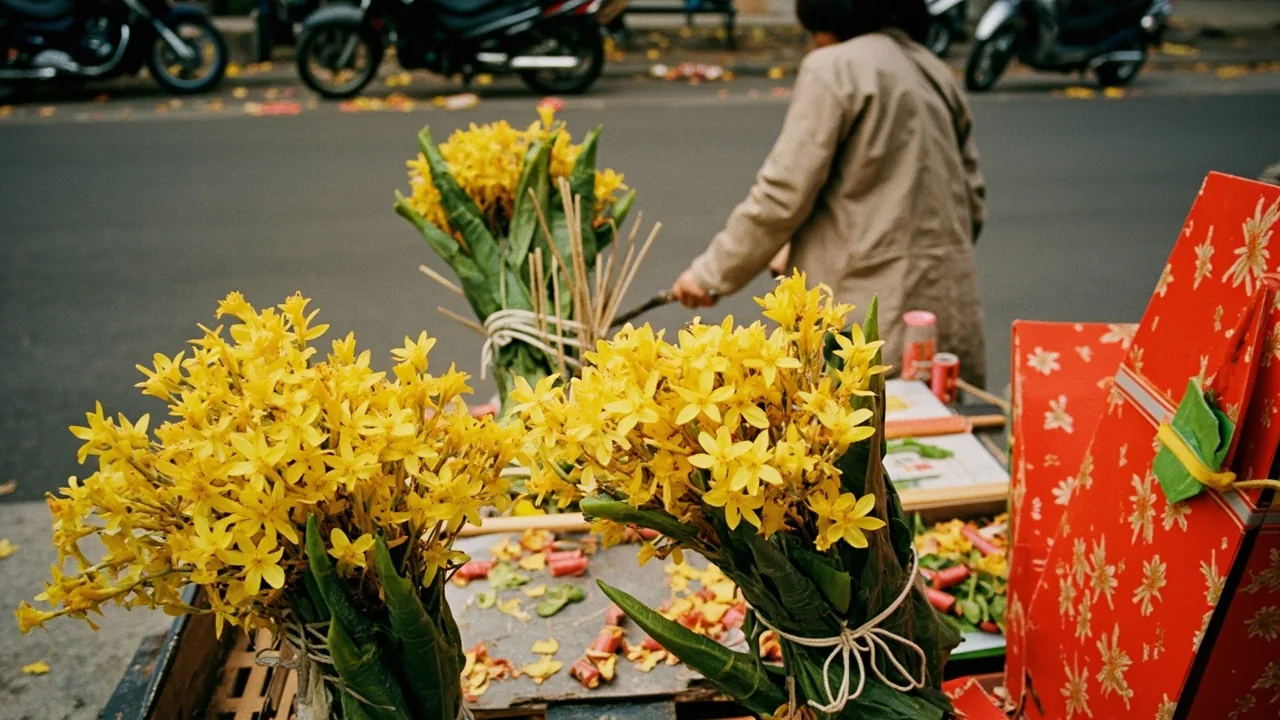
The cultural core of the holiday: family reunion dinners on New Year’s Eve, visits to the đình (communal house) or chùa (Buddhist pagoda) on the first three days, kids receiving lì xì (red envelopes with cash), and a flood of symbolic foods including bánh chưng (square sticky rice cakes) and mứt (candied fruits). The aesthetic is unmistakable: yellow apricot blossoms (hoa mai) dominate the south, peach blossoms (hoa đào) the north, and every shopfront, motorbike, and doorway gets a red-and-gold facelift.
For backpackers, the practical consequences matter more than the symbolism. Here’s the countdown of what happens in a typical Tết week:
7-10 days before Tết: The travelling rush begins. Sleeper buses and Reunification Express train tickets from Hanoi down to Ho Chi Minh City book out 2-3 weeks in advance in 2026, especially for the SE1/SE3 Hanoi-to-Da Nang and Hanoi-to-HCMC legs.
3-5 days before Tết: Flower markets spring up in every city’s empty lots. Hanoi has Hàng Lược and Quảng Bá flower markets; HCMC has the permanent Ho Thi Ky flower market street, which gets extra activity during Tết. Souvenir shops start closing.
Tết Eve + Days 1-3 (the dead zone): This is when Vietnam stops. Most hostels (especially family-run guesthouses) close. Tour operators stop running. The handful of restaurants that do stay open typically charge double and run a limited menu.
Days 4-7: Things reopen slowly. By day 5, you can usually find restaurants and hostels running again, though buses and trains take longer to resume normal schedules.
When Tết Falls in 2026 and 2027 (Mark These Dates)
The Vietnamese government officially announces the lunar holiday dates a few months in advance, and they line up with the lunar calendar rather than the Gregorian one. Travellers need both:
| Year | Lunar New Year’s Eve | Lunar New Year’s Day | Public Holiday Block | Reopening Sweet Spot |
|---|---|---|---|---|
| 2026 | 16 February (Monday) | 17 February (Tuesday) | 16 to 19 February | 22 to 23 February |
| 2027 | 5 February (Friday) | 6 February (Saturday) | 6 to 9 February | 12 to 13 February |
The 2026 public holiday block is four days (16-19 February), and in 2027 it’s also four days (6-9 February). The Government typically tacks on 1-2 extra paid days off for civil servants using year-end compensatory leave, which is why the dead zone usually extends to 6-7 days total.
Travellers report that the worst disruption window for backpackers is roughly a week centred on the official holiday block. If you’re flexible on dates, aim to arrive in any new city one full week before Tết OR one full week after.
What Vietnam Looks Like During Tết (Per City)
The experience varies sharply by region. Northern Vietnam goes hardest into the shutdown: Hanoi, Sapa, Ha Long Bay, Ninh Binh. The south stays semi-functional: Ho Chi Minh City, Phu Quoc, parts of the Mekong Delta. Da Nang and Hoi An sit in the middle.
Hanoi: The Old Quarter goes near-empty. The lake (Hoan Kiem) area, normally chaos, looks like a postcard. Most of the famous street food stalls, including bún chả and phở joints near Ta Hien, close for the week. Tourist infrastructure that remains open (hotels, big-brand hostels, the higher-end restaurants) raises prices noticeably.
Ho Chi Minh City: District 1 stays partly alive, partly because it has international hotels and bigger hostels that keep running. Backpacker Street Phạm Ngũ Lão thins, but doesn’t fully empty. The shutdown is shorter here: 3-4 days versus 5-6 in Hanoi.
Da Nang, Hoi An: Hoi An’s Old Town goes fully dark. Most tailors, lantern shops, and riverfront cafés close for at least 5 days. Da Nang stays more functional because it has fewer family-run guesthouses and more chain hotels. The beaches remain accessible year-round. Plan around the closing of tourist services rather than transport; see our Vietnam weather by month guide to confirm whether you’ll hit late-winter rains.
Phu Quoc, Nha Trang, Da Lat: These tourist-heavy cities run their own rhythms. Phu Quoc’s resorts typically stay open but shut internal dining and activities. Nha Trang still has things running because of its strong Russian and Chinese tourism base. Da Lat, famous for flowers, doubles down on Tet flower tourism, so it stays busier than Hanoi.
Booking Transport Around Tết (Critical in 2026)
This is where most backpackers lose days of their trip. Vietnam’s transport infrastructure runs on reduced schedules during Tết. Trains on the Reunification Express (the Hà Nội - Sài Gòn line) get booked out 2-3 weeks before Tết, and the prices jump. SLEEPER BUSES are even worse: in 2024 (the last comparable data point), the major operators like FUTA, The Sinh Tourist, and Phuong Trang ran 70-80% fewer trips, and tickets sold out 10-14 days early.
The Reunification Express Hanoi-to-Ho Chi Minh City seat segment in 2026: around ₹1,836-₹5,508 (~500,000-1,500,000 VND or ~$19.06-$57.17) depending on seat class and timing. The Hanoi-to-Hoi An sleeper bus segment from Da Nang onward: around ₹918-₹1,469 (~250,000-400,000 VND or ~$9.53-$15.25). For cross-country booking once the calendar is sorted, Book on 12go covers the full Reunification Express and most major bus operators in one search.
For intra-city transport during Tết, Grab availability drops and prices rise sharply. Grab bike is still the cheapest option but the queue can be 30+ minutes in Hanoi during peak shutdown days. Within-city Grab bike: around ₹37-₹92 (~10,000-25,000 VND or ~$0.38-$0.95). Within-city Grab car: around ₹147-₹294 (~40,000-80,000 VND or ~$1.52-$3.05). For Trip planning around Tet, our Hanoi nightlife guide covers the few venues that stay open in the Old Quarter during the shutdown.
Travellers report that tickets for popular routes vanish from inventory 2-3 weeks before Tết, so booking early matters. Reported safe transport strategies around Tết include:
- Book Hanoi-to-HCMC or HCMC-to-Hanoi trains at least 14 days in advance
- Buy bus tickets from FUTA bus stations 7 days in advance if trains are sold out
- Avoid 30 January through 5 February 2026 (10 days before Tết) on the Hà Nội-Sài Gòn express
- Plan to stay put in one city for 4-5 days minimum around the holiday block
Where To Stay During Tết (Without Getting Stranded)
The accommodation landscape shifts hard during Tết. Cheap family-run guesthouses and many independent hostels shut for the week. Big-chain hostels and international hotels usually stay open but raise their rates 30-50% in the days around the official holiday. Book dorm beds at least 2 weeks in advance if your trip overlaps Tết, and confirm in writing (a message thread, not just a verbal yes) that the property is open during your dates.
For pricing reference, here are the standard dorm-bed ranges across Vietnam’s main backpacker cities in 2026:
| City | Dorm Bed (per night) |
|---|---|
| Hanoi | ₹661-₹1,322 (~180,000-360,000 VND or ~$6.86-$13.72) |
| Da Nang | ₹441-₹991 (~120,000-270,000 VND or ~$4.57-$10.29) |
| Hoi An | ₹386-₹881 (~105,000-240,000 VND or ~$4-$9.15) |
| Ho Chi Minh City | ₹551-₹1,212 (~150,000-330,000 VND or ~$5.72-$12.58) |
Expect Tết-week prices to sit at the top of these ranges, or above them, especially for the international-chain hostels that stay open. Many family-run places post a “Closed for Tết” sign from 1 week before to 1 week after the holidays, so don’t gamble on showing up.
If your Vietnam trip has a couple of slack days built in and your dates sit anywhere near the Tết week, the safest pattern is to commit to one city for the full shutdown rather than try to keep moving. Hanoi is the most atmospheric place to be stuck (the flower markets alone justify it). Ho Chi Minh City and Da Nang are the most practical if you need a fully functioning city.
Tet-Specific Experiences Worth Staying For
If you deliberately plan around Tết, the holiday rewards a traveller who leans in.
Flower markets: Hanoi’s Hàng Lược flower market on Tết Eve stays open all night. Tourists and locals buy peach and apricot branches, kumquat trees, and the red-and-gold decorations. HCMC’s Nguyễn Huệ walking street transforms into a flower promenade and pedestrian zone.
Pagoda visits: Chùa Trấn Quốc and Chùa Quán Sứ in Hanoi both run through the night on New Year’s Eve and stay packed for the first three days. Bring a long-sleeved top and a scarf; shoulder coverage is required.
Food you only see during Tết: Bánh chưng (square glutinous rice cake with mung bean and pork), bánh tét (cylindrical cousin), dưa hành (pickled onion), and mứt (candied fruits like ginger, kumquat, and coconut). Vietnamese Soul Food in Hanoi and NGON DA NANG in Da Nang are solid restaurants to sample these regional Tết dishes (think bún chả cá and bánh xèo) anytime of year, but during Tết they run limited menus with the holiday specialties front and center. For strict-vegetarian travellers, Hoang’s Restaurant - Vietnamese Restaurant & Vegan Food in Hanoi and MẸT Vietnamese Restaurant & Vegetarian Met 2 across the country both do vegetarian Tết-specific plates.
Fireworks: Vietnam banned private firecrackers under Decree 137/2003/ND-CP but the major cities stage official fireworks shows at midnight on Tết Eve. Hanoi’s show runs at Hoan Kiem Lake and is visible from kilometres away. HCMC’s main show is by the Saigon River near Landmark 81.
Lì xì: This is the Vietnamese red envelope tradition. If a Vietnamese family gives you one, accept it with both hands and don’t open it on the spot. Adult travellers rarely receive these (kids are the targets), but tourist-facing shops occasionally give small lì xì to foreign customers.
What To Eat (And How)
Vietnam’s food scene during Tết runs on a limited, holiday-themed menu. Most street stalls close, but the places that stay open lean into Tết specialties.
For solid Vietnamese food year-round and during Tết where dishes like bánh xèo and bún chả cá (turmeric-dyed noodle soup with fish) are highlights, NGON DA NANG - VIETNAMESE CUISINE RESTAURANT in Da Nang has a 4.9 rating for its rustic, traditional plates. In Hanoi, Nhà An - Vietnamese local food restaurant and vegan serves classic family-style Vietnamese with vegan options at 4.8 stars, and is one of the few places open in the Old Quarter during Tết week. Vietnamese Soul Food, also in Hanoi, focuses on flavoursome street-food classics year-round.
Vegetarian travellers will be glad to know Tết is a giant vegetarian holiday in Vietnam. Many Vietnamese observe an all-vegetarian first week of the lunar new year (called ăn chay) for karmic and ancestral reasons. That means restaurants across the country serve vegetarian-friendly menus. Hoang’s Restaurant - Vietnamese Restaurant & Vegan Food in Hanoi has a 4.9 rating and a wholly vegetarian menu. Sen Trang An Vietnamese Restaurant in Hanoi goes heavy on the local vegetarian game. Across the country, MẸT Vietnamese Restaurant & Vegetarian Met 2 (4.9 stars), De Tham Restaurant - Vietnamese cuisine & vegetarian Food (4.9 stars), and A Taste Of Saigon - Old Market - Vietnamese Cuisine & Vegetarian Food (4.9 stars) are reliable veg-friendly spots anywhere on the itinerary.
Getting Connected During Tết
Network quality doesn’t drop during Tết but SIM card and eSIM vendors often close shop. Airports keep their kiosks open for arrivals, and the major telcos (Viettel, Mobifone, Vinaphone) keep running. If you’re arriving on Tết Eve or Day 1, buy your SIM at the airport rather than waiting to find a city store, which may not open for 4-5 days. The eSIM option is the cleanest solution if you don’t want to navigate reduced physical-shop hours: Get Nomad eSIM ships activation in minutes and works on all three Vietnamese networks.
Subodh’s Pro Tip: Buy your SIM at the airport even if you’re a control freak who likes to set up local connectivity slowly. During Tết the official Viettel/Mobifone/Vinaphone retail stores in central Hanoi and District 1 HCMC sometimes close for the public-holiday week, and the unofficial mini-marts that resell tourist SIMs vanish. The airport kiosk runs the same product lines all year.
Common Tet Mistakes Backpackers Make
Mistake 1: Booking Hanoi-to-HCMC transport 3-4 days before Tết
What people do wrong: assume last-minute tickets work. What happens: sleeper buses and trains are sold out 10-14 days in advance, and the only seats available are 2-3x the normal price. How to avoid it: book at least 2 weeks ahead or buy from a known big operator (FUTA, The Sinh Tourist, Vietnam Railways) as soon as you can confirm your dates. For Trip booking, our Vietnam backpacking hub covers transport basics.
Mistake 2: Assuming “Tet shutdown” is a 1-day event
What people do wrong: show up on Tết Day 1 expecting everything to be back normal. What happens: shops and hostels stay closed through Day 5 or even Day 7 in family-run areas. How to avoid it: treat the full week (Tết Eve + 6 days) as a “stay put” zone. Move into a city before Tết Eve and stay there until you’ve eaten one too many bánh chưng meals.
Mistake 3: Eating at the only tourist restaurant that happens to be open
What people do wrong: pay double for a tourist-menu meal because the only option is a hotel restaurant. What happens: an extra ₹551-₹1,102 (~150,000-300,000 VND or ~$5.72-$11.43) per meal for the same dish you could have had for ₹184 (~50,000 VND or ~$1.91) last week. How to avoid it: plan meals around your accommodation, ask hostel staff what’s open (they often know which traditional places stay open for the holiday), or ask hostel staff well in advance which traditional places stay open for the holiday.
Mistake 4: Wearing shorts to a pagoda on Tết
What people do wrong: show up to a major temple in tank tops and shorts. What happens: you get turned away at the entrance or asked to buy a borrowed scarf. How to avoid it: pack one pair of long trousers and a long-sleeved shirt. Hanoi’s pagodas get stricter on Tết than usual. Our Vietnam packing list for December covers clothing for the late-winter Tet window.
Mistake 5: Trying to leave Vietnam on Tết Day 1
What people do wrong: book a flight out on 17 February thinking it’s a regular Tuesday. What happens: airport’s fine, transport to the airport is the bottleneck. Grab cars get queued 60-90 minutes during Tết Day 1 morning. How to avoid it: book airport transfers (private car or shuttle) at least 3 days in advance, or fly out on Tết+5 when things have stabilized.
Safety and Scams During Tết
Tết is one of the safer periods for foreign travellers in Vietnam. Petty crime drops because so many stores are closed (and not in a way that creates criminal opportunity, in a “shops aren’t open for thieves to target” sense). What does rise: tourists wandering into closed markets trying to access their bookings, then getting directed to inflated alternatives.
The “Closed, but my cousin can help” scam: At flower markets or pagodas, locals tell tourists the “official” stall is closed but a cousin’s stall has the same thing for 3x the price. Walk away; the official stalls reopen 30 minutes later.
The inflated Grab surge: Grab prices jump 2-4x during Tết evening hours. If you’re not in a rush, public buses and the rare local taxi still run at meter rates.
The “no rooms” negotiation: At hostels that are open, the front desk knows foreign travellers have limited options. They’ll quote double or triple the rack rate. The fix: confirm a price before you hand over your passport, and ask for the dorm bed price (most hostels have a posted dorm rate; quoting from a card eliminates haggling).
For general safety scenarios during Tet week, check the Indian government’s official MEA travel advisory page at mea.gov.in before departure for the latest Vietnam-specific guidance. Vietnam’s own tourism advisory at tourism.gov.vn also lists holiday-period travel notes.
Safety Alert: Tết is family reunion time, which means drinking-related incidents and traffic accidents spike. If you ride a motorbike during Tết week (which we don’t recommend at any time), treat the roads with extra caution: more drunk drivers, more chaotic intersections, more families on foot. Carry your passport, register with your embassy if staying long-term, and have travel insurance that covers medical evacuation across Southeast Asia.
FAQ
Can I get a Vietnam visa during Tết?
Yes, the e-visa portal at https://evisa.xuatnhapcanh.gov.vn stays open 24/7 including Tết week (the Vietnam Immigration Department is one of the few government functions that doesn’t fully shut down). Apply at least 3 days before your flight, ideally 7 days, since processing can slow around major holidays. Indian passport holders get 90 days, multiple entry, for the standard e-visa fee of ~₹2,408 (~25 USD).
Should I just avoid Vietnam entirely during Tết?
Only if you only have one week in Vietnam. If your trip is 2-3 weeks and one chunk of it overlaps the holiday, you’ll be fine. Book transport and accommodation in advance, plan to stay put in 1 city for 4-5 days, and lean into the holiday rather than fight it.
Do hostels close?
Yes, especially family-run ones. Big international hostels (the chain-affiliated ones like the chain hostels that use Booking.com-style inventory) usually stay open but raise rates. Family-run guesthouses, where most cheap beds live, often close for 1-2 weeks.
Is Tết a good time to visit Phu Quoc, Nha Trang, or Da Lat?
Phu Quoc: yes, the resort infrastructure stays open and the island is calmer. Nha Trang: yes, similar logic, plus it has year-round Russian/Chinese tourism keeping things operational. Da Lat: yes, and the flowers are at their best. Hoi An: no, the Old Town goes fully dark.
What is the legal drinking age in Vietnam?
18, enforced inconsistently. Some bars and pubs in the backpacker districts will serve younger-looking tourists if they’re 18+ with passport. During Tết, the supermarkets limit alcohol sales in the early days of the holiday (until midday). Check local signage.
Is Tết a dry holiday (no alcohol)?
No. Tết itself is not a dry holiday. The dry holiday in Vietnam is Tết Đoan Ngô (summer solstice festival in late May). However, family values during Tết mean public displays of drunkenness are frowned on in residential and pagoda zones.
Can I book Vietnam transport through 12go during Tết?
Yes, 12go aggregates FUTA, The Sinh Tourist, Vietnam Railways, and most major operators, and works during Tết even when individual operator websites struggle under the load. Tickets for popular routes vanish from inventory 2-3 weeks before Tết, so don’t wait.
Subodh’s Take
Tết is one of those rare moments where Vietnam’s everyday hustle takes a breath, and the country shows you who it is underneath the motorbike and scooter chaos. If you can structure your trip around it (a week before or after), do, because the flower markets, pagoda crowds, and family warmth are the most Vietnamese thing you can experience. If you can’t, be honest with yourself about constraints, lock down your transport 2 weeks ahead, pick one city to bunker in, and treat the reduced menu and inflated prices as a temporary tax, not a crisis. Either way, accept the lì xì if locals offer it, and stay an extra day if a Vietnamese family invites you to their Tết lunch.
