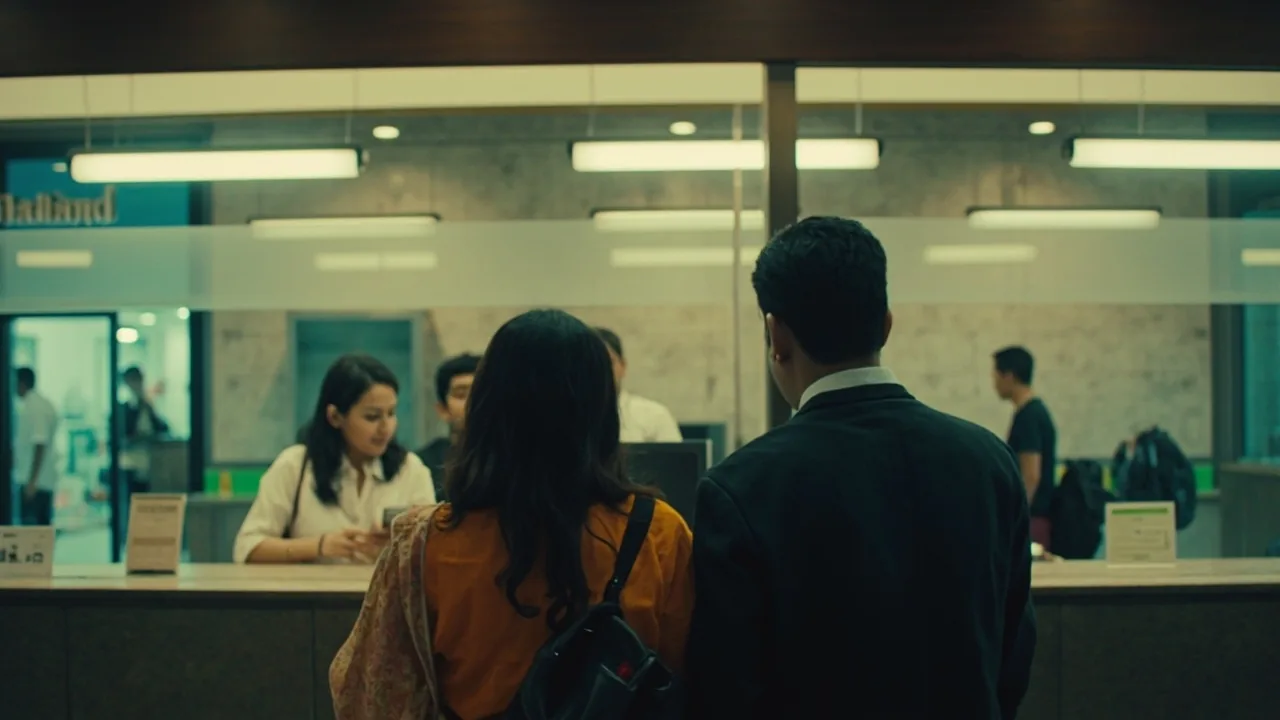
Thailand Visa for Unmarried Indian Couples: Real Problems at Immigration and How to Avoid Them
The short answer to the thailand visa for unmarried indian couple problems question: there is none. Indians get 60-day visa-free entry to Thailand as of mid-2026, no marriage certificate required, no separate “couple visa,” nothing beyond a valid passport, the Thailand Digital Arrival Card, and proof of funds.
There is no Thai law that bars unmarried Indian couples from entering, sharing a hotel room, or travelling together. The trouble is not policy. The trouble is paperwork, presentation, and a handful of officials at smaller airports who sometimes ask questions Indian couples are not prepared for. This guide walks through what happens at the desk, the documents that smooth the interview, and the cash and accommodation requirements that trigger rejection if you walk in unprepared.
If your situation is more standard (solo traveller, family with kids, business trip), the Thailand visa guide for Indian passport holders covers the basics. If you are specifically weighing visa-on-arrival against visa-free, the VoA step-by-step for Indians is the closer fit. This article is for the case everyone whispers about on Reddit and Quora: two Indians, no marriage certificate, planning a honeymoon or holiday together.
Quick Answers
| What | Answer | Price (INR) |
|---|---|---|
| Visa required for Indians? | No, visa-free 60 days | ₹0 |
| Primary visa type | Visa Exemption (bilateral) | ₹0 |
| Fallback / alternative | Tourist Visa (TR) from embassy | ₹7,230 (~$75) |
| Processing time | Instant at immigration (visa-free) | ₹0 |
| Validity / max stay | 60 days, single entry under exemption | ₹0 |
| Extension possible? | Yes, 30-day extension at immigration office | ₹5,400 (~$56.01) |
| Mandatory arrival form | TDAC at tdac.immigration.go.th | ₹0 (free, mandatory) |
Rates verified against the Thai Immigration Bureau portal on 2026-07-17. Visa rules are the most volatile data on this site, so the date matters: check the Thai MFA site within a week of travel.
What the Thai Law Says About Unmarried Couples
There is no Thai statute that asks about marital status at the border. Thailand’s immigration form (the TDAC, formerly the TM.6) asks for accommodation address, purpose of visit, and length of stay. It does not ask whether the two of you are married. Hotel check-ins across the country accept any two adults with valid IDs, married or not. The much-repeated “you need a marriage certificate at Thai immigration” is a rumour that has outlasted the actual practice by at least a decade.
Where it gets thorny is the gap between Thai law and individual officer discretion. A senior officer at a quiet border checkpoint who has just dealt with a string of overstay cases may ask probing questions about a young Indian couple arriving on a one-way ticket with a single hotel booking under one name. None of this is written down. It is officer judgement. That is why preparation matters more than the visa category itself.
Subodh’s Pro Tip: Thai immigration officers at the four big international airports (Bangkok Suvarnabhumi, Bangkok Don Mueang, Phuket, Chiang Mai) handle hundreds of Indian passport holders a week. The smaller airports (Krabi, Surat Thani, Hat Yai, Chiang Rai) handle far fewer, which means less routine and more questions. If you have any anxiety about being asked to justify your relationship, fly into BKK or DMK.
The ₹57,430 (~20,000 THB or ~$595.72) Cash Rule (And Why It Matters for Couples)
This is the single most concrete document-related problem Indian travellers hit, and it is where the NDTV-cited Thai travel advisory matters most. As of mid-2026, Thailand requires visa-on-arrival travellers to carry at least ₹57,430 (~20,000 THB or ~$595.72) per person (₹114,860 (~40,000 THB or ~$1,191.45) per family) in cash, plus a confirmed return ticket and a hotel booking for the entire stay. The rule technically targets VoA, but immigration officers at land borders have been known to apply the same standard to visa-free arrivals if they suspect the visitor may not be able to support themselves. Couples should treat this as a soft floor regardless of which visa type they are on.
| Traveller profile | Cash to carry (minimum) |
|---|---|
| Single adult (visa-on-arrival) | ₹57,430 (~20,000 THB or ~$595.72) |
| Family of 4 on VoA | ₹114,860 (~40,000 THB or ~$1,191.45) |
| Couple on visa-free 60 days | ₹28,715 (~10,000 THB or ~$297.86) per person recommended (not enforced, but officer may ask) |
The cash does not need to be Thai baht. Equivalent in USD, or any convertible currency counts. A forex card balance does not count. The officer wants to see physical currency or a recent ATM withdrawal slip. Couples who fly in with only forex cards and zero cash in hand are the profile that gets secondary screening.
Subodh’s Pro Tip: Carry ₹71,788 (~25,000 THB or ~$744.66) per person in mixed notes. The ₹2,872 (~1,000 THB or ~$29.79) notes add up fast and look more legitimate than a thick stack of 100s at the bottom of a backpack. Couples can share the cash between bags so neither wallet looks suspiciously empty.
Documents That Smooth the Interview
There is no official document checklist for “Indian unmarried couple entering Thailand,” but travellers who sail through immigration smoothly tend to carry the same handful of items. None of these are required by law for the visa-free 60-day entry. All of them help an officer move on to the next passport.
Both travellers carry:
- Passport valid for 6+ months, with at least 2 blank pages (check the Thailand visa photo requirements for Indians for exact specs)
- Printed TDAC confirmation (QR code or PDF, not just a phone screenshot)
- Printed return flight ticket (the route, not necessarily a paid booking, but a confirmed GDS itinerary looks better)
- Hotel booking covering the first 3 to 5 nights, in either or both names
- 20,000 THB+ in cash or equivalent convertible currency
- Travel insurance showing Thailand coverage dates (SafetyWing and similar plans work)
Optional but useful:
- A short cover letter on plain paper stating the trip dates, cities you plan to visit, and a contact in India. This is overkill for 90% of arrivals, but for couples who have been pulled aside before, it works.
- A printout of your salary slips or a bank statement showing the last 3 months. Officers almost never ask, but if asked, this ends the conversation in 30 seconds.
- A wedding invitation card, engagement photo printout, or any document that establishes you are a couple. This is the single most over-recommended item online. Officers do not ask for it, and if you offer it unprompted, it draws attention to the thing you are trying to avoid flagging.
The key principle: look like a tourist, not like someone trying to immigrate. Confirmed return ticket, paid hotel, sufficient cash, travel insurance. That’s the profile officers wave through.
Step-by-Step: How Unmarried Couples Should Prepare
These are the steps Indian couples consistently report working, in order:
- Book a return flight, both names on the same PNR if possible. Two one-ways on different airlines looks like indefinite travel. A round-trip with a fixed return date in the same booking looks like a holiday.
- Book hotel for the first 3 to 5 nights, ideally refundable. The booking should be under either name (not both, that triggers questions about shared finances in some cases). Use Booking.com or Agoda for free cancellation up to 24 hours before check-in.
- Complete the TDAC at tdac.immigration.go.th within 3 days of arrival. Both travellers fill it separately. Save the QR code on two devices each.
- Carry the cash floor: 20,000 THB per person in convertible currency, split between wallets and bags.
- Buy travel insurance that covers Thailand for the trip duration. The SafetyWing plan covers Indian travellers from ~$62/month (~₹5,900) and prints the certificate in 5 minutes.
- Print everything: TDAC QR, return ticket, hotel confirmation, insurance certificate. Phone screenshots fail more often than paper printouts at immigration.
- At the desk: answer only what is asked. “Holiday,” the city names, the hotel name, the return date. Do not volunteer explanations. Do not show your relationship documents unless asked.
At the Airport: What Happens
At Bangkok Suvarnabhumi, Indian passport holders line up at the foreign passport counter. The officer scans the passport, glances at the TDAC, and asks the standard three questions:
- Purpose of visit? (“Holiday” or “tourism”)
- How long? (Whatever your TDAC says, plus 1 to 2 days buffer)
- Where are you staying? (First hotel name, city)
That is the routine. Couples in the same queue get asked the same questions separately or together. There is no question about marital status. There is no request for a marriage certificate. There is no refusal on the basis of relationship. The stamp goes in, 60 days is granted under the bilateral exemption, you walk out. If you are leaving Thailand with purchased goods, read the VAT refund at airport guide to claim back the 7% on qualifying purchases before you board.
The non-routine case looks like this: the officer flips through the passport and notices a previous overstay stamp, a denied US visa, a tourist visa that was extended once already, or a work permit that has expired. The officer may ask for proof of funds (cash, bank statement, credit card). The officer may ask how you know each other if the photo on the passport does not match the person standing there. None of this is about being unmarried. All of it is about looking low-risk.
Safety Alert: If you are asked to step aside for secondary screening, stay calm, hand over the documents you have, and answer in short sentences. Officers at Thai immigration are professional. Secondary screening is not a detention. It usually lasts 10 to 30 minutes and ends with either entry granted or, in rare cases, a voluntary withdrawal where you board the next available flight home. For current advisory updates from the Indian government, check MEA travel advisories before departure.
The Thailand visa-free entry rules for Indians explain what has changed in 2026 and how long the 60-day window is expected to last. Couples who want a longer stay than 60 days should read that article before booking non-refundable hotels.
Extensions and Overstay
The 60-day visa-free entry can be extended by 30 days at any Thai immigration office, including the one at Bangkok’s Chaeng Watthana government complex. The cost is ₹5,456 (~1,900 THB or ~$56.59), paid in cash at the counter. Couples can apply together but each pays separately. The extension gives you 90 days total in the country on one entry.
Overstay fines are ₹1,436 (~500 THB or ~$14.89) per day, capped at ₹57,430 (~20,000 THB or ~$595.72). The bigger risk is the blacklisting: overstays of more than 90 days trigger an automatic entry ban of 1 to 10 years, depending on the case. Couples who overstay together get processed separately, and the ban applies to the individual passport, not the relationship.
For most unmarried couples on a standard 7 to 14 day trip, none of this is relevant. It is relevant only for couples who decide to extend their stay informally (do not do this) or who overstay because of a miscalculated TDAC date.
Common Mistakes Indian Couples Make
Mistake 1: No hotel booking at all. Travellers who plan to “find a place when we land” get asked at immigration where they are staying. “We will figure it out” is not an answer that works. Book the first 3 nights, refundable, and you’re done.
Mistake 2: One-way ticket. This is the single biggest red flag at any immigration desk worldwide, not just Thailand. Buy a return. The cheapest round-trip from India to Bangkok in mid-2026 is around ₹18,000 (~$186.71) with a stopover, and the round-trip proves you intend to leave.
Mistake 3: Bringing more than the cash floor, expecting to spend it. Carrying ₹287,150 (~100,000 THB or ~$2,978.62) in cash raises a different question: where did you get it, and is it declared? Stay within the 20,000-30,000 THB range per person. Use ATMs in Thailand for the rest.
Mistake 4: Sharing a name on the TDAC form. Each traveller fills their own TDAC. A common error is for one person to fill both names in the “travelling with” field and skip the second form. The second traveller then has no QR code and gets pulled aside at immigration.
Mistake 5: Lying about the relationship when asked. If an officer directly asks if you are married and you say yes, then get asked to produce the certificate, the lie becomes the problem, not the unmarried status. The honest answer is “we are partners, we are travelling together on holiday.” That has never been a legal ground for refusal.
Mistake 6: Forgetting that VoA is 15 days, not 60. Couples on a longer honeymoon who picked VoA over visa-free because a blog said so are stranded at day 16 with no extension option. The bilateral 60-day exemption is the right fit for almost everyone. If you are weighing both, the VoA vs visa-free comparison is worth reading.
Honeymoon Packages and the Marriage Certificate Question
Indian travel agents selling Thailand honeymoon packages sometimes tell couples they need a marriage certificate for hotel check-in. This is false. Thai hotels accept any two adults with valid IDs. The confusion comes from a handful of resorts that ask for “relationship proof” to grant couple-specific perks (welcome drinks, honeymoon bed decoration, complimentary cake). These perks are marketing, not legal. You can claim them by saying “it’s our honeymoon” at check-in. No proof required.
The same applies to the marriage registration angle. Couples asking “can we get married in Thailand?” should know that Thailand allows foreigners to marry, but the process requires an affidavit from the Indian embassy in Bangkok, translations, and a waiting period of at least 3 days. It is not a casual ceremony. Most Indian couples who ask this question are just looking for a romantic trip, not a legal marriage. If the latter, contact the Embassy of India in Bangkok before travelling.
For couples coming to Thailand on a Schengen, UK, or US visa and hoping that helps with immigration, the VoA-with-other-visa guide explains why this does not change the Thai immigration process.
Getting Connected
The moment you clear immigration you need data: for the Grab ride to the hotel, for the hotel address in Thai, for the TDAC QR if you need to show it again. The cheapest physical SIM at Suvarnabhumi is the AIS or TrueMove tourist SIM, ₹1,146 (~399 THB or ~$11.88) for a 15-day pack with around 15 GB of data, available at the official AIS and TrueMove counters past customs and at any 7-Eleven in the arrivals hall. For travellers who want connectivity before they land, the Get Nomad eSIM activates over Wi-Fi on the plane and works the moment you step out of the airport.
FAQ
Do unmarried Indian couples need a marriage certificate for Thailand visa? No. The visa-free 60-day entry has no marital status requirement, and the TDAC form does not ask.
Is Thailand safe for unmarried Indian couples? Yes. Thai law does not restrict unmarried couples from entering, sharing hotel rooms, or travelling together. Hotel check-ins across the country accept any two adults with valid IDs.
Can unmarried couples share a hotel room in Thailand? Yes. Thai hotels routinely accept any two adults with valid IDs regardless of marital status.
What is the ₹57,430 (~20,000 THB or ~$595.72) cash rule for Indians? Visa-on-arrival travellers must show ₹57,430 (~20,000 THB or ~$595.72) per person (40,000 THB per family) in cash or equivalent convertible currency. The rule targets VoA but officers may apply it to visa-free arrivals during secondary screening.
Do I need a separate Thailand visa for a honeymoon? No. The standard visa-free 60-day entry covers honeymoon trips. There is no “honeymoon visa” category.
Can I get married in Thailand as an Indian citizen? Yes, but the process requires an affidavit from the Indian embassy in Bangkok, sworn translations, and a 3-day waiting period. It is not a casual legal step. Contact the Embassy of India Bangkok in advance.
What if the immigration officer asks about our relationship? Answer honestly: “We are partners, here on holiday.” This is not a legal ground for refusal under Thai immigration law.
Subodh’s Take
The Indian internet has spent a decade convincing unmarried couples that Thailand is a paperwork minefield. It is not. Thai immigration has no rule, no form question, and no officer script that asks about your marital status. The couples who get pulled aside are the ones who look low-risk on paper (no return ticket, no hotel, no cash, blank passport) and that has nothing to do with the relationship. Travel with the standard tourist profile: round-trip ticket, paid hotel for the first few nights, ₹57,430 (~20,000 THB or ~$595.72) per person in cash, TDAC filled, insurance printed. You will walk through immigration in under 5 minutes. The blog fear is louder than the airport reality. If you are planning a broader Southeast Asia trip, the Southeast Asia backpacking hub has country-by-country logistics for all nine destinations.
