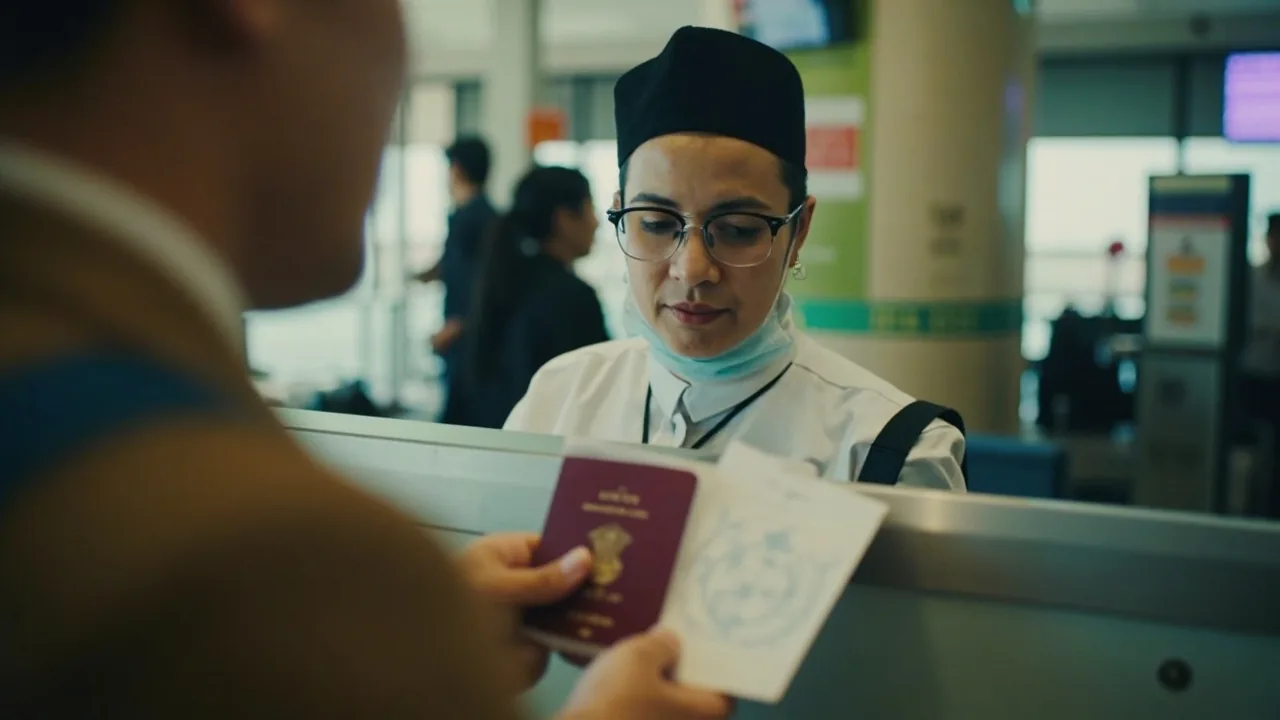
Thailand Visa-Free Entry for Indians: Current End Date, New Rules & How Long It Lasts
Indians get a 60-day visa-free entry to Thailand under the bilateral exemption, and this page answers the thailand visa for indians free date question with the latest rules. The catch is the new TDAC digital arrival card, which is now mandatory for every Indian traveller boarding a flight to Bangkok, Phuket, or Chiang Mai, with or without a visa.
This page covers the current visa-free window, the exact rules Indian passport holders must follow in 2026, the documents immigration checks, and what the 15-day VoA fallback looks like for the day this scheme ends. You may also find Thailand Tourist Visa Unmarried Indian Couple Problems useful for this trip.
Quick Answers
| What | Answer | Price (INR) |
|---|---|---|
| Visa required for Indians? | No, 60-day visa-free | , |
| Primary visa type | Visa Exemption (bilateral) | ₹0 |
| Fallback / alternative | Visa on Arrival (15 days) | 5,773 |
| Processing time | Instant at immigration | , |
| Validity / max stay | 60 days, single entry | , |
| Extension possible? | Yes, at Thai immigration office | 5,500 |
| Mandatory arrival form | TDAC (digital arrival card) | ₹0 |
The Current End Date and How Long It Lasts
Thailand’s bilateral visa-free arrangement with India has been renewed on a rolling basis for years, and the Thai Ministry of Foreign Affairs treats it as a permanent standing exemption rather than a fixed-window scheme with a sunset clause. As of 2026-07-23, there is no published expiry date, no scheduled termination, and no announcement that Indians will be moved back to visa-required status.
What does have a hard date is the TDAC digital arrival card rule. Thailand made TDAC mandatory from 1 May 2025, and it now applies to every foreign visitor, including Indians travelling visa-free, on VoA, or on a tourist visa. The card itself is free and takes under five minutes to fill in at the official portal, but it has to be done before you board your flight.
Subodh’s Pro Tip: The “end date” question in Google searches usually means one of two things: when does the 60-day exemption itself end (no fixed date as of this writing), or when does the free-entry perk get downgraded. The real deadline that bites Indian travellers is the TDAC submission window, which closes at the boarding gate, not at the Thai border.
Visa Types Compared
Visa Exemption (the bilateral 60-day scheme)
This is the one Indians use in 2026. Indian passport holders walk up to Thai immigration, present a passport with at least six months validity, a confirmed return or onward ticket, and proof of funds (the unofficial threshold is ₹28,589 (~10,000 THB or ~$296.75) per person or ₹57,178 (~20,000 THB or ~$593.51) per family), and the officer stamps 60 days. There is no fee, no application, and no embassy visit. A single entry stamp is the default, though you can request a multiple-entry exemption at the officer’s discretion if you show a tight same-trip itinerary covering a third country.
If 60 days isn’t enough, you can extend once at a Thai immigration office for a further 30 days, giving a 90-day total stay. The extension fee is 1,900 THB (~₹5,500 or ~56 USD), paid in cash in Thai baht at the counter.
Visa on Arrival (the 15-day fallback)
If the bilateral exemption ever lapses, or if you arrive without TDAC filled in correctly, the fallback is VoA, which gives Indians just 15 days. The fee is ₹5,773 (~58 USD), paid in cash at the VoA counter before you queue at immigration. You also need a 4x6 cm photo on a white background, taken within the last six months, and the same proof of funds and return ticket as the visa-free route. VoA is not extendable, so once your 15 days are up you either leave or start overstaying. For most Indian travellers doing a real Thailand trip (Bangkok, an island, Chiang Mai), 15 days is too tight to be useful, which is why the visa-free 60 days matters.
Tourist Visa (TR / METV) from a Thai embassy
If you want a multiple-entry option or you need a longer total stay than 90 days, the Thai embassy in Delhi, Mumbai, Kolkata, Chennai, or Bengaluru issues a single-entry Tourist Visa (TR) for ₹7,225 (~75 USD). It gives 60 days, extendable by another 30 days inside Thailand. The multiple-entry version (METV) is ₹17,153 (~6,000 THB) and is worth it only if you plan to cross into Laos, Cambodia, or Myanmar and come back to Thailand on the same trip. Most Indians skip the TR entirely because the visa-free 60-day scheme already covers most real itineraries.
Subodh’s Pro Tip: Don’t pay for a TR visa through an agent if you only need a single entry under 60 days. The visa-free exemption gives you the same 60-day window for ₹0, and the only reason to pre-pay for a TR is if you want a multiple-entry stamp in your passport before you fly, or if you’re arriving on a one-way ticket and need the embassy-issued visa to satisfy airline check-in.
Step-by-Step: How to Apply (Visa-Free, the default Indian path)
The “application” is preparation, because Thai immigration issues the stamp on arrival. Indian travellers do still need to do two things before they fly: complete TDAC and check their documents.
-
Fill in TDAC at the official portal. Go to https://tdac.immigration.go.th, enter your passport details, flight number, accommodation address in Thailand, and submit. You get a QR code or PDF, either of which immigration accepts on arrival. No fee, takes 3 to 5 minutes.
-
Check passport validity. Your passport must be valid for at least 6 months from your date of entry into Thailand. If it has under 6 months left, you will be refused boarding at the airline counter, not at Thai immigration.
-
Carry proof of funds and return ticket. Immigration doesn’t always ask, but if they do, you need either ₹28,589 (~10,000 THB or ~$296.75) in cash, a forex card statement, or a bank app screenshot showing the equivalent, plus a return or onward flight booking out of Thailand.
-
At Bangkok Suvarnabhumi, Don Mueang, Phuket, or Chiang Mai: follow the “Visa Exemption” or “Passport Control” line, not the VoA line. Hand over your passport, TDAC QR, and boarding pass. The officer stamps 60 days, takes a photo, and you’re through in 10 to 20 minutes if the queue is normal.
If You Ever Need to Use the 15-day VoA Instead
- Pre-fill TDAC the same way. Even VoA travellers need the digital arrival card now.
- Carry a 4x6 cm photo on white background, taken within 6 months. Photo booths at Suvarnabhumi cost around ₹286 (~100 THB or ~$2.97) if you forget.
- Have ₹5,773 (~58 USD) ready in cash. Pay at the VoA counter before joining the immigration queue.
- Hand over passport, photo, TDAC QR, and proof of funds. Officer stamps 15 days, single entry.
At the Airport / Border
At Suvarnabhumi (BKK) and Don Mueang (DMK), Indian passport holders use the same immigration hall as everyone else. The “Visa Exemption” lane is signposted in English and Thai. At smaller airports like Chiang Mai (CNX), Phuket (HKT), or Krabi (KBV), there’s usually one combined foreign-passport counter with a separate VoA window next to it. Pick the visa-exemption counter unless you specifically requested VoA.
Officers typically ask three questions: where you’re staying, how long you plan to stay, and whether you have a return ticket. Answer with the address of your first hotel/hostel, the actual length of stay (under 60 days), and your confirmed return flight. Have your TDAC QR pulled up on your phone in case the officer asks for it, but you don’t need to show it unless requested.
For land borders, the rules are identical on paper but the enforcement is stricter. The Thai-Myanmar border at Mae Sot, the Thai-Cambodia border at Aranyaprachom, and the Thai-Laos border at Nong Khai all stamp the same 60-day visa-free entry, but they sometimes ask for a printed hotel booking and a tighter proof-of-funds check than airports. Don’t try to enter Thailand overland without a printed return ticket and TDAC completed, both are far more likely to be enforced at a land post than at BKK.
For the full land-border picture, the Thai visa-on-arrival guide for Indians covers the documentary checklist in detail.
Extensions & Overstay
If you want more than 60 days, you can extend once at any Thai immigration office inside the country. The fee is 1,900 THB (~₹5,500 or ~56 USD), paid in cash in Thai baht. The standard offices are at Chamchuri Square in Bangkok, Chiang Mai’s Promenada area, and the provincial halls in Phuket, Krabi, and Koh Samui. Apply at least 7 days before your current 60-day stamp expires, bring your passport, a TM.7 form (available at the office), and a passport photo. The extension adds 30 days for a 90-day total.
Overstay fines are ₹1,429 (~500 THB or ~$14.84) per day for overstays under 90 days, capped at ₹57,178 (~20,000 THB or ~$593.51). Overstays exceeding 90 days face a different fine structure and a higher blacklisting risk. Thai immigration rarely deports on a small overstay if you pay the fine at the airport, but a 30-day overstay can trigger a re-entry ban that lasts one to ten years depending on severity. The cheapest version of any Thailand trip is one where you check the calendar before flying home.
Common Mistakes & Rejection Reasons
Forgetting TDAC. Indian travellers arriving visa-free sometimes skip TDAC because they assume it only applies to VoA holders. It applies to everyone. No TDAC = no boarding at most airlines, no entry at the gate if you slip through. Five minutes at https://tdac.immigration.go.th solves it.
Six-month passport rule misread. The six months is from your date of entry, not from the date of visa application (there is no application for visa-free). Count from the day you land in Thailand. If you have 5 months and 29 days left on entry day, you can be turned away.
Name mismatch between Aadhaar/passport and return ticket. The name on your flight booking out of Thailand must match your passport exactly. If your Aadhaar has a middle name and your passport doesn’t, or vice versa, the airline check-in agent can refuse to let you board.
Asking for 60 days without a return ticket. A one-way ticket to Thailand on visa-free is a red flag. Thai immigration can grant a shorter stamp (sometimes 30 or 15 days) if they don’t see an exit plan. Book a refundable return, or at least an onward flight to Bangkok’s neighbour.
Assuming VoA and visa-free are interchangeable. VoA is 15 days, not extendable, costs ₹5,773 (~58 USD), and needs a photo. Visa-free is 60 days, extendable once, free, and only needs TDAC. They are not interchangeable; pick the right one before you fly.
For the visa photo specification Indians need at the VoA counter, see the Thailand visa photo size guide.
Getting Connected
If you’d rather not queue at the airport, Get Nomad eSIM and activate before you fly, so you have data the second the plane lands.
Safety and Pre-Departure Checks
Thailand is one of the safer Southeast Asian destinations for Indian travellers, but visa rules and safety advisories are updated independently of each other, so check both before you fly. Before booking, glance at the current Indian Ministry of External Affairs travel advisory at mea.gov.in for any region-specific notes (the southern provinces occasionally see travel advisories that don’t affect Bangkok, Phuket, or Chiang Mai). The Thai government’s own tourism safety portal is also worth a look. For the broader Southeast Asia backpacking route through Thailand and its neighbours, see our Southeast Asia backpacking hub.
Standard precautions apply: keep a photocopy of your passport and TDAC QR separate from the originals, register on the Indian embassy portal if you’re staying 30+ days, and save the Thai tourist police number (1155) in your phone before you leave the airport.
For the wider Southeast Asia picture, the country-by-country visa guide covers every neighbouring country’s rules in one place.
FAQ
Do Indians need a visa for Thailand in 2026? No. Indians get 60-day visa-free entry under Thailand’s bilateral exemption scheme, with no fee and no embassy visit.
What is the last date of Thailand’s visa-free entry for Indians? There is no fixed end date as of 2026-07-23. Thailand renews the exemption on a rolling basis and has not announced a termination.
What are the new rules for Indians entering Thailand? TDAC (the digital arrival card) is mandatory for every Indian traveller, even those travelling visa-free. Submit it at https://tdac.immigration.go.th before boarding.
Can Indians get a Thailand visa on arrival? Yes. The Visa on Arrival gives Indians 15 days at ₹5,773 (~58 USD) and is mainly a fallback if the bilateral exemption is ever suspended.
How many blank pages do I need in my passport for Thailand? At least two blank pages for the entry stamp and any extension stamp. Some airlines also want space for their own stickers, so four is safer.
Can I extend my 60-day visa-free stay in Thailand? Yes, once, for 30 more days. Apply at a Thai immigration office (Chamchuri Square in Bangkok is the main one) for 1,900 THB (~₹5,500 or ~56 USD), giving a 90-day total.
What happens if I overstay my Thai visa? You pay ₹1,429 (~500 THB or ~$14.84) per day, up to ₹57,178 (~20,000 THB or ~$593.51). Overstays can trigger re-entry bans whose length depends on the duration of the overstay and is set by Thai immigration on a case-by-case basis.
Subodh’s Take
The “Thailand visa-free for Indians end date” question gets Googled hundreds of times a day, and the honest answer is that there isn’t one worth worrying about right now. The bilateral exemption has been continuous for years, and Thailand has no economic reason to end it when Indian arrivals are at record highs. The thing that catches Indian travellers out is TDAC, which is free and fast but mandatory, and the 6-month passport rule, which is older than the visa-free scheme itself but still the single most common reason for a refused boarding. If you’re doing a standard 7 to 21 day Thailand trip, don’t pay anyone for a visa, don’t book through an agency that charges for the free visa-free entry, and don’t show up without TDAC filled in. That’s the whole game in 2026.
