Thailand Train Network: Maps, Lines, Routes & How to Use It (2026)
Yes, Thailand has a working rail network, and yes, you can cross the country by train. This guide covers the State Railway of Thailand (SRT), Bangkok’s BTS and MRT, official maps, and how Indians book and ride. For related planning, see our Sea Backpacking Hub guide. If this is your first trip, our solo Thailand guide for first-timers covers the broader logistics.
If you’re Googling “thailand train network map” or “thailand train map bangkok”, you’re asking three different questions. Which long-distance trains exist? Where can I get a printable map? And how do I ride one without booking the wrong class? This article answers all three. Current rate: 1 INR = 0.3486 THB at time of writing. You may also find Border Crossing Step By Step Documents Checks and What Happens useful for this trip.
What Is the Thailand Railway Network?
The Thailand railway network is the State Railway of Thailand (SRT), a state-owned operator running about 4,000 km of track across all four regions of the country. Its main hub is Bangkok’s Krung Thep Aphiwat Central Terminal, which replaced the historic Hua Lamphong station as the primary long-distance departure point. The SRT runs passenger trains in three classes: ordinary, rapid, and express, plus the Eastern and Oriental luxury services. It is not the same as the BTS Skytrain you use to get around Bangkok’s Silom and Sukhumvit areas. Bangkok’s BTS and MRT are urban transit, owned by different companies, and they don’t connect to SRT intercity trains except via a short walk or MRT interchange at Krung Thep Aphiwat.
Quick Answers
| What | Answer | Price (INR) |
|---|---|---|
| Official operator | State Railway of Thailand (SRT) | — |
| Main long-distance hub | Krung Thep Aphiwat Central Terminal, Bangkok | — |
| Total network length | ~4,000 km | — |
| Northern line endpoint | Chiang Mai | — |
| Northeastern line endpoint | Ubon Ratchathani / Nong Khai | — |
| Southern line endpoint | Padang Besar (Malaysian border) / Su-ngai Kolok | — |
| Class classes | 1st class air-con, 2nd class (fan/air), 3rd class fan | — |
| Booking site (English) | https://www.dticket.railway.co.th/ | — |
| Official PDF map | https://www.railway.co.th/ (English section) | — |
| Bangkok urban rail | BTS Skytrain, MRT, Airport Rail Link (separate systems) | — |
| Luxury train | Eastern & Oriental Express | ₹2,28,700+ |
| Sleeper berth typical price | ~₹2,287-₹4,288 (~800-1,500 THB) | ₹2,287-₹4,288 |
The Four Main Lines, Plain English
Thailand’s long-distance network is not a “spoke and wheel” from Bangkok. It’s four lines that all start in Bangkok and fan outward. Once you see them this way, the whole map reads in your head.
1. Northern Line (Bangkok → Chiang Mai)
This is the route most backpackers care about. It leaves Bangkok, stops at Ayutthaya (about 1.5 hours), then Lopburi, Phitsanulok, Lampang, and ends at Chiang Mai. Total journey time on a sleeper is roughly 13-15 hours. Day trains take longer. The route runs through some of the country’s nicest countryside and is the only realistic non-flying option for the Bangkok-Chiang Mai corridor.
2. Northeastern Line (Bangkok → Nong Khai / Ubon Ratchathani)
This line splits at Thanon Pho branch. The main fork goes through Nakhon Ratchasima and Khon Kaen to Nong Khai on the Laotian border (you can cross to Laos by the Thai-Lao Friendship Bridge from here). The other fork runs to Ubon Ratchathani in the far east. Most travellers use this line to reach Isan region towns or to get to Vientiane overland.
3. Southern Line (Bangkok → Surat Thani → Hat Yai → Malaysia)
This is the line you’ll take if you’re heading to the islands. Trains stop at Hua Hin, then Chumphon, Surat Thani (for Koh Samui, Koh Phangan, Koh Tao ferries), and continue to Hat Yai near the Malaysian border. From Hat Yai, trains continue to Padang Besar, where you cross into Malaysia by rail. The branch to Su-ngai Kolok serves the southernmost Thai-Malaysian border.
4. Eastern Line (Bangkok → Aranyaprathet / Chachoengsao)
This is the line you take to cross into Cambodia. From Bangkok, trains run to Aranyaprathet at the Poipet border crossing. It’s also the line that serves the coastal town of Pattaya via a branch. Most travellers use it specifically for the Cambodia border crossing.
Where to Get the Official Map
There are three versions of the Thailand train map that matter, and they answer different questions.
The SRT system map (PDF, English)
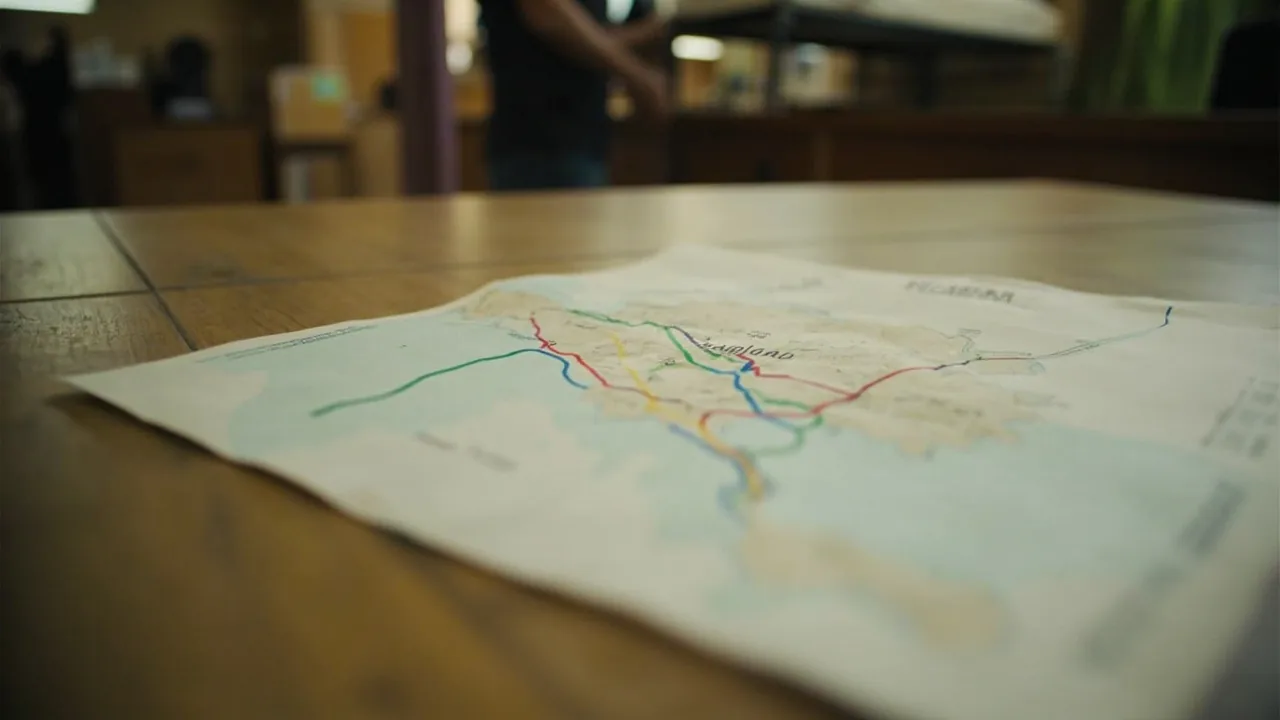
The State Railway of Thailand publishes an English-language system map on its official site. It shows all four lines, every station name in English, and kilometer markers. This is the one you want for planning an itinerary. Grab it from the SRT official site at https://www.railway.co.th/ before you leave home.
The Bangkok-focused transit map
For Bangkok’s BTS, MRT, and Airport Rail Link, you want a separate map. These three systems don’t share a single printed map, but they all have route diagrams on their own websites. BTS shows Sukhumvit and Silom lines; MRT shows the Blue and Purple lines; the Airport Rail Link runs from Suvarnabhumi Airport to Phaya Thai. When you search “thailand train map bangkok”, this is usually what shows up, and it’s a different system from the long-distance trains.
Google Maps and Rome2Rio
For real-time planning, Google Maps now includes SRT schedules for most long-distance routes, and Rome2Rio lets you compare train vs bus vs flight between any two Thai cities. Both are accurate enough for daytime planning, but for booking the actual ticket you still go to the SRT site.
Step-by-Step: How to Ride a Thailand Train
Step 1: Decide where you’re going
Open the SRT system map and find the line that ends at your destination. If you’re going to Chiang Mai, that’s the Northern line. If you’re going to Koh Samui, you’ll take the Southern line to Surat Thani, then a ferry. If you’re going to Vientiane, that’s the Northeastern line to Nong Khai, then a bus over the Friendship Bridge.
Step 2: Pick your class
SRT trains run in three classes. Third class is a basic hard seat, no air-conditioning, and it’s the cheapest way to roll through the countryside. Second class comes as fan or air-conditioned, with seats or sleeper berths. First class is air-conditioned two-berth sleepers only, on the premium express services. As a rule, any journey over six hours, you want a sleeper. Day trips under four hours, third-class seat is fine.
Step 3: Book online or at the station
The SRT now has an English booking portal at https://www.dticket.railway.co.th/. You can search routes, pick seats, and pay with a foreign credit card. Sleeper berths on the Bangkok-Chiang Mai overnight express sell out 2-3 days ahead in high season (November to February). For low-demand routes and 3rd class seats, you can usually just walk up on the day.
Step 4: Show up 30 minutes early
SRT stations are formal, announcements are in Thai and English, and gates close 5-10 minutes before departure. The bigger stations (Hua Lamphong, Krung Thep Aphiwat, Chiang Mai) have left-luggage counters, food stalls, and 7-Eleven-style convenience stores. Bring your passport, it’s required for ticket purchase.
Step 5: Board and find your carriage
Tickets print a carriage number and berth. For sleepers, the attendant will turn your seats into beds at night and reverse them in the morning. The attendant also sells drinking water, light snacks, and pad thai from a trolley at most stops. Travellers report the pad thai is decent but overpriced; bring your own snacks if you’re on a budget.
Step 6: Pay for the Bangkok city transfer
If you’re arriving at Hua Lamphong or Krung Thep Aphiwat and need to get to your hostel, you have three options. The MRT connects Hua Lamphong directly to the city centre (about ₹114 (~40 THB or ~$1.19)). BTS from Phaya Thai (if you came on the Airport Rail Link) covers Sukhumvit and Silom. Or grab a metered taxi, about ₹200-₹429 (~70-150 THB or ~$2.08-$4.45) depending on traffic. For trips across the country, you can also Book on 12go as a rail backup option if a particular train is sold out.
Common Mistakes Indians Make on Thai Trains
Booking first class on the day
First-class two-berth sleepers on the Bangkok-Chiang Mai express sell out during peak season. Travellers who walk up at Hua Lamphong expecting a private sleeper get put on a 2nd class fan berth instead. Book 3-5 days ahead in November-February. Book 1-2 days ahead in March-October.
Confusing BTS with SRT
This is the most common confusion for first-time visitors. BTS is the Bangkok Skytrain, an urban metro that runs above Silom and Sukhumvit roads. SRT is the long-distance train that goes to Chiang Mai. They don’t share stations, fares, or tickets. When you search “thailand train map bangkok” and the result is a BTS map, that’s urban transit, not the intercity system.
Paying in cash at the station when the card works
The SRT booking portal takes Visa and Mastercard. If you don’t have a forex card, this is the moment to get one. Without one, you’ll be in the foreign exchange queue at the airport, paying rates that are 3-5% worse than your card. We’ve covered the best options for Indians in our forex card guide.
Showing up with half a day to spare
Thai trains are not Swiss trains. Delays of 30-60 minutes are normal, especially on the southern line. If you have a tight ferry or flight connection, build in buffer. Conversely, the night sleeper from Bangkok to Chiang Mai is famously punctual, arriving at 6:05 AM on the dot most mornings.
Not packing for the cold
First-class and second-class air-conditioned carriages are freezing cold overnight. The SRT sets AC to a temperature that makes sense for a Thai office, not a sleeper. Travellers report shivering through every overnight train in winter. Bring a hoodie, a pair of socks, and a light jacket. Third-class fan carriages are warmer but no sleeper.
What Most Guides Don’t Tell You
The new central terminal is changing the hub
As of 2026, all Bangkok long-distance trains depart from Krung Thep Aphiwat Central Terminal in the north of the city. The historic Hua Lamphong station remains open as a tourist landmark and for some commuter services, but it is no longer the intercity hub. The MRT’s Blue Line connects directly to Krung Thep Aphiwat. If you book a ticket, your confirmation will say “Krung Thep Aphiwat” — that’s the terminal you go to.
Sleeper berths have a gender rule
If you’re a solo female traveller, you can book a single lower berth in the women-only carriage on most overnight services. Same goes for solo male travellers in male-only carriages. Mixed berths are also available, and couples can book the two-berth first-class cabin for privacy. The ₹2,859-₹5,718 (~1,000-2,000 THB or ~$29.68-$59.35) fine for “wrong carriage” is rare but the rule is enforced.
The Eastern & Oriental Express costs as much as a flight
The luxury train everyone’s Instagram shows is the Eastern & Oriental Express, a private Belmond service running Bangkok to Singapore (or Bangkok to Chiang Mai) with marble bathrooms, butler service, and a four-figure USD price tag. As a backpacker, you don’t need it. The regular SRT sleeper to Chiang Mai is ₹2,287-₹4,288 (~800-1,500 THB or ~$23.74-$44.51) and you get the same countryside. The Eastern & Oriental is for honeymooners and railway obsessives, not for backpackers watching their Southeast Asia trip budget from India.
Long-distance trains can be slower than buses
This surprises people. The Bangkok-Chiang Mai bus is 9-10 hours; the train is 13-15 hours. The train is more comfortable, the bus is faster and cheaper. For trips under 6 hours, the bus is usually the better call. For overnight trips, the train wins because you sleep on the train and wake up at your destination, no hotel cost.
Train tickets are not always refundable
SRT policy: 3rd class is non-refundable. 2nd class and 1st class can be refunded up to 48 hours before departure, with a 10-20% fee. If you book and then change your mind, you can’t get your money back at the station counter. Check the refund policy before paying.
How to Stay Connected While Planning on the Move
You’ll want data while booking trains. The SRT site loads slowly on hotel Wi-Fi, and Rome2Rio’s full feature set needs a stable connection. Your options:
For a physical SIM, AIS and TrueMove both offer tourist SIMs at Suvarnabhumi Airport for around ₹855 (~299 THB or ~$8.87) for 8 days with 15 GB. The same SIM at a 7-Eleven inside the city is typically ₹571-₹798 (~199-279 THB or ~$5.91-$8.28). If you’re not picking up at the airport, walk into any 7-Eleven and ask for the “tourist SIM AIS” or “tourist SIM True”. You’ll need your passport.
For an eSIM that activates before you fly, Get Nomad eSIM sells Thailand-specific data packs starting at around ₹578 (~6 USD) for 5 GB over 7 days. The pros: it’s already active when you land, no airport counter queue, no passport photocopy. The cons: your phone must be eSIM-compatible (most phones made after 2020 are) and you can’t make phone calls over it.
Quick rule: if you’re arriving late, don’t want to queue at the airport, and only need data, pick the eSIM. If you want a local number, voice calls, or are arriving during a peak hour with long SIM counter queues, pick the physical SIM. Most Indians we’ve travelled with use the physical SIM for the Thai number, and keep the Indian operator’s international roaming as a fallback.
FAQ
What’s the difference between BTS and SRT?
BTS is the Bangkok Skytrain, an urban metro system running above Silom and Sukhumvit roads. SRT is the State Railway of Thailand, the national long-distance network. They are different companies, different tickets, different routes. If you’re staying in Bangkok, you’ll use BTS. If you’re going to Chiang Mai, you’ll use SRT.
Can I travel around Thailand entirely by train?
Mostly yes, but not entirely. You can reach Bangkok, Ayutthaya, Chiang Mai, Surat Thani, Hat Yai, Nong Khai, and the main regional cities by SRT. You cannot reach the islands (Koh Samui, Koh Phangan, Koh Tao, Koh Lanta) by train alone, you’ll need a ferry from the nearest train station. You also cannot reach the beaches on the Andaman coast (Krabi, Phuket) by train, except as far as Surat Thani, then bus.
Is there a luxury train in Thailand?
Yes, the Eastern & Oriental Express is a private luxury service running between Bangkok and Singapore (and between Bangkok and Chiang Mai on certain itineraries). It costs thousands of USD per person. For backpackers, the regular SRT sleeper is the affordable alternative, and it’s the same route for about 1% of the price.
How do I get a printable Thailand train map PDF?
The State Railway of Thailand publishes an English-language system map as a PDF on its official site at https://www.railway.co.th/. Click the English link, then look for “system map” or “route map” in the publications section. The PDF is roughly 1-2 MB and downloads in seconds.
Is the train cheaper than flying in Thailand?
Usually yes, but not always. Bangkok to Chiang Mai by train is ₹2,287-₹4,288 (~800-1,500 THB or ~$23.74-$44.51) in a sleeper. By AirAsia or Nok Air, it’s often ₹3,431-₹7,147 (~1,200-2,500 THB or ~$35.61-$74.19) on a low-cost fare. The train wins on price and the experience, the plane wins on time. For shorter routes like Bangkok to Hua Hin, the train is dramatically cheaper and faster than driving or flying.
Where can I book SRT tickets online?
The official SRT booking portal in English is https://www.dticket.railway.co.th/. It accepts Visa, Mastercard, and some local Thai payment methods. For tickets bought within 72 hours of departure, you’ll usually need to book at the station counter.
Is the overnight train to Chiang Mai safe?
Yes, for solo travellers including solo women. The SRT runs women-only carriages on most overnight services. Bags can be locked to the luggage rack. The train is staffed by attendants all night. Treat it like any night train in India, but with better food and crisper sheets.
Can I take a motorbike or extra luggage on the train?
Yes. The SRT has a luggage van on long-distance trains. You can check in suitcases, backpacks, and motorbikes (bikes need to be crated). The fee is small, typically ₹86-₹229 (~30-80 THB or ~$0.89-$2.37) per item. Bag theft is rare but bring a small padlock for your main bag.
Subodh’s Take
The Thai train network is one of the best ways to see the country, and the Bangkok-Chiang Mai overnight sleeper is the single best first experience for any India-to-Thailand backpacker. It’s cheap, it’s safe, the countryside is genuinely beautiful, and you wake up in the mountains. Don’t overthink the booking. Pick a date, book a 2nd class air-con sleeper, and show up 30 minutes early. The rest takes care of itself.
