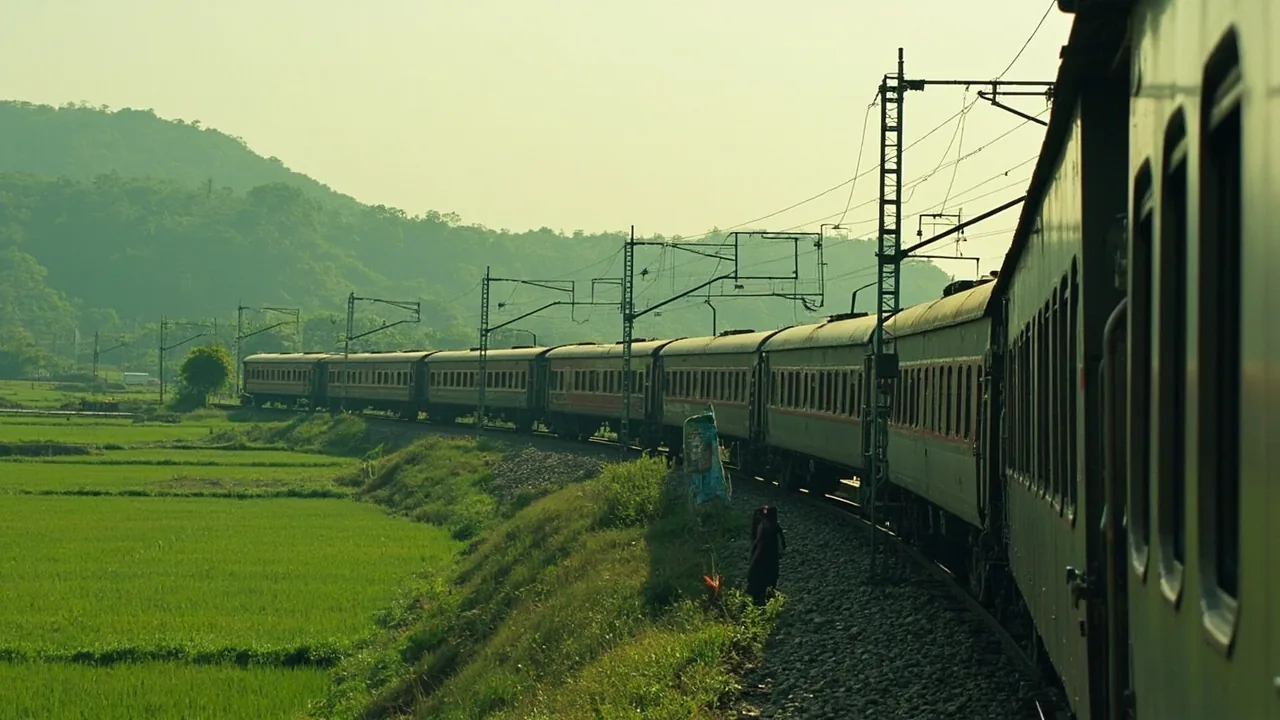
Trans-Asia Train Routes: Most Scenic Cross-Border Rail Trips for Indian Backpackers (2026)
✅ Last verified on-the-ground: 2026-07-17
Indians can ride long cross-border rail segments across Southeast Asia in 2026. The Trans-Asian Railway is a planned network linking 28 Asian countries, and the Southeast Asian leg is the part you can realistically plan as a backpacker. You can’t do the whole thing in one go, but you can stitch four to six cross-border train routes together for a 30-day rail trip starting from Bangkok. Planning the wider region? Our Southeast Asia backpacking hub covers the full multi-country route.
This guide covers the routes Indian backpackers book, the tickets they get, and the borders that work in 2026 (the Laos. Vietnam one is the trickiest, more on that below).
What Is the Trans-Asian Railway?
The Trans-Asian Railway (TAR) is a planned 141,000 km network of rail corridors linking 28 Asian countries, formalised under a 2006 UN ESCAP agreement. Indian backpackers usually mean one of two specific routes: the Southern Corridor (Bangkok. Kunming. Singapore, the famous “Kunming. Singapore Railway”), or short segments of the Eastern Corridor (Ho Chi Minh City. Phnom Penh. Bangkok, which is partly rail and partly bus). The Kunming. Singapore line is the only one completed end-to-end, and it’s the route Indians ride. For a primer on what the Thai sleeper experience feels like, see our Thailand sleeper train guide.
It’s not the Trans-Siberian (that’s Russia. Mongolia. China), and it’s not the Eastern & Oriental Express (which is a luxury tourist train, ₹4 lakh+ per cabin, and not what budget backpackers are after).
Quick Answers
| What | Answer | Price (INR) |
|---|---|---|
| Southern Corridor (Bangkok → Singapore) total rail distance | ~1,920 km | |
| Number of border crossings on the Bangkok → Singapore route | 2 (Thailand. Malaysia at Padang Besar; Malaysia. Singapore at Woodlands) | |
| Most scenic segment | Bangkok → Chiang Mai (SRT Special Express) | |
| Longest Indian-bookable route in one ticket | Bangkok → Hat Yai → Butterworth (Penang) on SRT + KTMB | |
| Cheapest cross-border sleeper | Hanoi → Nanning (hard sleeper, China Railways) | |
| Easiest border to cross | Padang Besar (Thailand. Malaysia), used by daily trains | |
| Visa required for India passport for full route | Yes, depending on the segment (Thailand, Malaysia, Singapore, plus e-visas for Vietnam and Cambodia; Laos requires a pre-approved eVisa, no visa-on-arrival for Indian citizens) | |
| Booking platform for SRT Thailand | dticket.railway.go.th | |
| Booking platform for KTMB Malaysia | ktmb.com.my | |
| Booking platform for China Railways (international) | 12306.cn | |
| Booking platform for VNR Vietnam (limited cross-border) | dvexpress.com.vn | |
| Best alternative for sold-out trains | Book on 12go |
The 5 Routes Indian Backpackers Ride
These are the cross-border train routes that work in practice in 2026, ordered roughly west to east. Pick one, build a loop, or stitch two or three together for a longer trip.
Route 1: Bangkok → Chiang Mai (Thailand, no border)
The classic and the most photogenic. The SRT Special Express 13/14 runs from Bangkok’s Hua Lamphong (now Krung Thep Aphiwat, the new central terminal) to Chiang Mai overnight, with sleeper berths. Tickets are reliably available if you book 2 to 4 weeks ahead on the official SRT portal. For typical scheduled times and berth classes, see our Thailand sleeper train breakdown.
Why it matters: it’s the most beautiful sleeper train journey in Southeast Asia, threading through the mountains of Northern Thailand with fogged-in valleys, rice terraces, and tiny wooden stations you can buy grilled chicken from at 3 a.m. There is no border crossing here, both ends are in Thailand, so no visa issue, no foreign-currency exchange, no passport stamp.
| Class | Price (THB) | Berths |
|---|---|---|
| 2nd-class A/C sleeper (lower berth) | ₹3,400 (~1,184 THB or ~$35.27) | 2 per cabin |
| 2nd-class A/C sleeper (upper berth) | ₹2,894 (~1,008 THB or ~$30.02) | 2 per cabin |
| 1st-class A/C sleeper | ₹4,617 (~1,608 THB or ~$47.90) | 2 per cabin, private |
| 3rd-class fan seat | ₹919 (~320 THB or ~$9.53) | no sleeper |
Book via 12go if the SRT site is showing sold out, they hold SRT ticket inventory for a small markup.
Route 2: Bangkok → Butterworth (Penang), Thailand to Malaysia
This is the most underrated cross-border train ride in Southeast Asia. It’s also the easiest border crossing for Indian backpackers. The SRT overnight service runs from Krung Thep Aphiwat (Bangkok) to Hat Yai (sleeper), and onward to Butterworth in Penang by the next evening. You can split-ticket and break the journey, but the real cross-border moment comes at Padang Besar, where the train halts while immigration officers stamp you out of Thailand and into Malaysia.
Most scenic stretch: the climb from Hat Yai up the Malaysian borderlands. Lush jungle, mosques, palm oil plantations, and a sudden change in language and food the moment you cross.
| Class (Bangkok → Butterworth) | Price (THB) | Notes |
|---|---|---|
| A/C sleeper, lower berth | ~₹4,307 (~1,500 THB or ~$44.68) | Sold out by March, book early |
| A/C sleeper, upper berth | ~₹3,733 (~1,300 THB or ~$38.72) | Slightly less legroom |
| Fan sleeper | ~₹2,584 (~900 THB or ~$26.81) | Older carriages, 2-berth |
Many Indians split-ticket: Bangkok → Hat Yai on the 13:55 service, then a separate KTMB ETS (Electric Train Service) from Hat Yai → Kuala Lumpur the next morning, which is faster and air-conditioned. Buy Malaysian-leg tickets at ktmb.com.my up to 60 days ahead.
Route 3: Chiang Mai → Kunming, Thailand to China, via Laos
The dream route. Also the one that takes the most planning. The China. Laos high-speed line (Boten to Vientiane) opened in December 2021 and connects to China via Kunming. There is currently no continuous Chiang Mai to Kunming rail service; Chiang Mai is connected only to the Thai rail network.
Critical caveat for Indian passport holders: in 2026, you cannot do this whole route on a single tourist visa. Thailand requires tourist visa or visa exemption, Laos needs an eVisa (apply at laoevisa.gov.la, ₹4,820 (~50 USD) processing, ~3 working days), and China requires an Indian citizen visa in advance, no visa-on-arrival.
Most scenic part: the Laos segment, Boten to Luang Prabang, where the train winds through the Nam Ou river gorge. You’ll see karst limestone, misty ridges, banana-leaf stilt villages, and no other tourists because most people still fly. For comparison, see the Mekong slow boat alternative for the same region.
For Indian backpackers, the practical move is the Vientiane ↔ Luang Prabang short segment, a 4-hour ride through the best stretch. The cross-border stretch into China is overland but the train itself is closed to Indian tourist visa holders unless you have a working or student visa.
Route 4: Hanoi → Nanning, Vietnam to China
This is the cross-border train you can take without flying. Hard sleeper, soft sleeper, or hard seat. China Railways T8701 runs from Hanoi Gia Lam station to Nanning, Guangxi, with a visa-and-immigration procedure at the Friendship Pass border (they do this on the train).
For Indian backpackers, the relevant stretch is Hanoi → Nanning, then connecting onward to Kunming → Shanghai → Beijing, if you want to keep going. Or, vice versa, Nanning → Hanoi to start a Vietnam loop after you’ve travelled through China.
It is the cheapest long-distance cross-border rail option on this list.
| Class | Price (VND) | Berths |
|---|---|---|
| Hard seat | ₹1,068 (~290,000 VND or ~$11.08) | 5 per row |
| Hard sleeper, lower berth | ₹2,173 (~590,000 VND or ~$22.54) | 2 per compartment + 3 tiers |
| Soft sleeper, lower berth | ₹3,278 (~890,000 VND or ~$34) | 4 per compartment |
| Soft sleeper, upper berth | ₹2,910 (~790,000 VND or ~$30.18) | 4 per compartment |
Tickets are bought via dvexpress.com.vn for the Hanoi → Nanning side, and via 12306.cn once you are past the Chinese border. Many travellers confirm with the Vietnam Railways station agent at Hanoi Gia Lam in person, as the e-payment system is limited.
Route 5: Bangkok → Singapore via the KTM Shuttle
If you want the bragging rights of having ridden the train from Bangkok to Singapore without ever stepping on a plane, this is the practical version. There is no through train that runs the whole distance, so you will need to break it up:
- Bangkok → Hat Yai (SRT sleeper, 16h)
- Hat Yai → Kuala Lumpur (KTMB ETS, overnight, 13h)
- Kuala Lumpur → Singapore Woodlands (KTMB KTM Intercity, shuttle, 5h)
The famous Johor Bahru → Woodlands shuttle is the actual “border moment”: you climb off the Singapore train, walk through Malaysian immigration, walk a few hundred metres across the causeway, and get stamped into Singapore. Twelve to thirty minutes total. It is ordinary. That ordinariness is the charm.
You can book KTMB tickets at ktmb.com.my, but most backpackers walk into KL Sentral or Butterworth station one day before and book in person, since most regional trains have walk-up availability.
Step-by-Step: How to Plan a Cross-Border Rail Trip from India
1. Start with your visa map
Before booking a single train, sketch out which countries you’re crossing and pin down the visa requirements in that order. India passport holders do NOT get visa-on-arrival for Laos (despite what some blog posts say; it requires a pre-approved eVisa). Vietnam, Thailand, and Malaysia work on visa exemption or e-visa for Indian passport holders.
Sketch:
- Thailand: visa-free, 60 days (extendable for 30, twice), as of bilateral update 2024. Verify current rule at the MFA Thailand site before flying.
- Malaysia: eVisa or eNTRI via imi.gov.my, roughly ₹3,374 (~35 USD).
- Laos: eVisa, ₹4,820 (~50 USD), 3 working days, at laoevisa.gov.la.
- Vietnam: e-visa, ₹2,410 (~25 USD), 3 working days, at evisa.xuatnhapcanh.gov.vn.
- China: regular tourist visa from the Chinese consulate in Mumbai/Delhi, 4 to 7 working days (verify the current fee on the consulate’s official site before applying).
Subodh’s Pro Tip: Get your China visa and Laos eVisa done first, in that order, before booking trains. Laos is fast and cheap, China takes longer and costs more. Once you have those two, the rest can be done online in 24 to 72 hours from a Bangkok hostel.
2. Lock your start city, then book outward from there
Most India-to-SEA backpackers fly into Bangkok (cheapest flight from Mumbai/Delhi/Bangalore, roughly ₹18,000 (~$186.56) round-trip with AirAsia, IndiGo, or VietJet). Bangkok sits at the centre of the entire Trans-Asia SEA leg, so you can branch north to Chiang Mai, west to Malaysia, east to Cambodia, or northeast to Laos. First-timers should also read our first trip abroad from India checklist before flying out.
If your final goal is Singapore, the most efficient route is: Bangkok → Hat Yai → Butterworth → Kuala Lumpur → Singapore.
If your final goal is Hanoi or beyond to China: Bangkok → Vientiane (fly, since the train option requires Laos-China visas that complicate the trip), then Vientiane → Hanoi overland (bus is the only option, the rail link is still under construction in 2026), or fly to Hanoi and start the Hanoi → Nanning segment by train.
If your final goal is just a taste of cross-border rail without leaving Thailand: Bangkok → Chiang Mai. 11 hours, no border, the scenic reward.
3. Book each leg on the right portal
No single platform books all the train operators. The good news: each segment is short, and Indian cards (HDFC Forex, Niyo, or Wise debit) work on the major sites. Quick list:
- SRT (Thailand): dticket.railway.go.th, D-Bahn D-Ticket portal
- KTMB (Malaysia): ktmb.com.my
- VNR (Vietnam): dvexpress.com.vn, most international tickets issued by third-party agencies
- China Railways: 12306.cn
- For Laos (China-Laos high-speed): crr.la or 12go.asia
- Cross-border backup option that books almost anything: 12go.asia
4. Sync the timeline
Indian backpackers: budget 30 to 45 days for a realistic Bangkok → Singapore + Chiang Mai loop, with three border crossings and one overnight bus where rail doesn’t run. Don’t try to do the whole Trans-Asia SEA leg in 2 weeks, you’ll spend the trip in stations. For day-by-day spend assumptions, see our Southeast Asia 5000 per day budget reference.
Working timeline:
- Day 1: Arrive Bangkok
- Day 2 to 4: Bangkok, sort out money/SIM, book trains
- Day 5 to 9: Bangkok → Chiang Mai sleeper (Train 13), 3 nights in Chiang Mai
- Day 10: Overnight sleeper to Bangkok, or fly down
- Day 11 to 12: Bangkok → Hat Yai (Train 45), 17 hours, sleeper
- Day 13: Hat Yai → Butterworth → Penang
- Day 14 to 16: Penang, Cameron Highlands if you detour
- Day 17 to 19: Penang → KL (KTMB ETS, 4h30), visit KL
- Day 20 to 21: KL → Singapore by KTMB shuttle (5h including border)
- Day 22 to 25: Singapore
- Day 26: Fly back to Bangkok, or to a Thai coastal city
- Day 27 to 30: Return to India
Add a 7-day northern Laos rail extension before or after, if you have the Laos + China visas sorted.
5. Get connected on the train corridors
Cell signal drops on the long rural stretches in Thailand (between Lampang and Chiang Mai, between Nakhon Lampang and Uttaradit) and in Lao People’s Democratic Republic north of Luang Prabang. ESIM with multi-country data is the practical fix.
In Bangkok, grab a physical AIS tourist SIM (30-day, ₹172 (~60 THB or ~$1.79) for 30 GB) at the airport. For Laos, Lao Telecom eSIM or TrueMove ESIM that runs for 8 days across Thailand and Laos works well. For Vietnam, Viettel eSIM or Mobifone eSIM at the airport kiosk in Hanoi or Ho Chi Minh.
Get Nomad eSIM as your one-multi-country fallback, especially for the Kunming. Vientiane stretch where local SIM availability drops to zero.
6. Pay for tickets in the right currency
- SRT Thailand: Thai credit/debit cards work, Wise debit card works, Indian HDFC Forex witherwise apply small FX markup.
- KTMB Malaysia: KTM accepts Visa/Mastercard, payment processed in MYR, your card does the conversion.
- China Railways: 12306 only takes Chinese bank cards or Alipay/WeChat Pay. Cash payment at the counter is the easy fallback, or use a third-party agent via 12go.
- VNR Vietnam: accepted cards issued by Vietnamese banks only. Walk into Hanoi station and pay cash, the rates are roughly 10% better than the website anyway.
Common Mistakes Indians Make on Trans-Asia Rail
Treating the Kunming. Singapore line as one ticket. It is not. Each segment is on a different national operator, each with a separate booking portal and a separate currency.
Confusing the Eastern & Oriental Express with the regular SRT sleeper. The E&O is a luxury tourist train that costs ₹4 lakh+ for one cabin, runs Bangkok → Singapore as a 5-day package, and is a once-in-a-lifetime experience that most backpackers skip. The SRT Special Express 13/14 is the regular Bangkok ↔ Chiang Mai sleeper at ₹3,400 (~1,184 THB or ~$35.27) and is what budget travellers book.
**Forgetting border-crossing paperwork. **Indian citizens cannot use Laos visa-on-arrival at the Thanaleng station; the eVisa is required, period. Pre-apply on laoevisa.gov.la, get the printout, carry 2 copies.
Trying to ride the China-Laos high-speed train on a tourist visa. The Vientiane ↔ Boten segment in Laos is open to foreign tourists on a Laos eVisa, but crossing into China at Boten requires a Chinese tourist visa obtained in advance from a Chinese consulate. Plan around this.
Booking trains on the wrong day. The Bangkok → Hat Yai sleeper (Train 45) only runs thrice a week in 2026 (changed from daily post-COVID rail optimisation). Confirm the schedule on the SRT portal before committing.
Adding an extra day for a missed border stamp. If the border officer forgets to stamp you out, ask them to do so on the spot before leaving the booth; carry a pen and your passport, and verify the exit stamp is legible before getting back on the train.
What Most Guides Don’t Tell You About Trans-Asia Train Routes
The Bangkok → Butterworth route is not direct anymore. SRT discontinued the through-running overnight service as of 2023. You now book two separate tickets: Bangkok → Hat Yai (SRT) and Hat Yai → Butterworth (KTMB shuttle). Same train, same track, but the operator change at Hat Yai means a 1-hour platform transfer. Many backpackers don’t realise this and end up with a stranded sleeve and an unmovable reservation.
Laos has launched an e-Visa system specifically tied to rail users. For anyone entering Laos at the Boten international railway station, the eVisa process is faster (24 hours, often same-day) than for those flying into Wattay airport. If your trip is Laos-train-based, apply on the rail entry route form on the eVisa portal. The system is designed to move you faster through Boten immigration.
The Hanoi → Nanning train doesn’t depart every day. In 2026, only 2 services run weekly, Tuesdays and Fridays, with T8701 the only such service still operated. Confirm on dvexpress.com.vn in your planning week; do not assume daily service. For budget planning on the Vietnam side, see our Vietnam budget trip for couple guide.
The Indian consulate in Bangkok and the one in Kuala Lumpur issue China tourist visas faster than Mumbai. Roughly 5 working days in Bangkok versus 8 to 12 in Mumbai. If you want to ride the Kunming → Vientiane stretch, getting the China visa while you’re already in Bangkok before going to Vientiane saves weeks.
The Johor Bahru. Singapore RTS Link is scheduled to open to the public from end-2026 onwards. As of writing, the JB → Woodlands KTM shuttle remains the standard border crossing between Malaysia and Singapore by rail. Verify the latest cross-border rail status on ktmb.com.my before boarding.
Subodh’s Take
The Trans-Asia Railway is sold by travel magazines as a single dramatic line that you ride end-to-end. It is not. It is a dozen short cross-border segments on different operators with different currencies, different booking portals, and different visa rules. The good news: each segment is short, each is roughly ₹1,500 (~$15.55) to ₹5,000 (~$51.82) for a sleeper, and each can be booked by an Indian on a bank card. The single biggest mistake is treating this as a “trip” rather than 6 to 8 short train rides stitched together. Plan segment by segment, keep your passport stamped at every border, and let the train become the rhythm of the trip rather than the destination. The Bangkok → Chiang Mai sleeper is still the most beautiful night ride you can do on a backpacker budget.
FAQ
How long is the Trans-Asian Railway total?
The full Trans-Asian Railway network as planned under UN ESCAP is roughly 141,000 km across 28 countries. The Southeast Asian segment that backpackers ride is roughly 1,920 km from Bangkok to Singapore. The longest continuous cross-border rail journey an Indian passport holder can do realistically on tourist visas is roughly Hanoi → Kunming → Vientiane, about 3,000 km over 6 days.
Is the Kunming Singapore Railway open to tourists?
Yes, fully open since 2021 for the Laos segment and 2022 for the Vietnam ↔ China segment. Thai ↔ Laos, Laos ↔ China, China ↔ Vietnam, and Thailand ↔ Malaysia services all run regularly. Indian passport holders can ride every segment with the right combination of tourist visas.
What is the most scenic train route in Thailand?
The Bangkok → Chiang Mai SRT Special Express 13/14 is widely considered the most scenic overnight rail route in Thailand and among the most photogenic in Southeast Asia. The stretch between Lampang and Chiang Mai, especially in October to December fog season, is the highlight.
Can I do the Bangkok to Singapore train in one go without flying?
No. There is no through train that runs the entire Bangkok → Singapore distance in 2026. You must take 2 to 3 separate trains, with a station change at Hat Yai (to switch from SRT to KTMB), and a transfer at KL Sentral or Johor Bahru. Total journey time including transfers is roughly 36 to 42 hours.
Do I need a return ticket to take the cross-border trains?
No. None of these border crossings require proof of onward or return tickets. Thai and Malaysian immigration ask about length of stay but accept one-way travel with a 30-day fund statement shown if requested.
How much does a 30-day Thailand. Malaysia. Singapore rail trip cost?
Budget roughly ₹55,000 (~$570.06) to ₹75,000 (~$777.35) total including sleeper trains, food, and hostel stays across all three countries in 2026. Trains themselves are only about 12 to 18% of that cost; the bulk is accommodation and food.