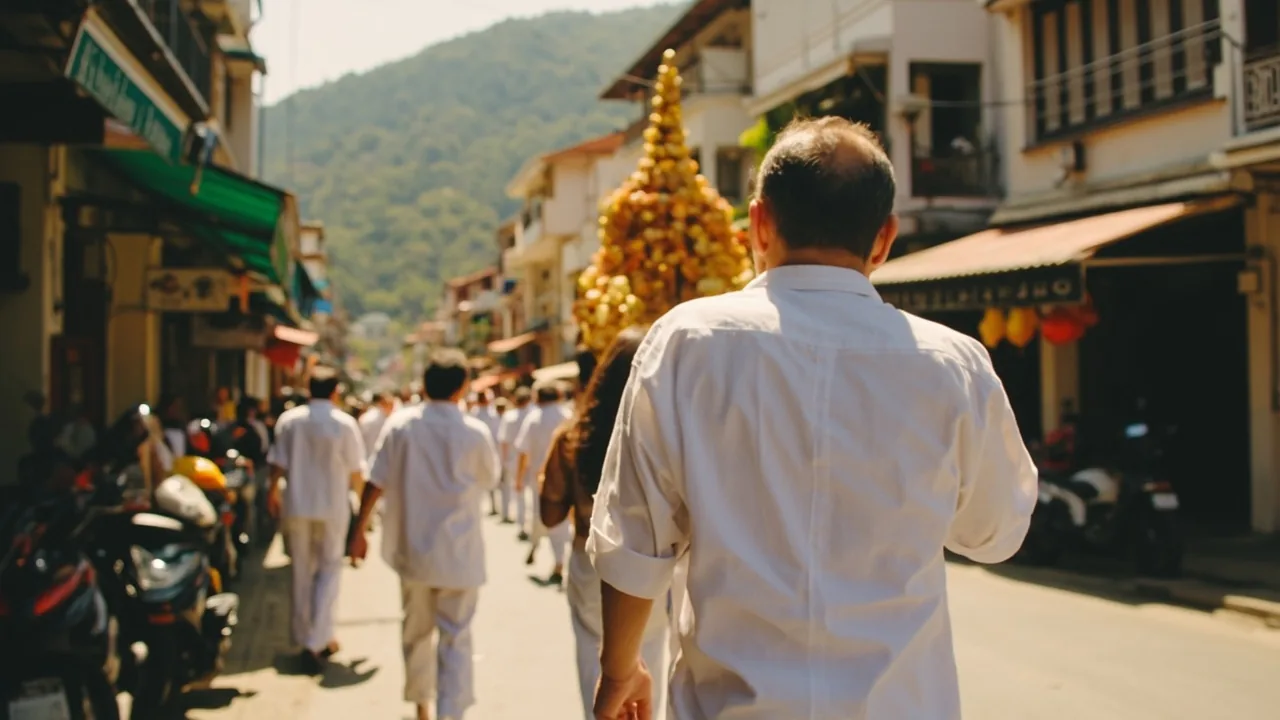
Vegetarian Festival Phuket October
The Phuket Vegetarian Festival (also called the Nine Emperor Gods Festival or Tesagan Gin Je) is the headline seasonal: October event in Phuket. It is one of the key festivals in our Southeast Asia backpacking hub. It runs on the lunar calendar, which usually lands it in late September or October. In 2026 the street processions, ma song piercings, and nine days of strict-veg eating run roughly 17 to 25 October.
I checked the dates against the TAT Phuket events calendar and cross-referenced with traveller reports from the 2025 festival. One thing the marketing doesn’t tell you: the festival is at the tail end of the south-west monsoon. Expect short, heavy afternoon downpours that clear in an hour, plus 70-80% humidity throughout.
Quick Answers
| What | Answer | Price (INR) |
|---|---|---|
| Festival dates 2026 | 17-25 October (main processions 18, 19, 24, 25 Oct) | Free to watch |
| Veg food at street stalls | Pad thai, khao soi, som tam (no meat, no dairy) | ₹172-₹345 (~60-120 THB or ~$1.79-$3.57) |
| Indian veg thali in Phuket Town | Royal Kitchen / PAPAJI BANGKOK, etc. | ₹431-₹861 (~150-300 THB or ~$4.47-$8.94) |
| Weather in late October | 28-32°C, 70-80% humidity, daily 1-2 hr afternoon rain | Free |
| SIM card (7 days, AIS) | Unlimited 5G tourist SIM, register at airport | ₹859-₹1,290 (~299-449 THB or ~$8.91-$13.39) |
What the Festival Is
This is not a wellness fair or a yoga retreat. The Vegetarian Festival in Phuket Town is a nine-day Taoist observance tied to the Nine Emperor Gods, a stretch where the local Thai-Chinese community observes strict vegetarian or vegan eating to purify body and mind, attract good fortune, and honour the deities. The rules of the festival are unusually strict: no meat, no fish, no eggs, no dairy, no pungent vegetables (garlic, onion, leek, Chinese chives), no alcohol, and no sex. Participants also wear white throughout the nine days.
For travellers, the visible side of the festival is the street processions through Phuket Old Town. Shrine troupes (kio) walk from their neighbourhood shrine to the main Chinese shrine (Shrine of the Serene Light, San Chao Pho Suea), carrying palanquins, lanterns, and effigies. The famous and the most graphic part: ma song, mediums who enter trance states and pierce their cheeks, tongues, or backs with long metal rods, skewers, or even bicycles. If you attend, watch from a respectful distance, don’t use flash photography near ma song, and don’t touch them. Travellers report the procession is one of the more intense things you’ll see anywhere in Southeast Asia, but the actual violence is performative and the ma song themselves describe it as painless.
Subodh’s Pro Tip: Show up 30-45 minutes before the scheduled start time. The route gets packed shoulder-to-shoulder within 20 minutes, and the best spots along Thalang Road fill first. If you want photos without someone’s head in the way, position yourself on the second floor of a shophouse with a balcony facing the route. Several coffee shops (NumNum and Cafe Delight both in the Old Town shortlist) will let you perch with a drink.
Food: What You Eat During the Festival
This is the part that matters most for Indian backpackers. The festival rules mean almost every stall, restaurant, and street vendor in Phuket Town serves strict vegetarian food for the nine days. You’ll see yellow and red flags with Chinese characters at the front of participating shops. Even non-Chinese restaurants in the Old Town often run a veg-only menu because the food blessing ritual (tit gin che) is good for business.
The food scene is one of the best parts of visiting during the festival. Vendors who normally run meat-heavy menus pivot to vegan Thai for nine days, and there is genuine creativity that you don’t see the rest of the year. Some Phuket-specific festival dishes to look for:
- Khao soi pak (vegetarian khao soi): a Northern-style coconut curry noodle, made without the usual chicken or beef
- Pad thai jay: vegan pad thai, no egg, no dried shrimp, sometimes with tofu and preserved radish
- Hoy tod jay: crispy vegetable omelette, festival version
- Mapo tofu (jay): Sichuan-style spicy tofu, no pork
- Mango sticky rice: dessert, no changes for the festival
- Thob wan pak: Thai-style vegetable sweets, often dyed red and green
The main spots for authentic festival food in Phuket Town are the food courts in markets and the dedicated festival stalls that pop up around the shrines. Lao Pa Sat Phuket Town (the local market on Thalang Road) shifts to a near-100% vegetarian mode during the festival, and a plate of pad thai or khao soi will run you ₹172-₹345 (~60-120 THB or ~$1.79-$3.57). Local Canteen Phuket and Su Va Na are also good local stops; expect to pay ₹230-₹574 (~80-200 THB or ~$2.38-$5.96) per dish. For a sit-down breakfast with a vintage feel, Cafe Delight Phuket Old Town and NumNum Old Town Cafe & Restaurant both do veg-friendly brunch plates around ₹345-₹718 (~120-250 THB or ~$3.57-$7.45).
For Indian or strict-veg travellers who need a dal-chawal or biryani fix, the festival is one of the easier times to find Indian food in Phuket, because many Indian and Arabic restaurants participate for the foot traffic. Amritsr Old Town (Phuket Town) does North Indian and Punjabi, with veg thalis around ₹718-₹1,005 (~250-350 THB or ~$7.45-$10.43). PAPAJI BANGKOK in Phuket does North Indian and Arabic food, with biryani at around ₹861 (~300 THB or ~$8.94) per person. For Chinese-style Indian favourites, Royal Kitchen has dishes ranging ₹431-₹1,723 (~150-600 THB or ~$4.47-$17.87) per plate.
Safety Alert: If you are strict-veg, the festival is a good time to be in Phuket Town. Outside the festival, Thai kitchens freely use fish sauce, oyster sauce, dried shrimp paste, and pork. During the festival the green/yellow flag is your guarantee the place has gone fully jay. Look for the flag; don’t trust English “vegetarian” signs alone.
Month-by-Month Breakdown
The festival is one event within a wider month. Here is how October shapes up in Phuket:
| Month | Weather | Crowds | Cost Level | Verdict |
|---|---|---|---|---|
| September | Wettest month of the year, 350-450mm rain | Low | Budget | Avoid unless you like storms |
| Early October (1-15) | 28-32°C, frequent rain | Low | Budget | Quieter, weather improving |
| Mid-late October (15-31) | 28-32°C, rain easing, festival running | Medium | Shoulder | Festival sweet spot |
| November | Dry season starts, 26-31°C | High | Peak | Best weather, but peak prices |
| December | Cool and dry, 25-30°C | high | Peak | Christmas/New Year crowds |
Late October is the turning point. The south-west monsoon tapers off, the rain gets shorter and less frequent, and Phuket transitions into its high season. The festival gives you a reason to be there before the prices spike. Compare with Phuket weather by month for a fuller picture of the year. If you are planning around the monsoon, see our Thailand monsoon season honest review.
Festival Pros and Cons
Pros:
- Nine days of cheap, clean, strict-vegetarian food across Phuket Town
- One of the most distinctive street festivals in Southeast Asia, free to watch
- Shoulder-season prices, hostels and flights still 20-30% cheaper than November
- Smaller crowds than Songkran, easier to find a decent dorm bed
- Excellent time for Indian travellers because the food is by default veg-friendly
- The ma song processions are genuinely worth seeing once in a lifetime
- Phuket Town itself is calmer than the beach, walkable, and the Old Town shophouses are photogenic
Cons:
- Late October is still the monsoon tail. Expect 1-2 hour downpours most afternoons
- Humidity is brutal, 70-80% throughout, with a heat index around 36-38°C
- The ma song piercings involve blood and can be disturbing for kids or squeamish adults
- Many beach resorts are still in low-season mode, some beach restaurants and tour operators are closed
- Ferry services to Phi Phi and the Similan Islands can get cancelled in rough weather
- Flights from India can be slightly more expensive than early October because Diwali travel (mid-October to early November) overlaps with the festival
- The street processions are loud, smoky, and the smell of incense is overwhelming in places
What to Pack Specifically for the Festival
- Quick-dry shirts: cotton stays wet; a moisture-wicking travel shirt will save you during the afternoon rain
- Poncho, not umbrella: a compact travel poncho is better in the crowd than an umbrella (you can’t lift your arms)
- Dry bag for phone and passport: at the procession, you’ll be packed tight, and a single rain burst will soak everything
- Bandana or buff: useful for incense smoke; the route is thick with it
- Reef shoes or sturdy sandals: the procession spills onto wet roads, the food market floors get slippery
- Light long-sleeve: for visiting shrines (covered shoulders, no shorts above the knee is the polite minimum)
- Mosquito repellent: late-October humidity means mosquitoes in the evenings
- Refillable water bottle: 1.5L minimum per day, you’ll sweat more than you think
- Power bank: the procession can run 4-5 hours, you’ll be filming
Where to Stay for the Festival
You want to stay in Phuket Town, not Patong or Kata. The processions are all in Phuket Old Town; staying on the beach means a 30-45 minute drive back to the Old Town each night. Phuket Town has decent, cheap accommodation within walking distance of the shrine and the main processional route along Thalang Road.
Book 3-4 weeks ahead if you can. The festival is not as crowded as Songkran, but Phuket Town accommodation is small and the good dorm beds go first. Private rooms in the Old Town shophouse guesthouses run ₹3,446-₹7,179 (~1,200-2,500 THB or ~$35.74-$74.47).
Season Costs Comparison
| Item | Peak Season (Nov-Feb) | Shoulder (Oct, Mar-May) | Low/Monsoon (Jun-Sep) |
|---|---|---|---|
| Flight (India to Phuket, round trip) | ₹22,000-₹32,000 (~$228.21-$331.94) | ₹15,000-₹22,000 (~$155.60-$228.21) | ₹12,000-₹18,000 (~$124.48-$186.71) |
| Dorm Bed (per night) | ₹2,010-₹3,446 (~700-1,200 THB or ~$20.85-$35.74) | ₹1,292-₹2,297 (~450-800 THB or ~$13.40-$23.83) | ₹1,005-₹1,723 (~350-600 THB or ~$10.43-$17.87) |
| Private Room (Old Town) | ₹5,169-₹10,050 (~1,800-3,500 THB or ~$53.62-$104.25) | ₹3,446-₹6,317 (~1,200-2,200 THB or ~$35.74-$65.53) | ₹2,297-₹4,307 (~800-1,500 THB or ~$23.83-$44.68) |
| Street Food Meal | ₹230-₹431 (~80-150 THB or ~$2.38-$4.47) | ₹172-₹345 (~60-120 THB or ~$1.79-$3.57) | ₹144-₹287 (~50-100 THB or ~$1.49-$2.98) |
| Indian Thali | ₹718-₹1,292 (~250-450 THB or ~$7.45-$13.40) | ₹574-₹1,005 (~200-350 THB or ~$5.96-$10.43) | ₹574-₹861 (~200-300 THB or ~$5.96-$8.94) |
| Scooter Rental (per day) | ₹1,005-₹1,436 (~350-500 THB or ~$10.43-$14.89) | ₹718-₹1,149 (~250-400 THB or ~$7.45-$11.91) | ₹574-₹861 (~200-300 THB or ~$5.96-$8.94) |
| SIM Card (7 days) | ₹859-₹1,720 (~299-599 THB or ~$8.91-$17.84) | ₹859-₹1,290 (~299-449 THB or ~$8.91-$13.39) | ₹859-₹1,290 (~299-449 THB or ~$8.91-$13.39) |
Getting Connected
Pick up a local SIM at Phuket Airport on arrival. AIS, dtac, and TrueMove all have booths in the arrivals hall. A 7-day unlimited 5G tourist SIM is ₹859 (~299 THB or ~$8.91), and you’ll need your passport for registration. Coverage on Patong, Kata, Karon, and Phuket Town is solid; remote beaches like Freedom Beach or the road to Promthep Cape can drop to 3G.
If you’d rather not queue at the airport, an eSIM is the easier option. Get Nomad eSIM for Phuket, AIS and dtac are the two networks with the best island-wide 4G/5G. Useful for checking real-time weather and ferry cancellations during monsoon weeks.
Getting There and Around
Most Indian travellers fly into Phuket International Airport (HKT). There are direct flights from Delhi, Mumbai, Bangalore, and Chennai on Air India, IndiGo, and SpiceJet in the high season. In late October the route is usually 1-stop via Bangkok on Thai Airways, VietJet, or AirAsia; budget ₹18,000-₹28,000 (~$186.71-$290.45) for round trip.
To get from the airport to Phuket Town (where the festival is): the airport is at the north of the island, Phuket Town is 30 km south. Airport bus (route 1) runs hourly from 6:00 to 21:00 and costs ₹287 (~100 THB or ~$2.98). A metered taxi is ₹1,723-₹2,297 (~600-800 THB or ~$17.87-$23.83); the airport limousine counter sells fixed-price tickets at ₹2,010-₹2,872 (~700-1,000 THB or ~$20.85-$29.79) to most of the Old Town.
For transport around the Old Town itself, walk. The processional route along Thalang, Phang Nga, and Ranong roads is compact. For trips to the beach, the cheapest option is a songthaew (shared pickup truck taxi) from Phuket Town, ₹86-₹144 (~30-50 THB or ~$0.89-$1.49) per person to Patong or Kata. A Grab taxi in the Old Town runs ₹574-₹1,149 (~200-400 THB or ~$5.96-$11.91) depending on destination.
If you’re extending the trip, the rest of the Thai south is good in late October. Book on 12go for ferries to Koh Phi Phi (weather permitting), Book on 12go for the overnight bus or train to Bangkok, and Book on 12go for ferries down to Koh Lanta. Similan Islands diving season opens in mid-October, see Similan diving season for details on the November-February peak. If your trip extends into Laos, the end of Buddhist Lent (Boun Ok Phansa) also falls in October — see our Boun Ok Phansa guide.
Safety and Etiquette
- Do not touch the ma song, even if they invite you. Do not block their path. Do not use flash photography up close.
- The procession is loud. Earplugs help if you’re bringing kids.
- Stay aware of pickpockets in dense crowd sections near the shrine entrances. Cross-body bag, zipped.
- Dress modestly if you’re entering the shrine complex or following a kio. Shoulders and knees covered. White clothing is the festival-appropriate colour but not required for spectators.
- The street food during the festival is held to high standards because of the religious rules, but if a stall doesn’t display the jay flag, skip it.
- The October tail of the monsoon can bring tropical storms. Check the Thai Meteorological Department and the Phuket provincial government advisory page before you travel, especially if you have ferry or diving plans. For broader travel advisory context, the Indian MEA travel advisories and the destination government’s official travel advisory are the right places to check before booking.
Festival Etiquette Quick Reference
- Say “gin jay” (literally, “eat vegetarian”) instead of “gin yang” (eat meat) when ordering. Local staff will appreciate it.
- Don’t take leftovers home. Festival food is meant to be eaten on site or thrown away.
- Don’t photograph the palanquin from the front if a ritual is in progress. Side angles are fine.
- The shrine complex is open to visitors during the day, but the central altar area is restricted. Follow signs and staff directions.
- If you smoke, this is the time to skip it for nine days. Smoking in front of a ma song is the worst possible look.
Subodh’s Take
The Vegetarian Festival in Phuket is the rare event that delivers on its name for Indian backpackers. The food is genuinely better than usual, the rules are strict, and the Old Town’s casual, slightly faded atmosphere is a nice counterpoint to the party-beach image most travellers have of Phuket. October is a sweet spot: the worst of the monsoon is behind you, the prices are still low, and you can walk the same street where the ma song procession is happening and then eat a 80-THB vegan pad thai from a yellow-flagged stall a few metres later. It’s not the cleanest or most polished festival in Asia, but it’s one of the few where the food is by default set up for what Indian travellers want to eat. Worth a detour, especially if you’re already in Thailand at that time of year.
FAQ
Is the Phuket Vegetarian Festival all vegetarian?
Yes, for the nine festival days, any shop displaying the jay flag (yellow or red with Chinese characters) serves fully vegetarian food. No meat, fish, eggs, dairy, or pungent vegetables (garlic, onion, leek, Chinese chives). The rules are strict, and the food blessing ritual is taken seriously. Look for the flag and trust it.
What are the 2026 festival dates?
The festival follows the Chinese lunar calendar. In 2026, the nine-day run is roughly 17-25 October, with the main street processions on 18, 19, 24, and 25 October. Always re-confirm on the Phuket City municipality site closer to your trip because the Gregorian dates shift slightly each year.
Is October a good time to visit Phuket overall?
It is the shoulder between monsoon and high season. Late October specifically is good. The worst of the rain is over, prices are still 20-30% below peak, and the festival gives a strong reason to be there. Early October is wetter. November starts the peak season with higher prices and bigger crowds. For a broader look at the end-of-year window, see visiting Thailand in December.
Can I see the ma song piercings up close?
You can watch from a respectful distance, typically 2-3 metres back from the procession route. The ma song do not want to be touched or photographed with flash. They will walk past within arm’s reach at points, so you will see the piercings clearly. Do not try to interact, take selfies, or stop them. Some travellers find the piercings graphic; if you are squeamish, watch from across the street and stay near a coffee shop with a balcony view.
Is the food safe for strict-veg Indians?
It is the safest time of year to be a strict-veg traveller in Phuket. Outside the festival, Thai food uses fish sauce, oyster sauce, dried shrimp paste, and pork freely. During the festival, the jay flag means none of that. For a more familiar Indian meal, Amritsr Old Town, PAPAJI BANGKOK in Phuket, and Royal Kitchen (all in the shortlist) are good options, with veg thalis and biryanis around ₹574-₹1,005 (~200-350 THB or ~$5.96-$10.43).
How much money should I budget per day?
A backpacker can do Phuket Town during the festival on ₹3,446-₹5,169 (~1,200-1,800 THB or ~$35.74-$53.62) per day: ₹1,436-₹2,297 (~500-800 THB or ~$14.89-$23.83) for a dorm bed, ₹718-₹1,149 (~250-400 THB or ~$7.45-$11.91) for food (street food, plus one Indian meal), ₹287-₹574 (~100-200 THB or ~$2.98-$5.96) for local transport, ₹287-₹574 (~100-200 THB or ~$2.98-$5.96) for a drink or entry fee. Add ₹861-₹1,436 (~300-500 THB or ~$8.94-$14.89) per day if you’re doing boat tours or day trips to nearby islands, which are more weather-dependent in late October.
Will ferry and island trips still run in late October?
Most ferries to Koh Phi Phi, Koh Lanta, and the smaller islands still run, but the schedule is more weather-dependent than in November-February. The Similan Islands liveaboard season opens 15 October, which is good for divers. For the safest experience, plan island trips for the back half of your stay so you can adjust to the actual weather. Always check the Phuket provincial weather advisory the day before booking.
