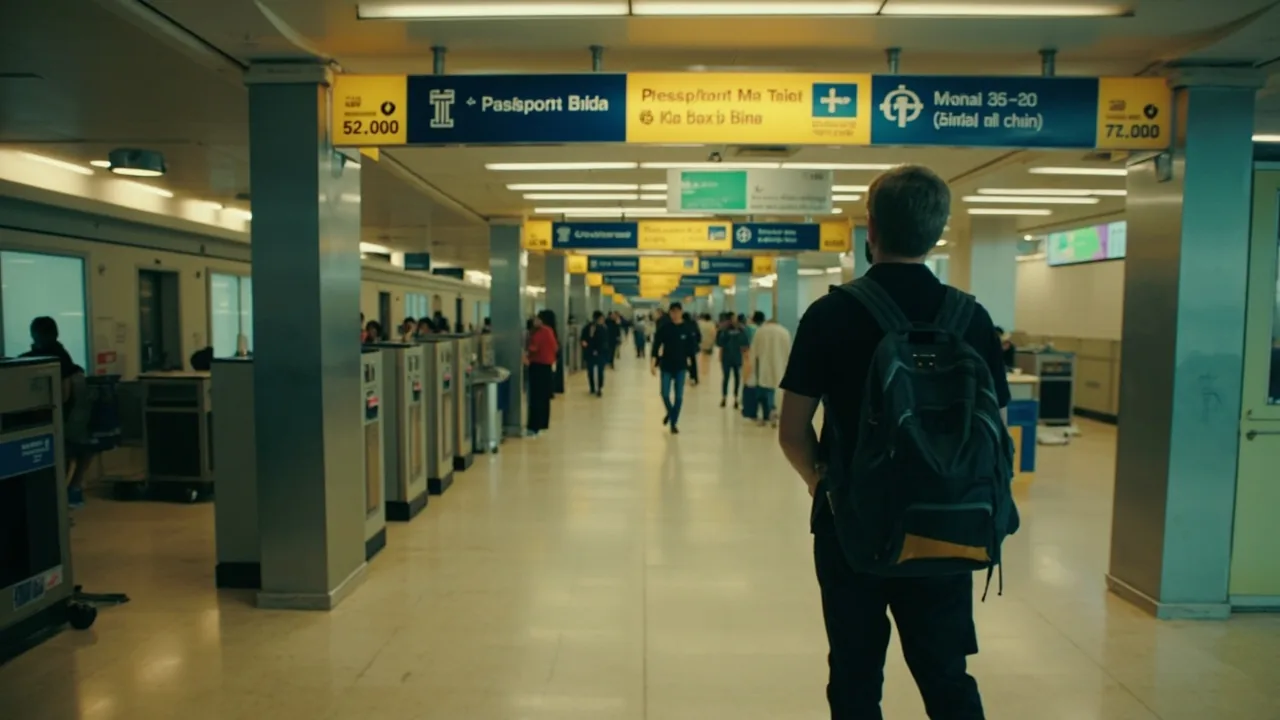
Vietnam Airport Rules Every Indian Traveler Should Know Before Flying Out
You have two weeks in Vietnam, you’ve nailed the e-visa process, you’ve worked out how much dong to carry, and now you’re standing in Tan Son Nhat or Noi Bai with a backpack that smells faintly of banh mi. The immigration line looks long, the duty-free shop is calling, and somewhere behind you a security officer is holding up a flask of curry.
This is the part most guides skip. The exit is not the same as the entry. Vietnam’s airport rules on the way out cover cash declaration thresholds, customs red and green channels, SIM card restrictions, what you can carry onto the plane, and how your e-visa gets stamped out cleanly. None of it is hard, but the small details are what turn a 25-minute exit into an hour-and-a-half exit. Here’s everything that matters.
Quick Answers
| What | Answer | Price (INR) |
|---|---|---|
| Passport validity required | 6 months minimum from date of entry into Vietnam | Free |
| Vietnam e-visa fee (Indian citizens) | ₹2,410 (~25 USD), single or multiple entry, apply via official portal only | ₹2,408 (~$24.96) |
| Duty-free alcohol allowance | 1.5 litres of spirits OR 2 litres of wine OR 3 litres of beer | Free |
| Duty-free cigarette allowance | 200 cigarettes OR 100 cigars OR 500g of tobacco | Free |
| Cash declaration threshold | USD 5,000 (equivalent in foreign currency) must be declared on exit | Free |
What You Need Before You Even Get to the Airport
Most exit delays at Vietnamese airports start with problems that were already baked in 48 hours earlier. Get these sorted and the actual departure is quick.
Passport Validity and E-Visa Printout
Vietnam requires six months of remaining validity on your passport from the date of entry. This is non-negotiable. Airlines will sometimes let you board with five months and 29 days, but immigration officers in Tan Son Nhat, Noi Bai, or Da Nang will turn you away at the desk, and the airline will then refuse to fly you back to India because they got fined. Renew your passport in India if you’re anywhere close to the cutoff.
Carry a printed copy of your Vietnam e-visa approval letter. The airport will accept the digital version on your phone in most cases, but immigration wifi is patchy at peak hours and a printed A4 saves you the gamble. The e-visa for Indian citizens costs USD 25 (₹2,408 at the current rate of 1 USD = ₹96.33), allows stays up to 90 days, is multiple-entry, and is processed in 3 working days. Apply only at the official portal: https://evisa.xuatnhapcanh.gov.vn. Third-party “visa services” charge five to ten times more for the same form. See the full e-visa walkthrough if you want the step-by-step.
Onward Ticket and Hotel Bookings
Vietnam immigration at entry can (and does) ask for proof of onward travel. On the exit side, this is rarely checked, but it’s worth keeping a screenshot of your return flight or your next-country bus booking (Cambodia by land, Laos by air) in your phone.
The Vietnam Departure Tax Question
Vietnam has no standalone departure tax payable at the airport. The fee is bundled into your airline ticket. If a counter at the airport tries to charge you a “departure tax” or “service fee” in cash, walk away and report it. Full details are in our Vietnam departure tax guide.
Step-by-Step: What Happens at a Vietnamese Airport on Departure
The exit sequence at Tan Son Nhat (Ho Chi Minh City), Noi Bai (Hanoi), and Da Nang is roughly the same. Here’s the order of operations and what to expect at each step.
1. Airline Check-In and Bag Drop
Allow 3 hours for international departures. Domestic connections within Vietnam use the same airports but separate terminals, so factor in a transfer if you’re flying out from a city you didn’t fly into.
Your checked bag gets weighed. Standard allowances:
- Economy on Vietnam Airlines, VietJet, Bamboo Airways: 20-23 kg checked, 7 kg cabin.
- Low-cost carriers (VietJet Air, sometimes AirAsia): 0-15 kg checked, 7 kg cabin. Anything over is charged per kilo, and the rate is steep.
- Carry-on liquid limit: 100 ml per container, all fitting in one 1-litre clear zip bag. Same as India.
2. Immigration / Passport Control
The exit immigration desk. This is where your e-visa gets scanned, your passport gets an exit stamp, and your fingerprints may be re-taken. The line moves faster than the entry line on most days.
Common reasons for slow processing:
- Passport photo page is worn or wet. If your passport has been through monsoon rain, immigration officers sometimes ask for a manual review.
- You’re carrying a SIM card tray in your passport pocket (yes, this happens). Keep SIM trays in your bag.
- You overstayed your visa. Vietnam calculates the day of exit as a full day, so a “30-day e-visa” means you leave by the 30th day, not the 31st. The fine for overstaying is around ₹2,410 (~25 USD) per day and can be charged at the desk.
3. Security Screening
Standard. Belt off, laptop out, liquids tray, shoes optional depending on the airport. Power banks under 100 Wh (about 27,000 mAh) are fine, 100-160 Wh need airline approval, anything over 160 Wh is banned from cabin baggage.
Vietnam bans hoverboards, electric scooters (including the small Xiaomi M365), and self-balancing devices from checked baggage. Leave them behind or risk confiscation.
4. Customs: Red Channel vs Green Channel
This is the part Indian travellers most often get wrong, mostly because there is no equivalent “nothing to declare” formality at Indian airports. Here’s how it works.
Vietnam Customs operates a two-channel system:
- Green Channel (nothing to declare): For travellers carrying goods within personal-use limits and under the cash declaration threshold.
- Red Channel (goods to declare): For travellers carrying goods above duty-free allowances, large amounts of cash (₹482,018 (~5,000 USD) or equivalent in foreign currency), or commercial quantities of goods.
If you’re an Indian tourist with a backpack of clothes, souvenirs, and the legal duty-free limit of alcohol or tobacco, take the green channel. Walk through, don’t stop. The green channel has no officer to speak to unless you set off a sensor.
If you’re carrying more than ₹482,018 (~5,000 USD) in cash (dong, dollars, rupees, any combination), you must declare. Fill out the customs declaration form before you reach the channel. Carrying undeclared cash above this threshold can lead to confiscation and fines.
5. Duty-Free Shopping and Allowance Rules
Vietnam’s duty-free shops at the airports stock liquor, tobacco, perfume, chocolate, electronics, and local goods. As an Indian citizen leaving Vietnam, you can purchase duty-free goods within Vietnam’s duty-free allowance:
| Item | Allowance |
|---|---|
| Spirits | 1.5 litres |
| Wine | 2 litres |
| Beer | 3 litres |
| Cigarettes | 200 sticks (one carton) |
| Cigars | 100 sticks |
| Tobacco | 500 grams |
| Perfume | Reasonable personal-use amount |
| Souvenirs (lacquerware, coffee, silk) | Personal-use quantity |
The Indian customs allowance is separate. When you land back in India, you can carry up to 2 litres of alcohol, 100 cigarettes, and ₹15,000 (~$155.47) worth of general goods duty-free if you’re over 18. Anything above that goes into the red channel at Indian customs and attracts duty. Vietnam’s exit allowance doesn’t override India’s entry allowance.
For more on what to bring home and what to declare at Indian customs, see our Vietnam money guide.
Cash Rules: Dong, Dollars, and What You Must Declare
Vietnam is largely a cash economy, and most travellers leave with a few hundred thousand dong in their wallet. The declaration threshold only matters if you’re carrying serious money, but here’s what you need to know.
- Under USD 5,000 (equivalent): No declaration required. This covers the vast majority of Indian backpackers.
- USD 5,000 to USD 7,000: Declare on the customs form. Allowed.
- Over USD 7,000: Allowed with prior written permission from the State Bank of Vietnam. Realistically, no tourist hits this.
- Indian rupees: Technically convertible in Vietnam, but the State Bank rate is poor and most exchange counters outside Hanoi or Ho Chi Minh City won’t touch INR. Convert leftover dong to USD or carry it back as a souvenir.
For the broader money picture (how much to carry, ATM limits, forex card rules), the how much money to carry to Vietnam guide has the detailed breakdown.
SIM Card Rules at the Airport
Buying a SIM in Vietnam on arrival is one of the best traveller hacks in Southeast Asia. Both Viettel and Mobifone tourist SIMs are available at airport kiosks, with 14-day tourist plans starting at around ₹479 (~130,000 VND or ~$4.97) (about ₹450 (~$4.66)) for roughly 6 GB of data. You’ll need your passport, and the kiosk staff will register the SIM in your name.
On exit, there is no rule requiring you to surrender the SIM. Throw it away, keep it as a souvenir, or take the little SIM ejector pin home. If you’re switching to an international eSIM before flying out, you can skip the physical SIM entirely. For travellers who want data the moment the wheels touch down in India, eSIMs work the same and skip the airport queue.
If you want data coverage that starts before you even land, several regional and global eSIM providers cover Vietnam and the rest of Southeast Asia on a single plan.
Prohibited and Restricted Items on Departure
Vietnam’s customs and security rules ban a few items that surprise Indian travellers. Most are common to most airports worldwide, but a few are worth flagging.
- No fresh meat, fruit, or unsealed dairy in cabin or checked baggage. Vietnam has strict biosecurity rules on agricultural exports. Travellers who’ve bought local honey, dried fruit, or vacuum-sealed snacks are fine; a fresh durian in your backpack is not.
- No counterfeit goods, replica branded items, or pirated media. Vietnam is stricter than most countries here, and customs officers do inspect.
- No weapons, including replicas and airsoft guns.
- No narcotics, including cannabis, poppy seeds in quantity, and most CBD products. Drug offences in Vietnam carry severe penalties. Don’t.
- Antiquities and items of cultural heritage require export permits. That beautiful old bronze piece from a Hoi An antique shop may be flagged. If the seller can’t provide an export certificate, leave it.
For Vietnamese souvenirs that are legal to bring home, lacquerware, Ao Dai fabric, packaged coffee, and conical hat reproductions are all fine.
Where to Eat Before You Fly
Tan Son Nhat, Noi Bai, and Da Nang all have domestic food courts past security. They’re functional, not memorable. If you have time before check-in, eat in the city.
Safety and Scam Awareness at the Airport
Vietnamese airports are well-run, but a few patterns repeat:
- Baggage wrapping services outside the terminal charge inflated rates. Not necessary, no scam, just overpriced.
- Unofficial “porter” services at the curb. Decline politely, manage your own bag. Even if you have 25 kg of luggage and a bad back, the airport trolleys are free inside the terminal.
- Taxi touts at arrivals (not relevant for departure, but if you just landed and are flying out from the same airport after a stopover): use Grab instead. A Grab bike within the city runs ₹37-₹92 (~10,000-25,000 VND or ~$0.38-$0.96) and a Grab car runs ₹147-₹295 (~40,000-80,000 VND or ~$1.53-$3.06).
- Currency exchange at airport kiosks is poor. Convert what you need for the airport (a few taxi rides, snacks) and leave the rest for the city. Indian travellers should also check our INR to Vietnam currency exchange guide before deciding what to bring.
For broader safety, including the regions India travellers most often ask about, see the Vietnam travel warnings for Indians guide, and check your government’s current advisory before departure.
Subodh’s Take
Most Indian travellers overthink the Vietnam exit because the entry is more dramatic (e-visa panic, queue anxiety, the bag-search theatre). The exit is calmer, but the customs and duty-free details catch people off guard. Read your customs form properly, declare cash if you’re carrying more than USD 5,000, and don’t try to sneak an extra bottle of vodka past the green channel. Vietnam’s airport staff are efficient and rarely adversarial. Show up with your documents printed, your bag within weight, and your dong spent, and you’ll be at the gate in 25 minutes.
FAQ
Do I need to declare my leftover dong at the airport? No. Below USD 5,000 equivalent, there’s no declaration requirement. Most travellers leave with ₹737-₹1,842 (~200,000-500,000 VND or ~$7.64-$19.10) in cash, well under the threshold.
Can I carry Vietnamese coffee and snacks back to India? Yes. Packaged coffee, dried fruits, vacuum-sealed snacks, and sealed spice mixes are fine. Fresh fruit and meat products are not.
Is my Vietnam e-visa still valid if I leave on the 90th day? Yes. The 90 days starts on your entry date. Calculate carefully because the exit day is counted. Overstaying triggers a fine of around ₹2,410 (~25 USD) per day.
Can I bring back more than two litres of alcohol from Vietnam duty-free? Vietnam’s exit allowance lets you carry up to 1.5 litres of spirits duty-free on departure. India’s entry allowance caps you at 2 litres duty-free. The lower of the two wins, and anything above is dutiable at Indian customs.
What happens if I lose my e-visa printout before departure? Immigration officers can look it up online at the desk, but this adds 10-20 minutes of waiting. Always carry a printed backup.
Are drones allowed in cabin baggage? Drones under 100 Wh are allowed in cabin baggage on most airlines, but check your specific carrier’s policy. Vietnam doesn’t ban drone import for personal use, but flying in restricted zones (military areas, near airports) is enforced.
