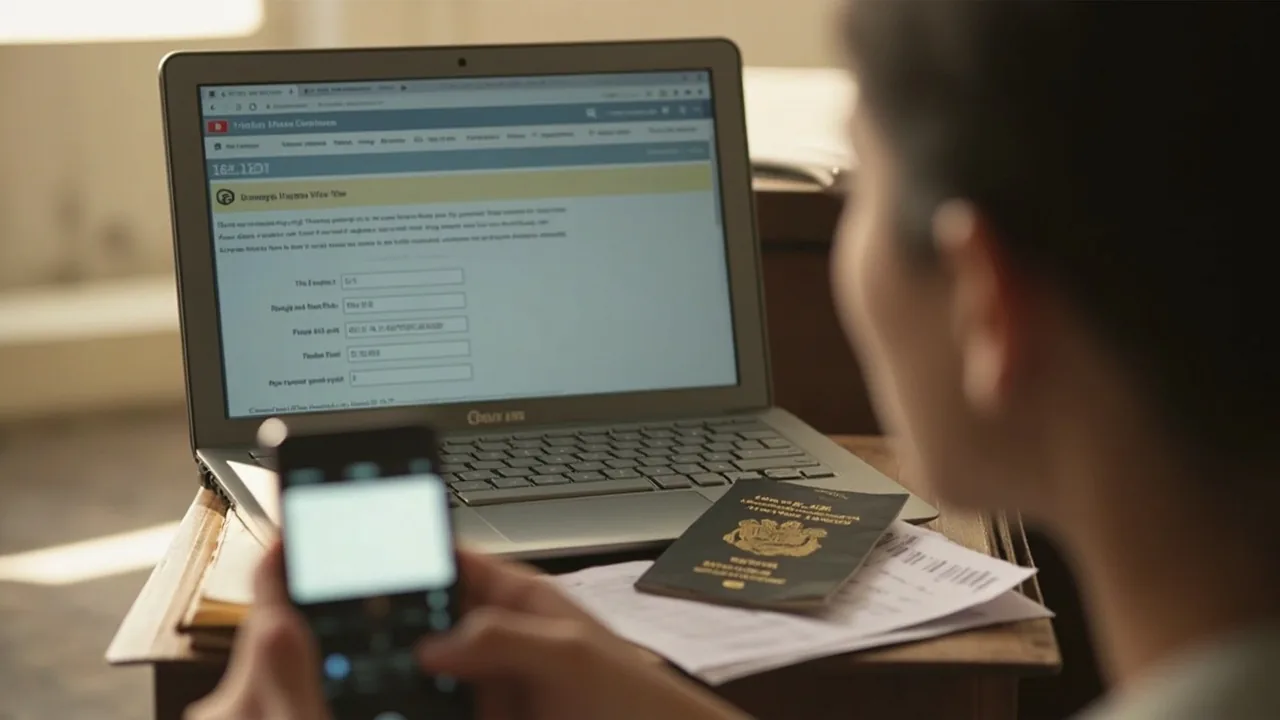
Vietnam E-Visa for Indians Entering from the Cambodia Land Border
The Vietnam e-visa works at every international land border crossing with Cambodia, including Bavet/Moc Bai and Kaam Samnor/Vinh Xuong. Indians no longer get visa-on-arrival, so applying online before you leave Phnom Penh or Siem Reap is the only legal route. The application takes about 15 minutes, costs ₹2,408 (~25 USD), and lands in your inbox in 3 working days. This guide walks you through the exact portal, the right “border checkpoint” code to pick, the photo specs that get applications rejected, and what happens at the actual crossing. For related planning, see our guide on Vietnam Departure Tax Airport.
Quick Answers
| What | Answer | Price (INR) |
|---|---|---|
| Do Indians need a visa for Vietnam? | Yes, e-visa only (no visa-on-arrival for Indians) | ₹2,408 (~25 USD) |
| How long is the Vietnam e-visa valid? | 90 days, multiple entry | Included in fee |
| Processing time | 3 working days (official), often faster | Free to expedite |
| Where to apply | https://evisa.xuatnhapcanh.gov.vn | Government portal, no agent needed |
| Which border checkpoint for Cambodia land entry? | ”Landport” codes L1 through L13, pick the one you cross at | Free on the form |
Why the Land Border Changes Everything
The Vietnam e-visa for Indians is the same document whether you fly into Hanoi, Ho Chi Minh City, or walk across a bridge from Cambodia. The fee, the 90-day validity, and the multiple-entry stamp are identical. The thing that changes is the border checkpoint code on the application form. Indian applicants who copy a friend’s application and leave the airport code blank get rejected at the border, even when the visa PDF in their inbox looks fine. You may also find Vietnam Airport Rules useful for this trip.
The official Vietnam Immigration portal (https://evisa.xuatnhapcanh.gov.vn) lists 13 land ports that accept e-visas. The two most-used crossings for backpackers coming from Cambodia are: See also: How Many Days Do You Need in Vietnam.
- Bavet / Moc Bai (code L1 on the form): the main crossing between Svay Rieng Province in Cambodia and Tay Ninh Province in Vietnam, used by everyone going between Phnom Penh and Ho Chi Minh City by road.
- Kaam Samnor / Vinh Xuong (code L2): the river crossing between Kandal Province in Cambodia and An Giang Province in Vietnam, used by travellers going from Phnom Penh to Chau Doc or Can Tho.
If you cross at a different gate, the form has codes L3 through L13. Pick the right one. Wrong code = entry denied at the checkpoint.
For more on the actual bus/road journey from Phnom Penh to Ho Chi Minh City, see the Cambodia to Vietnam overland border guide. For a deeper dive on the e-visa itself, including the airport version of the same form, see the Vietnam 90-day e-visa guide for Indian travelers.
Step-by-Step Application on the Official Portal
The official site is https://evisa.xuatnhapcanh.gov.vn. Bookmark it. Every other website claiming to “process” Vietnam e-visas is an agent charging you a markup for a form you can fill yourself in 15 minutes.
Step 1: Create the Application
- Click “Apply Now” on the homepage.
- Upload your photo: 4x6 cm, white background, taken within the last 6 months, no glasses, no hat. This is the most common rejection reason. The photo file must be under 200 KB and in .jpg or .png format.
- Upload your passport bio page scan: clear, full page, all four corners visible, under 300 KB.
- Fill in personal details exactly as printed on your passport. One typo on the passport number = rejection.
Step 2: Pick the Right Border Checkpoint
The form asks for “Intended entry checkpoint.” Scroll the dropdown to the land port section, not the airport section. Pick the code that matches the gate you will physically walk through:
| Border Crossing | Cambodia side | Vietnam side | Code on form |
|---|---|---|---|
| Bavet / Moc Bai | Svay Rieng | Tay Ninh | L1 |
| Kaam Samnor / Vinh Xuong | Kandal | An Giang | L2 |
| Trapeang Sralau / Xa Mat | Tboung Khmum | Tay Ninh | L3 |
| Phnom Den / Tinh Bien | Takeo | An Giang | L4 |
| O Smach / Le Thanh | Banteay Meanchey | Gia Lai | L5 |
If you list L1 on the form but walk through L4, you get sent back to the back of the queue. The officer can refuse entry even with a valid e-visa if the checkpoint code does not match.
Step 3: Pay the ₹2,408 (~25 USD) Fee
The portal accepts Visa, Mastercard, JCB, and a Vietnamese domestic card option. Indian Rupee cards on a Visa/Mastercard network work fine. The fee is $25 USD (~₹2,408 at the current rate of 1 USD = ₹96.3294). The site charges in USD and your bank converts to INR at its own rate, usually 3-4% above the live mid-market. A few travellers report their bank blocking the first attempt as fraud. Call your bank’s international transaction line once before applying, or use a forex card.
The portal does not accept UPI, netbanking, Indian Rupay, or cryptocurrency.
Step 4: Wait for the Email
The official processing time is 3 working days, not counting the day you apply and not counting Vietnamese public holidays. Travellers in mid-2026 report median turnaround of about 48 hours for applications submitted on weekday mornings. The PDF arrives as an attachment from a xuatnhapcanh.gov.vn address.
Print the PDF in colour on A4 paper. Also save a copy on your phone and email it to yourself. The border officer will scan the QR code on the printout.
Step 5: Walk Across the Bridge
At Bavet/Moc Bai or Kaam Samnor/Vinh Xuong, you go through three queues in order: Cambodia exit, no-man’s-land, Vietnam entry. At Vietnam entry, hand over your passport, printed e-visa, and the onward bus/transport booking you filled on the application form. The officer stamps your passport, scans your e-visa QR, and waves you through. Total time at the Vietnam side is usually 5-10 minutes if your form is clean.
Photo Specs That Get Applications Rejected
Roughly 1 in 8 e-visa applications from Indian travellers get bounced on the first try, and almost always for the photo. The Vietnam Immigration portal is strict on three things:
- Background must be pure white. Cream, off-white, or textured backgrounds fail the auto-check.
- Face must take up 70-80% of the frame. Passport photo studios in India default to 35x45 mm prints, which work fine. The 4x6 cm size is a soft conversion, the underlying file is what matters. Ask for a digital scan of the same photo at 600 DPI.
- No glasses, no hats, no head covering except for religious reasons. A dupatta or turban is allowed but must leave the full face visible from chin to hairline.
Do not photograph your passport photo with your phone. Scan it on a flatbed scanner or ask the studio for the digital file.
Payment Methods That Work (and Don’t)
The official portal’s gateway is set up for international Visa/Mastercard/JCB networks. Indian-issued cards on these networks work. Here is what works and what does not:
| Method | Works? | Notes |
|---|---|---|
| HDFC Visa debit card | Yes | Enable international transactions first |
| SBI RuPay card | No | RuPay not supported |
| ICICI Mastercard forex card | Yes | Best option, no markup over interbank rate |
| UPI / GPay / PhonePe | No | Portal does not show QR option |
| Cryptocurrency | No | Do not use agents promising this |
| Cash via agent | Yes, but 2-3x markup | Skip agents entirely |
If your card gets declined, the most common fix is to call your bank’s 24-hour international number and unblock “online international transactions” on the card. Indian banks default this off.
Common Rejection Reasons (and How to Avoid Them)
Traveller reports from June 2026 highlight five reasons applications get refused:
- Photo fails the auto-check. White background, full face, no glasses. Get it right the first time.
- Passport bio page scan is cropped or blurry. Scan the full page including the edges.
- Passport number has one wrong digit. Copy from the photo page, not the cover.
- Nationality field left blank or filled wrong. “Indian” is the correct answer.
- Wrong entry checkpoint code. Land border = L1-L13, not the airport codes. Match it to the gate you cross.
If you do get rejected, the portal emails a reason and you can resubmit. There is no extra fee. The 3-day clock restarts.
What Happens at the Actual Border
At Bavet/Moc Bai (the most-used crossing for backpackers), the sequence is:
- Cambodian exit: stamp out at the Cambodian immigration hall. Keep your Cambodia visa stamp visible.
- No-man’s land: about 300 metres on foot. Tuk-tuk drivers offer rides but the walk is fine with a backpack.
- Vietnam entry: join the “foreign passport” queue. Hand over passport + printed e-visa + onward transport proof. The officer scans, stamps, and you walk into Tay Ninh Province. From there, buses to Ho Chi Minh City run every 30 minutes and cost around ₹368 (~100,000 VND or ~$3.82).
The whole process at the Vietnam side is faster than at airports. The line is shorter, the officer has time to read your form, and there is no visa-on-arrival counter competing for the same queue.
For a complete money plan once you cross, the Vietnam money guide covers ATM withdrawals, forex cards, and the cash-handling rules for the Dong. For how much cash to carry across, see how much money to carry to Vietnam from India.
FAQ
Can I apply for the e-visa at the Cambodia side of the border?
No. The official portal needs Wi-Fi and a working payment gateway, and Cambodian land-border offices do not run a Vietnam e-visa service. Apply from your hostel in Phnom Penh or Siem Reap, or from any café with a stable connection. Most applications go through in 15 minutes.
Do I need a printed photo as well, or is the digital upload enough?
The portal only requires the digital upload. Border officers do not ask for a physical photo at the land crossings. At airports they sometimes do, so keep a couple of 4x6 cm prints in your passport for safety.
What if my e-visa gets rejected the day before I cross?
Rejections for typos or photo issues come back within 24-48 hours. Fix the flagged field and resubmit. If the rejection is for “incomplete information,” call the Vietnam Immigration hotline (the number is on the portal) before resubmitting. There is no fee to resubmit. Do not pay an agent to “expedite” a rejected application.
Is the ₹2,408 (~25 USD) fee refundable if I cancel my trip?
No. Vietnam Immigration does not refund e-visa fees under any circumstance, even for rejections that are their own system’s fault. The only protection is to apply only when your itinerary is fixed.
Can I re-enter Vietnam on the same e-visa from Cambodia a week later?
Yes. The e-visa is multiple-entry and valid for 90 days from the date of issue. One application covers every Vietnam border crossing in that window, including a Cambodia-Vietnam-Cambodia-Vietnam loop.
Do I need to declare anything at Vietnamese customs from Cambodia?
Standard cash declaration rules apply. If you carry more than USD 3,000 (the VND equivalent) in cash, declare it. Currency above this threshold without declaration can be confiscated. The same rule applies for gold over 300g.
Safety and Advisory Note
Crossing the Bavet/Moc Bai and Kaam Samnor/Vinh Xuong gates is routine. Travellers in mid-2026 report smooth crossings with no special risks. As with any border zone, keep your passport and printed e-visa in a sealed folder close to your body, refuse unsolicited “help” from touts on the bridge, and pay only at the official ticket windows for onward buses.
For broader Vietnam travel safety, see Vietnam travel warnings for Indians. For current government advisories, check the official MEA travel advisory page before you fly out of India, and re-check it on the morning you cross.
Subodh’s Take
The single biggest mistake Indian backpackers make on the Cambodia-to-Vietnam land crossing is treating the e-visa like a flight visa. The application form is identical, the fee is identical, but the checkpoint code is the one field you have to think about. Get the photo right, type the passport number twice, pick L1 for Bavet/Moc Bai or L2 for Kaam Samnor, pay with a forex card, and the crossing is one of the smoothest border experiences in Southeast Asia.
