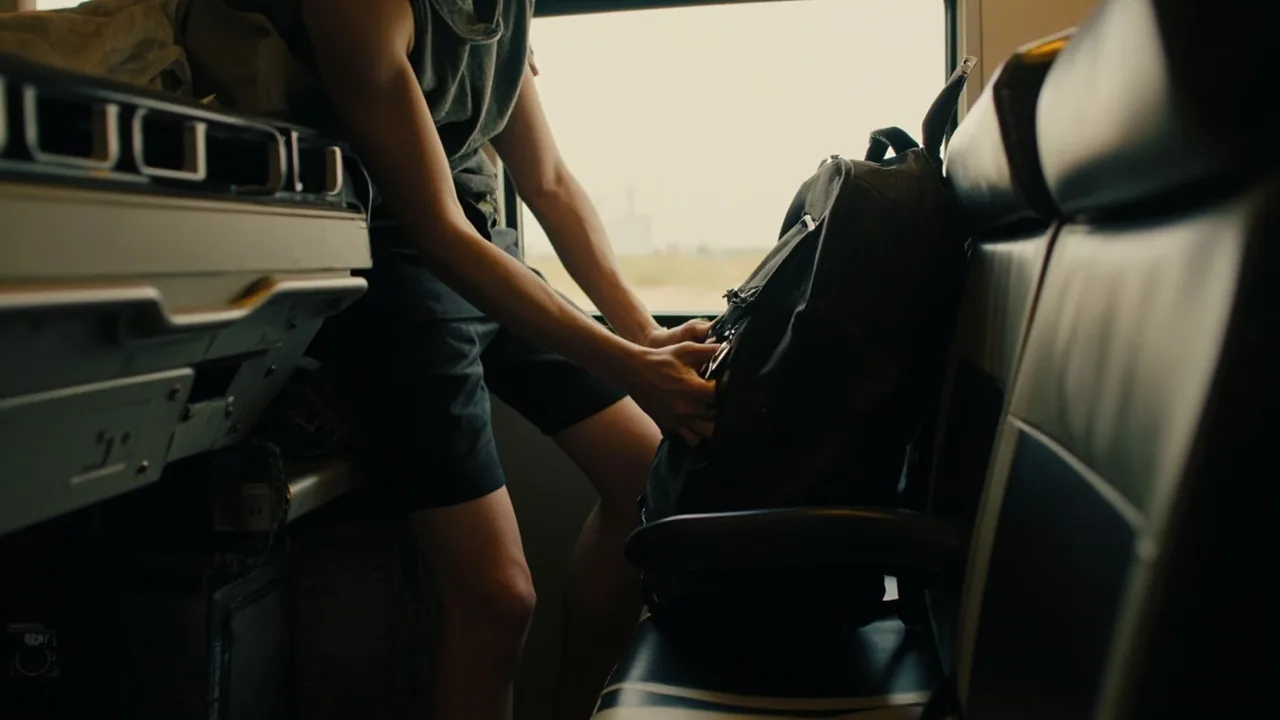
Vietnam Sleeper Bus Safety Gear: 7 Anti-Theft Items Every Indian Traveler Must Pack (Anti Theft Backpack Vietnam Sleeper Bus)
Vietnam sleeper buses are the cheapest way to cover long distances, but they’re also where most theft stories start. The right gear closes the gap before it opens. For the full Vietnam backpacking overview — budget, routes, seasonality — start with our Southeast Asia backpacking hub. Below is the anti theft backpack Vietnam sleeper bus kit, built from e-Visa portal rules and sleeper-bus operator norms, not generic travel-safety blogs.
If you’ve already booked a Hanoi to Sapa sleeper or a Ho Chi Minh City to Da Nang overnight ticket, the next thing on your list should be a packing pass focused on theft prevention. A ₹6,000 (~$62.24) anti-theft bag is cheaper than one lost phone, and one lock on your main bag prevents the most common theft pattern on Vietnamese sleeper buses: a zip opened from the bottom or side while the bag is under a seat or in the hold.
Quick Answers
| What | Answer | Price (INR) |
|---|---|---|
| Best anti-theft backpack for Vietnam sleeper buses? | Slash-proof 35L with lockable zips + hidden pockets | ₹4,000-₹7,000 (~$41.49-$72.61) |
| Money belt worth carrying? | Yes, for passport and spare cash on overnight journeys | ₹600-₹1,500 (~$6.22-$15.56) |
| TSA padlock for sleeper bus luggage hold? | Yes, small combination lock deters casual theft | ₹250-₹500 (~$2.59-$5.19) |
| Vietnam sleeper bus ticket typical price (Hanoi-Sapa)? | ₹2,210-₹3,315 (~600,000-900,000 VND or ~$22.92-$34.38) for a cabin sleeper | ~₹2,200-₹3,300 (~$22.82-$34.23) |
| Vietnam e-Visa fee for Indians (2026)? | ₹2,410 (~25 USD), 90 days, multiple entry, apply 3+ days before | ₹2,400 (~$24.90) |
1. Anti-Theft Backpack (35L, Slash-Proof)
Your main backpack is the single most important piece of gear on any sleeper bus. The Vietnamese sleeper bus luggage hold is a long, dark, mostly unsupervised metal bay under the cabin. Bags get tossed in at the depot, retrieved by name tag at the next stop, and rarely watched in between. A regular ₹2,000 (~$20.75) daypack with a single YKK zip on top is the easiest target in the world.
What to look for:
- 30L to 40L capacity. Anything larger won’t fit under a sleeper seat and forces you into the hold; anything smaller can’t carry a laptop, change of clothes, and a one-night kit.
- Cut-resistant fabric. Bags with a hidden steel mesh or UHMWPE lining (brands like XD Design, Pacsafe, or the Indian-market “Safari Anti Theft” line) resist a knife slash. A regular backpack fabric can be opened with a blade in under five seconds.
- Lockable zips. Two zips that meet at a single anchor point, so a small padlock or clip can run through both pull-tabs. This is the single most useful feature for sleeper buses.
- Hidden or rear-facing pockets. A pocket against your back is unreachable when you wear the bag. Use it for passport, spare cash, and phone.
Budget option for Indian travellers: A 35L slash-proof bag from Amazon India or Flipkart runs ₹3,500-₹6,500 (~$36.31-$67.42). Branded Pacsafe and XD Design models go up to ₹12,000 (~$124.48), but the ₹4,500 (~$46.68) to ₹6,000 (~$62.24) range is where the value sits. Travellers report the AmazonBasics slash-proof line is a cheaper entry point if you’re on a strict budget.
For an Indian traveller carrying a laptop, an anti-theft backpack also doubles as your daypack when you arrive, so it’s not sleeper-bus-only gear. A good 35L fits under most Vietnamese airline seats as well, which matters if you’re hopping Hanoi to Da Nang for a flight connection after a long bus.
2. Money Belt or Hidden Passport Pouch
A money belt worn under your shirt is the simplest insurance for the items that hurt most if lost: passport, spare USD cash, and a photocopy of your visa. Sleeper bus passengers routinely wake up to find their passport gone because they left it in the outer pocket of their daypack, which got moved when the bus stopped at a rest area.
What to look for:
- Soft fabric, worn flat against the stomach or lower back. Hard plastic money belts are uncomfortable to sleep in, and sleeper bus passengers sleep.
- RFID-blocking layer. Vietnam doesn’t have a major contactless-card skimming problem the way some European cities do, but the RFID layer costs nothing extra and protects debit/credit cards.
- Zip + button closure, not just a zip. A button flap over the zip means a casual pickpocket can’t open it in one motion.
Price range: ₹600-₹1,500 (~$6.22-$15.56) on Amazon India. The lower end is a thin nylon pouch with a strap; the higher end is a proper RFID-blocking belt from a brand like Eagle Creek or Travelon.
What to put in it: passport (mandatory), 1-2 spare USD notes for emergency, one photocopy of your e-Visa printout, and one debit card backup. Your main daily cash stays in your pocket or backpack.
Subodh’s Pro Tip: If your anti-theft backpack has a rear-facing hidden pocket, you can skip the money belt for daily city use, but never skip it for the sleeper bus. Passports on Vietnamese sleeper buses have been reported stolen from outer bag pockets more than any other item.
3. Combination Padlock (TSA-Style or Small Luggage Lock)
A small combination padlock on your main backpack’s zips is the single most effective theft deterrent for the price. The point isn’t to stop a determined thief; it’s to make your bag look slower than the one next to it. Vietnamese sleeper bus luggage holds have 30 to 50 bags in a single bay, and a thief with 30 seconds at a rest stop will pick the bag with no lock every time.
What to look for:
- 3-digit combination, not keyed. You will forget the key on a sleeper bus at 3 AM.
- Small enough to fit through two zip pull-tabs at once. Anything over 60 grams is too heavy for daily carry.
- TSA-style is optional. Vietnamese customs won’t have TSA keys, but if you’re transiting through Singapore or Bangkok on the way home, a TSA lock can be opened by airport security without breaking.
Price range: ₹200-₹500 (~$2.07-$5.19) on Amazon India or any luggage shop. Buy two: one for the main backpack, one for the daypack or waist bag.
For the luggage hold specifically, you can also thread a small lock through the zipper pulls of your main bag and clip the bag’s carry strap to a fixed bar in the hold (if available). Not every bus has a bar, but the long-distance Phuong Trang, The Sinh Tourist, and FUTA buses usually do.
4. Cable Luggage Lock or Bike-Style Retractable Cable
If your main backpack has a single YKK zip on top, a regular padlock doesn’t help; it only secures the two pull-tabs together, leaving the rest of the zip exposed. The fix is a retractable cable lock: a 60cm to 90cm steel cable with a 3-digit combination, which you thread through the entire zip run and back to a single anchor point.
What to look for:
- 3mm or thicker steel cable. Anything thinner can be cut with fingernail clippers.
- 4-digit combination if you can find one. 3-digit combinations have only 1,000 options and can be cracked in under 5 minutes by a determined thief, but for sleeper bus deterrence that’s still enough.
- Retractable spool, not a fixed-length cable. Retractable versions pack flat in your bag; fixed ones tangle.
Price range: ₹400-₹1,200 (~$4.15-$12.45) on Amazon India. The OxyLite and Kisloto brands on Amazon India are good value in the ₹500-₹700 (~$5.19-$7.26) range. Branded options like Master Lock go up to ₹1,500 (~$15.56).
5. Slash-Proof Daypack or Crossbody Bag
Your daypack is what you’ll carry onto the sleeper bus cabin itself. Anything that doesn’t fit under the seat goes on the roof rack or in the hold, and you want a daypack with three properties: slash-proof body fabric, lockable zips, and a way to anchor it to the seat or your body.
What to look for:
- Crossbody strap option. A crossbody bag is harder to grab-and-run than a backpack when the bus door opens at a rest stop. Travellers report snatchings of loose shoulder bags at rest stops; crossbody with the strap under your jacket is the safer version.
- Slash-proof fabric in the body, not just the strap. Most cheap “anti-theft” bags slash-proof only the strap; the body is still cuttable.
- Lockable zips with at least one hidden pocket.
Price range: A good slash-proof crossbody runs ₹1,500-₹4,000 (~$15.56-$41.49) on Amazon India. Brands like XINBAO, Bagline, and the AmazonBasics anti-theft line dominate this category in India. The 8L to 12L size is right for a phone, passport, power bank, headphones, and a water bottle.
Safety Alert: On sleeper bus rest stops, take your daypack with you even if it’s heavy. A 5-minute toilet break is enough for a bag left on the seat to disappear. Travellers also report leaving a decoy shirt or towel in the seat to make it look like the bag is still there, and carrying the actual valuables into the rest stop.
6. RFID-Blocking Card Sleeve or Wallet
Vietnam isn’t the worst country for card skimming, but RFID-blocking sleeves are cheap enough that there’s no reason to skip them. A set of 4 to 6 card sleeves costs ₹250-₹500 (~$2.59-$5.19) on Amazon India, fits in any wallet, and protects both debit and credit cards from contactless skimming in crowded markets and bus stations.
If your anti-theft backpack already has RFID-blocking fabric in the main pocket, you may not need sleeves. If it doesn’t, this is the cheapest single item on the list for the safety it adds.
For Indian travellers specifically: the SBI, HDFC, and ICICI Visa/Mastercard debit cards all support contactless tap. Skimming is rare but reported, and your primary debit card is your emergency lifeline if you get locked out of UPI, so protect it.
7. Portable Door Lock or Stop Alarm for Hostels
Not a sleeper bus item directly, but Vietnamese backpackers use sleeper buses because they save on hostel costs, which means you arrive at 5 AM at a hostel where check-in isn’t until 2 PM and you want a bed for a few hours. A portable door lock or stop alarm lets you sleep in a dorm bed without worrying about someone walking in.
What to look for:
- Portable door wedge with rubber grip. A rubber door wedge that locks under the door from the inside. ₹300-₹800 (~$3.11-$8.30) on Amazon India.
- Or a doorstop alarm that screams when pressure is released. ₹600-₹1,200 (~$6.22-$12.45). Less reliable in a noisy dorm but useful for private rooms.
Travellers report the rubber wedge works better than alarms in Vietnamese hostels because alarms get triggered by hostel staff or thin walls, leading to social awkwardness at 7 AM.
Sleeper Bus Ticket Booking (Quick Reference)
Vietnam sleeper buses are bookable online via 12go, Baolau, or directly through operators like Phuong Trang, FUTA, The Sinh Tourist, and Sapa Express — see our full how to book a Vietnam sleeper bus guide for step-by-step instructions. If you want extra legroom and a private bunk, check the VIP sleeper bus booking options. Book at least 24 hours in advance for overnight routes on weekends and holidays.
| Route | Operator | Price (VND) | Duration |
|---|---|---|---|
| Hanoi to Sapa | Sapa Express, The Sinh | 600,000-900,000 | 6-7 hours |
| Ho Chi Minh City to Da Nang | FUTA, Phuong Trang | 600,000-1,000,000 | 16-18 hours |
| Da Nang to Hoi An | Local minibus | 80,000-150,000 | 45 min |
| Hanoi to Hue | The Sinh, FUTA | 500,000-800,000 | 12-14 hours |
| Da Nang to Hoi An | Grab or local bus | 80,000-150,000 | 45 min |
For multi-stop trips, sleeper buses are usually the cheapest option. A Hanoi to Da Nang sleeper at ₹2,578 (~700,000 VND or ~$26.74) is cheaper than a flight at ₹2,946-₹5,524 (~800,000-1,500,000 VND or ~$30.56-$57.31) once you factor in airport transfers. Book via 12go for English-language booking and refund policies.
Vietnam e-Visa for Indians (2026)
Before any sleeper bus route, you need to clear immigration. Vietnam’s e-Visa for Indian passport holders in 2026 costs $25 USD (~₹2,410 at the current rate of 1 USD = ₹96.3294) and is valid for 90 days with multiple entries. For the full walkthrough with screenshots, see our Vietnam e-Visa step-by-step guide. Apply online at the official portal: https://evisa.xuatnhapcanh.gov.vn
Processing is officially 3 working days, so allow 5-7 days before travel to be safe. Photo requirements: 4x6 cm, white background, taken within 6 months. There is no visa-on-arrival for Indian passport holders, so pre-apply before you fly.
For the visa-printout carry rule: keep one printed copy in your money belt, one digital copy in your email, and one digital copy on your phone. Sleeper buses don’t ask for visa documents, but border crossings and hotel check-ins do.
Money & SIM Setup Before the First Sleeper Bus
Before you board your first overnight bus, get your money and SIM sorted. Travellers who arrive at the Hanoi or Ho Chi Minh City airport with a working Vietnamese SIM and ₹3,683-₹7,366 (~1,000,000-2,000,000 VND or ~$38.20-$76.41) in cash get on sleeper buses with zero friction.
SIM card: Viettel or Mobifone tourist SIM, 14-day, ₹479 (~130,000 VND or ~$4.97), includes ~6GB data. Available at airport kiosks on arrival. Alternatively, buy an eSIM before you fly and activate on landing.
Cash: Withdraw ₹3,683-₹7,366 (~1,000,000-2,000,000 VND or ~$38.20-$76.41) from an airport ATM (Vietcombank, BIDV) on arrival. Indian debit cards work at most Vietnamese ATMs; SBI and HDFC travel cards are the most reliable. UPI is not accepted in Vietnam, so cash + a Visa/Mastercard debit card is your baseline.
For full SIM options, see our Vietnam SIM card cost guide and the Viettel/Mobifone recharge guide once you’ve bought your first SIM.
Packing Order: 7 Items in Your Daypack for the Bus
When you board a Vietnamese sleeper bus, you should have these 7 items on your person or in a bag you take into the cabin (for the full country-wide packing list beyond sleeper bus gear, see our Vietnam month-by-month packing guide):
- Anti-theft backpack (35L) with main luggage
- Money belt with passport and spare ₹289 (~3 USD). Crossbody slash-proof daypack with phone, water, headphones, power bank
- Combination padlock on main backpack’s zips
- Cable lock through main backpack’s zip run, anchored if possible
- RFID card sleeves in your wallet
- Portable door wedge for hostel arrival
Total cost of all seven items: roughly ₹7,000-₹15,000 (~$72.61-$155.60) if bought new on Amazon India. That’s less than the cost of replacing a stolen phone, and a fraction of replacing a passport abroad.
Common Mistakes Indian Travellers Make on Sleeper Buses
Mistake 1: Storing passport in the outer pocket of a backpack going into the luggage hold. Passports have been reported stolen from outer bag pockets on Vietnamese sleeper buses; the money belt fix applies on every overnight route.
Mistake 2: Trusting the luggage hold tag system. The hold is a shared metal bay with 30-50 bags. Tags get swapped, names get misread, and a thief who grabs your bag at a rest stop has 10 minutes before the bus leaves. Lock your bag and use a unique luggage tag (a coloured ribbon or strap) so you spot your bag fast at the destination.
Mistake 3: Sleeping through rest stops. Rest stops are 15-20 minutes, the bus doors stay closed, but someone can still climb off at a stop and walk to the hold. Stay half-awake, take your daypack with you if you get off, and check your bag’s lock visually before going back to sleep.
Mistake 4: Carrying all cash in one pocket. Split your daily cash into two or three spots: some in the front pocket, some in the rear pocket, some in the money belt. If you get pickpocketed at a rest stop market, you lose a third, not everything.
Mistake 5: Bringing a suitcase instead of a backpack. Sleeper bus luggage holds are built for soft bags; a hardshell suitcase can’t be stacked and often gets left on the floor unsecured. A backpack with a lockable zip and a strap that can be anchored is a better fit.
Safety Alert: Vietnamese sleeper buses are statistically safe, but the theft risk is real on overnight routes. Thefts are most commonly reported on long-haul routes (Hanoi-Sapa, HCMC-Da Nang, HCMC-Nha Trang) and during the 11 PM to 4 AM window. Pack as if those hours are unguarded, because they mostly are.
FAQ
What is the best anti-theft backpack for Vietnam sleeper buses?
A 30L to 40L slash-proof bag with lockable zips and at least one hidden rear pocket. The Amazon India price range is ₹4,000-₹7,000 (~$41.49-$72.61) for the value tier (AmazonBasics, Safari, Bagline); Pacsafe and XD Design go higher. Anything smaller than 30L won’t fit your laptop and a change of clothes; anything over 45L goes into the luggage hold, not the cabin.
Are Vietnamese sleeper buses safe for solo Indian travellers?
Generally yes. The buses are well-used by Vietnamese domestic travellers and foreign backpackers. The main risks are theft of small items from the luggage hold and pickpocketing at rest stops, both of which are addressable with the gear in this article. Solo female travellers also report safety on overnight buses, with the usual caveat of staying alert at rest stops.
How much does a Vietnamese sleeper bus ticket cost?
Standard cabin sleeper Hanoi to Sapa runs ₹2,210-₹3,315 (~600,000-900,000 VND or ~$22.92-$34.38); Ho Chi Minh City to Da Nang is ₹2,210-₹3,683 (~600,000-1,000,000 VND or ~$22.92-$38.20) for 16-18 hours. Vip cabin with single-occupancy bunk runs higher, around ₹4,420-₹6,629 (~1,200,000-1,800,000 VND or ~$45.84-$68.77) on long routes.
Can I lock my backpack on a Vietnamese sleeper bus?
Yes. Bring a small combination padlock or retractable cable lock and thread it through the zip pull-tabs. The luggage hold has fixed bars on most Phuong Trang, FUTA, and The Sinh buses for anchoring. Avoid keyed locks; you’ll lose the key at 3 AM.
Should I bring a money belt on a sleeper bus?
Yes, for passport, spare USD cash, and one backup debit card. The ₹600-₹1,500 (~$6.22-$15.56) cost is worth it. Use the money belt only for items you cannot afford to lose; daily spending cash stays in your pocket or daypack.
Is Vietnam e-Visa still ₹2,410 (~25 USD) for Indians in 2026?
Yes. ₹2,410 (~25 USD), valid 90 days, multiple entry. Apply at https://evisa.xuatnhapcanh.gov.vn at least 5 days before departure. Photo is 4x6 cm on white background.
What’s the cheapest way to get from Hanoi to Da Nang?
Sleeper bus (12-14 hours, ₹1,842-₹2,946 (~500,000-800,000 VND or ~$19.10-$30.56)) is cheapest. Flight (1.5 hours, ₹2,946-₹5,524 (~800,000-1,500,000 VND or ~$30.56-$57.31)) is faster but more expensive once you factor in airport transfers. Train (12-16 hours, similar price to bus) is the middle option for scenery.
Subodh’s Take
Seven items, under ₹15,000 (~$155.60) total, and you’ve closed 90% of the realistic theft risk on a Vietnamese sleeper bus. The remaining 10% is alertness at rest stops, which costs nothing but attention. Skip the “anti-theft clothing” with built-in pockets, skip the GPS tracker unless you’re carrying a ₹80,000 (~$829.84) laptop, and skip the TSA locks (Vietnamese customs don’t have TSA keys anyway). Spend the money on a slash-proof 35L bag, a money belt, and a cable lock. The rest is theatre.