Nong Khiaw to Sapa & Hanoi: The Honest Overland Corridor (2026)
📍 Distance: ~450 km (Nong Khiaw → Sapa), ~520 km (Nong Khiaw → Hanoi) ⏱️ Fastest option: 20 hours (direct sleeper to Sapa) 💰 Cheapest option: ₹4,753 (~1,100,000 LAK or ~$49.24) 🏆 Best option: Sleeper bus to Hanoi via the Lao Bao border (if you have the time)
If you’re wondering is Nong Khiaw worth it as a stopover on the Laos-Vietnam corridor, the short answer is yes, but only if you do it right. The Nong Khiaw → Sapa → Hanoi corridor is the cleanest way to thread yourself into Vietnam without flying. It’s also the corridor nobody warns you about until you’re already at the bus station in Nong Khiaw, staring at a hand-painted timetable with two rows and no English. For the full Southeast Asia route context, see our SEA Backpacking Hub. You may also find Chiang Rai to Luang Prabang useful for this trip.
Fares below were verified against Laos Easy Go Travel’s July 2026 quotes; border timings reflect traveller reports from June 2026; VoA fee pinned to the current Laos Immigration schedule. This guide covers every realistic option, what each one feels like, and how to skip the cheap mistakes that eat a full day of your trip. See also: Nong Khai to Vientiane.
Quick Answers
| What | Answer | Price (INR) |
|---|---|---|
| Cheapest way out of Nong Khiaw | Sleeper bus to Hanoi (single ticket, ~22h 30m) | ₹4,753 (~1,100,000 LAK or ~$49.24) |
| Fastest way to Sapa | Direct sleeper, 20h with one transfer | ₹4,969 (~1,150,000 LAK or ~$51.48) |
| Best overall experience | Sleeper to Hanoi + Lao Bao border | ₹5,401 (~1,250,000 LAK or ~$55.95) |
| Muang Ngoi boat detour | Long-tail boat, ~1h upstream, ₹108 (~25,000 LAK or ~$1.12) each way | ₹108 (~$1.12) |
| Border crossing fee (Vietnam VoA, Indian passport) | ₹2,896 (~30 USD), payable in clean USD or THB | ₹2,896 (~$30) |
Subodh’s Pro Tip: Carry the visa fee in brand-new USD notes from Bangkok. Lao Bao is famous for refusing creased or torn bills, and there’s no ATM at the border. For related planning, see our guide on Luang Prabang to Vang Vieng.
Option 1: Cheapest (The Long Sleeper)
The cheapest exit out of Nong Khiaw is a sleeper bus, full stop. There’s no train, no cheap domestic flight, and no shared minivan. You’re on a sleeper or you’re staying another night. You may also find Savannakhet to Hue useful for this trip.
For Hanoi, the cheapest 12go option for July 2026 is the 22h 30m sleeper operated by an unbranded partner. It leaves Nong Khiaw in the late afternoon, rolls through Phonsavan overnight, and arrives in Hanoi around midafternoon the next day. The seat-to-bed conversion is a three-quarter recline, not a flat sleeper. Reviews suggest it’s tight for anyone over 175 cm. The bus does stop for dinner at a Lao roadside restaurant around 9 PM; the rice-and-egg plate is ₹108 (~25,000 LAK or ~$1.12) and the only other option is a packaged noodle cup.
For Sapa, Laos Easy Go Travel runs a 20-hour sleeper with one passenger transfer at the border. Price hovers around ₹4,969 (~1,150,000 LAK or ~$51.48). It is cheaper than booking Hanoi-then-train because the transfer is bundled in.
How to book: Tickets sell out the morning of departure, not the day before. Walk into the Nong Khiaw bus station before 9 AM, ask for the next day’s Hanoi or Sapa sleeper, and pay cash in LAK. Online pre-booking on 12go works but adds a ₹216 (~50,000 LAK or ~$2.24) service fee and locks you into a specific operator. Compare prices on 12go for the Sapa sleeper, or see the Hanoi options below.
Safety Alert: Sleeper buses in Laos run a “wake you at the border” model. Keep your passport in your hand, not your daypack, and stay alert. Phones, power banks, and external batteries sometimes get flagged at the Lao Bao customs x-ray. They won’t be confiscated, but they will slow you down.
Option 2: Best Experience (Sleeper + Muang Ngoi Loop)
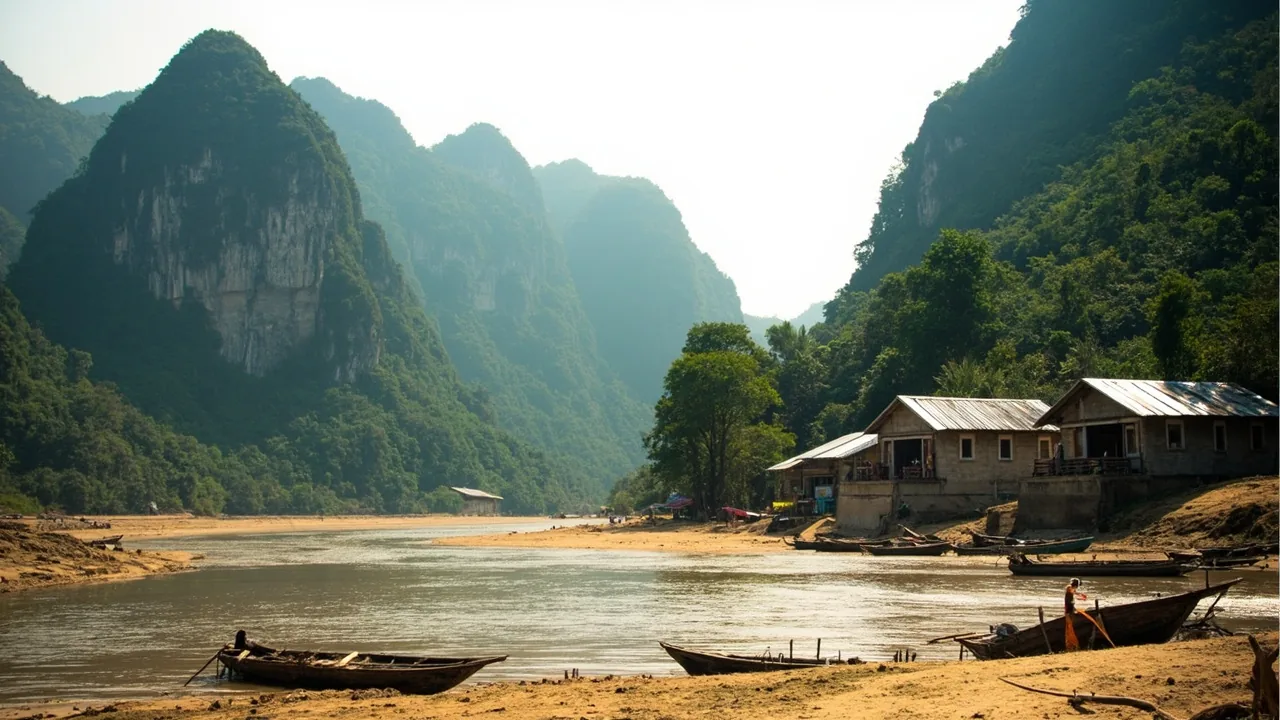
The single best Nong Khiaw experience isn’t a transport option; it’s the Muang Ngoi boat detour you’ll want to add before boarding the sleeper. The long-tail boats are a local on-demand service arranged at the south end of the bridge; there is no advance booking. The long-tail boats leave from the south end of the bridge, run on demand, and cost ₹108 (~25,000 LAK or ~$1.12) each way. The upstream ride is one hour through karst cliffs that look almost CGI in afternoon light. Muang Ngoi itself is a single-street village with no roads, no cars, and exactly two guesthouses that matter. Most travellers do a half-day: catch the 8 AM boat up, walk to the Muang Ngoi viewpoint (45 minutes return, gentle gradient), and ride the 2 PM boat back.
If you’re heading to Hanoi or Sapa, sleep in Nong Khiaw the night before, do the Muang Ngoi boat at sunrise, then board your sleeper that afternoon. This is the only corridor where I’d recommend a one-night layover instead of pushing straight through.
Subodh’s Pro Tip: The 8 AM boat and 2 PM return both wait until they’re full — usually 15–30 minutes — then depart. If demand is low, the operator may leave ahead of schedule, so show up early with your daypack ready.
For the actual sleeper, the comfortable upgrade is the 21h option on 12go which uses full-flat berths (3 rows of 9 beds, side-facing aisle) instead of the half-recliner seats. It runs at the same price band as the budget option, so the only reason to pick the budget sleeper is if it’s the only ticket left.
Option 3: Fastest (What “Fastest” Means Here)
There is no flight from Nong Khiaw to anywhere. The fastest surface route to Sapa is 20 hours, to Hanoi is 21 hours, and nothing under that exists without a detour through Luang Prabang and a domestic flight.
If you genuinely cannot do 20+ hours on a sleeper, the only realistic alternative is Nong Khiaw → Luang Prabang slow boat (8 hours, scenery you came for), overnight in Luang Prabang, then LPQ → Hanoi flight. The LPQ-Hanoi flight on Lao Airlines or Vietnam Airlines runs 3-4 times a week in high season, ~₹9,500 (~$98.42) one way, 1h 20m. Total time door-to-door: 22-24 hours, same as the direct sleeper, but you spend 4 hours of it in an airport and another 8 hours on the slow boat. Net result: roughly the same total time, ~40% more cost.
Worth it only if you specifically want to fly, hate sleeper buses, or need to be in Hanoi for a fixed appointment. Otherwise, the sleeper wins.
Border Crossing (Lao Bao / Cau Treo)
The Nong Khiaw → Hanoi sleeper crosses at the Lao Bao international border (Laos) → Cau Treo (Vietnam). It’s the second-busiest Laos-Vietnam land crossing after the Friendship Bridge, but still a low-key operation. For a full breakdown of all Laos-Vietnam crossings, see our Laos-Vietnam Border Crossings guide.
For Indian passport holders:
- Visa on arrival is available. Fee: ₹2,896 (~30 USD), payable in clean USD or THB.
- Bring: passport (6+ months validity), two passport photos, completed arrival form (provided on the bus), and proof of onward travel (a hostel booking in Hanoi is enough).
- Process: disembark on the Laos side, walk through Lao immigration, board a tuk-tuk for ₹130 (~30,000 LAK or ~$1.34) across the 4 km no-man’s-land to the Vietnamese checkpoint, walk through Vietnamese immigration, and reboard your bus.
- Total border time: 60-90 minutes if you’re at the front of the bus, up to 3 hours if you’re at the back.
Safety Alert: Money changers near the Lao Bao → Cau Treo crossing offer poor rates (often 15-20% below market). If you need Vietnamese dong for the tuk-tuk, change the bare minimum at the border and find a real exchange in Hanoi. Better: keep Lao kip for the bus dinner and change money properly in Hanoi.
The Lao Bao border closes at 9 PM Laos time. If your sleeper is delayed past 8 PM, you’ll be spending the night at the border in a guesthouse. Delays of 12+ hours are possible during the August monsoon.
Indian Passport Specifics
Two quirks worth knowing before you board:
1. Laos exit stamp trick: Lao immigration sometimes asks for “departure tax” receipts that haven’t existed since 2018. Polite refusal (“this was abolished, here is my bus ticket”) works. Don’t pay out of confusion.
2. Passport photo requirement: Vietnamese immigration will reject photos with white backgrounds if the photo paper is too thin. Use the photo booth at the Luang Prabang immigration office the day before if you’re transiting through, or just use the booth at Lao Bao (two prints, ready in 3 minutes).
The Indian embassy in Vientiane handles Laos-side emergencies: +856 21 241 733. The Indian embassy in Hanoi is reachable 24/7 for Indian nationals: +84 24 3824 4989. Save both before you board.
When NOT to Take This Route
June through September: The monsoon turns the road between Phonsavan and the Vietnamese border into a mud risk. Buses are delayed 4-12 hours and the Phonsavan pass can be risky during peak monsoon. If you’re travelling in August, skip this route and fly Nong Khiaw → LPQ → Hanoi.
Late December / Tet: Vietnamese New Year (late January or early February) brings a 10-day window when most sleeper operators suspend the corridor entirely. Check the operator’s Vietnamese holiday calendar before booking.
The week of Boun That Luang (mid-November): Lao holiday, domestic travel spikes, sleeper tickets sell out 48 hours in advance.
Getting Connected
Cell signal on the Nong Khiaw → Phonsavan stretch is solid on Unitel and Tplus. The Phonsavan → Vietnamese border stretch drops to 2G/EDGE for long sections, with one full dead zone between Phonsavan and the Lak Sao junction. After the border, Viettel Vietnam has the strongest signal across the corridor.
A Lao Unitel SIM with 30 GB runs ₹216 (~50,000 LAK or ~$2.24) at the Nong Khiaw morning market. If you’d rather not swap SIMs twice in one day, an eSIM covering both Laos and Vietnam is the cleaner option and can be purchased from major regional eSIM providers before departure.
Where to Stay (Nong Khiaw End)
Nong Khiaw is tiny. Two real backpacker hostels, plus a handful of mid-range guesthouses. For the standard dorm band in Laos, expect ₹389-₹691 (~90,000-160,000 LAK or ~$4.03-$7.16) across the country. Most Nong Khiaw hostels sit on the cheaper end of this because of the small-town competition. Walk in and compare; prices are negotiable in low season.
What to Eat in Nong Khiaw (Before You Board)
Nong Khiaw’s food scene is small but well-priced. Two real spots:
Nongkhiaw Local Restaurant is the go-to for local Lao food: hearty laap, sticky rice, and grilled river fish portions that easily feed two. Expect to pay ₹108-₹173 (~25,000-40,000 LAK or ~$1.12-$1.79) per dish, full meal for ₹259 (~60,000 LAK or ~$2.69) with a Beerlao.
Namlin Restaurant is the Indian/Asian fusion spot, useful on day three of rice-and-egg fatigue. Their dal-rice and paneer curries run ₹151-₹216 (~35,000-50,000 LAK or ~$1.57-$2.24) and the portions are honest. Rated 4.9 by travellers who walked in, not by Instagram aggregators.
Skip the generic “view of the bridge” cafes; they’re priced 30-40% above these two and the food is noticeably weaker.
FAQ
Is the Nong Khiaw to Hanoi sleeper safe? Yes, but it’s a 22-hour bus. Drive safe means buckle up on the sleeper (yes, there’s a seatbelt), keep valuables on your person, and don’t drink the bus-water bottle offered around midnight.
Can I take the Muang Ngoi boat with luggage? Yes, the long-tail boats handle backpacks. Anything over 60L gets strapped to the roof and you sit inside with your daypack. There is no extra charge.
How much cash should I carry for the border? ₹2,896 (~30 USD) for the visa fee, plus ₹432 (~100,000 LAK or ~$4.48) for tuk-tuk and a meal. That’s ₹3,200 (~$33.15) total. Anything more, change in Hanoi.
What happens if my bus breaks down? The operator dispatches a replacement within 90 minutes on the Nong Khiaw → Phonsavan stretch. Past Phonsavan, you’re on your own for 4-6 hours. Carry 500 ml of water and a power bank.
Do I need a Vietnam visa in advance? No, Indian passport holders get visa-on-arrival at Lao Bao / Cau Treo. Make sure you have two passport photos and clean USD bills.
Subodh’s Take
Nong Khiaw is the kind of stop that makes a Laos trip. But the route north is a slog, and no blog post makes it shorter. The honest read: do the Muang Ngoi boat at sunrise, sleep one more night, board the sleeper in the late afternoon, and don’t try to be a hero. The corridor is beautiful in the same way a long train ride in India is beautiful. You settle in, you stop fighting the clock, and three weeks later you’ll remember the Phonsavan valley at dusk and forget the back-of-the-bus knee pain.
Always check your government’s travel advisory before any cross-border overland move.
