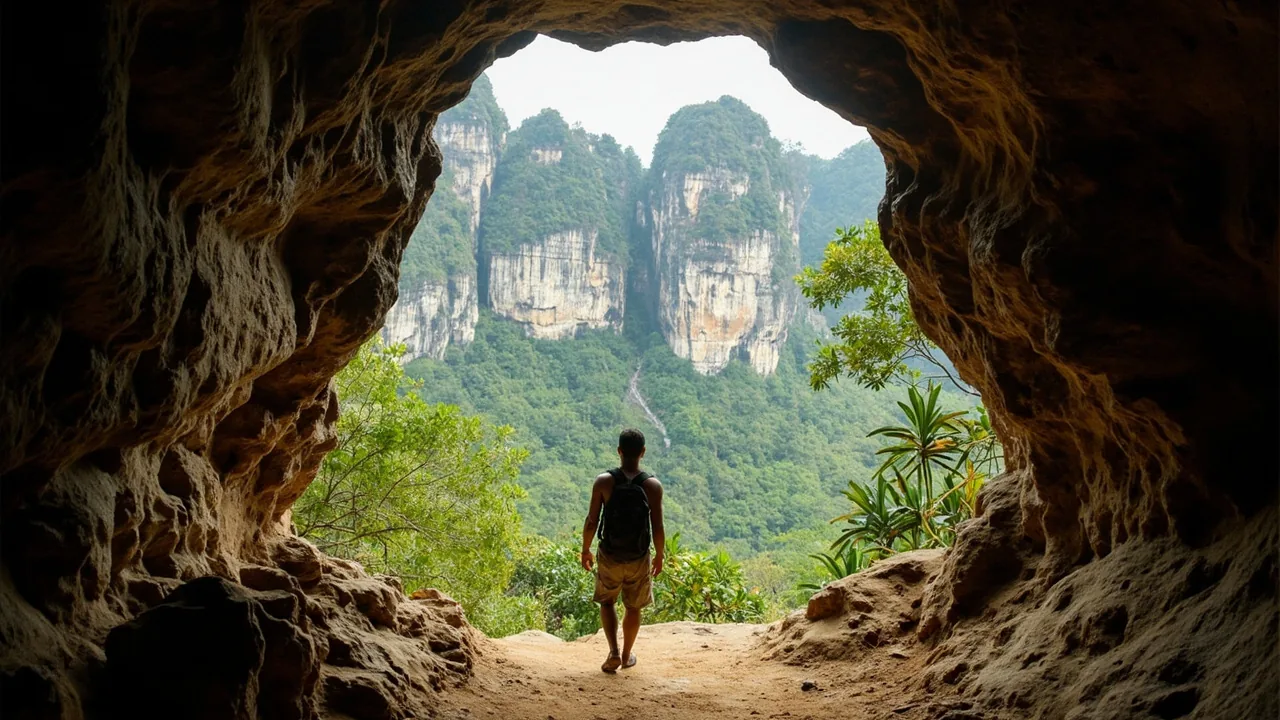
What to See in Vang Vieng: Caves, Lagoons, Viewpoints, and the Stuff Skipping the Brochures (2026)
Vang Vieng is the kind of town that gets a bad rap from people who visited it fifteen years ago and never came back. Back then it was a tubing-and-shisha wasteland where backpackers got hurt. Today’s Vang Vieng is quieter, the tubing has been re-routed away from the bars, and the surrounding karst mountains hide some of the best half-day adventure in Southeast Asia for under ₹644 (~150,000 LAK or ~$6.69) total. If you’re doing the Laos loop, this town gets two nights minimum. Three if you want a rest day. For related planning, see our guides on Sea Backpacking Hub and Chiang Rai to Luang Prabang.
This guide covers the real must-do sights: the Blue Lagoon, Nam Xay Viewpoint, Tham Phu Kham Cave, the hot springs, Kaeng Nyui Waterfall, plus the two things competitors don’t mention enough but should, Tham Nam Water Cave (the actual cave tubing experience) and the balloon ride at sunrise. Costs are in LAK with the FX context, since the local currency is what you’ll hand over at every entry gate and noodle stall. You may also find Nong Khai to Vientiane useful for this trip.
FX rate right now: 1 INR ≈ 232.56 LAK, or 1 LAK ≈ 0.0043 INR. All entry fees and scooter rentals below are quoted in LAK. At current rates, ₹215 (~50,000 LAK or ~$2.23) ≈ ₹215 (~$2.23). See also: Luang Prabang to Vang Vieng.
Quick Answers
| What | Answer | Price (INR) |
|---|---|---|
| Blue Lagoon 1 entry fee | ₹86 (~20,000 LAK or ~$0.89) per person, includes the swing | ₹85 (~$0.88) |
| Tham Phu Kham Cave entry | ₹64 (~15,000 LAK or ~$0.67) per person | ₹65 (~$0.67) |
| Nam Xay Viewpoint | Free, but the motorbike climb is the main event | , |
| Hot springs entry | ₹129 (~30,000 LAK or ~$1.34) per person | ₹130 (~$1.35) |
| Scooter rental for the day | ₹344-₹430 (~80,000-100,000 LAK or ~$3.57-$4.46) | ₹345-₹430 (~$3.58-$4.46) |
| Tham Nam Water Cave (cave tubing) | ₹322 (~75,000 LAK or ~$3.34) including inner tube | ₹325 (~$3.37) |
| Hot air balloon ride (sunrise) | ₹3,651 (~850,000 LAK or ~$37.89) per person | ₹3,655 (~$37.94) |
Blue Lagoon 1. The Poster Child (Yes, It Lives Up to It)
See Tham Phu Kham & Blue Lagoon 1 tours on GetYourGuide. Blue Lagoon 1 sits about 7 km west of town, past the airport turn-off, with a turn signposted along the main road. Entry is 20,000 LAK, which gets you the lagoon itself plus the famous rope swing and a couple of tree swings over the water. The water is a deep blue-green because of the limestone sediment, the temperature stays cold year-round (refreshing in March, borderline painful in December), and the surrounding karst cliffs make every photo look photoshopped. For related planning, see our guide on Savannakhet to Hue.
The lagoon is busiest between 10 am and 2 pm when the day-trippers arrive. Get there at 8 am or after 4 pm and you’ll have the rope swing to yourself. There’s a small café by the entrance selling grilled corn and Beerlao for ₹43-₹64 (~10,000-15,000 LAK or ~$0.45-$0.67), which is the only place to eat near the lagoon, so bring snacks if you’re particular.
Subodh’s Pro Tip: The “secret” second lagoon (Blue Lagoon 2) is 4 km further down a dirt road and costs ₹43 (~10,000 LAK or ~$0.45). It’s smaller and quieter but the water is the same temperature. Skip it if you’ve already done Blue Lagoon 1, but if you have a scooter and an extra hour, it’s worth the detour.
Blue Lagoon 1 pairs with Tham Phu Kham Cave (next stop), which is why most operators bundle them. If you’re renting a scooter, do them in one loop.
Tham Phu Kham Cave. The 200-Step Climb Worth It
The cave entrance is a 200-step stair climb up the limestone cliff behind Blue Lagoon 1, signposted from the lagoon pool. Entry is ₹129 (~30,000 LAK or ~$1.34). Inside, the main chamber holds a brass reclining Buddha that locals have been leaving offerings at for generations, and a smaller side passage leads to a hidden lagoon you can swim in if you bring a torch.
The climb is the hardest part. Two hundred uneven steps in flip-flops is doable but sketchy. Wear the trainers you biked in. The cave itself is cool, well-lit enough to walk without a headlamp in the main chamber, and the stalactites are the real-deal kind you don’t see in the tourist caves near Luang Prabang.
Safety Alert: Watch your head at the Buddha chamber entrance, the ceiling drops fast, and the floor is uneven limestone. Travellers have reported minor scrapes here. Slow down at the threshold.
Nam Xay Viewpoint. The Motorbike Climb YouTube Ruined
The Nam Xay Viewpoint (sometimes called Pha Ngern) sits at the top of a karst ridge about 4 km north of town, on the same road as the airport turn-off. Entry is free, but you have to ride a scooter (walk) up a brutal 1.5 km concrete road that gains 300 metres of elevation in the last kilometre. The last 200 metres is a footpath through a boulder field with a steel cable handrail.
Two wrecked motorbikes sit at the top of the hill, the result of someone trying to ride the boulders instead of walking them. Don’t be that someone. Park at the saddle, walk the boulder field, take the cable up the final scramble.
The view from the top is the entire Nam Song river valley, the limestone ridges running north toward Luang Prabang, and on a clear morning, the hot air balloons drifting up from the river. Sunrise gets you the balloons and cooler air. Sunset gets you the gold hour but more crowds. Most travellers report that the sunrise slot is the better photo, with fewer people than the sunset slot.
The road up is paved for the first 1.2 km then turns to rough concrete. Scooter rental places will rent you a semi-automatic 110cc for ₹344-₹430 (~80,000-100,000 LAK or ~$3.57-$4.46) per day. Make sure the brakes work before you leave the shop. The hill is steep enough that brake failure means a hospital visit.
Subodh’s Pro Tip: Rent from one of the family-run shops two streets back from the main road, not the ones on the riverfront strip. The riverfront shops charge 120,000+ LAK for the same bike. The off-street shops will throw in a phone mount and a free top-up if you ask.
Tham Nam Water Cave. The Real Cave Tubing (Not What You Remember)
This is the part the brochures skipped for a decade. Tham Nam (literally “Water Cave”) is a 1.5 km limestone tunnel with an underground river running through it, about 2 km south of town on the river road. You grab an inner tube, paddle yourself into the cave mouth with a headlamp (provided), and drift 800 metres through the limestone gallery until you reach a daylight exit on the other side.
Cost is ₹322 (~75,000 LAK or ~$3.34) including the tube rental, life jacket, and headlamp. The whole thing takes 45 minutes to an hour. It is, in this writer’s opinion, a better experience than the old river tubing that made Vang Vieng infamous. You don’t see daylight for 10-15 minutes at a stretch, the cave walls reflect the headlamp into something halfway between glow-in-the-dark and a cathedral, and you emerge soaking wet into a quiet bamboo grove on the far side. Several agencies in town run it as a half-day tour with a tuk-tuk pickup for around ₹472 (~110,000 LAK or ~$4.90) including transport, but you can rent a scooter and ride there yourself for half the price.
Avoid the dry-season midday slot if you don’t like crowds. The cave holds maybe 25 people before it starts feeling like a queue. Go at 8 am and you’ll have the gallery to yourself.
Kaeng Nyui Waterfall. The Local-Only Spot
Kaeng Nyui is about 12 km north of town, past the Nam Xay turn-off, on a side road that dead-ends at a Lao army checkpoint. You’ll need to leave your passport at the checkpoint (they’re used to backpackers doing the waterfall), then walk 15 minutes down a jungle path to the falls. The pool is deep enough to swim, the water is colder than Blue Lagoon because it’s mountain runoff, and there are rarely more than five other people here. Entry is technically free, though the locals at the checkpoint appreciate a ₹43 (~10,000 LAK or ~$0.45) donation to the village fund.
This is the kind of spot that makes Vang Vieng worth two nights instead of one. You’re not going to see it on a day-trip itinerary because it doesn’t photograph well from the road and there’s no signage. But if you have a scooter and an afternoon with nothing booked, it’s the best fallback when the Blue Lagoon crowds peak.
Safety Alert: The waterfall flow drops in March-April. If you’ve heard it described as “huge” by someone who visited in August, that was monsoon-fed. The dry-season pool is swim-sized but not jumping-from-cliff-sized.
Hot Springs. The Free-and-Expensive-But-Worth-It Stop
The Vang Vieng hot springs sit about 4 km east of town on the road toward Kasi. Entry is 30,000 LAK, which buys you access to two tiered pools: a hotter one (around 45°C, borderline scalding) at the top and a cooler soak pool (38°C, perfect) at the bottom. There’s a basic changing room, a café, and shaded benches.
It’s a 30-minute stop, not a half-day plan. Best done on the way back from somewhere else, or as the last stop of a scooter loop. Travellers report the 7 am slot is the quietest; by 10 am it’s full of tour buses from Vientiane. Bring a towel, the rental ones at the gate are ₹43 (~10,000 LAK or ~$0.45) and rough.
Hot Air Balloon at Sunrise. The Splurge
This is the one thing in Vang Vieng that genuinely justifies the price tag. The hot air balloon companies launch at sunrise from a field 3 km west of town, you float for 45 minutes over the Nam Song river valley and the karst ridge, and the pilot lands the balloon in a random rice paddy where a tuk-tuk is waiting to drive you back to your hostel. Cost is ₹3,651 (~850,000 LAK or ~$37.89) per person, no negotiation. The ground crew takes photos and emails them to you the next day.
They leave at the same time, charge the same price, and use the same launch field. Book through your hostel the day before; they fill the baskets in order of booking.
Subodh’s Pro Tip: The balloon doesn’t fly in heavy fog or rain. December-February mornings are sometimes too foggy to launch. If you’re booking this, have a backup day available.
How to Do It All on a Backpacker Budget
Most travellers spend two nights in Vang Vieng and do the sights in a “nature day” + “rest day” split. Day one: rent a scooter (₹344-₹430 (~80,000-100,000 LAK or ~$3.57-$4.46)), do the Blue Lagoon + Tham Phu Kham combo (₹150 (~35,000 LAK or ~$1.56)), ride up to Nam Xay Viewpoint, then loop back via Kaeng Nyui if you have energy. Day two: book the balloon at sunrise, do Tham Nam Water Cave in the afternoon, hit the hot springs on the way back.
Total cost for two days of activities, excluding food and lodging: around ₹5,154-₹6,013 (~1,200,000-1,400,000 LAK or ~$53.50-$62.42) per person, including the balloon. Without the balloon: ₹1,203-₹1,632 (~280,000-380,000 LAK or ~$12.48-$16.94) per person, which is ₹1,205-₹1,635 (~$12.51-$16.97) at current rates.
If you skip the scooter and use tuk-tuks instead, budget an extra ₹859-₹1,288 (~200,000-300,000 LAK or ~$8.92-$13.37) per day for transport. The tuk-tuks are cheap individually (₹43-₹129 (~10,000-30,000 LAK or ~$0.45-$1.34) per trip depending on distance) but they add up over four stops.
Where to Eat
Vang Vieng’s main strip has shifted away from the riverfront party bars and towards a smaller cluster of family-run kitchens and a few Indian restaurants for the dal-rice fix.
For the local scene, Beats & Bites Restaurant Vangvieng is the highest-rated restaurant in town on traveller review aggregators, serving a mix of Lao, Thai, and Western dishes with generous portions and a quiet garden setting a few streets back from the river. The laap (minced meat salad, the national dish of Laos) here is consistently rated better than the main strip places, and the fried rice with morning glory is the dish locals recommend.
For Indian food, Mandala Restaurant is the long-standing Indian-run option on the main road, serving dal-chawal, paneer curries, and masala dosa at prices roughly double what you’d pay in Vientiane (this is a small town with limited supply) but still well under what you’d pay in Luang Prabang. Most Indian travellers passing through the Laos loop eat here at least once. Veg options are solid; ask for the paneer butter masala, which is consistently better than the dal.
Subodh’s Pro Tip: Vang Vieng does not have a Jay-certified pure-veg restaurant. Mandala is veg-friendly but the kitchen handles meat. Strict-veg travellers should clarify with the staff when ordering.
Where to Stay
Vang Vieng’s hostel scene has consolidated since the riverfront bars closed. Most budget dorms are clustered two streets back from the river, which is also where the quietest rooms are. Dorm beds run ₹387-₹687 (~90,000-160,000 LAK or ~$4.01-$7.13) per night depending on season (₹385-₹685 (~$4-$7.11) at current rates).
A few reliable budget hostels in the town centre (none specifically named here to keep recommendations current; check Hostelworld or Booking.com for the most up-to-date dorm availability and reviews for Vang Vieng). Most have air-con, which matters in March-May when the valley gets hot, and most include breakfast. Look for places with rooftop terraces; the sunset over the karst ridge from a hostel roof is the second-best view in town after Nam Xay itself.
If you want a private room, expect ₹859-₹1,503 (~200,000-350,000 LAK or ~$8.92-$15.60) for a basic double with fan, more with air-con. The guesthouse strip on the south end of town has the best value.
Getting Connected
Unitel and Lao Telecom both sell tourist SIMs at the Vientiane airport if you’re arriving by air, or at any phone shop in Vang Vieng for ₹129-₹215 (~30,000-50,000 LAK or ~$1.34-$2.23) with 30 days of data. Coverage on the scooter loops to Blue Lagoon and Nam Xay is solid (4G), but Kaeng Nyui Waterfall is a dead zone past the army checkpoint. If you want data before you land, the Get Nomad eSIM ships a Laos data pack that activates the moment you touch down at Wattay airport.
Getting to Vang Vieng
Vang Vieng sits on the Laos-China Railway line between Vientiane and Luang Prabang, which makes it one of the easier stops to reach. Most travellers arrive by train or minibus. From Vientiane, the train is ₹1,638 (~17 USD) for a 1-hour ride, the minibus is ₹430-₹644 (~100,000-150,000 LAK or ~$4.46-$6.69) and takes 3-4 hours. From Luang Prabang, the train is similar and the minibus is ₹644-₹859 (~150,000-200,000 LAK or ~$6.69-$8.92) for 5-6 hours.
Compare prices on 12go for all transport options in and out.
FAQ
Is Vang Vieng safe for solo travellers in 2026?
Yes, with the usual Southeast Asia caveats. The town itself is quieter than it was a decade ago, the riverfront party scene has mostly relocated to the guesthouses two streets back, and violent crime against tourists is rare. The two genuine risks are scooter accidents on the hill roads (especially Nam Xay) and dehydration on the longer viewpoints. Wear a helmet, drink water, and don’t ride the boulder field at the top of Nam Xay. Check your government’s travel advisory before you go (Indian travellers: mea.gov.in).
How many days do I need in Vang Vieng?
Two nights is the minimum. One night if you’re tight on time and only doing Blue Lagoon + Tham Phu Kham. Three nights lets you add the balloon ride, Kaeng Nyui, and a proper rest day.
Can I do Blue Lagoon and Nam Xay Viewpoint in one day on a scooter?
Yes, easily. The two are 4 km apart on the same road, the whole loop takes 4-5 hours including time at both stops, and the scooter rental (₹344-₹430 (~80,000-100,000 LAK or ~$3.57-$4.46)) covers it. This is the standard one-day scooter route.
Do I need to book the hot air balloon in advance?
Yes, ideally one day ahead. The baskets fill in order of booking, and they cancel the morning of if the fog is too thick. Book through your hostel the day before you want to fly, not through the balloon company directly (the hostels get the same price and sometimes a small commission refund they pass on).
Is the cave tubing (Tham Nam) safe for non-swimmers?
Yes, with a life jacket (provided). The current inside the cave is gentle, you can stand up in most sections of the underground river, and the exit pool is waist-deep. The only real risk is hitting your head on a low stalactite if you stand up too fast, which is why the headlamp matters.
Subodh’s Take
Vang Vieng used to be the town backpackers loved and then felt guilty about. That’s over. The river bars closed, the tubing got re-routed, and what’s left is a small valley town with genuinely good half-day adventures, a quiet hostel scene, and a balloon ride that’s worth saving for. Two nights is the right call, three if the weather’s good and you can swing the balloon.
