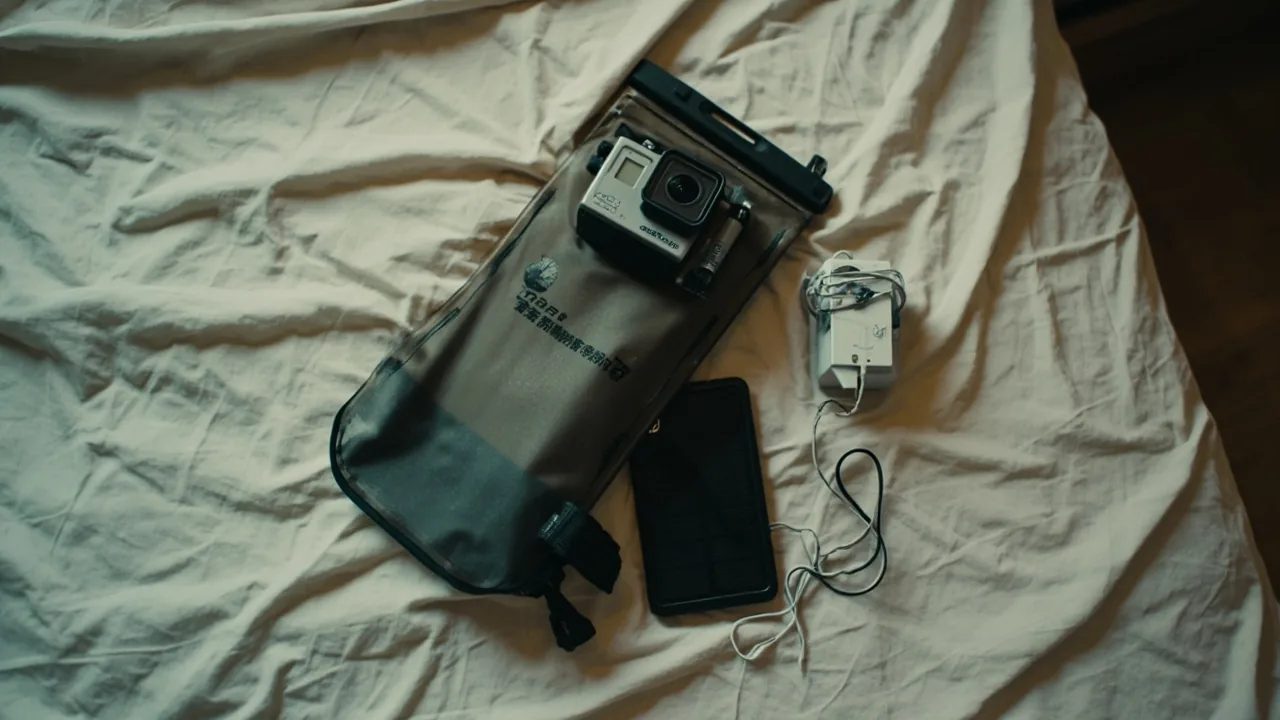
11 Must-Have Travel Tech for the Philippines: GoPro, Solar Banks & Waterproof Cases
Whether you’re packing the essential tech gear for Philippines trip or building a kit from scratch, the Philippines is 7,641 islands of salt spray, brownouts, and one near-certainty: your phone will get wet. Between island-hopping in Palawan and jeepney rides that rattle your kidneys loose, the right tech decides whether you come back with 4K footage or a waterlogged paperweight. This list covers Indian backpackers flying into Manila or Cebu. Planning the wider region? Our Southeast Asia backpacking hub covers the full multi-country route.
Subodh’s Pro Tip: Buy electronics in India before you fly. The same GoPro Hero 12 that costs ₹30,000 (~$311.19) on Amazon.in is 28,000 PHP in Manila stores (around ₹54,000 after peso-to-rupee conversion). The 70% markup is real.
Quick Answers
| What | Answer | Price (INR) |
|---|---|---|
| Best action camera for Philippines | GoPro Hero 12 Black, waterproof to 10m without a case | ~₹30,000 (~$311.19) |
| Waterproof phone case that works | JOTO Universal IPX8 pouch, rated 30m | ~₹600 (~$6.22) |
| Power bank airline limit in India | Under 100Wh (20,000 mAh at 5V) for cabin baggage | ₹1,500-₹4,500 (~$15.56-$46.68) |
| Best solar panel for island-hopping | BigBlue 28W foldable, charges a 10,000 mAh bank in 4–5 hours of direct sun | ~₹5,000 (~$51.87) |
| Noise-cancelling headphones for long bus rides | Sony WH-1000XM5 or Soundcore Space One (budget pick) | ~₹18,000/ ~₹5,500 (~$57.05) |
| Philippines tourist SIM (7 days) | Globe or Smart GoSURF, 50 PHP at airport | ~₹75 (~$0.78) |
| Power strip with USB ports | Anker 30W or Amazon Basics 4-port | ~₹1,200 (~$12.45) |
| Lightweight laptop for editing | MacBook Air M3 13” or ASUS ZenBook 14 OLED | ~₹100,000/ ~₹70,000 (~$726.11) |
Why the Philippines Demands Different Gear
Most Southeast Asia packing lists lump the Philippines with Thailand and Vietnam. That’s wrong. Thailand has plug sockets everywhere, Vietnam has reliable grid power in cities, and neither country has 7,000 islands forcing you onto bangka boats, kayak rentals, and beachfront dives. The Philippines has all three, plus typhoon-season brownouts, salt-corrosion risk, and humidity that kills electronics faster than monsoon rain kills paperbacks.
The gear below isn’t a generic travel kit. It’s built for the specific problems the Philippines throws at you: charging your phone on a sandbar, filming sardine runs in Moalboal, surviving a 14-hour overnight ferry from Manila to Cebu, and finding WiFi that works during a 6-hour island power cut.
1. GoPro Hero 12 Black (DJI Osmo Action 5 Pro)
The single highest-value piece of tech you can pack. The Philippines is the most camera-worthy country in Southeast Asia for water-based action: sardine runs in Moalboal, turtle tracking in Apo Island, cliff jumps in Boracay, and shipwreck diving in Coron. Your iPhone 15 can handle some of this, but a GoPro at chest-mount depth while freediving captures footage no phone can match.
Why the Hero 12 over older models: 5.3K60 video, HyperSmooth 6.0 stabilization that kills bangka-boat shake, and waterproof to 10 meters without an external case. Older Hero 9s and 10s are 20–30% cheaper on the used market in India (₹18,000-₹22,000 (~$186.71-$228.21)) and still shoot 4K, which is plenty for YouTube or Instagram.
DJI alternative: The Osmo Action 5 Pro is a better low-light camera and slightly cheaper (~₹26,000). It also has a magnetic quick-release system that’s faster than the GoPro thumb-screw when you’re switching mounts on a moving boat.
Pack at least three batteries. Cold water, hot sun, and continuous recording drains them in 60–90 minutes. The official Enduro battery (₹2,000 (~$20.75) each) lasts 40% longer than the standard one.
2. Waterproof Phone Case (JOTO or ProShot)
A GoPro is great. But your phone is your wallet, your Grab app, your GCash scanner, and your offline maps. Losing it to a wave on a Boracay sunset cruise is a ₹80,000 (~$829.84) disaster. A ₹600 (~$6.22) waterproof pouch prevents it.
What to buy: JOTO Universal IPX8 (₹600 on Amazon.in) fits every phone up to an iPhone 15 Pro Max or Samsung S24 Ultra. The ProShot Hard Case (₹1,800 (~$18.67)) is better for serious diving down to 15m and has a lanyard.
The mistake to avoid: Cheap no-name cases from Shopee that claim “IPX8” but leak at 1m. Stick to brands that print the actual depth rating and come with a one-year warranty.
For our full breakdown of Philippine SIMs, see the Philippines SIM cards for Indian travelers guide.
3. Solar Power Bank (BigBlue 28W or Ryno Tuff 21W)
Island-hopping in El Nido means 4–8 hours of boat time a day, and the boats have no power outlets. A standard power bank drains in two days of heavy use. A foldable solar panel keeps it topped up between islands.
What to buy: BigBlue 28W foldable solar panel (~₹5,000). Three USB-A ports, 28 watts of output, weighs 590g folded. In direct tropical sun, it charges a 10,000 mAh power bank in 4–5 hours. The Ryno Tuff 21W is ₹1,000 (~$10.37) cheaper and slightly smaller, fine for one phone plus a small power bank.
The honest truth: Solar panels under 20W are mostly useless in the Philippines. Cloud cover during habagat (southwest monsoon, roughly June. September) cuts output by 60–70%, and you need direct overhead sun to hit rated wattage. The 28W panel still works in partial sun at 10–15W, which is enough to keep a phone alive.
Pair the solar panel with a 20,000 mAh power bank (₹1,800-₹2,500 (~$18.67-$25.93)). Anker, Mi, and Ambrane are reliable in India and handle 100Wh cabin baggage limits cleanly.
4. Power Strip with USB Ports (Anker or Amazon Basics)
A single power outlet in a Manila hostel room is a daily annoyance. A power strip with built-in USB ports solves charging six devices (phone, power bank, GoPro batteries, laptop, Kindle, AirPods) from one wall socket.
What to buy: Anker 30W PowerPort Strip (₹1,200 (~$12.45)) has 2 AC outlets, 2 USB-A, and 1 USB-C PD. The Amazon Basics 4-Port USB Power Strip (₹900 (~$9.34)) is cheaper and works fine for non-fast-charge devices.
Voltage reality: The Philippines uses 220V / 60Hz, same as India. You don’t need a voltage converter for Indian-bought electronics, just a plug adapter. Most Indian plugs (Type C, Type D) work in Philippine Type A and Type B sockets with a simple ₹150 (~$1.56) adapter. For the full socket-and-voltage breakdown, see Is the EU plug the same as the Philippines and Do I need a voltage converter in the Philippines.
5. Noise-Cancelling Headphones
A 14-hour Manila to Siargao ferry is loud. A Cebu City jeepney is louder. A night out in Boracay is the loudest. Over-ear noise-cancelling headphones make all three survivable.
Premium pick: Sony WH-1000XM5 (~₹18,000). Industry-leading ANC, 30-hour battery, multipoint Bluetooth so you can connect to laptop and phone simultaneously.
Budget pick: Soundcore Space One (~₹5,500) or Soundcore Life Q45 (~₹4,500). 95% of the ANC performance at 30% of the price. Most Indian backpackers under 25 go with the Soundcore and don’t regret it.
Avoid: AirPods Max (₹60,000 (~$622.38), heavy, bad for tropical heat) and any non-ANC “travel headphones” (they just make the engine louder in your ears).
6. Lightweight Laptop (MacBook Air M3 or ASUS ZenBook 14)
If you’re editing GoPro footage, working remotely, or backing up photos nightly, you need a real laptop. A phone or iPad isn’t enough for 4K video work or running a VPS.
Best for Apple users: MacBook Air M3 13” (~₹1,00,000). 18-hour battery, fanless (no dust intake in tropical humidity), weighs 1.24 kg. The M2 Air is ₹15,000 (~$155.60) cheaper and 90% as good.
Best for Windows users: ASUS ZenBook 14 OLED (~₹70,000). OLED display for photo editing, 1.2 kg, decent 13-hour battery. The Lenovo IdeaPad Slim 5 is ₹20,000 (~$207.46) cheaper with a non-OLED screen and 8-hour battery, fine for writing and light editing.
Skip: Gaming laptops (too heavy, fans clog with humidity dust), Chromebooks (no GoPro editing software), anything over 1.6 kg (you’ll resent it by day 5).
7. Universal Travel Adapter (with USB-C PD)
The Philippines uses Type A (two flat pins) and Type C (two round pins) sockets. Indian Type C plugs fit, but loose. A Type D adapter (Indian round-pin) does not fit. Buy a universal adapter that handles both, with at least one USB-C PD port for fast-charging a MacBook or Nintendo Switch.
What to buy: Anker 65W GaNPrime adapter (~₹4,500) covers 100+ countries, has 2 USB-C and 1 USB-A, and replaces three charging bricks. The cheaper Stuffcool ChargePro 65W (₹2,800 (~$29.04)) is similar but bulkier.
Don’t bring: A 5-port “international adapter kit” with separate plugs for each country. You’ll lose half of them in your bag within 48 hours.
8. Fast-Charging Power Bank (20,000 mAh, 30W PD)
A 10,000 mAh power bank is enough for a day trip. A 20,000 mAh bank covers two days of heavy phone use plus a GoPro battery top-up. The 30W Power Delivery (PD) output fast-charges an iPhone 15 to 50% in 30 minutes.
What to buy: Anker 737 Power Bank 24,000 mAh (~₹4,500) is the gold standard: 140W output, can charge a MacBook Air to full once. The Mi Power Bank 4i 20,000 mAh (~₹2,000) is the budget pick, 18W output, charges most phones fast.
Airline rule (important): Indian airports and Cebu Pacific / AirAsia enforce 100Wh per battery limit in cabin baggage. 100Wh = 20,000 mAh at 5V. A 24,000 mAh Anker at 3.7V nominal = 88.8Wh, fine. A 30,000 mAh no-name bank at 5V is 150Wh, gets confiscated at security. Stick to known brands and check the Wh rating on the label.
9. Wireless Charging Pad (for Hostel Nights)
A wireless charging pad is a small luxury that becomes a habit by day 3. Drop your phone on the pad when you get back to the dorm, wake up to 100% charge, no fumbling for a cable in the dark.
What to buy: Anker 313 Wireless Charger (~₹1,500) or Mi 20W Wireless Charging Pad (~₹1,200). Both work through thin cases (under 5mm) and don’t need a separate power brick if you plug them into the power strip from #4.
Skip: MagSafe-only chargers (iPhone-only, slower than 15W on Android), 3-in-1 travel chargers (too fragile, break in a backpack within a month).
10. Dry Bag or Waterproof Backpack Cover
Your GoPro is waterproof. Your phone is in a waterproof case. Your power bank is not. A 10L dry bag (₹500-₹800 (~$5.19-$8.30) on Amazon.in) keeps electronics, passports, and cash dry during bangka rides, sudden rain squalls, and beach days.
What to buy: Sea to Summit Big River Dry Bag 10L (~₹1,800) is overkill but lasts years. The Decathlon Forclaz Trek 100 30L backpack cover (~₹800) is a cheaper alternative and fits over a 40–50L pack.
Important: A “waterproof” backpack from Amazon is rarely waterproof. If it doesn’t have a roll-top closure or welded seams, it’s water-resistant at best. Use a dry bag inside the backpack for the critical stuff (passport, electronics, cash).
11. Universal SIM/eSIM Setup
A 7-day Globe or Smart tourist SIM at Manila NAIA or Cebu Mactan airport is 50 PHP (~₹75) with 5–8GB data. That’s the cheapest reliable connectivity in the country. For more data, longer stays, or if you’re switching phones mid-trip, an eSIM you activate before flying is faster.
Physical SIM: Walk out of arrivals, find the Globe or Smart counter (both are in every major airport), bring your passport. The SIM is activated in 10 minutes. Add a GoSURF50 pack (50 PHP, 5GB for 3 days) or GoSURF299 (299 PHP, 8GB for 7 days) via the Globe One app.
eSIM alternative: Get Nomad eSIM lets you buy a Philippines data plan before you leave India. Plans start at ₹482 (~5 USD) for 1GB / 7 days, ₹964 (~10 USD) for 3GB / 15 days, and ₹1,928 (~20 USD) for 10GB / 30 days. The eSIM activates the moment you land, no airport counter queue.
Number format gotcha: Philippine mobile numbers start with 09 and have 11 digits total. If you’re using GCash or Grab, the app asks for this format. For the full breakdown, see Philippines SIM card number format guide.
Safety Alert: Brownouts hit the Philippines hard between April and June (dry season overload) and during typhoon months (typically July. October). Charging your devices to 100% before a typhoon warning and carrying a fully-charged 20,000 mAh power bank is not optional, it’s the difference between a working map and being stranded in a blackout.
What NOT to Pack
Drone (under 250g): Technically legal in the Philippines, but registration is required for anything over 250g and tourist drone permits from CAAP (Civil Aviation Authority of the Philippines) take 7–10 working days. A DJI Mini 4K (~₹38,000) is exempt from registration but still banned at most national parks and marine sanctuaries (Tubbataha, Apo Reef, Bantayan). Skip it for a 2-week trip.
Electric shaver (rechargeable cordless): Brownouts make charging unreliable, and most hostels don’t have shaver-friendly sockets. A manual razor (₹100 (~$1.04)) weighs 30 grams and never needs power.
Portable WiFi router (MiFi): Useless in the Philippines without a SIM, and your phone’s hotspot works the same. One less device to charge.
Hardshell suitcase: Rougher roads, bangka boats, and constant repacking destroy wheels within a trip. A 40–50L backpack is the only sensible answer for the Philippines. The full case for this is in Packing list for the Philippines.
Where to Stay and Eat in the Philippines (Because You Need to Charge Somewhere)
For hostels and hotels in the Philippines that cater to Indian backpackers, see the Philippines hostels for Indian travelers guide. Booking a room with reliable power and WiFi is half the gear battle.
Where to Eat in the Philippines (Because You Need to Charge Somewhere)
You’ll spend hours in cafés and restaurants waiting for devices to charge. Skip the Starbucks and pick spots that give you both good food and a wall outlet. In Manila, Kantina Manila (~₹1,200/person for a full sisig and adobo meal) has reliable WiFi and hidden outlets near the bar. In Cebu, Leandro’s Bistro (~₹800/person) lets you linger over rice bowls while a 20,000 mAh bank tops up. For the full vegetarian-friendly Philippines food scene, see Vegetarian Indian food Philippines survival guide and Vegetarian Indian food Manila Cebu.
When you need a dal-chawal reset, Biryanista (~₹600/person for a full Hyderabadi biryani plate) and Agni - By Mantra (~₹1,000/person for North Indian thali) are the two spots Indian travellers consistently rate above 4.8 on Google Maps.
Connectivity Beyond SIM: WiFi, VPN, and Brownout Survival
Free WiFi at Starbucks, McDonald’s, and mall food courts is common but slow and unreliable. A SIM with 8–10GB of data is non-negotiable. For VPN access during sensitive browsing (banking, work calls), a paid NordVPN or Surfshark subscription (₹350–₹500/month) gets you past geo-restricted content at some resorts. The full brownout-and-VPN survival guide is at Philippines VPN WiFi charging brownout survival.
Subodh’s Take: The GoPro is the splurge, the solar panel is the saver, the waterproof phone case is the must-have. Skip the drone, skip the gaming laptop, skip the hardshell suitcase. Bring 30% less than you think you need and buy the rest in a Manila mall if you need it. The Philippines rewards light packers and punishes over-packers with a 15 kg baggage fee on every Cebu Pacific flight.
FAQ
Is a GoPro worth it for a 2-week Philippines trip? Yes, if you’re going to El Nido, Coron, Moalboal, or Apo Island. The sardine run footage alone justifies the cost. Skip it if you’re staying in Manila and Cebu City only.
Can I bring a power bank on a Cebu Pacific flight? Yes, under 100Wh in cabin baggage. That’s any 20,000 mAh power bank at 5V. Anything over 100Wh gets confiscated at Manila NAIA security. Check the Wh label, not just the mAh.
What’s the best waterproof phone case for Boracay? JOTO IPX8 (₹600) for casual beach use, ProShot Hard Case (₹1,800 (~$18.67)) for actual snorkeling down to 15m. Avoid no-name Shopee cases that fail at 1m.
Do I need a voltage converter in the Philippines? No. The Philippines uses 220V / 60Hz, same as India. You only need a plug adapter for Type A sockets (two flat pins), since most Indian plugs are Type C or D.
Is a solar power bank useful in the Philippines? Yes, during island-hopping trips where there’s no grid power for 8+ hours. A 28W panel like the BigBlue keeps a 20,000 mAh bank topped up in 4–5 hours of direct sun. In monsoon season, output drops 60%, so carry a charged bank as backup.
Can I charge my laptop on a sleeper bus or ferry? Rarely. Manila to Cebu ferries have one shared outlet per cabin, and overnight buses from Cebu to Moalboal have no power at all. Carry a fully charged 20,000 mAh bank and a 30W PD adapter for laptop top-ups.
What’s the best lightweight laptop under ₹80,000 (~$829.84) for Philippines travel? ASUS ZenBook 14 OLED (~₹70,000) for Windows users, MacBook Air M2 13” (~₹85,000) for Apple users. Both handle GoPro 4K editing and weigh under 1.3 kg.
Planning your own Philippines trip? Bookmark this essential tech gear for Philippines trip checklist and you’ll come home with dry electronics, full memory cards, and footage worth sharing.
